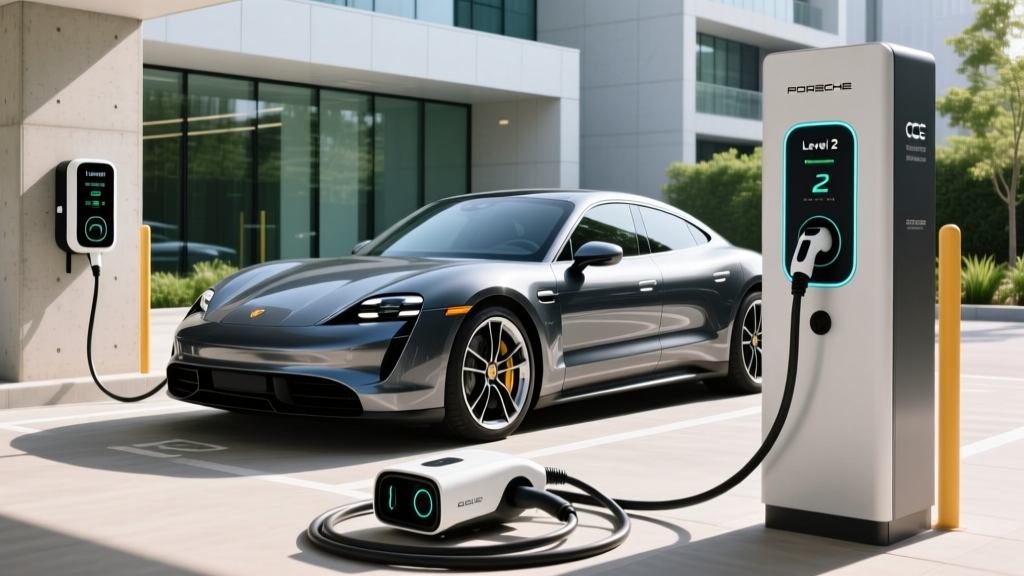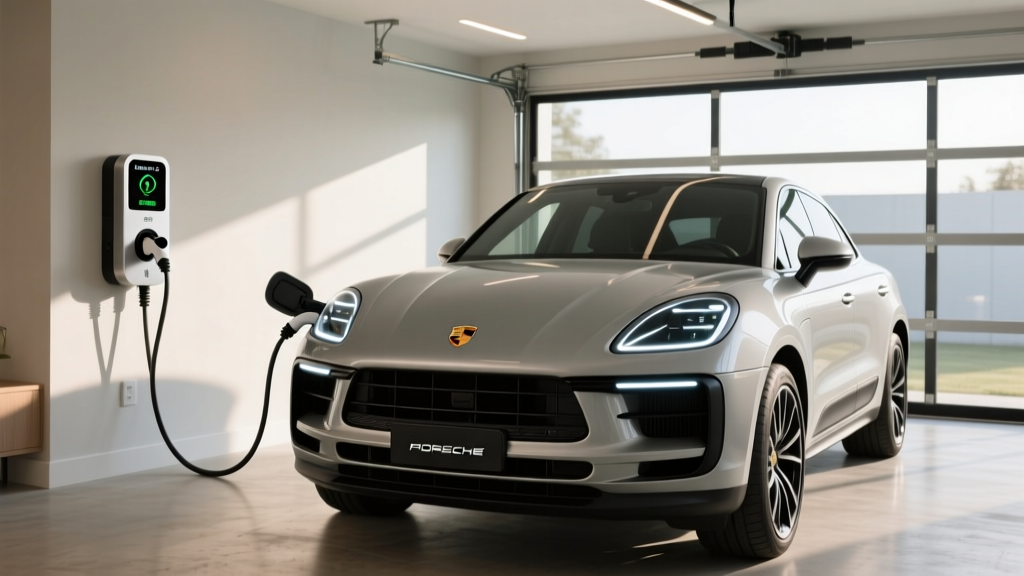
The 2025–2026 Porsche Macan Electric is a performance SUV that redefines what an electrified Porsche can be, but owning one means understanding how to keep its 100 kWh battery (95.9 kWh usable) fed efficiently. Whether you're trying to extract every mile of its EPA-rated range or planning a home charging setup that won't bottleneck its 270 kW peak DC fast-charge capability, this guide covers the numbers that matter.
Porsche Macan EV Range and Efficiency at a Glance
| Spec | Macan 4 Electric | Macan Turbo Electric |
|---|---|---|
| EPA Range | 308 mi (20" wheels) | 288 mi (21" wheels) |
| Battery (Usable) | 95.9 kWh (NMC) | 95.9 kWh (NMC) |
| Efficiency (MPGe) | 84 MPGe combined | 80 MPGe combined |
| Peak DC Charge Rate | 270 kW | 270 kW |
| 10–80% DC Fast Charge | ~21 minutes | ~21 minutes |
| Level 2 AC Charge Rate | 11 kW (optional 22 kW) | 11 kW (optional 22 kW) |
| Horsepower | 402 hp | 630 hp |
| 0–60 mph | 4.9 sec | 3.3 sec |
| Base MSRP | ~$80,000 | ~$106,000 |
| Battery Warranty | 8 yr / 100,000 mi | 8 yr / 100,000 mi |
Source: fueleconomy.gov and Porsche USA specifications. Real-world range varies with temperature, speed, terrain, and tire selection.
Understanding Charging Levels: How Fast Will Each Add Range?
Before you plug in, it's essential to understand the three charging tiers available to Macan EV owners. Power is measured in kilowatts (kW) — the rate of energy flow — while battery capacity is measured in kilowatt-hours (kWh), the total energy stored. Confusing these two is the single most common EV mistake.
| Level | Voltage / Amperage | Power (kW) | Miles Added per Hour | Full Charge Time (0–100%) |
|---|---|---|---|---|
| Level 1 (120V household) | 120V / 12A | ~1.4 kW | ~3–4 mi/hr | ~68+ hours |
| Level 2 (240V home/public) | 240V / 48A | ~11.5 kW | ~30–35 mi/hr | ~8.5 hours |
| Level 2 (optional 22 kW onboard) | 208–240V / 3-phase | ~22 kW | ~60 mi/hr | ~4.5 hours |
| DC Fast Charge | 400–800V DC | Up to 270 kW peak | ~180+ mi in 10 min | 10–80% in ~21 min |
Home Charger Installation: Electrical Requirements and Costs
The Macan Electric's 11 kW onboard charger (standard) means you'll want a Level 2 home station delivering at least 48 amps on a 60-amp dedicated circuit to take full advantage. Porsche's optional 22 kW onboard charger requires a three-phase 240V supply — uncommon in most US residential panels — so most owners will operate at 11 kW at home.
Electrical Requirements
- Circuit: Dedicated 60-amp breaker (for a 48A continuous-draw charger, NEC requires 125% overcurrent protection)
- Wire gauge: 6 AWG copper (THHN in conduit or NM-B where permitted)
- Voltage: 240V single-phase (standard US residential split-phase)
- Connector: NACS (J3400) for 2025+ Macan Electric models in North America, or CCS1 for early 2024 deliveries
- GFCI protection: Required by NEC 2020+ for outdoor receptacles; hardwired installations may not require a GFCI breaker depending on local code
Panel Upgrade Considerations
Most modern homes with a 200-amp electrical panel can accommodate a 60-amp EV circuit without a panel upgrade. However, if your home has a 100-amp panel (common in homes built before 1990), or if your existing panel is already near capacity with electric HVAC, an electric range, a dryer, and a water heater, you may need a service upgrade to 200 amps. This is a significant cost factor that many online estimates omit.
| Cost Component | Low Estimate | High Estimate | Notes |
|---|---|---|---|
| Level 2 Charger Equipment | $400 | $750 | 48A smart charger (e.g., ChargePoint Home Flex, Wallbox Pulsar Plus) |
| Electrician Labor | $500 | $1,500 | Depends on run length from panel, conduit type, wall penetrations |
| Permit & Inspection | $100 | $350 | Varies by municipality; some jurisdictions waive for simple installs |
| Panel Upgrade (if needed) | $1,500 | $4,000 | 100A → 200A service upgrade; not required for most newer homes |
| Total (no panel upgrade) | $1,000 | $2,600 | Typical for homes with 200A panel |
| Total (with panel upgrade) | $2,500 | $6,600 | Older homes or high-load panels |
Always hire a licensed electrician for EV charger installation. Your local utility may offer rebates of $250–$1,000 for Level 2 installations — check with your provider. Some states also offer point-of-sale or tax-credit incentives for home charging equipment under §30C (Alternative Fuel Vehicle Refueling Property Credit), capped at $1,000 for residential per the IRS.
Connector Compatibility: NACS, CCS1, and Adapter Needs
Porsche began transitioning its North American EVs to the NACS (J3400) connector — the Tesla-designed standard now adopted by nearly every major automaker — starting with 2025 model-year vehicles. Here's what Macan EV owners need to know:
| Model Year | Native Connector | Tesla Supercharger Access | CCS1 Network Access | Adapter Needed? |
|---|---|---|---|---|
| 2024 (early deliveries) | CCS1 | Via NACS-to-CCS adapter | Native | NACS adapter for Superchargers |
| 2025–2026 | NACS (J3400) | Native | Via CCS-to-NACS adapter | CCS adapter for Electrify America, EVgo, etc. |
For 2025–2026 Macan Electric owners, the NACS port gives you native access to Tesla's Supercharger network (now open to non-Tesla EVs at participating stations) as well as NACS-equipped chargers from Electrify America, EVgo, and others rolling out the new connector. If you plan to use legacy CCS1 stations, Porsche and third-party suppliers offer CCS-to-NACS adapters ($150–$250). Keep one in your frunk for road trips through areas where CCS infrastructure still dominates.
Home charging: Regardless of your vehicle's DC fast-charge connector, Level 2 home charging in North America uses the J1772 standard — or NACS for newer vehicles. Most Level 2 chargers sold today ship with either a J1772 or NACS plug, and adapters between the two are widely available. Porsche's recommended Porsche Mobile Charger Connect includes a NACS plug for 2025+ models and delivers up to 11 kW (48A).
Cost to Charge: Home vs. Public vs. Gas Comparison
One of the strongest ownership arguments for the Macan Electric is fuel cost savings — especially if you charge primarily at home. Here's how the numbers break down using the Macan 4 Electric's efficiency of approximately 2.4 miles per kWh (derived from its 84 MPGe combined rating per fueleconomy.gov):
| Scenario | Rate | Cost per kWh | Cost per Mile | Cost for 300 mi |
|---|---|---|---|---|
| Home (off-peak utility rate) | $0.12/kWh | $0.12 | $0.050 | $15.00 |
| Home (national avg electricity) | $0.17/kWh | $0.17 | $0.071 | $21.25 |
| Public Level 2 (network pricing) | $0.30/kWh | $0.30 | $0.125 | $37.50 |
| DC Fast Charge ( Electrify America) | $0.48/kWh | $0.48 | $0.200 | $60.00 |
| Gasoline equivalent (25 MPG, $3.50/gal) | $3.50/gallon | — | $0.140 | $42.00 |
The takeaway: Charging at home on off-peak rates costs roughly one-third of what gasoline would for a comparable performance SUV. Even at DC fast-charge public rates, the Macan Electric is competitive with premium gasoline on a cost-per-mile basis — though DC fast charging should be reserved for road trips, not daily use, to preserve long-term battery health.
For a Macan owner driving 12,000 miles per year with 80% home charging at $0.14/kWh average and 20% DC fast charging at $0.48/kWh, annual fuel cost lands around $2,160 — compared to approximately $5,040 for a gas-powered Porsche Macan S (21 MPG combined, premium fuel at $4.20/gallon). That's roughly $2,880 in annual fuel savings.
Recommended Home Chargers for the Porsche Macan Electric
With an 11 kW onboard charger (and optional 22 kW), the Macan Electric benefits from a high-quality 48-amp Level 2 home station. Here are three chargers that pair well with the Macan's capabilities:
ChargePoint Home Flex
- Power Output: Up to 11.5 kW (48A, 240V)
- Connector: NACS or J1772 (configurable)
- Cable Length: 23 feet
- Smart Features: Wi-Fi, app scheduling, Alexa integration, energy reporting
- Price: ~$550–$650
- Best For: Reliable daily charging with robust app ecosystem
Wallbox Pulsar Plus
- Power Output: Up to 11.5 kW (48A, 240V)
- Connector: NACS or J1772
- Cable Length: 25 feet
- Smart Features: Wi-Fi + Bluetooth, Power Sharing (daisy-chain two units), app control
- Price: ~$500–$600
- Best For: Two-EV households needing load management
Porsche Mobile Charger Connect
- Power Output: Up to 11 kW (48A, 240V)
- Connector: NACS (2025+ models)
- Cable Length: 19.7 feet
- Smart Features: Porsche Connect integration, touchscreen display, over-the-air updates
- Price: ~$750 (often included with vehicle purchase)
- Best For: Seamless Porsche ecosystem integration and portability
Our recommendation: If you received the Porsche Mobile Charger Connect with your vehicle, it's a solid 11 kW unit and a fine daily driver. For a dedicated wall-mounted installation, the ChargePoint Home Flex or Wallbox Pulsar Plus offer longer cables, more robust scheduling, and broader compatibility if you ever add a second EV to your garage. All three support the 48A / 11.5 kW output that matches the Macan's standard onboard charger.
DC Fast Charging on Road Trips: Maximizing the Macan's 270 kW Capability
The Macan Electric's 800-volt architecture is one of its strongest road-trip assets. On a compatible 350 kW DC fast charger (like those at Electrify America or Tesla Supercharger V4 stalls), the Macan can accept up to 270 kW, adding approximately 180 miles of range in just 10 minutes.
However, real-world fast charging requires strategy:
- Precondition the battery: Use the Porsche Navigation system's EV route planning. When you set a DC fast charger as your destination, the car automatically preconditions the battery to optimal temperature (roughly 95–104°F / 35–40°C), enabling peak charge rates. Without preconditioning — especially in cold weather — your peak rate may be limited to 100–150 kW.
- Arrive at low SoC: The 270 kW peak holds best between 10–40% SoC. Arriving at 5–10% SoC yields the fastest overall 10–80% time (~21 minutes). If you arrive at 30%, you'll miss the fastest portion of the curve.
- Don't wait for 100%: Charging from 80–100% on DC fast charge can take 25–35 additional minutes due to tapering. For road trips, charge to 80% and go — the time savings from driving outweighs the diminishing charge rate.
- Seek 350 kW chargers: While the Macan peaks at 270 kW, a 350 kW-rated station can deliver that peak. A 150 kW station will cap you at 150 kW, extending your 10–80% time to roughly 35–40 minutes.
Safety, Code Compliance, and Smart Charging Practices
A proper home charging installation goes beyond just plugging in. Here are the safety and code considerations every Macan EV owner should verify:
- Dedicated circuit: Your Level 2 charger must be on its own dedicated breaker — never shared with other appliances. A 48A charger requires a 60A breaker per NEC Article 210.20 (continuous loads must not exceed 80% of breaker rating).
- Hardwired vs. plug-in: Hardwired installations (no plug) eliminate one failure point and avoid GFCI nuisance trips common with 240V NEMA 14-50 receptacles. If you use a receptacle, ensure it's an industrial-grade NEMA 14-50R (not a residential-grade unit) rated for daily plug/unplug cycles.
- Outdoor rating: If your charger is installed outdoors (garage exterior, carport, driveway), verify it carries a NEMA 4 or IP65 weatherproof rating. All three chargers recommended above meet this standard.
- GFCI protection: NEC 2020 and later require GFCI protection for outdoor receptacles used for EV charging. Hardwired installations may be exempt in some jurisdictions — confirm with your local electrical inspector.
- Cable management: Use a cable organizer or holster to prevent the charging cable from dragging on the ground, which can cause insulation wear over time.
- Scheduled charging: Use your charger's app to schedule charging during off-peak utility hours (typically 10 PM – 6 AM) for the lowest per-kWh rates. The Macan also supports scheduled charging through Porsche Connect.
Frequently Asked Questions
How much does it cost to install a home EV charger for the Porsche Macan Electric?
For most homes with an existing 200-amp electrical panel, expect to pay between $1,000 and $2,600 total, including the charger ($400–$750), electrician labor ($500–$1,500), and permits ($100–$350). If your home requires a panel upgrade from 100A to 200A, add $1,500–$4,000 to the total.
How fast will each charging level add range to the Macan EV?
Level 1 (120V) adds roughly 3–4 miles per hour — impractical for daily use with a 95.9 kWh battery. Level 2 (240V, 48A) adds approximately 30–35 miles per hour, fully recharging overnight in ~8.5 hours. DC fast charging at 270 kW can add roughly 180 miles in 10 minutes under optimal conditions.
Which connector and charger is compatible with my Macan Electric?
2025–2026 Macan Electric models use the NACS (J3400) connector for both Level 2 AC and DC fast charging in North America. 2024 early deliveries use CCS1. For home Level 2 charging, any NACS-equipped (or J1772 with adapter) station delivering 48A at 240V will work. For DC fast charging on non-Tesla networks, a CCS-to-NACS adapter may be needed at legacy CCS1 stations.
How much does charging the Macan EV cost per mile vs. gasoline?
At a typical home electricity rate of $0.14/kWh, the Macan Electric costs about $0.059 per mile to fuel. A comparable gas-powered Macan S at 21 MPG combined with premium fuel at $4.20/gallon costs approximately $0.20 per mile. Home-charged electricity saves roughly $0.14 per mile, or about $1,680 per year at 12,000 miles driven.
What electrical upgrades might I need for a home charger?
If your home has a 200-amp panel with available capacity, you likely need only a new 60-amp breaker and a wire run to your garage or parking area. If your panel is 100 amps or already near capacity, you'll need a service upgrade to 200 amps ($1,500–$4,000). A licensed electrician can perform a load calculation to determine your exact needs. Some utilities offer free or discounted load assessments.
Does the Porsche Macan EV qualify for the federal tax credit?
As of 2026, the Macan Electric's MSRP exceeds $80,000, which places it above the IRS §30D SUV price cap of $80,000 for the new clean vehicle credit. Buyers should verify current eligibility on the IRS website, as rules around battery sourcing, critical minerals, and MSRP caps are subject to change. Point-of-sale transfer of the credit is available for eligible vehicles and buyers meeting income requirements.