The 2025–2026 Porsche Macan Electric pairs sports-car dynamics with an 800-volt architecture that enables some of the fastest DC charging in its class. But extracting the full Porsche Macan Electric range from its ~100 kWh (usable) battery requires more than just plugging in — it demands the right home charging setup, an understanding of charge-curve tapering, and realistic expectations about highway and cold-weather efficiency.
This guide breaks down everything Macan EV owners and prospective buyers need: EPA range versus real-world miles, charging speeds at every level, home Level 2 installation costs, connector compatibility as the industry shifts to NACS, and the specific equipment we recommend for Porsche's high-capacity battery.
Understanding the Porsche Macan Electric Range: EPA vs. Reality
The Macan Electric lineup uses a lithium-ion NMC (nickel-manganese-cobalt) battery pack with approximately 100 kWh of usable capacity. Porsche's 800V platform isn't just about charging speed — it also enables thinner, lighter wiring and efficient thermal management that helps preserve range under load.
| Trim | EPA Range | Battery (Usable) | Efficiency (kWh/100 mi) | 0–60 mph | Horsepower |
|---|---|---|---|---|---|
| Macan 4 Electric | 308 mi | ~100 kWh | ~33 | 4.9 sec | 402 hp |
| Macan Turbo Electric | 288 mi | ~100 kWh | ~36 | 3.1 sec | 630 hp |
The EPA sticker tells only part of the story. Based on real-world testing patterns for 800V NMC platforms:
- Highway cruising (75 mph, 70°F): Expect ~250–270 mi (Macan 4) — roughly 12–18% below EPA
- Cold weather (30°F, mixed driving): Plan for ~210–240 mi — a 20–30% reduction due to cabin heating and reduced battery efficiency
- City/regenerative driving (55°F): You may exceed EPA, reaching ~310–320 mi thanks to regen braking
The Macan's heat pump (standard on most trims) mitigates cold-weather losses compared to EVs without one, but physics still applies — battery chemistry slows in the cold, and cabin heating draws significant power.
Charging Levels Explained: How Fast Can You Add Range?
A critical distinction every EV owner must internalize: kW (kilowatts) measures power — the rate of energy flow, like water pressure from a hose. kWh (kilowatt-hours) measures energy — the total amount stored, like gallons in a tank. Charging speed is measured in kW; battery capacity in kWh.
| Level | Voltage / Amps | Power (kW) | Miles of Range per Hour | Best For |
|---|---|---|---|---|
| Level 1 (120V) | 120V / 12A | ~1.4 kW | ~3–4 mi/hr | Emergency / trickle |
| Level 2 (240V) | 240V / 48A | ~11.5 kW | ~30–35 mi/hr | Daily home charging |
| DC Fast Charge | 800V DC | Up to 270 kW (peak) | ~160+ mi in 10 min | Road trips |
Level 1 is essentially useless for a 100 kWh battery — a full charge would take over 70 hours. Level 2 at 240V/48A is the home-charging sweet spot, replenishing roughly 80% of the battery in under 8 hours (overnight). DC Fast Charging leverages the Macan's 800V architecture for dramatically faster stops.
DC Fast Charging: The 10–80% Reality
Porsche rates the Macan Electric at up to 270 kW peak DC charge rate. But peak rate is not sustained rate — the charge curve tapers significantly as the battery fills to protect cell longevity.
- 10–80% at a 350 kW charger: ~21 minutes (Macan 4/Turbo)
- 10–80% at a 150 kW charger: ~33 minutes
- 10–80% at a 50 kW charger: ~95 minutes
- Above 80% SoC: Charge rate drops sharply to ~50 kW or less — plan to unplug at 80% on road trips unless you need the final miles
The Macan's thermal preconditioning system will warm or cool the battery when you navigate to a DC fast charger, ensuring you hit near-peak rates on arrival. Always precondition before fast charging — skipping it can add 5–10 minutes to your stop.
Home Charger Installation: Costs, Electrical Requirements & Panel Upgrades
Installing a Level 2 home charger for the Macan Electric is one of the smartest ownership investments, but costs vary dramatically based on your home's electrical infrastructure.
Electrical Requirements for Macan EV Home Charging
To maximize Level 2 speed, you'll want a 240V / 48A dedicated circuit (a 60-amp breaker, per NEC code requiring 80% continuous-load derating). The Macan's onboard charger accepts up to 11.5 kW AC, so anything beyond 48A won't add speed.
- Ideal setup: 240V / 60A breaker → 48A continuous → 11.5 kW
- Adequate setup: 240V / 40A breaker → 32A continuous → 7.7 kW (~22 mi/hr)
- Minimum viable: 240V / 20A breaker → 16A continuous → 3.8 kW (~11 mi/hr)
Installation Cost Breakdown
| Component | Cost Range | Notes |
|---|---|---|
| Level 2 Charger (Equipment) | $400 – $750 | Smart Wi-Fi chargers, 48A, 24ft cable |
| Electrician Labor | $500 – $1,500 | Varies by run length, conduit, wall type |
| Electrical Permit | $50 – $200 | Required in most jurisdictions |
| Panel Upgrade (if needed) | $1,500 – $4,000 | 100A → 200A service; common in pre-2000 homes |
| Total (no panel upgrade) | $950 – $2,450 | Typical scenario for modern homes |
| Total (with panel upgrade) | $2,450 – $6,450 | Older homes with 100A service |
Homes built before 2000 often have 100-amp electrical panels. Adding a 60A EV circuit alongside existing loads (HVAC, electric oven, dryer) may exceed your panel's capacity. A licensed electrician will perform a load calculation per NEC Article 220. If you're over the limit, a panel upgrade to 200A is mandatory — budget $2,000–$4,000 and add 1–2 weeks for utility coordination.
Some utilities offer rebates of $200–$500 for panel upgrades tied to EV adoption — check with your provider before proceeding.
Connector Compatibility: NACS, CCS, and the Adapter Question
The 2025 Porsche Macan Electric launched in North America with a CCS1 (Combined Charging System) port. However, Porsche has confirmed that the 2026 model year will transition to the NACS (North American Charging Standard / Tesla) connector, joining the broader industry shift.
| Model Year | Built-In Connector | Tesla Supercharger Access | Non-Tesla DC Networks |
|---|---|---|---|
| 2025 Macan EV | CCS1 | Via CCS-to-NACS adapter | Native (Electrify America, EVgo, Ionity) |
| 2026 Macan EV | NACS (expected) | Native access | Via NACS-to-CCS adapter (if needed) |
For 2025 CCS1 owners: Porsche and third-party suppliers offer CCS-to-NACS adapters ($200–$300) enabling access to Tesla Supercharger stalls. Tesla has opened its network to non-Tesla EVs via adapters and the Tesla app, though availability varies by station.
For home Level 2 charging: Both CCS and NACS vehicles use the J1772 standard for AC charging (or an adapter). Any quality Level 2 home charger with a J1772 connector will work with both model years.
Charging Cost: $/kWh Scenarios and Cost Per Mile vs. Gas
One of the Macan Electric's strongest ownership arguments is fuel cost savings — but the math depends heavily on where you charge.
| Scenario | $/kWh or $/gal | Cost per 100 Miles | Annual (12,000 mi) |
|---|---|---|---|
| Home (off-peak utility rate) | $0.13/kWh | $4.29 | $515 |
| Home (average US rate) | $0.17/kWh | $5.61 | $673 |
| Public Level 2 (avg) | $0.30/kWh | $9.90 | $1,188 |
| DC Fast Charging (avg) | $0.48/kWh | $15.84 | $1,901 |
| Gas Macan (premium, 20 MPG) | $4.20/gal | $21.00 | $2,520 |
Even at public DC fast-charger rates, the Macan Electric costs less per mile than its gasoline counterpart. Home charging at off-peak rates delivers an 80% fuel cost reduction. For owners who charge primarily at home and take occasional road trips, annual fuel savings of $1,500–$2,000 are realistic.
Check your utility for time-of-use (TOU) plans — charging between midnight and 6 AM can drop your effective rate to $0.08–$0.10/kWh in many markets.
Recommended Home Chargers for the Porsche Macan Electric
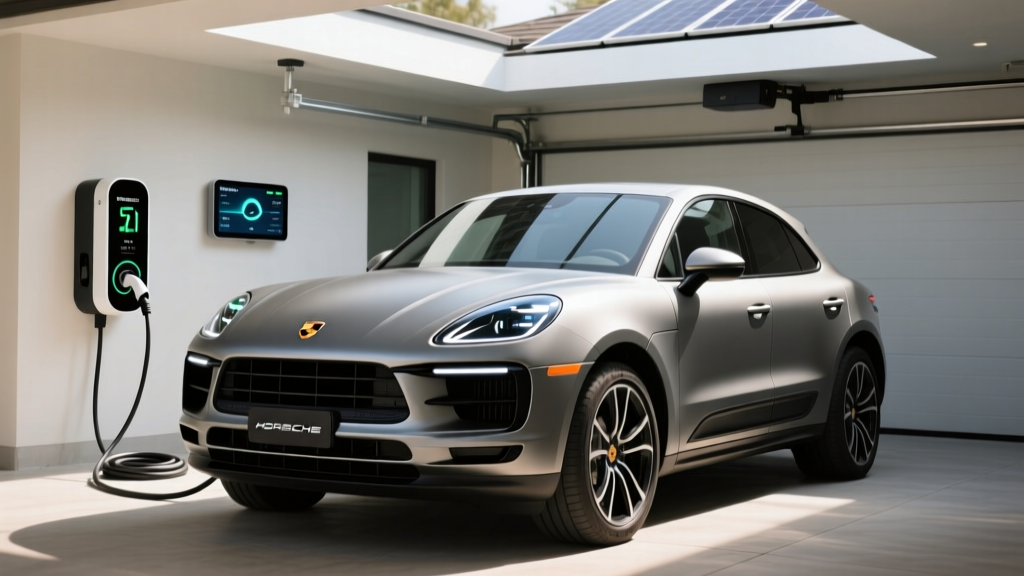
With a 100 kWh battery and 11.5 kW onboard charger, the Macan rewards a high-quality, high-amperage Level 2 unit. Here are three chargers we recommend based on power output, reliability, cable management, and smart features:
ChargePoint Home Flex — Best Overall
- Power Output: Up to 11.5 kW (48A / 240V) — matches Macan's max AC rate
- Connector: J1772 (works with CCS and NACS via adapter)
- Cable Length: 23 feet
- Smart Features: Wi-Fi, app scheduling, Alexa integration, energy tracking
- Price: ~$599
- Why for Macan: Amperage is adjustable via DIP switch (16A–48A), letting you match your circuit exactly. UL-listed, NEMA 4 outdoor-rated.
Emporia Level 2 EV Charger — Best Value
- Power Output: Up to 11.5 kW (48A / 240V)
- Connector: J1772
- Cable Length: 24 feet
- Smart Features: Wi-Fi, app with real-time energy monitoring, solar integration
- Price: ~$399
- Why for Macan: Pairs with Emporia Vue home energy monitor to track exactly how much your EV charging costs. Excellent for solar-home owners.
Wallbox Pulsar Plus — Most Compact
- Power Output: Up to 11.5 kW (48A / 240V)
- Connector: J1772
- Cable Length: 25 feet
- Smart Features: Wi-Fi + Bluetooth, Power Sharing (two chargers on one circuit), app control
- Price: ~$649
- Why for Macan: Smallest form factor in the category. Power Sharing lets two Macan-owning households share a single 60A circuit, alternating full power.
Safety, Code & Best Practices for Macan EV Home Charging
Home EV charging is safe when installed to code, but cutting corners creates fire and liability risk. Key requirements:
- Dedicated circuit: Your Level 2 charger must be on its own breaker — never share a circuit with other high-draw appliances
- GFCI protection: NEC 2023+ requires GFCI protection for EV charging outlets; hardwired units may have this built in
- Outdoor rating: If your charger is outside, ensure it's rated NEMA 4 (weatherproof). All three recommendations above qualify
- Hardwired vs. plug: Hardwired installations (no plug) are preferred for 48A+ circuits — they eliminate receptacle overheating risk and are required by code above 40A continuous in some jurisdictions
- Permit and inspection: Every jurisdiction requires a permit for new 240V circuits. Skipping this voids homeowner's insurance coverage for any related incident
Always hire a licensed electrician — and specifically one experienced with EV charger installs. Ask for their load calculation methodology before signing a contract.
Frequently Asked Questions
How much does it cost to install a home EV charger for the Porsche Macan Electric?
Expect $950–$2,450 for a standard installation (equipment, electrician, and permit) if your home has a 200A electrical panel with spare capacity. If a panel upgrade from 100A to 200A is needed, add $1,500–$4,000, bringing the total to $2,450–$6,450. Get at least three quotes from licensed electricians.
How fast will each charging level add range to the Macan EV?
Level 1 (120V) adds roughly 3–4 miles per hour — impractical for a 100 kWh battery. Level 2 (240V/48A) adds approximately 30–35 miles per hour, fully replenishing overnight. DC fast charging at a 350 kW station can add ~160 miles in 10 minutes, with a 10–80% charge taking about 21 minutes.
Which connector does the Porsche Macan Electric use?
The 2025 Macan Electric uses a CCS1 connector. The 2026 model year is expected to switch to NACS (Tesla standard). Both can charge at home using any J1772 Level 2 charger. For Tesla Supercharger access with a 2025 CCS1 model, you'll need a CCS-to-NACS adapter ($200–$300).
How much does charging the Macan Electric cost per mile versus gas?
At home off-peak rates ($0.13/kWh), the Macan 4 Electric costs roughly $4.29 per 100 miles, or about 4.3 cents per mile. A gasoline Macan at 20 MPG on premium ($4.20/gal) costs $21.00 per 100 miles, or 21 cents per mile. That's an 80% per-mile savings with home charging.
What electrical upgrades might I need for a Macan EV home charger?
The most common upgrade is a panel capacity increase from 100A to 200A service, needed in older homes that can't support a new 60A breaker alongside existing loads. Your electrician will perform an NEC Article 220 load calculation. Other potential needs: running new conduit from the panel to the garage, upgrading the meter base, or adding a sub-panel if your garage is far from the main service panel.
Does the Porsche Macan Electric qualify for the federal EV tax credit?
As of 2026, the Macan Electric's eligibility under IRS §30D depends on several factors: the buyer's modified adjusted gross income (caps at $150K single / $300K joint), the vehicle MSRP cap ($80,000 for SUVs), and battery component and critical-mineral sourcing requirements. The Macan's MSRP starts above $78,000 and can exceed the cap at higher trims. Check fueleconomy.gov for the latest eligibility list and consult a tax professional before relying on the credit.
How does cold weather affect Macan Electric range and charging?
In temperatures below 40°F, expect a 20–30% range reduction (roughly 210–240 miles instead of 308). DC fast charging also slows in the cold — preconditioning the battery by navigating to a charger in the car's nav system is essential. The Macan's standard heat pump reduces cabin-heating energy draw compared to resistive heaters, partially offsetting cold-weather losses.