Understanding Porsche Destination Charging and Where It Fits
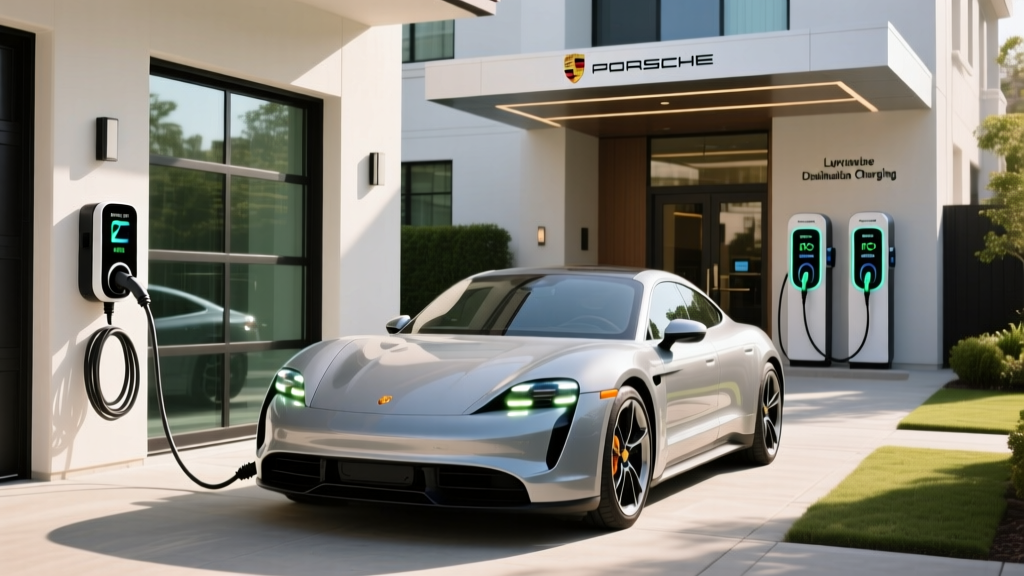
Porsche Destination Charging is a network of Level 2 AC chargers installed at premium hospitality venues — hotels, resorts, golf clubs, and fine-dining restaurants. Unlike DC fast charging, which is designed for quick highway top-ups, Destination Charging is built around the idea that your car charges while you dine, sleep, or attend an event. For 2026, Porsche lists over 1,000 Destination Charging locations across North America, typically offering between 7.2 kW and 19.2 kW per port.
If you own a Porsche Taycan (83.7 kWh usable battery, NMC chemistry) or are eyeing the upcoming all-electric Cayenne, understanding how Destination Charging compares to a home Level 2 installation is essential for planning your daily and travel charging strategy. The math on cost-per-mile, install requirements, and connector compatibility changes significantly depending on which setup you rely on.
Charging Levels Explained: Speeds, kW, and Miles Per Hour
Every EV owner needs to understand the three charging tiers. Here's how they stack up with real numbers relevant to Porsche's current and upcoming EV lineup:
| Level | Voltage / Amperage | Max Power (kW) | Miles of Range Per Hour | Typical Use Case |
|---|---|---|---|---|
| Level 1 | 120V / 12A | 1.4 kW | ~3–5 mi/hr | Emergency / overnight trickle (PHEV-friendly) |
| Level 2 | 240V / 32–80A | 7.7–19.2 kW | ~20–55 mi/hr | Home daily charging, Porsche Destination Charging |
| DC Fast | 400–800V DC | 50–350 kW | ~150–600+ mi/hr (peak) | Road trips, highway corridors |
Real-world Taycan context: The 2026 Taycan with the Performance Battery Plus (83.7 kWh usable, EPA-estimated 282–318 miles depending on trim) gains roughly 25 miles of range per hour at a 7.2 kW Destination Charger, and up to 52 miles per hour at a 19.2 kW unit. A full 10–80% charge at 19.2 kW takes approximately 3.5 hours — ideal for an overnight hotel stay, but impractical as a mid-day quick stop.
On DC fast charging, the Taycan's 800-volt architecture allows peak rates up to 320 kW on 2025+ models, achieving a 10–80% charge in roughly 18 minutes at a compatible 350 kW Electrify America station. However, sustained rates taper significantly above 80% State of Charge (SoC) to protect the NMC cells — expect the final 80–100% to take another 25–30 minutes.
Home Level 2 Installation: Electrical Requirements and Costs
Most Porsche owners will want a dedicated home Level 2 charger. The Porsche Mobile Charger Connect (included with new Taycan deliveries) supports up to 9.6 kW on a 240V/40A circuit, or up to 19.2 kW if you upgrade to the optional Porsche Home Energy Manager and a 240V/80A hardwired connection.
Electrical Requirements by Charger Amperage
- 40A circuit (9.6 kW): Requires a 50A breaker (NEC rule: circuit must be rated 125% of continuous load). Uses NEMA 14-50 outlet or hardwired.
- 48A circuit (11.5 kW): Requires a 60A breaker. Hardwired recommended for reliability.
- 80A circuit (19.2 kW): Requires a 100A breaker. Hardwired only. This is the maximum the Taycan's onboard charger can accept on Level 2 AC.
Panel Upgrade Considerations
Many homes built before 2000 have 100A or 150A main service panels. Adding a 50A or 60A EV circuit may push total load beyond 80% of panel capacity — the NEC threshold that triggers a mandatory upgrade. A panel upgrade from 100A to 200A typically costs $1,500–$3,000 including permit and utility coordination. Homes with 200A service usually accommodate a 40–48A EV circuit without issue, provided existing loads (HVAC, electric range, dryer) don't already consume most capacity.
Always have a licensed electrician perform a load calculation before committing to a charger amperage. This is not optional — it's a code requirement and a fire-safety necessity.
| Cost Component | 40A / NEMA 14-50 | 48A Hardwired | 80A Hardwired (19.2 kW) |
|---|---|---|---|
| EVSE Equipment | $400–$700 | $500–$800 | $700–$1,200 |
| Electrician Labor | $500–$1,500 | $600–$2,000 | $1,000–$3,000 |
| Permit & Inspection | $50–$200 | $50–$250 | $100–$350 |
| Panel Upgrade (if needed) | $0–$3,000 | $0–$3,000 | $1,500–$4,000 |
| Total (no panel upgrade) | $950–$2,400 | $1,150–$3,050 | $1,800–$4,550 |
| Total (with panel upgrade) | $2,450–$5,400 | $2,650–$6,050 | $3,300–$8,550 |
The IRS §30D tax credit applies to the vehicle, not the charger itself. However, the separate Residential Clean Energy Credit (§25D) does NOT cover EV chargers as of 2026 — that provision expired for standalone EVSE. Some utilities offer rebates of $250–$500 for Level 2 installations; check with your local provider. The Alternative Fuel Vehicle Refueling Property Credit (§30C) may cover up to $1,000 of home charger costs, but it has census-tract eligibility restrictions. Consult a tax professional for your specific situation.
Connector Compatibility: NACS, CCS, and the Porsche Transition
As of the 2025 model year, Porsche transitioned the Taycan to the NACS (North American Charging Standard) connector in North America, aligning with Tesla's Supercharger network opening. Prior 2020–2024 Taycan models shipped with CCS1. Here's what that means for your charging options:
| Connector | Porsche Model Years | Network Access | Adapter Needed? |
|---|---|---|---|
| NACS (J3400) | 2025+ Taycan, upcoming electric Cayenne/Macan EV | Tesla Superchargers, new Electrify America NACS stalls, EVgo NACS | CCS-to-NACS adapter (~$200) for legacy CCS stations |
| CCS1 | 2020–2024 Taycan | Electrify America, EVgo, ChargePoint DC, most non-Tesla networks | NACS-to-CCS adapter (~$200–$250) for Tesla Superchargers |
| J1772 (Level 2 AC) | All Porsche EVs and PHEVs (Cayenne E-Hybrid, Panamera E-Hybrid) | Porsche Destination Charging, all public Level 2, home chargers | NACS vehicles use J1772-to-NACS adapter (usually included) |
Key takeaway for Destination Charging: Porsche Destination Chargers use the J1772 connector (the North American standard for Level 2 AC). If your 2025+ Taycan has a NACS inlet, you'll need the J1772-to-NACS adapter that Porsche includes in the vehicle's charging kit. For 2020–2024 Taycan owners with CCS1 inlets, J1772 plugs directly into the upper portion of the CCS port — no adapter needed.
Charging Cost Per Mile: Home vs. Destination vs. DC Fast vs. Gas
The economics of EV charging vary dramatically by location and speed. Let's run the numbers for a 2026 Taycan 4S (EPA-estimated 2.9 kWh/mile, or roughly 115 MPGe combined):
| Scenario | Rate ($/kWh) | Cost Per Mile | Cost for 300 Miles |
|---|---|---|---|
| Home (off-peak utility rate) | $0.12/kWh | $0.035/mi | $10.44 |
| Home (average US residential) | $0.17/kWh | $0.049/mi | $14.79 |
| Porsche Destination Charging | Free–$0.30/kWh* | $0.00–$0.087/mi | $0–$26.10 |
| Public DC Fast (Electrify America) | $0.43–$0.56/kWh | $0.125–$0.162/mi | $37.41–$48.72 |
| Gas equivalent (25 MPG, $3.50/gal) | — | $0.14/mi | $42.00 |
*Many Porsche Destination Charging locations offer complimentary charging as a guest amenity. Others partner with networks like ChargePoint and bill at local commercial rates. Always check the venue's charging policy before assuming free power.
The financial advantage is clear: home off-peak charging costs roughly 75% less per mile than premium gasoline. Even public DC fast charging at peak rates is competitive with gas, though it erodes the EV cost advantage. For the Taycan owner who charges at home 80% of the time and uses Destination Charging on road trips, annual fuel savings versus a comparable Porsche Panamera V6 (21 MPG combined) can exceed $1,800 at 12,000 miles/year.
Recommended Home Level 2 Chargers for Porsche Owners
Based on compatibility, build quality, smart features, and output matching the Taycan's 19.2 kW onboard charger capability, here are top picks:
Porsche Mobile Charger Connect
- Power: Up to 9.6 kW (40A, 240V) with standard plug; up to 19.2 kW with Home Energy Manager
- Connector: J1772 (included with vehicle)
- Cable Length: 23 ft
- Smart Features: Wi-Fi, Porsche Connect app integration, scheduled charging, solar integration with Home Energy Manager
- Price: Included with new Taycan; replacement ~$750
- Verdict: Best ecosystem integration for committed Porsche owners
ChargePoint Home Flex
- Power: Configurable 16A–50A (3.8–12 kW); up to 60A (14.4 kW) on 2025+ hardware revision
- Connector: J1772 (NACS version available for 2025+ vehicles)
- Cable Length: 23 ft
- Smart Features: Wi-Fi, app scheduling, Alexa, load sharing for multi-charger setups
- Price: $550–$700
- Verdict: Best third-party flexibility; ideal if you also own non-Porsche EVs
Tesla Wall Connector (NACS)
- Power: Up to 11.5 kW (48A, 240V) hardwired
- Connector: NACS native — direct fit for 2025+ Taycan
- Cable Length: 24 ft
- Smart Features: Wi-Fi, OTA updates, power sharing between units, no app required for basic use
- Price: $475
- Verdict: Best value for NACS-equipped Porsches; no adapter needed
Important note on 19.2 kW: To achieve the Taycan's maximum Level 2 AC charge rate of 19.2 kW, you need an 80A circuit (100A breaker), a hardwired EVSE rated for 80A continuous, and the Porsche Mobile Charger Connect paired with the Home Energy Manager. Third-party chargers currently max out at 48A/11.5 kW or 60A/14.4 kW — still fast enough for overnight charging, but roughly half the Taycan's onboard capability.
Safety, Code, and Installation Best Practices
EV charging is a continuous high-draw electrical load — your charger may run at full power for 4–8 hours straight. This demands strict adherence to the National Electrical Code (NEC) and local amendments:
- Dedicated circuit: Your EV charger must have its own dedicated breaker — no shared circuits with other appliances.
- 125% rule: NEC Article 625 requires the circuit rating to be at least 125% of the charger's maximum continuous draw. A 40A charger needs a 50A breaker; a 48A charger needs a 60A breaker.
- GFCI protection: The 2023 NEC (adopted by most jurisdictions by 2026) requires GFCI protection for all 125V and 250V EV outlets (NEMA 14-50 included). Hardwired units are exempt from the GFCI requirement but must have ground-fault protection built into the EVSE.
- Outdoor rating: If your charger is installed outside (garage-exterior wall, carport, driveway post), the EVSE must carry a NEMA 4 or NEMA 4X weather rating. All three chargers recommended above meet this standard.
- Wire gauge: A 50A circuit requires minimum 6 AWG copper; a 60A circuit requires 4 AWG; a 100A circuit requires 1 AWG. Your electrician will spec this based on run length and local code.
- Permit and inspection: Every jurisdiction requires an electrical permit for new EV circuits. The inspection verifies wire gauge, breaker sizing, grounding, and GFCI compliance. Do not skip this — unpermitted work can void home insurance coverage in the event of an electrical fire.
Porsche Destination Charging vs. Home Charging: When to Use Each
Decision Framework
Choose home Level 2 if: You have garage or dedicated parking access, drive under 100 miles daily, want the lowest cost-per-mile ($0.035–$0.049), and value the convenience of a full battery every morning without planning.
Lean on Porsche Destination Charging if: You're on a multi-day road trip staying at partner hotels, your daily commute is minimal and you lack home charging access, or you're combining charging with an activity (dinner, event) where the car sits for 2+ hours.
Use DC fast charging for: Highway road trips where you need 200+ miles added in 20 minutes. This is the only practical option for same-day long-distance travel in the Taycan.
For the typical Porsche EV owner, the optimal strategy is a home Level 2 charger as the primary daily solution, supplemented by Destination Charging on weekend trips and DC fast charging on longer highway runs. The Taycan's 800V architecture makes it one of the fastest-charging EVs on DC infrastructure, but at home or at a hotel, Level 2 AC charging is gentler on the NMC battery chemistry and costs significantly less.
Frequently Asked Questions
How much does it cost to install a home EV charger for a Porsche Taycan?
Expect $950–$2,400 for a standard 40A NEMA 14-50 installation without a panel upgrade, or $1,800–$4,550 for an 80A hardwired setup capable of the Taycan's full 19.2 kW AC rate. If your home needs a panel upgrade from 100A to 200A service, add $1,500–$3,000. Always get a load calculation from a licensed electrician first.
How fast does Porsche Destination Charging add range to a Taycan?
Most Porsche Destination Chargers deliver 7.2–19.2 kW. At 7.2 kW, expect ~25 miles of range per hour. At 19.2 kW, expect ~52 miles per hour. A 10–80% charge at 19.2 kW takes approximately 3.5 hours on the Taycan's 83.7 kWh battery.
Is Porsche Destination Charging free?
It varies by venue. Many Porsche partner hotels and restaurants offer complimentary Level 2 charging as a guest amenity. Others bill through network partners like ChargePoint at commercial rates ($0.15–$0.30/kWh). Check the specific location on Porsche's Destination Charging map or the venue's website before arriving.
Which connector do I need for my Porsche EV?
For 2025+ Taycan models, your vehicle has a NACS inlet — use NACS-native chargers or a J1772-to-NACS adapter (included) for Level 2 stations like Destination Charging. For 2020–2024 Taycan models, your vehicle has CCS1 — J1772 plugs directly into the upper CCS port. For DC fast charging, 2025+ uses NACS; 2020–2024 uses CCS1.
How much does charging a Taycan cost per mile versus gasoline?
At home off-peak rates ($0.12/kWh), the Taycan costs approximately $0.035 per mile. A comparable gasoline Porsche Panamera at 21 MPG combined with $3.50/gallon fuel costs $0.14 per mile — roughly 4× more. Even public DC fast charging at $0.50/kWh ($0.145/mile) is competitive with premium gasoline.
What electrical upgrades might my home need for an EV charger?
Homes with 100A main service panels often require an upgrade to 200A to safely add a 40–80A EV circuit. Homes with 200A panels usually accommodate a 40–48A charger without upgrades, provided existing loads are moderate. Your electrician will perform a NEC Article 220 load calculation to determine this. Other potential upgrades include running new conduit from the panel to the garage and upgrading wire gauge for long runs.
Can I use a Tesla Wall Connector with my Porsche Taycan?
Yes — if your Taycan is a 2025+ model with a NACS inlet, the Tesla Wall Connector plugs in directly with no adapter. For 2020–2024 CCS-equipped Taycans, you'd need a NACS-to-CCS adapter, which is available but adds a point of failure and may not support the full 48A rate. The Tesla Wall Connector delivers up to 11.5 kW (48A), well below the Taycan's 19.2 kW maximum, but more than sufficient for overnight charging.