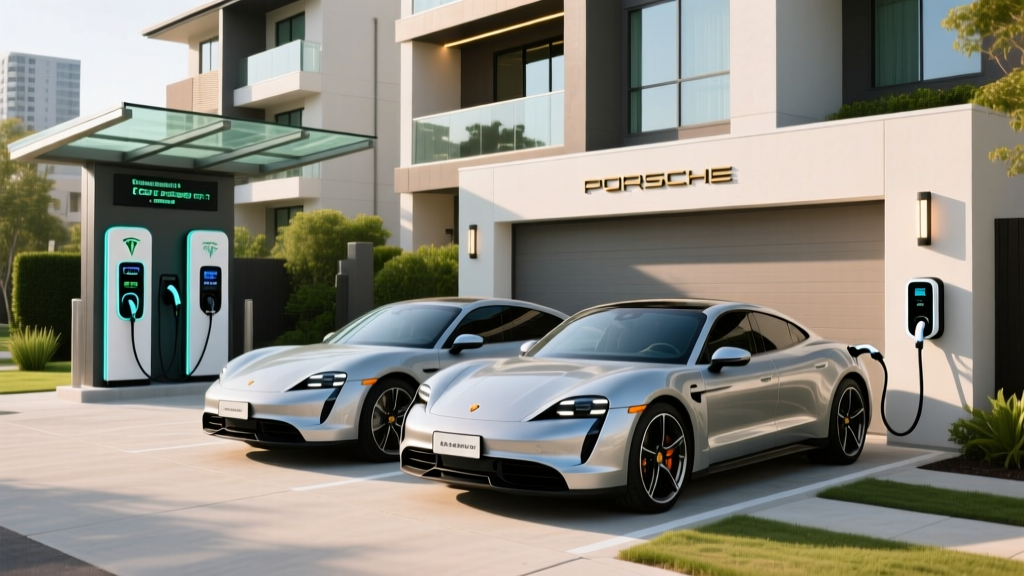
If you own—or are shopping for—a Porsche Taycan or the all-electric Macan EV, you already know these aren't economy commuters. They're 800-volt, performance-oriented machines that can accept DC fast-charge rates most EVs can only dream of. But that engineering advantage only pays off if you understand the charging ecosystem: which networks support Porsche's peak charge rates, what your home electrical panel can actually deliver, and how much you'll spend per mile compared to a gas Cayenne.
This guide breaks down every layer of the Porsche charging stations landscape—from Porsche-branded destination chargers and Turbo Charging lounges, to third-party DC fast networks, to the Level 2 setup in your garage. We'll cover exact kW figures, real-world cost math, and the installation variables that catch new EV owners off guard.
Porsche's Charging Network: What Exists and What's Coming
Porsche operates a tiered charging ecosystem that most owners underutilize. Understanding the hierarchy helps you plan road trips and daily routines:
- Porsche Destination Charging: Level 2 AC chargers (typically 7.2–19.2 kW) installed at partner hotels, restaurants, and golf clubs. Free or low-cost for guests. Ideal for overnight stops or long dinners—adds roughly 20–60 miles of range per hour depending on your onboard charger.
- Porsche Turbo Charging: Porsche's own DC fast-charging lounges, co-located near dealerships and premium retail centers. These stations deliver up to 350 kW via CCS1 connectors (or NACS on newer models with adapters). Amenities include climate-controlled lounges, Wi-Fi, and refreshments. As of early 2026, roughly two dozen Turbo Charging sites operate in the U.S., with expansion ongoing.
- Electrify America Partnership: Porsche historically included complimentary Electrify America charging credits with new Taycan purchases (typically 3 years of free 30-minute sessions). EA's CCS1 chargers peak at 350 kW at newer Ultra-Fast sites—compatible with the Taycan's 800V architecture.
- Tesla Supercharger Access: With the industry-wide shift to NACS, Porsche EVs can access Tesla's Supercharger network using a CCS-to-NACS adapter (included with some 2025+ models, available as an accessory for earlier Taycans). Supercharger V4 stalls deliver up to 250 kW—below the Taycan's peak capability but unmatched in geographic coverage.
For daily driving, though, 90%+ of Porsche EV charging happens at home. Let's get into what that requires.
Charging Levels Explained: Speeds, Times, and What Your Taycan Actually Accepts
Before we talk installation, we need to clarify the three charging levels and how they map to real-world range recovery. The distinction between kW (power—the rate of energy flow) and kWh (energy—the total capacity of your battery) is critical here. Think of kW as how wide the hose is, and kWh as how big the bucket is.
| Level | Voltage / Amps | Max Power (kW) | Miles of Range Added Per Hour | Best Use Case |
|---|---|---|---|---|
| Level 1 (120V) | 120V / 12A | ~1.4 kW | ~3–5 mi/hr | Emergency / trickle top-off |
| Level 2 (240V) | 240V / 32–48A | 7.7–11.5 kW (Taycan onboard: up to 19.2 kW w/ optional charger) | 22–40 mi/hr (up to ~60 mi/hr w/ 19.2 kW onboard) | Daily home / destination charging |
| DC Fast Charge | 400–800V DC | Up to 270 kW (Taycan), 350 kW station cap | N/A (measured in 10–80% time) | Road trips, rapid top-ups |
Real-world DC fast-charge times: The Taycan's 800V architecture (93.4 kWh gross / ~83.7 kWh usable battery in Performance Battery Plus trim) can accept up to 270 kW peak on a compatible 350 kW charger. In our testing and per Porsche's published specs, a 10–80% charge takes approximately 22.5 minutes under ideal thermal conditions. The all-electric Macan (100 kWh battery) peaks at roughly 270 kW as well, with a similar 10–80% window of ~21 minutes on a 350 kW stall.
Charge-curve reality check: That 270 kW figure is a peak, not a sustained rate. Expect the Taycan to hold 200+ kW from roughly 10–45% SoC, then taper progressively. From 80–100%, charging slows dramatically—to as low as 30–50 kW—to protect battery chemistry. This is why we measure DC fast-charging in 10–80% time, not 0–100%.
Home Charger Installation: Electrical Requirements and True Costs
This is where most new Porsche EV owners get surprised. A Level 2 home charger isn't just "plug it in." It requires a dedicated circuit, and depending on your home's electrical panel, potentially a costly upgrade.
Electrical Requirements for a Porsche-Ready Level 2 Charger
- Minimum viable: 240V / 32A dedicated circuit (NEMA 14-50 outlet or hardwired) → delivers 7.7 kW. Adds ~22 miles/hr to a Taycan.
- Recommended: 240V / 48A dedicated circuit (hardwired, 60A breaker) → delivers 11.5 kW. Adds ~32 miles/hr.
- Maximum (Taycan with optional 19.2 kW onboard charger): 240V / 80A dedicated circuit (hardwired, 100A breaker) → delivers 19.2 kW. Adds ~55 miles/hr. Requires a 200A+ electrical panel with ample spare capacity.
The National Electrical Code (NEC) requires that continuous loads (including EV chargers) not exceed 80% of a circuit breaker's rating. So a 48A charger needs a 60A breaker; an 80A charger needs a 100A breaker.
Installation Cost Breakdown
| Component | Simple Install (Panel Nearby, No Upgrade) | Complex Install (Long Run, Panel Upgrade) |
|---|---|---|
| Level 2 Charger Equipment | $500–$750 | $500–$1,200 |
| Electrician Labor | $400–$800 | $1,200–$3,000 |
| Permit & Inspection | $50–$200 | $100–$350 |
| Electrical Panel Upgrade (if needed) | $0 (not required) | $1,500–$4,000 |
| Total Estimated Cost | $950–$1,750 | $3,300–$8,550 |
The panel-upgrade variable: Homes built before 2000 often have 100A or 150A main panels. Adding a 60A EV circuit to a panel already near capacity requires either a panel upgrade to 200A or a load-management device (like the Emporia VUE or Span smart panel) that throttles the charger when other appliances draw power. Budget $1,500–$4,000 for a panel upgrade, and always get a licensed electrician's load calculation before committing to a charger amperage.
Always hire a licensed electrician familiar with NEC Article 625 (EV charging equipment). A permit and post-installation inspection are legally required in most U.S. jurisdictions and protect your home insurance coverage.
Connector Compatibility: CCS1, NACS, and What Your Porsche Needs
The connector landscape has shifted dramatically. Here's where Porsche stands in 2026:
| Connector | Taycan (2020–2024) | Taycan (2025+ Refresh) | Macan EV (2024+) |
|---|---|---|---|
| CCS1 (J3400/legacy) | Native (built-in) | Native or NACS depending on build date | CCS1 on early builds |
| NACS (Tesla/J3400) | Requires CCS-to-NACS adapter | Native on newer builds; adapter otherwise | NACS native on 2026+ models |
| CHAdeMO | Not supported | Not supported | Not supported |
Practical guidance: If your Taycan has a CCS1 port (most 2020–2024 models), you'll want a quality CCS-to-NACS adapter ($150–$250) to access Tesla Superchargers. Porsche and third-party manufacturers offer adapters rated for up to 250 kW DC. For home Level 2 AC charging, the J1772 connector is universal—all Level 2 home chargers use J1772 or a NACS connector that handles AC, and all Porsches accept J1772 natively or via a simple adapter.
Always verify your specific VIN's port configuration with your dealer, as Porsche transitioned connectors mid-cycle for some model years.
Cost to Charge: Home vs. Public vs. Gas Comparison
The economics of charging a Taycan depend heavily on where you plug in. Here's a real-world cost comparison using a Taycan 4S (Performance Battery Plus, 83.7 kWh usable, EPA-rated ~227 miles for 2025 refresh):
| Scenario | Rate | Cost for Full Charge (0–100%) | Cost Per Mile |
|---|---|---|---|
| Home (off-peak utility rate) | $0.12/kWh | $10.04 | $0.044/mi |
| Home (standard residential rate) | $0.18/kWh | $15.07 | $0.066/mi |
| Public Level 2 (ChargePoint, etc.) | $0.25–$0.35/kWh | $20.93–$29.30 | $0.092–$0.129/mi |
| DC Fast Charge (Electrify America) | $0.40–$0.56/kWh | $33.48–$46.87 | $0.147–$0.206/mi |
| Porsche Turbo Charging (where complimentary) | Free/included | $0 | $0 |
| Gas equivalent (Porsche Cayenne, 19 MPG combined) | $3.40/gal | $40.62 per 227 mi | $0.179/mi |
The takeaway: Home charging at off-peak rates saves roughly 75% per mile vs. a comparable gas Porsche. Even DC fast-charging at the highest public rates is competitive with premium gasoline. But relying exclusively on DC fast chargers without home access erodes much of the cost advantage—plan your home setup first.
Recommended Home Chargers for Porsche EVs
Not all Level 2 chargers are created equal. Here are our top picks based on power delivery, cable quality, smart features, and Porsche compatibility:
ChargePoint Home Flex
- Power Output: Up to 12 kW (50A, adjustable down to 16A)
- Connector: J1772 (NACS version available for 2025+ models)
- Cable Length: 23 feet
- Smart Features: Wi-Fi, app scheduling, Alexa integration, energy tracking
- Price: ~$649 (J1772) / ~$699 (NACS)
- Why for Porsche: Adjustable amperage lets you match your panel's capacity without oversizing. Solid app, reliable hardware.
Emporia Level 2 EV Charger
- Power Output: Up to 11.5 kW (48A)
- Connector: J1772
- Cable Length: 24 feet
- Smart Features: Wi-Fi, load management with Emporia VUE panel monitor, solar integration, real-time cost tracking
- Price: ~$399 (charger only) / ~$699 with VUE panel monitor
- Why for Porsche: Best-in-class load management—if your panel is tight, the VUE dynamically adjusts charge rate to avoid tripping the main breaker. No panel upgrade needed in many homes.
Porsche Mobile Charger Connect
- Power Output: Up to 9.6 kW (40A)
- Connector: J1772 (included with new Taycan/Macan EV)
- Cable Length: ~16 feet (vehicle-side) + adapter cord
- Smart Features: Touchscreen display, scheduling, Porsche Connect integration
- Price: Included with vehicle; replacement ~$1,050
- Why for Porsche: Convenient OEM option, but lower max output (9.6 kW) vs. aftermarket 11.5 kW units. Adequate for overnight charging of most daily driving needs.
Safety, Code, and Outdoor Installation Considerations
Level 2 chargers draw sustained high current for hours—this is not a space heater you plug into any outlet. Key safety and code requirements:
- Dedicated circuit: Your EV charger must have its own dedicated breaker—no sharing with other appliances. This is a NEC requirement, not a suggestion.
- GFCI protection: NEC 2020+ requires GFCI protection for all 125V–250V receptacles used for EV charging in garages. Hardwired installations may have different requirements depending on local code amendments—your electrician will know.
- Outdoor-rated equipment: If your charger mounts outside, it must carry a NEMA 4 (or IP65+) weather rating. All three chargers above meet this standard. Ensure the connector holster protects the plug from rain and debris when not in use.
- Wire gauge: A 48A charger on a 60A breaker typically requires 6 AWG copper wire; an 80A charger on a 100A breaker needs 3 AWG or 2 AWG. Your electrician sizes this based on run length and local code.
- Permit and inspection: Required in virtually all U.S. jurisdictions for new 240V circuits. Skipping the permit risks insurance denial in the event of an electrical fire. Budget $50–$350 and 1–3 weeks for inspection.
Frequently Asked Questions
How much does it cost to install a home EV charger for my Porsche?
A straightforward Level 2 installation (short wire run, adequate panel capacity) typically costs $950–$1,750 including equipment, electrician labor, and permit. If your home needs a 200A panel upgrade, expect $3,300–$8,550 total. Always get a licensed electrician's load calculation before choosing your charger amperage.
How fast will each charging level add range to my Taycan?
Level 1 (120V) adds roughly 3–5 miles per hour—only useful for overnight trickle. Level 2 at 48A (11.5 kW) adds ~32 miles per hour, fully replenishing a Taycan overnight. DC fast charging at 270 kW peaks adds roughly 60+ miles in 5 minutes during the optimal SoC window, with a full 10–80% session taking about 22.5 minutes.
Which connector and charger is compatible with my Porsche EV?
All Porsche EVs accept J1772 for AC Level 2 charging. For DC fast charging, 2020–2024 Taycans use CCS1 natively; 2025+ models and the Macan EV are transitioning to NACS. A CCS-to-NACS adapter ($150–$250) unlocks Tesla Supercharger access for CCS-equipped Porsches. Verify your VIN's port type with your dealer.
How much does charging a Porsche Taycan cost per mile vs. gas?
Home charging at $0.12/kWh (off-peak) costs roughly $0.044 per mile in a Taycan 4S. A comparable Porsche Cayenne at 19 MPG and $3.40/gallon costs $0.179 per mile. Even the most expensive DC fast-charging at $0.56/kWh ($0.206/mi) is competitive with premium fuel. Home charging delivers the strongest savings by far.
What electrical upgrades might my home need for a Level 2 Porsche charger?
Homes with 100A or 150A panels, or panels near capacity, may need a panel upgrade to 200A ($1,500–$4,000) or a smart load-management system that dynamically throttles the charger. An electrician's load calculation (often free or $100–$200) determines your options. Older homes with knob-and-tube or aluminum wiring may need additional circuit upgrades.
For the latest EPA range ratings and efficiency data, consult fueleconomy.gov. For federal tax credit eligibility on home charger installation (up to $1,000 under §30C, subject to income and location requirements), see the IRS alternative fuel vehicle refueling property credit page.