Porsche Cayenne Electric Range: What the Numbers Actually Mean
The all-electric Porsche Cayenne (officially the Cayenne EV, built on the Premium Platform Electric or PPE architecture shared with the Audi Q6 e-tron) arrives for the 2025–2026 model year with a headline EPA-estimated range of up to ~310 miles on the highest-capacity battery variant. Porsche has confirmed a usable battery capacity of approximately 100 kWh (gross ~108 kWh), using NMC (nickel-manganese-cobalt) chemistry optimized for high discharge rates and sustained fast-charging performance.
But as any seasoned EV owner knows, the EPA sticker is a starting point, not a guarantee. Here's how real-world conditions reshape that number:
Real-World Highway (70 mph, mild weather): ~260–280 miles
Cold Weather (below 32°F, highway): ~210–240 miles
Mixed City/Suburban: ~285–305 miles
Source: Porsche preliminary specs; real-world estimates based on PPE-platform testing data from fueleconomy.gov and independent EV testing.
The Cayenne EV's 800-volt architecture is the real story here. It enables sustained high-power DC fast charging that outpaces most 400V competitors, meaning you spend less time tethered to a charger on road trips — a critical factor if you're evaluating the Cayenne EV against the Tesla Model X, BMW iX, or Mercedes EQS SUV.
Charging Levels Explained: kW, Speeds, and Range Added Per Hour
Before we break down the Cayenne EV's charging behavior, let's clarify the single most important distinction in EV ownership: kW (kilowatts) measures power — the rate of energy flow. kWh (kilowatt-hours) measures energy — the total capacity stored in the battery. Think of kW as the width of a hose and kWh as the size of the bucket. Confusing the two is the most common mistake new EV buyers make.
Here's how each charging level translates to real-world range recovery for a ~100 kWh battery like the Cayenne EV's:
| Charging Level | Voltage / Amperage | Max Power (kW) | Miles of Range Added Per Hour | Typical Use Case |
|---|---|---|---|---|
| Level 1 (120V) | 120V / 12A | ~1.4 kW | ~3–5 mi/hr | Emergency / trickle top-up |
| Level 2 (240V) | 240V / 40–48A | 9.6–11.5 kW | ~25–35 mi/hr | Home overnight, workplace |
| DC Fast Charging | 400–800V DC | Up to 400 kW (Cayenne EV peak) | ~600–900 mi/hr (at peak) | Road trips, highway corridors |
At Level 1, fully recharging the Cayenne EV from empty would take over 70 hours — essentially impractical for daily use. Level 2 is where the majority of charging happens: an overnight session from 20% to 100% takes roughly 9–11 hours, perfect for a standard sleep cycle. DC fast charging is where the 800V platform shines, but sustained rates matter far more than peak numbers.
DC Fast Charging: The 800V Advantage and Real Charge Curves
Porsche rates the Cayenne EV at a peak DC fast-charge rate of up to 400 kW on compatible chargers (such as Electrify America's newest 400 kW stalls or Ionity stations in Europe). But peak power is only part of the equation — the charge curve tells the full story.
Here's what a typical 10–80% charging session looks like on a 350 kW charger:
- 10–30% SoC: Ramps quickly to ~350–400 kW
- 30–50% SoC: Sustains ~300–350 kW
- 50–70% SoC: Tapers to ~200–250 kW
- 70–80% SoC: Further tapers to ~120–150 kW
- 10–80% total time: Approximately 15–18 minutes on a capable charger
This tapering is normal physics: as the battery fills, the battery management system (BMS) reduces current to protect cell health and manage thermal load. The Cayenne EV's advanced thermal preconditioning — which warms or cools the battery to optimal temperature when you navigate to a charger — is essential for achieving these speeds. Always precondition before a DC fast-charge stop, especially in cold weather, where unpreconditioned charging can be 30–50% slower.
For the Level 2 onboard charger, Porsche equips the Cayenne EV with an 11 kW onboard charger (standard), with an optional 19.2 kW unit available. The 19.2 kW option cuts a full 0–100% Level 2 charge to roughly 5.5–6 hours, which can be valuable if you frequently need full charges between evening and morning.
Home Level 2 Charger Installation: Requirements, Costs, and Panel Upgrades
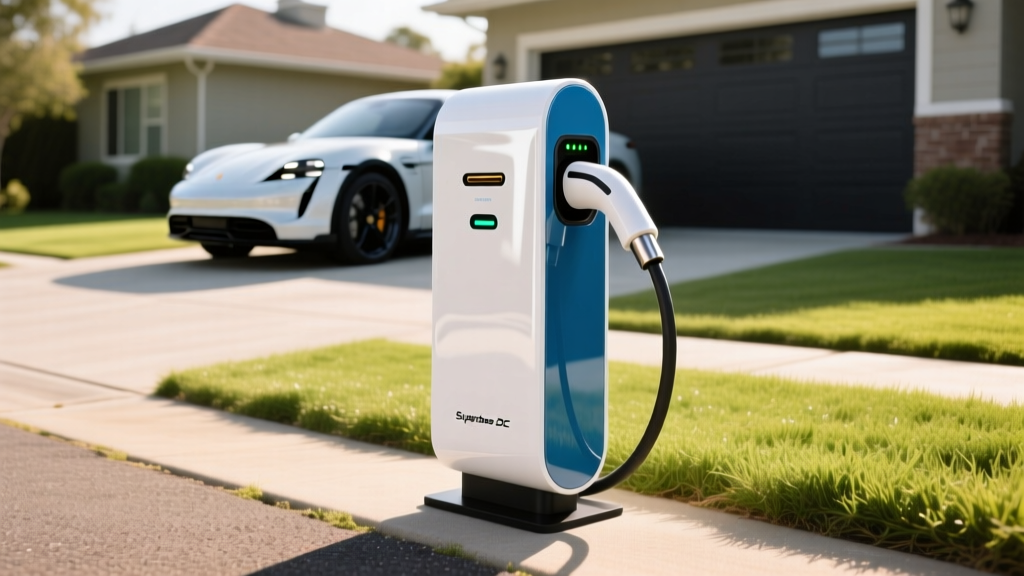
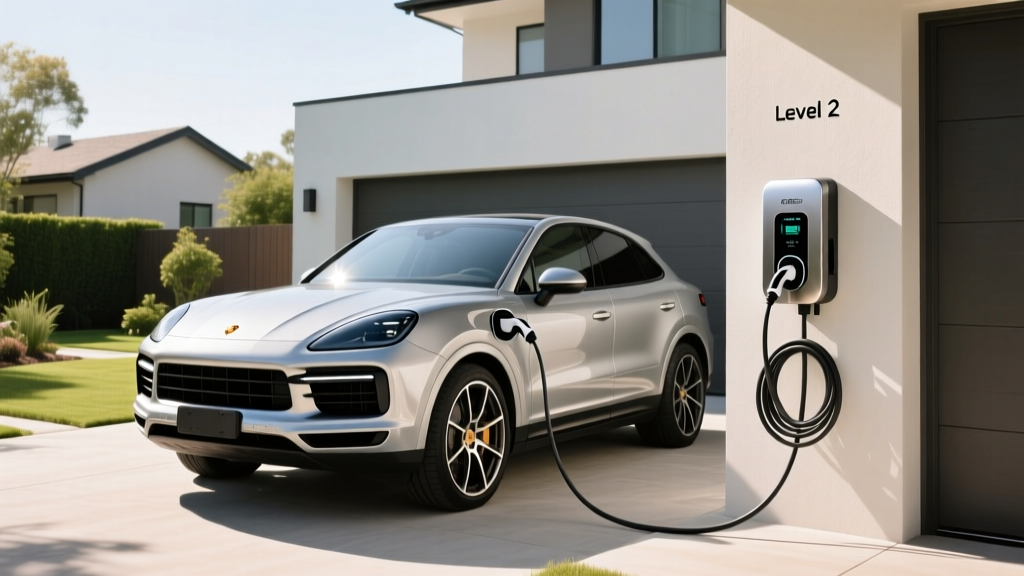
Installing a home Level 2 charger is the single most impactful upgrade for EV ownership. For the Cayenne EV, you'll want a 240V circuit that can deliver at least 40 amps (9.6 kW) to match the standard onboard charger, or 80 amps (19.2 kW) if you spec the optional faster onboard unit.
Here's a realistic breakdown of what a home installation costs:
| Cost Component | Typical Range | Notes |
|---|---|---|
| Level 2 Charger (Equipment) | $400 – $1,200 | Smart Wi-Fi chargers from ChargePoint, Wallbox, Emporia, Grizzl-E |
| Electrician Labor | $500 – $2,000 | Depends on run length, conduit, and wall type |
| Electrical Permit | $50 – $300 | Varies by municipality; required in most jurisdictions |
| Panel Upgrade (if needed) | $1,500 – $4,000 | Needed if existing panel lacks capacity (common in pre-2000 homes with 100A service) |
| Total (no panel upgrade) | $950 – $3,500 | Most homes with 200A service |
| Total (with panel upgrade) | $2,500 – $7,500 | Older homes or those adding multiple large loads |
Key electrical requirements for the Cayenne EV home charger:
- Circuit: Dedicated 50A breaker (for 40A continuous) or 60A breaker (for 48A continuous) minimum
- Wire gauge: 6 AWG copper for 50A; 4 AWG for 60A (electrician will confirm)
- GFCI protection: Required by NEC 2020+ for EV charging outlets (EVSE with built-in GFCI or GFCI breaker)
- Outlet type: NEMA 14-50 (most common, portable) or hardwired (required above 48A, no outlet)
- Outdoor rating: If mounting outside, ensure NEMA 4-rated enclosure and outdoor-rated EVSE
Connector Compatibility: NACS, CCS1, and the 2026 Landscape
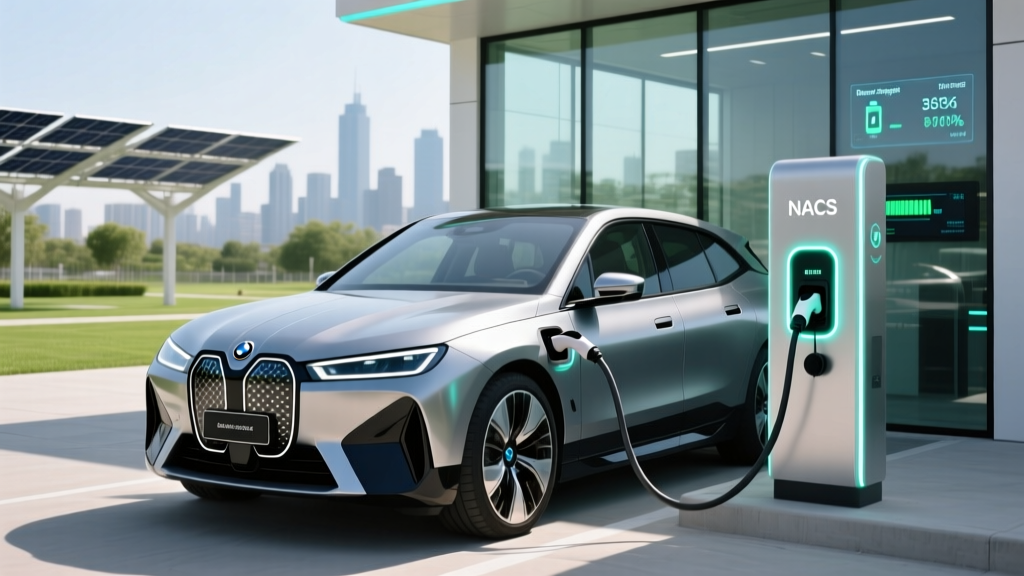
The connector landscape has shifted dramatically. As of 2025–2026, nearly every major automaker — including Porsche — has committed to adopting the NACS (North American Charging Standard) connector, originally developed by Tesla. The Cayenne EV is expected to ship with a NACS port for North American models, enabling direct access to Tesla Supercharger stalls (now opened to non-Tesla EVs via the "Open Supercharger" program).
| Connector | Used By | Max DC Power | Notes for Cayenne EV |
|---|---|---|---|
| NACS (Tesla) | Tesla, Ford, GM, Rivian, Porsche (2025+), Volvo, Hyundai/Kia (2025+) | Up to 900 kW (V4 Supercharger) | Native port on 2026 Cayenne EV; direct Supercharger access |
| CCS1 | Legacy: VW ID.4 (pre-2025), BMW iX, older models | Up to 350 kW | Use NACS-to-CCS adapter for Electrify America and other CCS networks |
| CHAdeMO | Nissan Leaf (legacy), Mitsubishi | Up to 100 kW | Effectively obsolete; avoid reliance on CHAdeMO stations |
If you purchase a Cayenne EV with a NACS port and want to use Electrify America or other CCS-based networks, you'll need a NACS-to-CCS1 adapter (approximately $150–$250 from brands like Lectron or A2Z). Porsche may include one with the vehicle — confirm with your dealer. The reverse scenario (CCS vehicle needing NACS adapter) is also available from Tesla and third-party manufacturers.
Cost to Charge: Home vs. Public vs. Gas — The Per-Mile Math
One of the strongest ownership arguments for the Cayenne EV over its gasoline predecessor (which averaged ~19 MPG combined) is fuel cost. Let's run the numbers with concrete electricity rates:
| Charging Scenario | Rate ($/kWh) | Cost for Full ~100 kWh Charge | Cost Per Mile (310 mi range) |
|---|---|---|---|
| Home Off-Peak (utility time-of-use) | $0.08 – $0.12 | $8 – $12 | $0.03 – $0.04/mi |
| Home Standard Rate | $0.14 – $0.18 | $14 – $18 | $0.045 – $0.06/mi |
| Public Level 2 (ChargePoint, workplace) | $0.20 – $0.35 | $20 – $35 | $0.065 – $0.11/mi |
| DC Fast Charging (Electrify America, EA Pass) | $0.35 – $0.55 | $35 – $55 | $0.11 – $0.18/mi |
| Tesla Supercharger (NACS, open network) | $0.25 – $0.40 | $25 – $40 | $0.08 – $0.13/mi |
| Gasoline Baseline (Cayenne Gas, 19 MPG, $3.60/gal): $0.19/mi | |||
At home off-peak rates, the Cayenne EV costs roughly 5–6× less per mile to "fuel" than the gasoline Cayenne. Even at public DC fast-charging rates, you're typically saving 20–40% versus premium gasoline. Over 15,000 miles/year, home charging can save $2,000–$2,500 annually compared to the gas model.
For federal incentive context, the IRS §30D tax credit for new EVs offers up to $7,500, but eligibility depends on MSRP caps ($80,000 for SUVs), buyer income limits ($300K MFJ / $150K single), and battery critical-mineral sourcing requirements. The Cayenne EV's base MSRP is expected above the cap, so verify current eligibility at irs.gov or consult a tax professional before purchase.
Recommended Home Chargers for the Porsche Cayenne EV
Not all Level 2 chargers are equal. Here are three proven options matched to the Cayenne EV's onboard charger capabilities:
ChargePoint Home Flex (NACS)
- Power Output: Up to 12 kW (50A circuit) or configurable down
- Connector: NACS (native) or J1772 with adapter
- Cable Length: 23 feet
- Smart Features: Wi-Fi, app scheduling, Alexa, energy tracking, load sharing
- Price: ~$550 – $650
- Best For: Most Cayenne EV owners; reliable app ecosystem, UL-listed
Wallbox Pulsar Plus (48A)
- Power Output: 11.5 kW (48A / 60A circuit)
- Connector: NACS (2025+ models) or J1772
- Cable Length: 25 feet
- Smart Features: Wi-Fi + Bluetooth, Power Sharing (two chargers on one circuit), myWallbox app
- Price: ~$450 – $600
- Best For: Compact form factor, dual-EV households
Emporia Vue Level 2 EV Charger
- Power Output: Up to 11.5 kW (48A)
- Connector: J1772 (NACS adapter included or sold separately)
- Cable Length: 24 feet
- Smart Features: Whole-home energy monitoring integration, solar-aware scheduling, V2X ready
- Price: ~$400 – $500
- Best For: Solar-panel owners, budget-conscious buyers wanting smart features
If you opted for the 19.2 kW onboard charger, you'll need a hardwired 80A circuit and a charger rated for that output — currently, the Grizzl-E Smart (up to 19.2 kW, ~$650) or the FLO Home X80 are among the few residential units that support it. Confirm with your electrician that your panel can handle a 100A breaker before committing.
Safety, Code, and Best Practices for Cayenne EV Charging
EV charging involves sustained high-current draw — essentially running a large appliance continuously for hours. Safety and code compliance are non-negotiable:
- Dedicated circuit: Your EV charger must have its own dedicated breaker — never share a circuit with other large appliances (dryer, oven, HVAC).
- GFCI protection: The National Electrical Code (NEC 625) requires ground-fault protection for all EVSE installations. Modern chargers have built-in GFCI; for hardwired units, a GFCI breaker may be needed.
- Outdoor installations: Use a NEMA 4-rated (weatherproof) enclosure and outdoor-rated EVSE. Drip loops on cables prevent water ingress.
- Cable management: Wall-mount a cable holster or retractable reel to prevent tripping hazards and cable damage.
- Smart load management: If your panel is near capacity, consider a load-management device (like the Emporia Smart Load Center or Wallbox Power Sharing) that dynamically adjusts charging current based on other household loads.
- Annual inspection: Check the plug, cable, and outlet for signs of heat damage, discoloration, or corrosion — especially in humid or coastal climates.
For detailed electrical code requirements, refer to the National Fire Protection Association's NEC guidelines and always hire a licensed electrician familiar with EVSE installations.
Frequently Asked Questions
How much does it cost to install a home EV charger for the Cayenne EV?
Expect $950–$3,500 for a standard installation on a home with a 200A panel. If your home needs a panel upgrade (common in pre-2000 homes), total costs can reach $2,500–$7,500. Always get 2–3 quotes from licensed electricians and confirm they have EVSE experience.
How fast will each charging level add range to the Cayenne EV?
Level 1 (120V) adds ~3–5 miles per hour — impractical for daily use. Level 2 (240V, 40–48A) adds ~25–35 miles per hour, fully recharging overnight. DC fast charging at peak (400 kW) can add ~200 miles in under 10 minutes, with a 10–80% session taking approximately 15–18 minutes on a 350 kW charger.
Which connector does the 2026 Cayenne EV use?
North American 2026 Cayenne EV models are expected to use the NACS connector natively, granting direct access to Tesla Superchargers. For CCS-based networks like Electrify America, a NACS-to-CCS1 adapter is required. Confirm with your dealer at purchase.
How much does charging the Cayenne EV cost per mile compared to gas?
At home off-peak rates ($0.08–$0.12/kWh), the Cayenne EV costs $0.03–$0.04 per mile — roughly 5–6× cheaper than the gasoline Cayenne at $0.19/mile (19 MPG, $3.60/gal premium). Even public DC fast charging at $0.35–$0.55/kWh typically undercuts gasoline on a per-mile basis.
What electrical upgrades might I need for home charging?
If your home has a 200A electrical panel with sufficient spare capacity, you likely only need a dedicated 50A or 60A circuit. Homes with 100A or 150A service, or panels already near capacity, may require a panel upgrade ($1,500–$4,000). A licensed electrician will perform a load calculation to determine your exact needs. Permits are required in most jurisdictions and protect your investment.
Does the Cayenne EV qualify for the $7,500 federal tax credit?
Eligibility under IRS §30D depends on the vehicle's MSRP (capped at $80,000 for SUVs), buyer income limits, and battery sourcing requirements. The Cayenne EV's MSRP is expected to exceed the cap on many trims. Verify current eligibility at irs.gov and consult a tax professional before relying on the credit in your purchase decision.
How does cold weather affect the Cayenne EV's range and charging speed?
In temperatures below 32°F, expect 20–30% range reduction (down to ~210–240 miles from the ~310 EPA estimate) due to battery chemistry limitations and cabin heating demands. DC fast charging can be 30–50% slower if the battery is not preconditioned. Always use the navigation-based preconditioning feature when heading to a charger in cold weather.