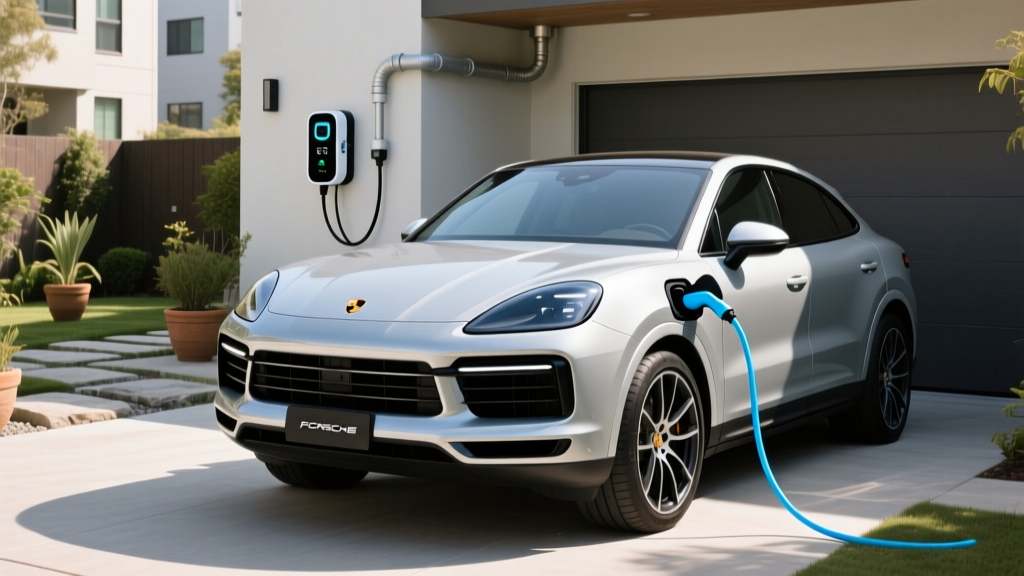
The Porsche Cayenne Electric represents a pivotal shift for the German automaker—translating the performance DNA of its best-selling SUV into a fully electric platform built on Volkswagen Group's PPE (Premium Platform Electric) architecture. But for prospective buyers, the questions go far beyond the sticker price: What is the real-world Cayenne EV range? How fast does it actually charge at home and on the road? And what will a Level 2 home charger installation cost?
This guide breaks down the Cayenne EV's range and charging profile with exact figures, then walks you through the home charging setup—electrical requirements, equipment picks, connector compatibility, and cost-per-mile math—so you can budget confidently before delivery day.
2026 Cayenne EV Range and Efficiency: EPA vs. Real World
Porsche has announced the Cayenne Electric with multiple battery and powertrain configurations. The base rear-wheel-drive model carries an estimated usable battery capacity of approximately 100 kWh (NMC chemistry), while the dual-motor all-wheel-drive variants push output up to 402 hp in standard form and significantly more in Turbo trims.
EPA Estimated Range: ~300 miles (RWD base, preliminary)
Real-World Highway (70 mph, moderate climate): ~250–270 miles
Cold Weather (below 32°F, highway): ~210–240 miles
Range estimates are preliminary for the 2026 model year. Final EPA certification may vary by trim. Cold-weather losses of 20–30% are typical for NMC chemistry without aggressive cabin preconditioning.
The Cayenne Electric's 800-volt architecture is the real story here. Higher system voltage means the vehicle can accept more power at the charger without requiring proportionally higher current—reducing heat, improving efficiency, and enabling charge rates that rival much smaller vehicles. Expect an efficiency rating in the neighborhood of 2.8–3.2 kWh/mile depending on driving style and conditions, which translates roughly to 85–95 MPGe combined.
| Spec | Base RWD | AWD / Turbo |
|---|---|---|
| Battery (usable) | ~100 kWh (NMC) | ~100 kWh (NMC) |
| EPA Range (est.) | ~300 mi | ~270 mi |
| Horsepower | ~402 hp | ~590+ hp (Turbo) |
| 0–60 mph | ~4.9 sec | ~3.5 sec |
| Max DC Fast Charge | 270 kW | 270 kW |
| 10–80% DC Time | ~18 min | ~18 min |
| Level 2 AC Charge Rate | 11 kW (standard) / 22 kW (optional) | 11 kW (standard) / 22 kW (optional) |
| Starting MSRP (est.) | ~$85,000 | ~$120,000+ |
| Battery Warranty | 8 yr / 100,000 mi | 8 yr / 100,000 mi |
Federal tax credit note: At an MSRP well above the IRS §30D SUV cap of $80,000 for some trims, Cayenne EV buyers should verify trim-level eligibility. Income caps ($150K single / $300K joint) and battery critical-mineral sourcing requirements also apply. Always confirm current-year rules with a tax professional.
Charging Levels Explained: How Fast Will Each Level Add Range?
Understanding charging speed requires distinguishing between kW (kilowatts)—the rate of power delivery, like water flow from a hose—and kWh (kilowatt-hours)—the total energy stored, like the size of the tank. A higher kW charge rate fills your battery faster, but the battery's kWh capacity determines how far you can drive.
| Level | Voltage / Power | Miles Added per Hour | Use Case |
|---|---|---|---|
| Level 1 (120V) | 1.4–1.9 kW | ~4–6 mi/hr | Overnight trickle; emergency top-up |
| Level 2 (240V) | 7.2–19.2 kW | ~24–64 mi/hr | Daily home/workplace charging |
| DC Fast Charge | 50–270 kW | ~160–540+ mi/hr (peak) | Road trips; rapid public charging |
For the Cayenne EV with its 11 kW onboard AC charger (standard), a 240V/48A Level 2 station delivers roughly 37 miles of range per hour of charging. Upgrade to the optional 22 kW onboard charger and a compatible 80A circuit, and that climbs to approximately 73 miles per hour. Either way, a full overnight session (8–10 hours) easily replenishes the entire battery.
On DC fast charging, the Cayenne's 800V architecture enables a peak rate of 270 kW. In practice, this means a 10–80% charge in roughly 18 minutes at a compatible 350 kW station. However, charge rates taper significantly above 80% SoC to protect battery health—expect the 80–100% portion to add another 15–20 minutes. Always precondition the battery (via the car's navigation-routed charging) for optimal charge curves in cold weather.
Home Charger Installation: Electrical Requirements, Costs & Panel Upgrades
Most Cayenne EV owners will install a Level 2 home charger on a dedicated 240V circuit. Here is what that involves electrically and financially.
Electrical Requirements
- Circuit: Dedicated 240V, 40A–60A circuit (most common); 80A for 22 kW onboard charger setups
- Wire gauge: 6 AWG copper for 50A circuits; 4 AWG for 60A; 2 AWG for 80A
- Breaker: Sized to 125% of continuous load (e.g., 40A charger = 50A breaker)
- Connector: NEMA 14-50 receptacle (most universal) or hardwired connection (required above 60A by NEC)
- GFCI protection: Required by NEC 2020+ for EV receptacles in garages; hardwired chargers with integrated ground-fault protection may exempt the breaker
Panel Upgrade Considerations
If your home has a 100A main service panel that is already heavily loaded (electric range, dryer, HVAC), adding a 40–60A EV circuit may require a panel upgrade to 200A. This is one of the most overlooked costs in EV ownership planning.
| Component | Simple Install (near panel) | Complex Install (long run / panel upgrade) |
|---|---|---|
| EVSE Equipment (Level 2 charger) | $400–$750 | $500–$1,200 |
| Electrician labor | $300–$800 | $1,000–$3,000 |
| Permit & inspection | $50–$200 | $100–$350 |
| Panel upgrade (if needed) | — | $1,500–$4,000 |
| Conduit/wiring materials | $50–$150 | $200–$600 |
| TOTAL RANGE | $800–$1,900 | $3,300–$9,150 |
The wide cost range is real. A homeowner with a 200A panel and a garage wall adjacent to the electrical service might spend under $1,200 all-in. A 1970s home needing a 200A panel upgrade, a 60-foot conduit run to a detached garage, and local permit fees could approach $8,000–$9,000. Always get two or three licensed electrician quotes and ask specifically about available panel capacity before committing to equipment.
Connector Compatibility: NACS, CCS1, and the Porsche Charging Ecosystem
The 2026 Cayenne Electric launches with a CCS1 (Combined Charging System) port in North America, consistent with the broader Volkswagen Group PPE platform. However, the industry-wide shift toward the North American Charging Standard (NACS) means adapter compatibility is a key planning consideration.
| Connector | Used By | Cayenne EV Status |
|---|---|---|
| NACS (Tesla) | Tesla, Ford, GM, Rivian, Volvo (2025+) | CCS1-to-NACS adapter required for Superchargers |
| CCS1 | VW, Porsche, Hyundai, BMW, most legacy EVs | Native port — direct compatibility |
| CHAdeMO | Nissan Leaf (legacy) | Not compatible; network declining |
| J1772 (AC only) | All EVs (Level 1/2) | Native — included adapter or direct plug |
For Tesla Supercharger access, Porsche owners will need a CCS1-to-NACS adapter (approximately $200–$250 from Porsche or third-party suppliers like Lectron). Porsche has confirmed Supercharger network access for PPE-platform vehicles via adapter. For Electrify America, EVgo, and other CCS-native networks, no adapter is needed.
For Level 2 home charging, all North American EVs use the J1772 connector (or NACS, which integrates J1772 signaling). Any J1772 Level 2 charger will work natively with the Cayenne EV.
Level 2 Home Charger Recommendations for the Cayenne EV
Given the Cayenne's 11 kW standard onboard charger (and optional 22 kW), you want a home station that can deliver at least 11.5 kW (48A on 240V) to maximize AC charging speed. Here are three proven options across budget tiers:
ChargePoint Home Flex
- Power Output: Up to 12 kW (50A, adjustable down to 16A)
- Connector: J1772 (NACS version also available)
- Cable Length: 23 ft
- Smart Features: Wi-Fi, app scheduling, Alexa, utility demand-response
- Price: ~$550–$650
- Best for: Most Cayenne owners; flexible amperage for panel-limited homes
Wallbox Pulsar Plus
- Power Output: Up to 11.5 kW (48A)
- Connector: J1772
- Cable Length: 25 ft
- Smart Features: Wi-Fi + Bluetooth, app control, Power Sharing (dual-unit load balancing)
- Price: ~$450–$550
- Best for: Budget-conscious buyers; compact form factor
FLO Home X5
- Power Output: 12 kW (50A)
- Connector: J1772
- Cable Length: 25 ft
- Smart Features: Wi-Fi, FLO app, ruggedized outdoor enclosure option
- Price: ~$600–$700
- Best for: Outdoor installs; Canadian/Northern US cold climates
Pro tip: If you spec the optional 22 kW onboard charger, you'll need a hardwired 80A circuit and a station capable of delivering 19.2 kW (80A) to take full advantage. The Grizzl-E Smart ($500–$600) and ChargePoint Home Flex (on a 100A circuit, set to 80A) are among the few residential units that support this. Confirm your electrician can provision an 80A continuous circuit before committing.
Charging Cost per Mile: Cayenne EV vs. Gas Cayenne
The Cayenne EV's efficiency of approximately 3.0 kWh/mile lets us calculate real fuel costs across charging scenarios. Here's how home, public, and DC fast charging compare to the gasoline Cayenne's fuel expense.
| Scenario | Rate | Cost per Mile | Annual (12K mi) |
|---|---|---|---|
| Home (off-peak utility rate) | $0.13/kWh | $0.039 | $468 |
| Home (average US rate) | $0.17/kWh | $0.051 | $612 |
| Public Level 2 (e.g., ChargePoint) | $0.25–$0.39/kWh | $0.075–$0.117 | $900–$1,404 |
| DC Fast (Electrify America) | $0.38–$0.56/kWh | $0.114–$0.168 | $1,368–$2,016 |
| Gas Cayenne (19 MPG combined) | $3.50/gal | $0.184 | $2,208 |
| Gas Cayenne (premium $4.20/gal) | $4.20/gal | $0.221 | $2,652 |
Even at public DC fast-charging rates, the Cayenne EV costs less per mile than its gasoline counterpart. For owners who charge primarily at home on off-peak rates, the annual fuel savings versus a gas Cayenne can exceed $1,700–$2,100. Over a typical 5-year ownership period, that's $8,500–$10,500 in energy savings alone—enough to offset a significant portion of the home charger installation cost and then some.
For the most accurate local rates, check your utility's time-of-use (TOU) plans. Many utilities offer EV-specific rates with overnight charging as low as $0.08–$0.11/kWh, which drops the Cayenne EV's cost per mile below $0.03.
Safety, Code & Best Practices for Cayenne EV Home Charging
EV charging draws sustained high current for hours—unlike any other household appliance. Proper installation is non-negotiable for safety and insurance compliance.
- Dedicated circuit: EV chargers must have their own dedicated breaker—never shared with other appliances. The National Electrical Code (NEC) classifies EV charging as a continuous load, meaning the circuit must be rated at 125% of the charger's maximum draw (a 48A charger requires a 60A breaker).
- GFCI protection: NEC 2020 and later requires ground-fault circuit interrupter protection for receptacles used for EV charging. Hardwired chargers with built-in GFCI may satisfy this requirement without a GFCI breaker—confirm with your electrician and local inspector.
- Outdoor rating: If installing outside, ensure the EVSE carries a NEMA 4 (weatherproof) rating. Most quality units (ChargePoint, Wallbox, FLO) are rated for outdoor use, but the electrical junction box and conduit connections must also be weather-sealed.
- Permit & inspection: Virtually all jurisdictions require an electrical permit for EV charger installation. Skipping the permit risks insurance claim denial in the event of an electrical fire and may violate local code. Budget $50–$350 depending on your municipality.
- Cable management: Use a wall-mounted cable organizer to prevent tripping hazards and connector damage. Never run charging cables across driveways or walkways where vehicles may drive over them.
Frequently Asked Questions
How much does it cost to install a home EV charger for the Cayenne EV?
A straightforward Level 2 installation near your electrical panel typically costs $800–$1,900 including equipment, labor, and permits. Complex installations requiring long wire runs, conduit, or a panel upgrade to 200A can range from $3,300–$9,150. Get multiple quotes from licensed electricians and confirm available panel capacity before purchasing equipment.
How fast will each charging level add range to the Cayenne EV?
Level 1 (120V) adds approximately 4–6 miles per hour—adequate only for overnight trickle charging or plug-in hybrid use. Level 2 (240V, 48A) adds roughly 37 miles per hour with the standard 11 kW onboard charger, or up to 73 miles per hour with the optional 22 kW charger. DC fast charging at 270 kW peak can add up to 150+ miles in 10 minutes under ideal conditions, though sustained rates taper above 50–60% SoC.
Which connector and charger is compatible with the Cayenne EV?
The 2026 Cayenne Electric uses a CCS1 port for DC fast charging and a J1772 inlet for Level 1/2 AC charging. Any J1772 home charger will work natively. For Tesla Supercharger access, you'll need a CCS1-to-NACS adapter. All major public networks (Electrify America, EVgo, ChargePoint) support CCS1 natively.
How much does charging cost per mile versus gas?
At the US average residential electricity rate of ~$0.17/kWh, the Cayenne EV costs approximately $0.051 per mile to fuel at home. A gasoline Cayenne at 19 MPG combined on premium fuel costs roughly $0.22 per mile. Home charging saves approximately $0.17/mile, or $2,000+ annually at 12,000 miles per year. Public DC fast charging narrows the gap but still undercuts gasoline in most markets.
What electrical upgrades might I need for a Cayenne EV home charger?
The most common upgrade is a 200A service panel if your home currently has 100A service with limited spare capacity. Homes built before 1990 are most likely to need this. Other potential upgrades include: adding a sub-panel in a detached garage, replacing aluminum wiring with copper, or upgrading the meter base. Your electrician should perform a load calculation (NEC Article 220) to determine whether your existing panel can handle the additional 40–80A continuous load.
Does the Cayenne EV's 800V architecture affect home charging?
Not directly for Level 2. The 800V architecture primarily benefits DC fast charging, enabling higher power acceptance (270 kW) with lower current and less heat. For AC home charging, the onboard charger converts AC to DC regardless of the vehicle's system voltage. However, the 800V system does contribute to slightly better overall charging efficiency, meaning marginally less energy lost as heat during both AC and DC sessions.
Can I use a portable Level 1 charger instead of installing Level 2?
You can, but it is impractical as a primary strategy for a 100 kWh battery. At ~5 miles of range per hour, fully recharging a depleted Cayenne EV battery would take 50+ hours on Level 1. Level 1 works well as a backup or for plug-in hybrids with smaller batteries. For a full-size EV with a large pack, Level 2 is effectively mandatory for daily usability.
Sources: fueleconomy.gov (EPA efficiency data), Porsche Newsroom (Cayenne Electric specifications), IRS §30D Clean Vehicle Credit (tax credit eligibility). All specifications are preliminary for the 2026 model year and subject to final EPA certification and manufacturer confirmation.