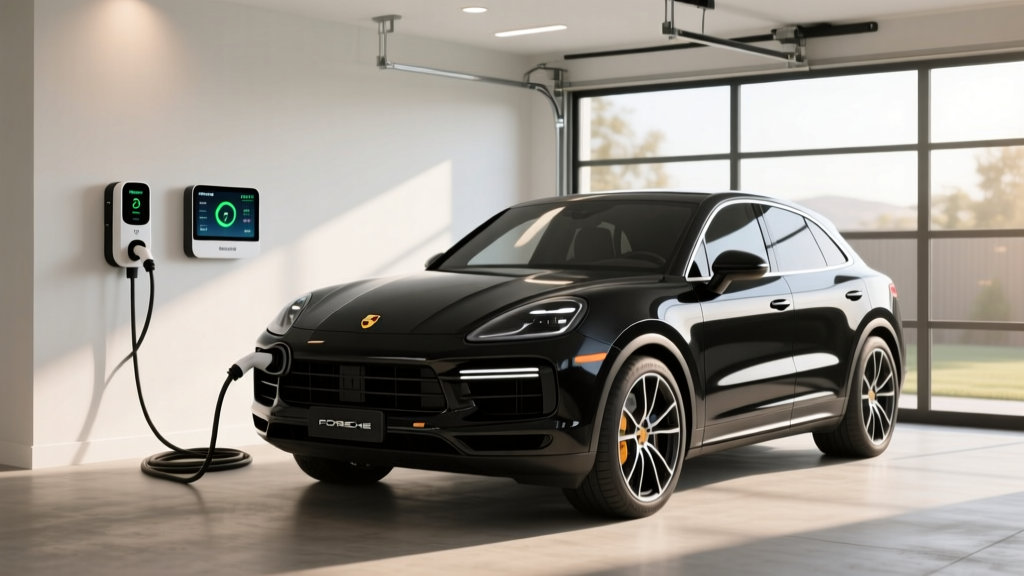
The all-electric Porsche Cayenne (introduced for the 2025 model year on the PPE platform shared with the Audi Q6 e-tron) represents a major shift for Porsche's best-selling SUV. With a usable battery capacity of approximately 94.4 kWh and an EPA-estimated range hovering around 300 miles for the base model, owners need a serious home charging strategy to make the most of that range day in and day out. This guide breaks down exactly what you need to charge a Cayenne Electric efficiently at home, what it costs, and how to avoid the most common installation pitfalls.
Understanding Charging Levels: What Each Delivers to Your Cayenne
Before selecting equipment, you need to understand the three charging levels and how each translates to actual miles added to your Cayenne Electric's battery. The distinction between kW (kilowatts — the rate of power delivery) and kWh (kilowatt-hours — the energy stored in your battery) is fundamental. Think of kW as the speed of water flowing through a hose and kWh as the size of the bucket you're filling.
| Level | Power (kW) | Miles of Range Per Hour | 0–100% Full Charge Time | Best For |
|---|---|---|---|---|
| Level 1 (120V household outlet) | 1.4–1.9 kW | 3–5 miles/hr | 50–65 hours | Emergency/trickle only |
| Level 2 (240V dedicated circuit) | 7.2–19.2 kW | 18–55 miles/hr | 5–13 hours | Daily home charging |
| DC Fast Charging | 50–270 kW | 120–500+ miles/hr | 10–80% in ~21 min | Road trips, quick top-ups |
The Porsche Cayenne Electric supports up to 270 kW DC fast charging on its 800-volt PPE architecture, meaning a 10–80% charge in roughly 21 minutes at a compatible high-power station. For Level 2 home charging, the Cayenne's onboard charger accepts up to 11 kW (with an optional 22 kW onboard charger available). A standard 48-amp Level 2 home charger delivering 11.5 kW will add approximately 30–33 miles of range per hour — enough to fully replenish the battery overnight.
Home Charger Installation: Electrical Requirements and True Costs
Installing a Level 2 home charger for a large-battery vehicle like the Cayenne Electric is not a simple plug-and-play affair. The electrical demands are substantial, and costs vary dramatically depending on your home's existing electrical panel capacity.
Electrical Panel and Circuit Requirements
For a 48-amp continuous-draw Level 2 charger (the sweet spot for the Cayenne), the National Electrical Code (NEC) requires a dedicated 60-amp circuit breaker (continuous loads must be derated to 80% of breaker capacity). This means:
- Minimum panel capacity: 200-amp electrical service is strongly recommended. Many older homes with 100-amp panels will need a panel upgrade before adding a 60-amp EV circuit.
- Wiring: 6 AWG copper wire (or 4 AWG aluminum) run from the panel to the charger location, typically in conduit.
- Circuit headroom: Your electrician will perform a load calculation to ensure adding 60 amps doesn't exceed 80% of your panel's total capacity.
Installation Cost Breakdown
| Component | Low Estimate | High Estimate | Notes |
|---|---|---|---|
| Level 2 Charger (48A, hardwired) | $500 | $800 | Smart WiFi-enabled models |
| Electrician labor (standard install) | $600 | $1,500 | Depends on run length & wall type |
| Materials (wire, conduit, breaker) | $150 | $400 | 6 AWG copper, PVC/EMT conduit |
| Permit & inspection | $50 | $300 | Varies by municipality |
| Panel upgrade (if needed) | $2,000 | $4,500 | 100A → 200A service upgrade |
| Total (no panel upgrade) | $1,300 | $3,000 | Most modern homes |
| Total (with panel upgrade) | $3,300 | $7,500 | Older homes with 100A service |
The federal government and many utilities offer incentives that can offset these costs. Check IRS.gov for the current Alternative Fuel Vehicle Refueling Property Credit (up to $1,000 for home charger installation in eligible census tracts) and consult your local utility for rebates on equipment and off-peak rate plans.
Connector Compatibility: NACS, CCS, and the Porsche Ecosystem
The Porsche Cayenne Electric launched with the CCS1 (Combined Charging System) connector for DC fast charging and a J1772 inlet for Level 2 AC charging. However, the industry is rapidly transitioning to the NACS (North American Charging Standard) — Tesla's connector — which most major automakers have adopted for future models.
| Connector Type | Native Support? | Adapter Needed? | Notes |
|---|---|---|---|
| J1772 (Level 2 AC) | Yes — native | No | Standard for home and public Level 2 |
| CCS1 (DC Fast) | Yes — native | No | Electrify America, EVgo, ChargePoint DC |
| NACS / Tesla Supercharger | No — adapter required | Yes (~$200–$250) | CCS-to-NACS adapter needed for Supercharger access |
| CHAdeMO | No | Not available | Legacy standard; no adapter exists |
For home Level 2 charging, any J1772 connector charger will work natively. If you plan to use Tesla Superchargers on road trips, invest in a CCS-to-NACS adapter from a reputable manufacturer. Porsche has indicated future models may ship with NACS natively, but the current Cayenne Electric relies on CCS1.
Charging Cost Per Mile: Home vs. Public vs. Gas Comparison
One of the most compelling ownership arguments for the Cayenne Electric is fuel cost savings — but only if you charge smartly. Let's break down real costs per mile using the Cayenne's efficiency rating of approximately 3.0 miles per kWh (roughly 112 MPGe combined).
| Charging/Fueling Scenario | Rate | Cost Per Mile | Annual Cost (12,000 mi) |
|---|---|---|---|
| Home Level 2 (off-peak utility rate) | $0.09/kWh | $0.030/mi | $360 |
| Home Level 2 (standard residential rate) | $0.16/kWh | $0.053/mi | $640 |
| Public Level 2 (network pricing) | $0.30/kWh | $0.100/mi | $1,200 |
| DC Fast Charging (public) | $0.45/kWh | $0.150/mi | $1,800 |
| Gas Cayenne (premium, 20 MPG combined) | $4.20/gallon | $0.210/mi | $2,520 |
Home charging on an off-peak rate plan delivers roughly a 7× cost advantage over gasoline. Even at standard residential rates, the electric Cayenne costs about one-quarter of the gas version to fuel annually. The savings widen further if your utility offers time-of-use (TOU) rates with cheap overnight electricity.
However, relying heavily on DC fast charging erodes most of that advantage. This is why a proper home Level 2 setup isn't optional for Cayenne Electric owners — it's the economic foundation of EV ownership.
Best Home Chargers for the Porsche Cayenne Electric
Given the Cayenne's 94.4 kWh battery and 11 kW (standard) or 22 kW (optional) onboard charger, here are the top Level 2 home charging units we recommend, each selected for reliability, smart features, and appropriate power delivery.
ChargePoint Home Flex
- Power: Up to 11.5 kW (48A) at 240V
- Connector: J1772 (25-foot cable)
- Smart features: WiFi scheduling, Alexa integration, energy tracking, amperage adjustable (16A–48A)
- Price: ~$650
- Best for: Flexible install on various circuit sizes; strong app ecosystem
Tesla Wall Connector (with J1772 adapter)
- Power: Up to 11.5 kW (48A) at 240V
- Connector: NACS native — requires CCS-to-J1772 adapter (~$50) for Cayenne
- Smart features: WiFi firmware updates, load sharing with multiple units, 24-foot cable
- Price: ~$475 (charger) + ~$50 (adapter)
- Best for: Multi-EV households with both Tesla and CCS vehicles
Emporia Level 2 EV Charger
- Power: Up to 11.5 kW (48A) at 240V
- Connector: J1772 (24-foot cable)
- Smart features: Integrated energy monitoring, solar integration, TOU scheduling, load management
- Price: ~$400
- Best for: Budget-conscious buyers wanting detailed energy data and solar pairing
Porsche Mobile Charger Connect
- Power: Up to 9.6 kW (40A) at 240V; up to 11 kW with industrial outlet
- Connector: J1772 (included, ~20-foot cable)
- Smart features: Porsche-native app integration, touchscreen display, home energy management
- Price: ~$760 (often included with vehicle purchase)
- Best for: Owners wanting Porsche-integrated experience and warranty support
For the Cayenne Electric specifically, the ChargePoint Home Flex at 48 amps is our top pick for most owners. It matches the Cayenne's 11 kW onboard charger capability, offers a long 25-foot cable for garage flexibility, and its adjustable amperage means you can dial it down if your panel can't support a full 60-amp circuit.
Safety, Code Compliance, and Installation Best Practices
Level 2 EV charging draws sustained high current for hours — far longer than most household appliances. Proper installation is non-negotiable for safety and insurance compliance.
- Dedicated circuit: Your EV charger must have its own dedicated breaker. Never share a circuit with other appliances.
- GFCI protection: The 2020 NEC update requires GFCI (Ground Fault Circuit Interrupter) protection for EV charging outlets. Hardwired installations may be exempt depending on local code interpretation — discuss with your electrician.
- Outdoor rating: If installing outdoors, ensure the charger is NEMA 4 rated (weatherproof). Indoor garage installations have no such requirement but should still be in a dry, ventilated location.
- Permitting: Most jurisdictions require an electrical permit for a new 240V circuit. Skipping this can void homeowner's insurance coverage for electrical fires. Budget $50–$300 for the permit and expect a post-install inspection.
- Load management: If your panel is near capacity, consider a smart charger with built-in load management (like the Emporia) that dynamically adjusts charging current to avoid tripping the main breaker.
Frequently Asked Questions
How much does it cost to install a home EV charger for the Porsche Cayenne Electric?
For a typical modern home with a 200-amp panel, expect $1,300 to $3,000 total (equipment + electrician + permit). Older homes needing a panel upgrade should budget $3,300 to $7,500. Always get 2–3 quotes from licensed electricians.
How fast will a Level 2 charger add range to my Cayenne Electric?
A 48-amp Level 2 charger delivering ~11.5 kW adds approximately 30–33 miles of range per hour. A full 0–100% charge takes roughly 8–9 hours — perfect for overnight replenishment. A 10–80% charge takes about 6 hours on Level 2.
Which connector and charger is compatible with the Porsche Cayenne Electric?
The Cayenne Electric uses a J1772 inlet for Level 2 AC charging and CCS1 for DC fast charging. Any J1772 home charger works natively. For Tesla Supercharger access, you'll need a CCS-to-NACS adapter (approximately $200–$250).
How much does charging cost per mile compared to gas?
Home charging on off-peak rates costs approximately $0.03 per mile — about 7× cheaper than the gas Cayenne at $0.21 per mile (assuming $4.20/gallon premium and 20 MPG combined). Standard residential rates bring the EV cost to ~$0.05/mile, still a 4× advantage.
What electrical upgrades might I need before installing a charger?
The most common upgrade is a panel replacement from 100-amp to 200-amp service ($2,000–$4,500). You may also need a new 60-amp double-pole breaker, 6 AWG wiring run, and possibly a sub-panel if the charger is far from the main panel. Your electrician's load calculation will determine exact requirements.
Can I use a NACS/Tesla charger with my CCS-equipped Cayenne?
Yes, with an adapter. CCS-to-NACS adapters are available from several manufacturers for $200–$250 and allow you to use Tesla Superchargers (where Tesla has opened access to non-Tesla vehicles). For home charging, using a J1772-native charger avoids the adapter hassle entirely.
Will frequent DC fast charging degrade my Cayenne's battery?
The Cayenne's PPE platform includes advanced thermal management that mitigates DC fast charging degradation. However, for long-term battery health (measured in State of Health, or SoH), prioritize Level 2 home charging for daily use and reserve DC fast charging for road trips. Porsche's battery warranty covers 8 years/100,000 miles with a minimum 70% capacity retention threshold. According to fueleconomy.gov, proper charging habits help maintain efficiency ratings over the vehicle's life.
For the latest details on the Cayenne Electric's specifications and available federal incentives, consult Porsche's official Cayenne Electric page and the IRS Clean Vehicle Credit guidelines. Your actual tax credit eligibility depends on MSRP caps, buyer income limits, and battery component sourcing requirements that change annually.