Why an EV Conversion Changes Everything About Charging
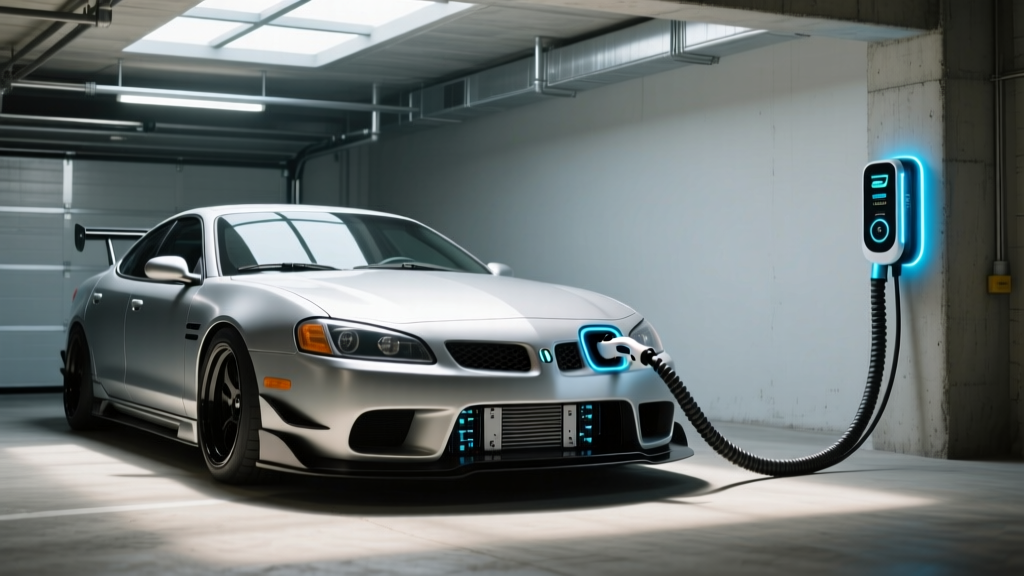
The 2001 Pontiac Grand Prix GTP Supercharged was a 240-horsepower, 3.8L V6 muscle sedan that delivered 19 MPG combined and a visceral supercharger whine. Today, a growing community of DIY builders is pulling that L67 engine and replacing it with an electric powertrain — typically a salvaged Tesla drive unit or a NetGain Hyper9 motor paired with a 40–60 kWh battery pack. The result is a 2,000-pound torque monster that costs pennies per mile to operate.
But once you've finished the conversion, you face a question most EV buyers never have to ask: how do I charge a car that was never designed to be electric? There's no factory charge port, no onboard charger spec sheet, and no dealer to call. This guide breaks down exactly what you need to charge a converted 2001 Grand Prix GTP — from Level 1 trickle charging to DC fast-charge capability — with real costs, real equipment, and the electrical upgrades your 25-year-old garage wiring almost certainly needs.
Charging Levels Explained: What Each Adds to Your Converted GTP
Understanding the three charging levels is non-negotiable. The distinction between kW (power — the rate of energy flow, like water pressure) and kWh (energy — the total amount stored, like gallons in a tank) is the single most common point of confusion. Your conversion's battery capacity is measured in kWh; your charger's output is measured in kW.
| Level | Voltage / Amps | Power (kW) | Miles Added/Hour | 0–80% Time (50 kWh pack) |
|---|---|---|---|---|
| Level 1 (Standard Outlet) | 120V / 12A | 1.4 kW | 3–5 mi/hr | ~28–30 hours |
| Level 2 (Home/Public) | 240V / 32–48A | 7.7–11.5 kW | 22–38 mi/hr | ~4–6 hours |
| DC Fast Charging | 400–800V DC | 50–250 kW | 150–600+ mi/hr | ~25–45 min (if equipped) |
For a daily-driver conversion with a 50 kWh pack and ~120 miles of range, Level 2 is the practical minimum. Level 1 will technically work for overnight top-ups if you drive fewer than 30 miles daily, but it's painfully slow for replenishing a depleted pack. DC fast charging on a home-built conversion is possible but requires specific hardware — we'll cover that below.
Home Charger Installation: Costs, Electrical Requirements, and Panel Gotchas
Your 2001 Grand Prix GTP spent two decades in a garage wired for incandescent bulbs and a garage door opener. Adding a 40-amp continuous EV load is a serious electrical event. Here's what you're actually looking at.
Electrical Requirements
A Level 2 home charger typically requires a 240V dedicated circuit on a double-pole breaker. The most common configurations:
- NEMA 14-50 outlet (50A breaker, 40A continuous draw) — the most versatile option, allows charger portability
- Hardwired connection (60A breaker, 48A continuous) — higher power, no plug to loosen, often required by code for circuits above 50A
- NEMA 6-20 outlet (20A breaker, 16A continuous) — budget option for lower-power Level 2 chargers
The National Electrical Code (NEC) requires that continuous loads (anything running 3+ hours, which includes EV charging) use only 80% of the breaker's rated capacity. A 50A breaker gives you 40A continuous (9.6 kW at 240V). A 60A breaker gives you 48A continuous (11.5 kW).
Panel Upgrade Reality
Homes built in the 1970s–2000s (which covers most GTP-era garages) commonly have 100A or 150A main service panels. Adding a 40–48A EV circuit may push your panel past its safe capacity, especially if you already run electric heat, a dryer, and an electric range. A licensed electrician will perform a NEC Article 220 load calculation to determine if your panel can handle the additional load.
If you need a panel upgrade to 200A service, expect to pay $1,500–$3,500 for the upgrade alone, on top of the charger circuit installation. This is the single biggest surprise cost in home EV charging — and it's especially common in the older homes where a project car like a Grand Prix GTP typically lives.
| Component | Simple Install (panel has capacity, short run) | Complex Install (panel upgrade, long conduit run) |
|---|---|---|
| Level 2 Charger (Equipment) | $350–$700 | $350–$700 |
| Electrical Permit | $50–$200 | $50–$200 |
| Electrician Labor (circuit + outlet/hardwire) | $400–$800 | $800–$1,500 |
| Panel Upgrade (if needed) | $0 | $1,500–$3,500 |
| Conduit / Wiring Materials | $100–$250 | $250–$600 |
| Total Estimated Cost | $900–$1,950 | $2,950–$6,500 |
Permits and Inspections
Nearly every jurisdiction requires an electrical permit for a new 240V circuit. The permit ensures a city or county inspector verifies the work meets NEC code — specifically proper wire gauge (typically 6 AWG copper for 50A circuits), correct breaker sizing, GFCI protection where required, and proper grounding. Skipping the permit risks fire, voided homeowner's insurance, and code violations that surface when you sell the house.
Connector Compatibility: What Works on a Conversion?
This is where EV conversions diverge sharply from production vehicles. A factory-built EV comes with a standardized charge port. Your converted Grand Prix GTP's charge port is whatever you decide to install. Here are your options as of 2026.
| Connector | Type | Standard On | Conversion Notes |
|---|---|---|---|
| J1772 | AC Level 1/2 | All non-Tesla EVs (pre-2025) | Most common choice for conversions; widely available inlet assemblies |
| NACS (Tesla) | AC + DC | Tesla vehicles; most 2025+ new EVs | Growing standard; NACS inlet kits available for conversions via EV supply vendors |
| CCS1 | AC + DC Fast | Most non-Tesla EVs (pre-2025) | Required if you want DC fast charging; more complex inlet and wiring |
| CHAdeMO | DC Fast | Nissan Leaf, Mitsubishi (legacy) | Declining standard; only relevant if using salvaged Leaf charging hardware |
The practical recommendation: Install a J1772 inlet for AC Level 2 charging (simplest, most compatible with public Level 2 stations and home chargers) and add a NACS adapter if you want Tesla Supercharger access. For DC fast charging capability, you'll need a CCS1 inlet paired with a compatible onboard charge controller — this is an advanced conversion build and adds $1,500–$3,000 in components.
If your conversion uses a salvaged Tesla drive unit and Tesla battery pack with its original BMS and charge controller, you may be able to retain the native NACS port. Consult your conversion's specific hardware documentation.
Charging Cost: Per-Mile Breakdown vs. the Original Supercharged V6
The original 2001 Grand Prix GTP Supercharged returned roughly 17 city / 26 highway / 20 combined MPG per EPA records on fueleconomy.gov. Let's compare what you'd spend per mile on electricity versus the gasoline that supercharged V6 would have consumed.
| Scenario | Rate | Cost Per Mile (50 kWh pack, 120 mi range) |
|---|---|---|
| Home Charging (off-peak utility rate) | $0.08/kWh | $0.033/mile |
| Home Charging (average US rate) | $0.16/kWh | $0.067/mile |
| Public Level 2 (network pricing) | $0.30/kWh | $0.125/mile |
| DC Fast Charging (public) | $0.45/kWh | $0.188/mile |
| Gasoline (original GTP, 20 MPG, $3.40/gal) | $3.40/gallon | $0.170/mile |
| Gasoline (original GTP, 20 MPG, $4.50/gal) | $4.50/gallon | $0.225/mile |
At average US residential electricity rates, your converted GTP will cost roughly $0.05–$0.07 per mile to fuel at home — about one-third the cost of gasoline at current prices. Even at public DC fast-charging rates, the EV conversion is competitive with or cheaper than gasoline. Over 12,000 miles annually, home charging saves approximately $1,200–$1,800 per year compared to the original gas powertrain.
Efficiency note: a well-executed conversion using a modern motor and controller typically achieves 3.0–4.0 miles per kWh in mixed driving. Heavy-footed driving (tempting with instant electric torque in a 3,500-lb sedan) will push that toward 2.5 mi/kWh. Cold weather reduces range by 15–30% due to battery chemistry limitations and cabin heating load.
Equipment Picks: Home Chargers for Your Converted GTP
Your charger choice depends on your conversion's onboard charger capacity. Most DIY conversions use an aftermarket onboard charger (Elcon, TC Charger, or Delta-Q) rated at 3.3 kW or 6.6 kW. Some Tesla-sourced conversions retain the 11.5 kW onboard charger. Match your EVSE (Electric Vehicle Supply Equipment) to your onboard charger's maximum acceptance rate.
Emporia Vue Level 2 Charger
- Power Output: 48A / 11.5 kW (hardwired) or 40A / 9.6 kW (NEMA 14-50)
- Connector: J1772 (NACS adapter available)
- Cable Length: 24 feet
- Smart Features: Wi-Fi, app-based scheduling, energy monitoring, solar integration
- Price: ~$399 (hardwired) / ~$399 (plug-in)
- Best For: Conversions with 6.6 kW+ onboard chargers; budget-conscious builders
ChargePoint Home Flex
- Power Output: Up to 50A / 12 kW (configurable via DIP switches for panel-limited homes)
- Connector: J1772 (NACS version available)
- Cable Length: 23 feet
- Smart Features: Wi-Fi, app scheduling, Alexa integration, amperage adjustment
- Price: ~$649
- Best For: Flexible installations where panel capacity is borderline; adjustable amperage avoids panel upgrade
Grizzl-E Smart
- Power Output: 40A / 9.6 kW
- Connector: J1772
- Cable Length: 24 feet
- Smart Features: Wi-Fi, OCPP protocol, load sharing, extreme-weather rated (-40°F)
- Price: ~$499
- Best For: Unheated garages and cold-climate conversions; rugged, no-nonsense build quality
Tesla Wall Connector
- Power Output: 48A / 11.5 kW (hardwired)
- Connector: NACS native (J1772 adapter included for non-Tesla vehicles)
- Cable Length: 24 feet
- Smart Features: Wi-Fi, power sharing (multiple units on one circuit), OTA updates
- Price: ~$450
- Best For: Tesla-sourced conversions with native NACS port; excellent value at 48A
If your conversion's onboard charger maxes out at 3.3 kW (common with Elcon PFC chargers), a 40A or 48A EVSE won't charge any faster — the bottleneck is in the car, not the charger. In that case, a simpler 32A / 7.7 kW unit like the Emporia or a basic Lectron saves money without sacrificing charge speed.
Safety, Code, and the Real-World Setup
EV conversions don't come with a compliance sticker from an automaker. That makes your installation's safety entirely dependent on correct execution. Here are the critical code and safety requirements:
- Dedicated circuit: Your Level 2 charger must be on its own dedicated breaker — no sharing with the dryer, water heater, or workshop outlets.
- GFCI protection: NEC 2020 and later require GFCI protection for all EVSE outlets (NEMA 14-50, etc.) in garages. Hardwired units are exempt in some jurisdictions but check local amendments.
- Outdoor rating: If your charge port or EVSE is mounted outside (common for driveway-parked project cars), the unit must carry a NEMA 4 (watertight) rating. All recommended chargers above meet this standard.
- Wire gauge: 6 AWG copper THHN for 50A circuits; 4 AWG for 60A. Undersized wire is a fire hazard and will fail inspection.
- Strain relief and cable management: Conversions often have custom charge port locations (sometimes in the original grille or fuel door). Ensure the inlet is properly sealed, strain-relieved, and that the charge cable doesn't drag on the ground or kink at sharp angles.
- BMS integration: Your conversion's Battery Management System must communicate with the onboard charger to terminate charging at the correct State of Charge (SoC). Never bypass BMS cutoffs to "squeeze in more range" — lithium battery overcharge is a fire risk.
Charging Time Examples: What to Expect With Common Conversion Setups
Charge times depend on two factors: your battery pack's usable capacity (kWh) and your onboard charger's acceptance rate (kW). The formula is straightforward:
Charge time (hours) = Usable kWh needed ÷ Charger kW output
Real-world examples for a 10%–80% charge (the standard daily-use window to preserve battery longevity):
- 50 kWh pack, 3.3 kW onboard charger: ~10.6 hours — overnight only, full nights needed for deep charges
- 50 kWh pack, 6.6 kW onboard charger: ~5.3 hours — comfortably replenishes during a workday or overnight
- 50 kWh pack, 11.5 kW onboard charger: ~3 hours — fast enough for quick turnaround between errands
- 50 kWh pack, DC fast charge at 50 kW (CCS equipped): ~35–45 minutes to 80% — viable for road trips, if your conversion supports it
Important charging-curve note: charging slows significantly above 80% State of Charge to protect battery cells. A 10–80% charge is much faster than 10–100%. For daily driving, set your BMS or charge controller to stop at 80–90% SoC unless you need full range for a longer trip.
Frequently Asked Questions
How much does it cost to install a home EV charger for a conversion?
For a straightforward installation with adequate panel capacity, expect $900–$1,950 total (equipment + electrician + permit). If your home needs a 200A panel upgrade, costs rise to $2,950–$6,500. Always get a load calculation from a licensed electrician before committing to a charger — the panel question determines your real budget.
How fast will each charging level add range to my converted Grand Prix?
Level 1 (120V) adds roughly 3–5 miles per hour — fine for a 20-mile commute top-up. Level 2 (240V) adds 22–38 miles per hour depending on your onboard charger's kW rating. DC fast charging can add 150+ miles in 30 minutes, but requires CCS1 hardware and is uncommon in DIY conversions.
Which connector should I install on my EV conversion?
A J1772 inlet is the safest, most compatible choice for AC Level 2 charging in 2026. It works with virtually every public Level 2 station and home charger. If your conversion uses Tesla hardware, a NACS inlet may be more practical. For DC fast charging, you'll need a CCS1 inlet — a more complex and expensive integration.
How much does charging cost per mile vs. the original supercharged V6?
Home charging at average US rates ($0.16/kWh) costs roughly $0.05–$0.07 per mile, compared to $0.17–$0.23 per mile for the original 20 MPG gas engine at $3.40–$4.50/gallon. Annual savings for a 12,000-mile driver: approximately $1,200–$1,800.
What electrical upgrades might I need for a Level 2 charger?
Homes with 100A or 150A service panels may need a panel upgrade to 200A ($1,500–$3,500) to safely add a 40–48A EV circuit. You'll also need a dedicated double-pole breaker, properly sized wire (6 AWG for 50A), and a NEMA 14-50 outlet or hardwired connection. A licensed electrician's load calculation is the definitive answer for your specific home.
Can I use a Tesla Supercharger with my EV conversion?
Only if your conversion has a NACS charge port AND a compatible communication protocol. Tesla's Supercharger network uses a proprietary handshake for non-Tesla vehicles through their Magic Dock adapter at select stations. Most DIY conversions with J1772 ports cannot access Superchargers without a compatible adapter and protocol bridge — check with your conversion hardware vendor.
Is a federal tax credit available for my home charger installation?
The IRS §30C Alternative Fuel Vehicle Refueling Property Credit covers up to 30% of home charger equipment and installation costs, capped at $1,000. However, eligibility depends on your census tract meeting specific low-income or non-urban criteria. Consult a tax professional and the IRS guidelines for your specific address.