Polestar 2 Long Range Dual Motor: Charging Specs at a Glance
The 2026 Polestar 2 Long Range Dual Motor packs an 82 kWh usable battery (NMC chemistry), 421 horsepower, and a 0-60 mph time of 4.3 seconds. Its EPA-estimated range sits at 276 miles, though real-world highway driving at 70+ mph typically yields 235-250 miles, and cold-weather conditions can shave another 15-20% off that figure. The car's EPA efficiency is 100 MPGe combined (34 kWh/100mi).
On the charging side, the Long Range Dual Motor supports up to 200 kW peak DC fast charging and accepts 11 kW on Level 2 AC. Understanding these numbers — and what they mean for your daily routine and road trips — is the foundation of a frustration-free ownership experience.
| Battery (usable) | 82 kWh, NMC |
| EPA Range | 276 miles |
| Efficiency | 100 MPGe (34 kWh/100mi) |
| Max DC Fast Charge | 200 kW peak |
| 10-80% DC Fast Charge | ~28 minutes (peak conditions) |
| Level 2 AC Charge Rate | 11 kW (48A at 240V) |
| 0-100% Level 2 Time | ~8 hours |
| Native Connector | CCS1 (NACS adapter available) |
| Battery Warranty | 8 years / 100,000 miles (70% capacity retention) |
Understanding Charging Levels: kW, kWh, and Miles Per Hour
Before plugging in, the single most important distinction to internalize: kW (kilowatts) is power — how fast energy flows into the car. kWh (kilowatt-hours) is energy — how much the battery stores. The Polestar 2 Long Range Dual Motor's 82 kWh battery is the tank size; the kW rating of your charger determines how quickly that tank fills.
Here's how each charging level translates to real-world range recovery for the Polestar 2, calculated at its 34 kWh/100mi efficiency (2.94 miles per kWh):
| Level | Voltage / Amperage | Max Power (kW) | Miles of Range Per Hour | Use Case |
|---|---|---|---|---|
| Level 1 | 120V / 12A | 1.4 kW | ~4 mi/hr | Emergency / overnight trickle |
| Level 2 (32A) | 240V / 32A | 7.7 kW | ~22 mi/hr | Home (smaller circuit) |
| Level 2 (48A) | 240V / 48A | 11.5 kW | ~33 mi/hr | Home (optimal for Polestar 2) |
| DC Fast (50 kW) | DC / variable | 50 kW | ~147 mi/hr | Older public stations |
| DC Fast (150 kW) | DC / variable | 150 kW (sustained) | ~280-440 mi/hr* | Common public fast chargers |
| DC Fast (200 kW peak) | DC / variable | 200 kW (peak) | ~588 mi/hr* | 350 kW stations (Polestar 2 capped at 200 kW) |
*Miles-per-hour at DC fast charging is not sustained — the charge curve tapers significantly above 80% State of Charge. Peak rates apply between roughly 10-50% SoC with a preconditioned battery.
DC Fast Charging the Polestar 2: Real Charge Curve and 10-80% Times
The Polestar 2 Long Range Dual Motor peaks at 200 kW on DC fast chargers, but peak is not sustained. Here's what the charge curve actually looks like in practice, based on real-world testing at 350 kW-capable stations with a preconditioned battery (battery warmed to optimal temperature via the car's navigation-routed preconditioning):
- 10-20% SoC: Ramps to ~175-200 kW — this is the sweet spot
- 20-50% SoC: Sustains roughly 140-160 kW
- 50-70% SoC: Tapers to ~100-120 kW
- 70-80% SoC: Drops to ~70-80 kW
- 80-100% SoC: Slows dramatically to ~30-40 kW — avoid waiting for this on road trips
The result: a 10-80% session takes approximately 28-32 minutes under ideal conditions (warm battery, high-power station). In cold weather without adequate preconditioning, add 5-10 minutes as the battery management system limits charge rate to protect the cells.
Home Charger Installation: Electrical Requirements, Costs, and Gotchas
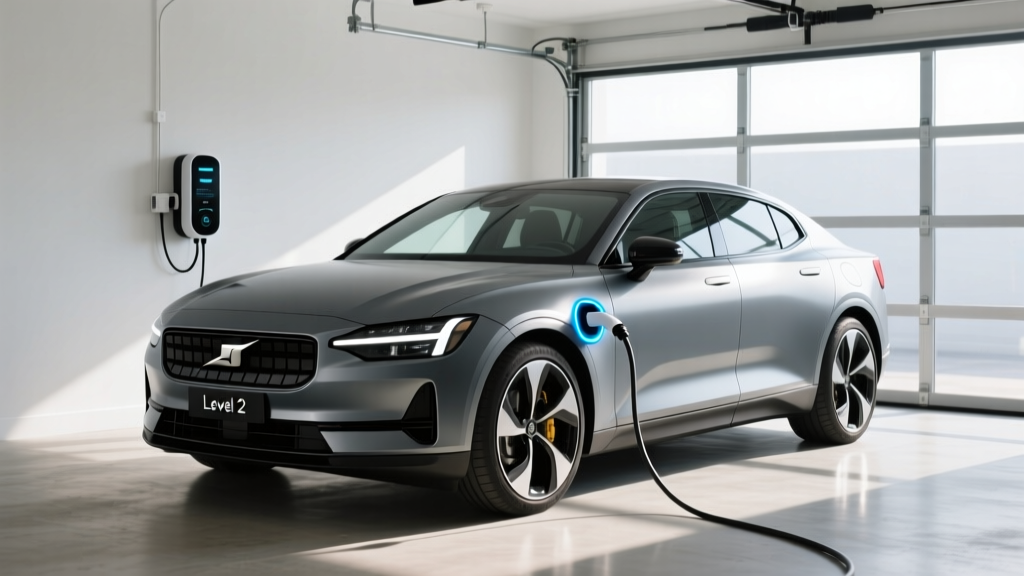
The Polestar 2's onboard charger accepts up to 11 kW on Level 2 AC, which requires a 240V circuit rated at 48 amps. Per the National Electrical Code (NEC), continuous loads like EV charging must use only 80% of a circuit's rated capacity, meaning you need a 60-amp dedicated circuit to deliver a full 48A to the car.
Here's what that installation involves and what it costs:
Electrical Requirements for Optimal Home Charging
- Circuit: 60A dedicated, 240V, 2-pole breaker
- Wire: 6 AWG copper (THHN in conduit or NM-B depending on run)
- Outlet option: NEMA 14-50 (50A receptacle — limits charge to 40A/9.6 kW) or hardwired (full 48A/11.5 kW)
- Panel capacity: Minimum 200A main service panel recommended; older 100A panels likely need an upgrade
- Permit: Required in virtually all jurisdictions; inspection included
How Much Does It Cost to Install a Home EV Charger?
| Component | Simple Install (near panel) | Complex Install (long run / upgrades) |
|---|---|---|
| Level 2 Charger (hardware) | $400 - $700 | $400 - $700 |
| Electrician labor (60A circuit) | $500 - $1,000 | $1,500 - $3,000 |
| Permit & inspection | $50 - $200 | $50 - $200 |
| Panel upgrade (if needed) | $0 (not needed) | $2,000 - $4,500 |
| Conduit/wire (long runs >50 ft) | $0 - $100 | $300 - $800 |
| TOTAL | $950 - $2,000 | $4,250 - $9,200 |
The wide range reflects a critical variable: your electrical panel. Homes built after 2000 typically have 200A service with spare breaker slots, making the install straightforward. Homes with 100A panels or full breaker boxes may need a panel upgrade or a load-management device that shares capacity between the charger and other appliances.
Safety and Code Considerations
- Dedicated circuit: The EV charger must have its own breaker — never share a circuit with other appliances
- GFCI protection: NEC 2020+ requires GFCI protection for outdoor receptacles; hardwired installations may not require a GFCI breaker (consult your local code and electrician)
- Outdoor rating: If mounting outdoors, the charger must carry a NEMA 4 or IP65 rating for weather resistance
- Hardwired vs. plug: Hardwired chargers avoid GFCI nuisance trips, allow full 48A, and eliminate the receptacle as a failure point — recommended for most Polestar 2 owners
Best Level 2 Home Chargers for the Polestar 2
Since the Polestar 2 can accept up to 11 kW (48A), you want a charger that delivers at least 48A to take full advantage. A 40A charger will work but caps you at 9.6 kW, adding roughly 2-3 hours to a full charge. Here are top picks that match the Polestar 2's capabilities:
ChargePoint Home Flex
- Power: Up to 12 kW / 50A (configurable 16-50A)
- Connector: CCS1 native (J1772 included)
- Cable: 23 feet
- Smart features: Wi-Fi, app scheduling, Alexa, energy tracking
- Install type: Hardwired or NEMA 14-50 plug
- Price: ~$550-$650
Best overall: Flexible amperage lets you match your circuit exactly.
Emporia Level 2 EV Charger
- Power: Up to 11.5 kW / 48A
- Connector: J1772 (CCS adapter included with Polestar)
- Cable: 24 feet
- Smart features: Wi-Fi, solar integration, real-time energy monitoring, load management
- Install type: Hardwired or NEMA 14-50
- Price: ~$400-$450
Best value: Excellent smart features at a lower price point.
Wallbox Pulsar Plus (48A)
- Power: Up to 11.5 kW / 48A
- Connector: J1772 (CCS compatible)
- Cable: 25 feet
- Smart features: Wi-Fi + Bluetooth, app control, Power Sharing for 2+ chargers
- Install type: Hardwired
- Price: ~$550-$600
Best for multi-EV households: Power Sharing lets two chargers share one circuit.
Connector Compatibility: CCS1, NACS, and the Tesla Supercharger Network
The 2026 Polestar 2 Long Range Dual Motor ships with a CCS1 (Combined Charging System) port natively. This is the standard used by Electrify America, EVgo, ChargePoint DC stations, and most non-Tesla public fast chargers in North America.
However, the industry-wide shift to NACS (North American Charging Standard) — the Tesla connector — means the Polestar 2 can access Tesla Superchargers using a manufacturer-provided or aftermarket CCS-to-NACS adapter. Polestar has confirmed Supercharger network access for its US models via adapter.
| Connector | Native on Polestar 2? | Networks Available | Adapter Needed? |
|---|---|---|---|
| CCS1 | ✅ Yes (native) | Electrify America, EVgo, ChargePoint, most non-Tesla DC | None |
| NACS (Tesla) | ❌ No | Tesla Supercharger network (17,000+ stalls in US) | CCS-to-NACS adapter (~$200-$250) |
| CHAdeMO | ❌ No | Legacy stations (declining availability) | Not available / not practical |
| J1772 (Level 2 AC) | ✅ Yes (via CCS inlet upper portion) | All public Level 2 stations, home chargers | None |
Our recommendation: Purchase a CCS-to-NACS adapter ($200-$250 from Polestar or a reputable third party like Lectron or A2Z). This unlocks the Tesla Supercharger network — the most reliable and widespread DC fast charging network in the US — giving you far more road-trip flexibility than CCS alone.
Charging Cost Per Mile: Home vs. Public vs. Gas
One of the strongest ownership arguments for the Polestar 2 Long Range Dual Motor is the fuel cost advantage. At 34 kWh/100mi, here's what charging actually costs across common scenarios, compared to a gas car averaging 28 MPG combined:
| Scenario | Rate | Cost Per Mile | Cost for 276 mi (full "tank") |
|---|---|---|---|
| Home (off-peak utility rate) | $0.12/kWh | $0.041 | $11.25 |
| Home (national avg. residential) | $0.17/kWh | $0.058 | $15.95 |
| Public Level 2 (ChargePoint, etc.) | $0.25-$0.39/kWh | $0.085-$0.133 | $23.46-$36.64 |
| DC Fast (Electrify America) | $0.48-$0.56/kWh | $0.163-$0.190 | $45.06-$52.54 |
| Tesla Supercharger (with adapter) | $0.30-$0.40/kWh | $0.102-$0.136 | $28.15-$37.54 |
| Gas car (28 MPG, $3.50/gal) | $3.50/gallon | $0.125 | $34.50 |
The takeaway: home charging is the economic sweet spot. At off-peak rates, the Polestar 2 costs roughly one-third per mile of a comparable gas car. Even at public DC fast charging rates, costs are competitive with gas — but exclusively relying on DC fast charging eliminates most of the financial advantage and accelerates battery wear.
For the full cost picture including insurance, maintenance, and depreciation, consult fueleconomy.gov's side-by-side comparison tool for the latest Polestar 2 efficiency data.
Tax Credits and Incentives for Home Charger Installation
The federal Alternative Fuel Vehicle Refueling Property Credit (IRC §30C) was reinstated and modified under the Inflation Reduction Act. For 2026, homeowners may be eligible for a 30% credit on home EV charger equipment and installation, up to $1,000, subject to income limits and census-tract eligibility requirements (the charger must be installed in a qualifying low-income or non-urban census tract).
Additionally, the Polestar 2 Long Range Dual Motor itself may qualify for the §30D new clean vehicle credit of up to $7,500, depending on:
- Buyer income caps ($150K single / $300K joint MAGI)
- Vehicle MSRP cap ($55,000 for sedans — verify current Polestar 2 pricing against this threshold)
- Battery critical-mineral and component sourcing requirements (which change annually)
- Point-of-sale transfer availability (applied at the dealer, reducing out-of-pocket)
Always verify current eligibility on IRS.gov's clean vehicle credits page and consult a tax professional — these rules change frequently and have specific documentation requirements.
Frequently Asked Questions
How much does it cost to install a home EV charger for the Polestar 2?
A straightforward installation with an adequate 200A panel runs $950-$2,000 (charger + electrician + permit). If your home needs a panel upgrade from 100A to 200A, total costs can reach $4,250-$9,200. Always get a licensed electrician's site assessment before purchasing equipment.
How fast will each charging level add range to my Polestar 2?
Level 1 (120V) adds roughly 4 miles per hour — impractical for daily use. Level 2 at 48A/240V adds about 33 miles per hour, fully recharging the 82 kWh battery in roughly 8 hours. DC fast charging at 150+ kW can add 150+ miles in 30 minutes, though the charge curve tapers above 80% SoC.
Which connector does the Polestar 2 use, and can I charge at Tesla Superchargers?
The Polestar 2 has a native CCS1 port. You can charge at Tesla Superchargers using a CCS-to-NACS adapter ($200-$250). All public Level 2 stations use J1772, which connects directly to the upper portion of the Polestar's CCS inlet.
How much does charging cost per mile compared to gas?
At home off-peak rates ($0.12/kWh), the Polestar 2 costs about $0.04 per mile — roughly one-third the cost of a 28 MPG gas car at $3.50/gallon. Even at average residential rates ($0.17/kWh), home charging costs $0.06/mile. Public DC fast charging ($0.48-$0.56/kWh) costs $0.16-$0.19/mile, which is more expensive than gas in some markets.
What electrical upgrades might I need for a 48A Level 2 charger?
You need a dedicated 60A, 240V circuit with 6 AWG wire. If your home has a 100A main panel, you will almost certainly need a panel upgrade to 200A ($2,000-$4,500). Homes with 200A panels generally have sufficient capacity, though a load calculation by a licensed electrician is required to confirm available headroom.
Should I charge my Polestar 2 to 100% every night?
No. NMC batteries (like the one in the Polestar 2 Long Range Dual Motor) last longest when kept between 20-80% State of Charge for daily use. Set the charge limit to 80-90% in the Polestar app for daily driving, and only charge to 100% when you need full range for a road trip. This practice significantly slows long-term degradation.
Does the Polestar 2 Long Range Dual Motor come with a charging cable?
Polestar includes a Level 1 (120V) portable charging cord. A Level 2 home charging station is not included and must be purchased separately. Check with your dealer — some regions include promotional charger credits or partnerships with ChargePoint or Wallbox.