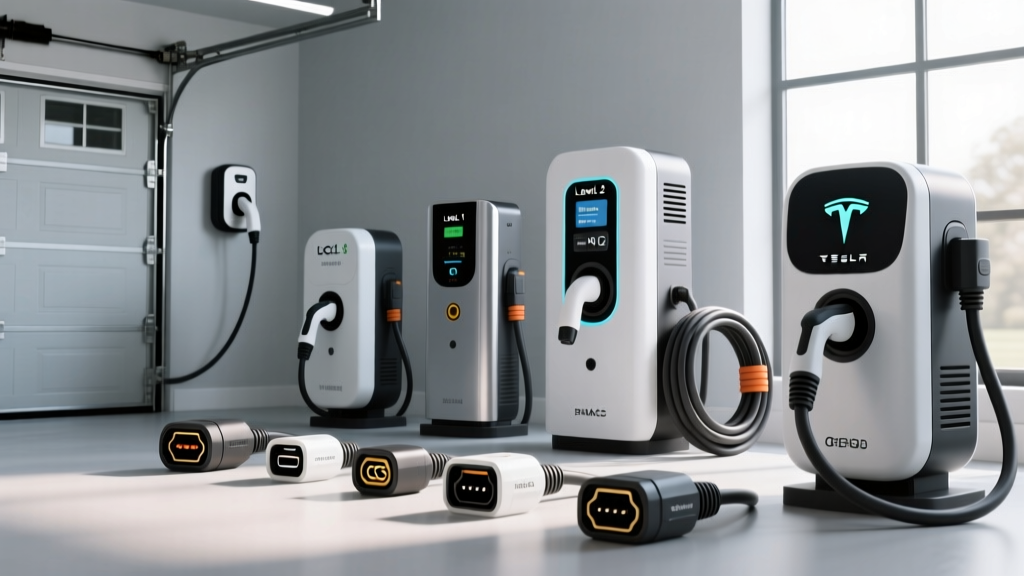
If you've been searching for pictures of the charger options available for electric vehicles, you've likely noticed how many shapes, sizes, and connectors exist. The hardware matters: a Level 1 cord, a wall-mounted Level 2 unit, and a DC fast-charging pedestal look nothing alike, and they charge your EV at vastly different speeds. This guide walks through what each charger actually looks like, what it does, how much it costs to install at home, and which connector fits your specific EV.
The Three EV Charging Levels Explained (With Real kW Numbers)
Before looking at pictures of the charger hardware, it helps to understand the three levels. The single most important distinction in EV charging: kW (kilowatts) measures power — how fast energy flows — while kWh (kilowatt-hours) measures energy — how much your battery holds. Think of kW as the width of a hose and kWh as the size of the bucket.
| Level | Voltage | Power (kW) | Miles of Range Added per Hour | Typical Equipment |
|---|---|---|---|---|
| Level 1 | 120V AC | 1.0–1.4 kW | 3–5 miles | Portable cord included with EV (plugs into standard household outlet) |
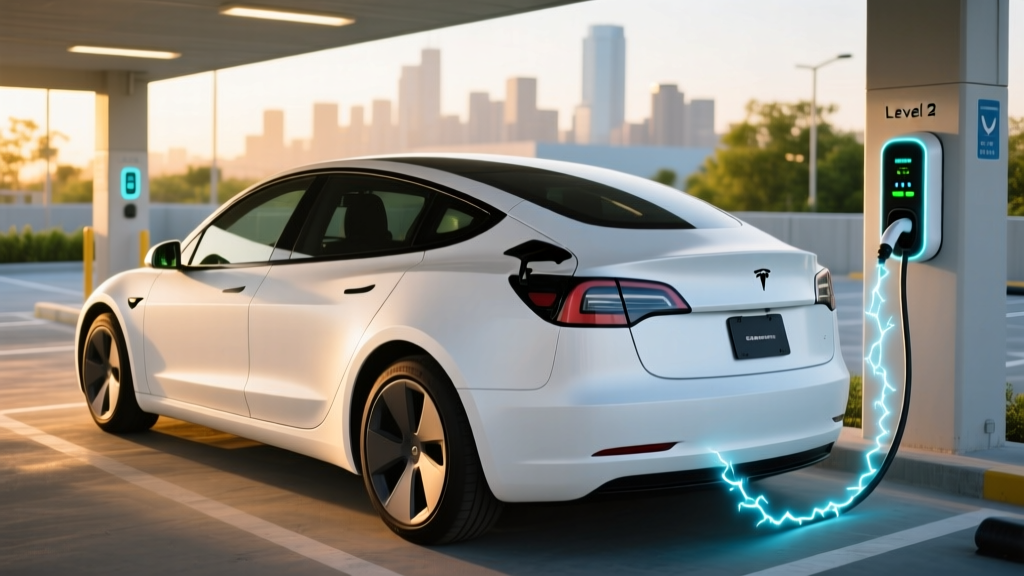
| Level 2 | 240V AC | 3.3–19.2 kW | 12–75 miles | Wall-mounted home unit or public pedestal (J1772 or NACS connector) |
| DC Fast | 400–900V DC | 50–350+ kW | 150–1,000+ miles (theoretical) | Large commercial cabinet with tethered cable (CCS1, NACS, or CHAdeMO) |
Real-world charging time examples: A 75 kWh battery (like the Ford Mustang Mach-E Extended Range) charging from 10–80% takes roughly 55 hours on Level 1, about 7–9 hours on a 9.6 kW Level 2 home charger, and approximately 20–30 minutes on a 150 kW DC fast charger (accounting for charge-curve taper above 80%).
A note on charge curves: DC fast chargers don't sustain their peak kW rate for the entire session. A station rated at 250 kW may only deliver that speed between 10–40% State of Charge (SoC), then taper to 100 kW or lower as the battery fills. This is why manufacturers quote "10–80%" times rather than "0–100%" times.
What Home EV Chargers Look Like (And What They Require Electrically)
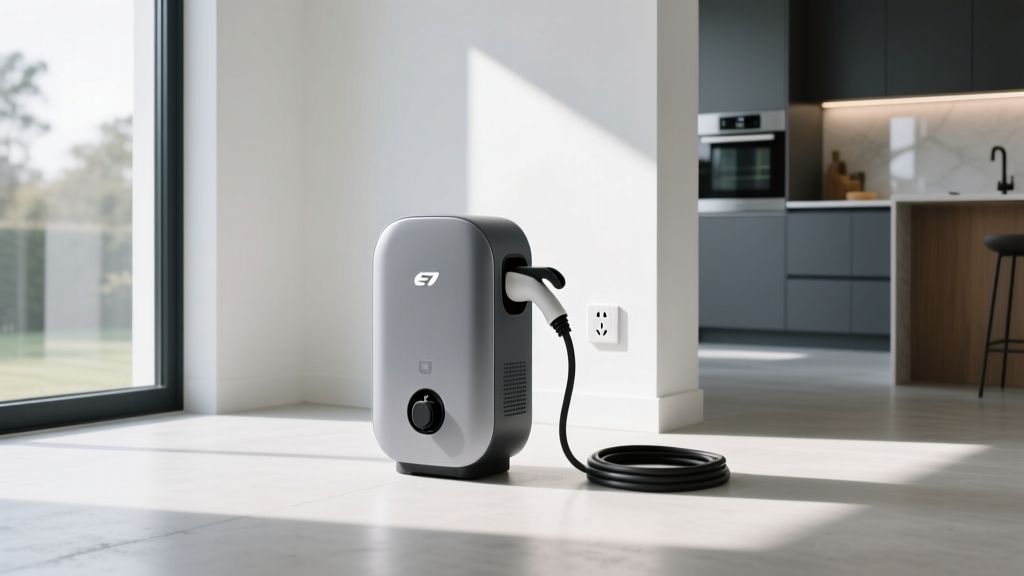
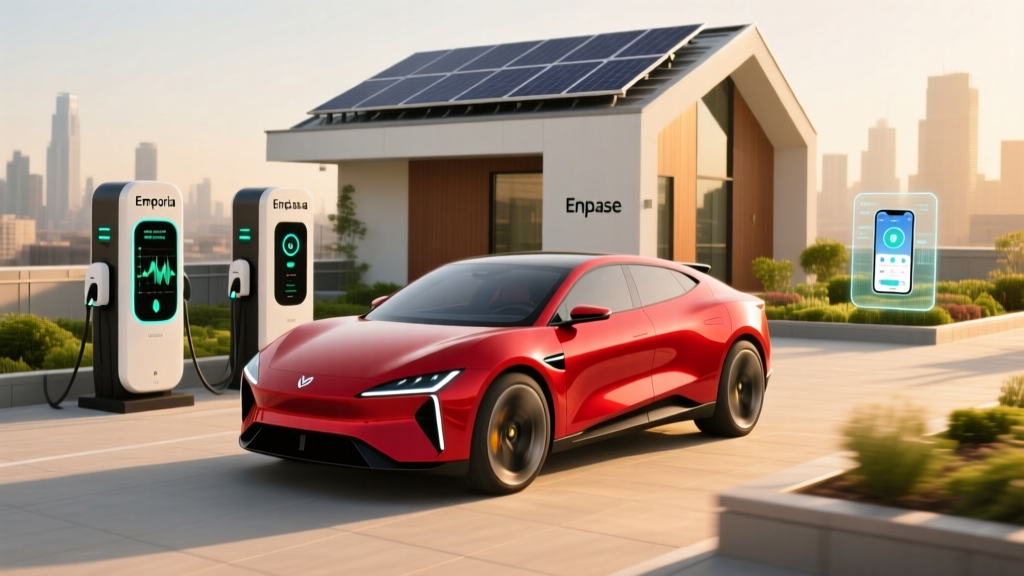
When you see pictures of the charger units designed for home installation, most look like a rectangular box — roughly the size of a large hardcover book — mounted to a garage wall or exterior post, with a coiled or straight cable (18–25 feet typical) ending in a J1772 or NACS plug. Some are sleek with touchscreens (ChargePoint Home Flex, Tesla Wall Connector); others are utilitarian bricks with just an LED indicator (Emporia Vue).
Electrical Requirements for Level 2 Home Charging
A Level 2 home charger requires a dedicated 240V circuit — the same voltage your electric dryer or oven uses. The most common configurations:
- 40-amp circuit → delivers up to 32 amps continuous (7.7 kW at 240V) — sufficient for most EVs overnight
- 50-amp circuit → delivers up to 40 amps continuous (9.6 kW) — the sweet spot for faster overnight charging
- 60-amp circuit → delivers up to 48 amps continuous (11.5 kW) — maximizes Level 2 speed for large-battery EVs
- 80-amp circuit → delivers up to 64 amps (15.3–19.2 kW) — requires hardwiring and robust panel capacity
Panel upgrade reality: Most homes built before 2000 have 100-amp or 150-amp main electrical panels. Adding a 50-amp EV circuit may push you close to your panel's capacity, especially if you already run electric heat, a dryer, and an oven. An electrician will perform a load calculation per NEC Article 220. If your panel is maxed, expect a panel upgrade to 200 amps, which adds $1,500–$3,500 to your project. Homes with modern 200-amp panels rarely need this.
Home Charger Installation Cost Breakdown
Installation costs vary enormously depending on your home's electrical setup, the distance from the panel to the charger location, and local permit fees. Here's what to budget based on typical 2026 pricing:
| Component | Simple Install (Same Wall as Panel) | Moderate Install (Across Garage/Basement) | Complex Install (Panel Upgrade + Long Run) |
|---|---|---|---|
| Charger Equipment | $200–$500 | $300–$700 | $300–$700 |
| Electrician Labor | $300–$600 | $600–$1,500 | $1,500–$3,000 |
| Permit & Inspection | $50–$150 | $50–$250 | $100–$350 |
| Panel Upgrade (if needed) | — | — | $1,500–$3,500 |
| Conduit & Materials | $50–$100 | $100–$400 | $200–$600 |
| Total Estimated Cost | $600–$1,350 | $1,050–$2,850 | $3,600–$8,150 |
Federal tax credit note: The IRS §30C Alternative Fuel Vehicle Refueling Property Credit covers 30% of home charging equipment and installation costs, up to $1,000. Eligibility depends on your census tract meeting certain income or rural criteria. Always confirm with a tax professional before claiming.
EV Connector Types: Which Plug Fits Your Car?
If you're looking at pictures of the charger connectors and wondering which one you need, the North American market in 2026 is consolidating around two standards, with a legacy third still in circulation:
| Connector | Description | Compatible EV Brands | Adapter Needed? |
|---|---|---|---|
| NACS (North American Charging Standard) | Compact, lightweight plug originally designed by Tesla. Now the dominant standard. | Tesla (all), Ford, GM, Rivian, Volvo, Polestar, Hyundai/Kia (2025+), BMW, Mercedes, Nissan (2026+) | CCS-to-NACS adapters available for legacy CCS vehicles charging at Tesla Superchargers |
| CCS1 (Combined Charging System) | Larger plug with two DC pins below the J1772 AC section. Phasing out on new vehicles. | Hyundai/Kia (pre-2025), VW ID.4 (pre-2026), older BMW i4/iX, legacy models | NACS-to-CCS adapters needed to access Tesla Supercharger network |
| CHAdeMO | Round DC connector, largely discontinued. Only on Nissan Leaf and Mitsubishi Outlander PHEV. | Nissan Leaf (all years), Mitsubishi Outlander PHEV (older) | No adapter available; CHAdeMO stations declining rapidly |
Practical advice: If you're buying a new EV in 2026, choose NACS if possible — it gives you native access to the Tesla Supercharger network, which has over 25,000 stalls in North America with far higher reliability than CCS-based networks. If you own a CCS-equipped EV, budget $150–$300 for a NACS adapter.
How Much Does EV Charging Cost Per Mile vs. Gas?
One of the strongest economic arguments for EVs is the per-mile energy cost, but it depends heavily on where and when you charge:
| Charging Scenario | Avg. $/kWh | Cost Per Mile (3.5 mi/kWh EV) | Annual Cost (12,000 mi) |
|---|---|---|---|
| Home, Off-Peak (Time-of-Use rate) | $0.08–$0.12 | $0.023–$0.034 | $275–$410 |
| Home, Standard Residential Rate | $0.14–$0.18 | $0.040–$0.051 | $480–$615 |
| Public Level 2 (ChargePoint, EVgo, etc.) | $0.25–$0.49 | $0.071–$0.140 | $855–$1,680 |
| DC Fast Charging (Electrify America, Tesla) | $0.30–$0.55 | $0.086–$0.157 | $1,030–$1,885 |
| Gasoline Vehicle (28 MPG avg, $3.40/gal) | $3.40/gal | $0.121 | $1,457 |
The takeaway: home charging on an off-peak rate saves 70–80% vs. gas. Relying exclusively on DC fast charging can cost more than gas in some markets. The economics only work if you can charge at home most nights. Data from fueleconomy.gov lets you compare specific EV efficiency (kWh/100mi or MPGe) against your local electricity rates.
Recommended Home EV Chargers (2026 Equipment Picks)
ChargePoint Home Flex (NACS or J1772)
- Power Output: Up to 12 kW (50A circuit) or 9.6 kW (40A circuit), adjustable via dip switches
- Connector: Available in NACS or J1772 versions
- Cable Length: 23 feet
- Smart Features: Wi-Fi connected, ChargePoint app scheduling, Alexa integration, energy-use tracking
- Price: ~$549 (NACS), ~$499 (J1772)
- Best For: Most EV owners wanting a reliable, app-connected charger with flexible amperage
Tesla Wall Connector (NACS)
- Power Output: Up to 11.5 kW (48A continuous on 60A circuit)
- Connector: NACS native — charges Tesla vehicles directly; requires adapter for non-Tesla NACS EVs (J1772-to-NACS)
- Cable Length: 24 feet
- Smart Features: Wi-Fi, over-the-air updates, Power Sharing (link multiple units on one circuit), Tesla app integration
- Price: ~$425
- Best For: Tesla owners and NACS-equipped Ford/GM/Rivian drivers who want clean design and fast charging
Emporia Level 2 EV Charger
- Power Output: Up to 11.5 kW (48A on 60A circuit)
- Connector: J1772 (NACS adapter sold separately)
- Cable Length: 24 feet
- Smart Features: Wi-Fi, Emporia app with real-time energy monitoring, integrates with Emporia Vue home energy panel, solar-aware scheduling
- Price: ~$399
- Best For: Budget-conscious buyers who want high power output and energy monitoring without premium pricing
Grizzl-E Smart (United Chargers)
- Power Output: Up to 10 kW (40A on 50A circuit)
- Connector: J1772 or NACS
- Cable Length: 24 feet
- Smart Features: OCPP-compatible (works with utility demand-response programs), adjustable amperage, rugged outdoor-rated enclosure
- Price: ~$449
- Best For: Outdoor installations in harsh climates (rated to -40°F); utility-program participants
All four units above are UL-listed (or ETL-listed to UL standards), which is non-negotiable for safety and insurance purposes. Avoid unbranded chargers from online marketplaces that lack independent safety certification.
Safety, Electrical Code & Installation Best Practices
When you see pictures of the charger in a professionally finished garage, what you don't see is the work behind the walls. Proper installation isn't optional — it protects your home from fire risk and ensures your insurance covers any incident.
- Dedicated circuit: Your Level 2 charger must be on its own dedicated breaker — never shared with other appliances. NEC 625.41 requires this.
- GFCI protection: The 2023 NEC (and 2026 adoptions) requires GFCI protection for outdoor EV charging outlets. Hardwired units may be exempt in some jurisdictions, but check local code.
- Outdoor rating: If your charger is mounted outside, it must be rated NEMA 4 (weatherproof) or NEMA 4X (corrosion-resistant). All units recommended above meet this standard.
- Hardwired vs. plug-in: Hardwired chargers (directly connected to junction box) allow higher amperage (48A+) and avoid the NEC 80% derating rule that limits plug-in outlets. A NEMA 14-50 outlet is limited to 40A continuous draw; hardwired can go to 48A or 64A.
- Permit & inspection: Most municipalities require an electrical permit for EV charger installation ($50–$350). The inspection verifies proper wire gauge, breaker sizing, and grounding. Skipping this can void your homeowner's insurance.
- Wire gauge: A 60-amp circuit requires 4 AWG copper wire (or 3 AWG aluminum). Undersized wire is a fire hazard. Your electrician will spec this correctly — don't DIY this portion.
Frequently Asked Questions
How much does it cost to install a home EV charger?
A straightforward Level 2 installation on an existing 200-amp panel typically costs $600–$1,350 (equipment + electrician + permit). If the charger is far from the panel, expect $1,050–$2,850. If you need a panel upgrade to 200 amps, total costs can reach $3,600–$8,150. Always get a quote from a licensed electrician who will perform an NEC Article 220 load calculation first.
How fast will each charging level add range?
Level 1 (120V) adds 3–5 miles per hour. Level 2 (240V, 40A) adds roughly 28–32 miles per hour. Level 2 (240V, 48A) adds roughly 35–42 miles per hour. DC fast charging (150 kW) can add 150–200 miles in 15–20 minutes, but tapers significantly above 80% SoC. Actual rates depend on your EV's onboard charger capacity and battery temperature.
Which connector/charger is compatible with my EV?
Check the table above for brand-specific compatibility. In 2026, most new EVs sold in North America use NACS. If your EV has a CCS1 port (common on 2020–2024 models from VW, Hyundai, and Kia), you'll need a CCS-to-NACS adapter (~$150–$300) to access Tesla Superchargers. CHAdeMO (Nissan Leaf) has no adapter path — CHAdeMO infrastructure is declining.
How much does charging cost per mile vs gas?
Home charging at off-peak rates costs roughly $0.02–$0.03 per mile — about 75–80% less than gasoline at $3.40/gal and 28 MPG. Standard residential rates push this to $0.04–$0.05/mile. Public DC fast charging at $0.40–$0.55/kWh can cost $0.11–$0.16/mile, which is comparable to or slightly more than gas. The savings case for EVs depends on home charging access.
What electrical upgrades might I need?
The most common upgrade is a panel upgrade from 100A or 150A to 200A ($1,500–$3,500) if your existing panel lacks capacity for a new 50–60A circuit. Other possible upgrades: adding a sub-panel if the charger is far from the main panel, trenching conduit for detached garages ($500–$2,000), or installing a smart load-management device (like the Emporia Smart Load Center) that dynamically shares capacity between your EV charger and other appliances — avoiding a panel upgrade entirely in some cases.
Can I just plug into a regular outlet?
Yes — that's Level 1 charging using the portable cord that comes with most EVs. It delivers 1.0–1.4 kW and adds 3–5 miles of range per hour. For a 75 kWh battery, a 10–80% charge takes roughly 55 hours on Level 1. It's adequate for PHEVs (which have smaller batteries of 10–20 kWh) or for BEV owners who drive under 30 miles daily and can charge overnight. Most BEV owners upgrade to Level 2 for practical daily use.