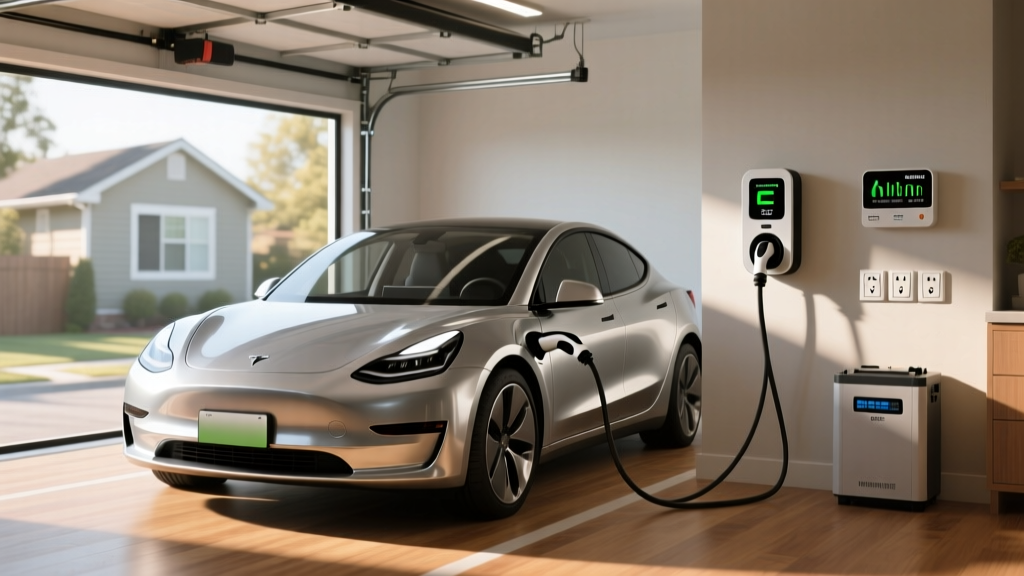
Plug-in hybrid owners face a unique charging calculus. With electric-only PHEV range typically spanning 25 to 50 miles on current models like the Toyota RAV4 Prime (42 miles EPA) or Jeep Wrangler 4xe (22 miles EPA), daily driving can be fully electric — but only if you charge consistently. The gap between Level 1 (120V) and Level 2 (240V) charging is the difference between waking up with a full battery every morning or watching your electric range slip away to gas miles.
This guide walks through the charging hardware, home electrical requirements, real costs, and equipment that keep your PHEV running in electric mode as much as possible.
Charging Levels and How They Affect PHEV Range Recovery
The single biggest factor in PHEV usability is how quickly you can replenish the battery between trips. A typical PHEV battery sits between 13 and 22 kWh usable capacity. Here is how each level handles that:
| Level | Voltage / Power | Miles of Range Added/Hour | 13 kWh Battery (10-80%) | 22 kWh Battery (10-80%) |
|---|---|---|---|---|
| Level 1 | 120V / 1.4 kW | 3–5 mi/hr | ~6.5 hours | ~11 hours |
| Level 2 (basic) | 240V / 3.3 kW | 10–14 mi/hr | ~2.75 hours | ~4.75 hours |
| Level 2 (high) | 240V / 7.2 kW | 20–28 mi/hr | ~1.25 hours | ~2.25 hours |
| DC Fast | 50 kW+ | 100–150+ mi/hr | ~20 min | ~30 min |
Key distinction: kW (kilowatts) measures power — the rate of energy flow, like water pressure in a hose. kWh (kilowatt-hours) measures energy — the total amount stored in your battery, like gallons in a tank. A 7.2 kW charger delivers 7.2 kWh of energy per hour under ideal conditions.
Most PHEVs accept a maximum of 6.6 to 7.2 kW on Level 2. Some older or lower-cost PHEVs are limited to 3.3 kW, meaning even a 48-amp Level 2 charger won't charge them faster. Check your owner's manual for the onboard charger rating — it caps your charge speed regardless of what the wall unit supplies.
Home Charger Installation: Electrical Requirements and Costs
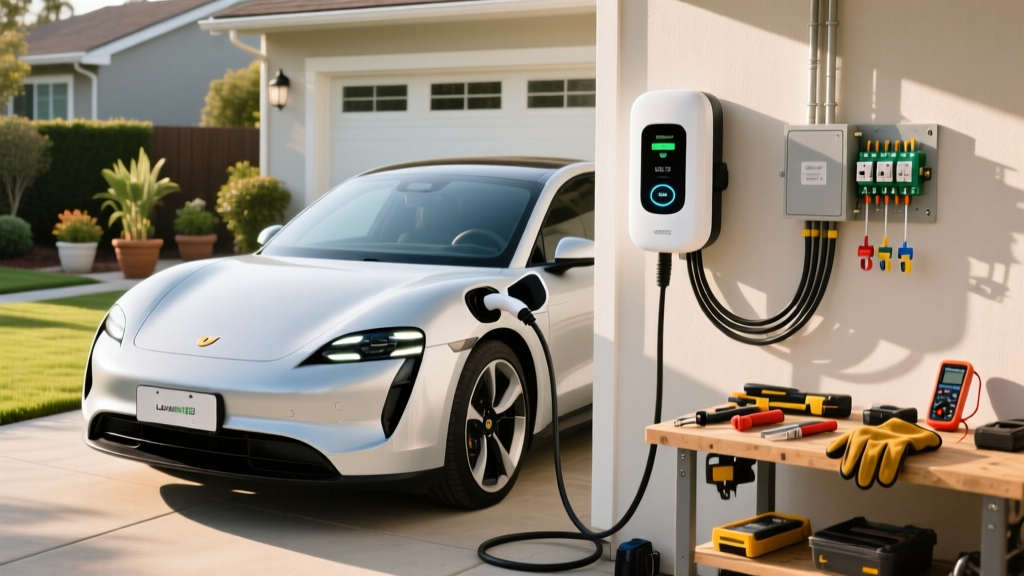
Installing a Level 2 charger at home is the most impactful upgrade for PHEV ownership. Here is what the project actually involves.
Electrical Requirements
A Level 2 charger requires a 240-volt circuit, similar to what powers an electric dryer or oven. Common configurations:
- 16-amp circuit (3.3 kW): Requires a 20-amp breaker. Adequate for PHEVs with 3.3 kW onboard chargers.
- 32-amp circuit (7.7 kW): Requires a 40-amp breaker. Covers most PHEVs and smaller BEVs.
- 48-amp circuit (11.5 kW): Requires a 60-amp breaker. Best for future-proofing if you may later own a BEV that accepts 11.5 kW or higher.
For a dedicated 40-amp circuit, you need 8-gauge copper wire (or 6-gauge for longer runs over 50 feet). A 60-amp circuit requires 6-gauge wire. Your electrician will size the wire based on the National Electrical Code (NEC) continuous-load rule: the circuit must be rated at 125% of the charger's maximum draw.
Panel Upgrade Considerations
Homes built before 2000 often have 100-amp or 150-amp main panels. Adding a 40-amp or 60-amp EV circuit may push you close to your panel's capacity, especially if you already run electric heat, a dryer, and an electric oven. Your electrician will perform a load calculation per NEC Article 220.
If a panel upgrade is needed — moving from 100A to 200A service — expect a significant cost addition. This is the most common "surprise" expense in home charger installations, and it applies to older homes regardless of whether you drive a PHEV or a full BEV.
| Component | Low End | High End | Notes |
|---|---|---|---|
| Level 2 charger (hardwired) | $350 | $750 | 32A–48A smart chargers |
| Electrical permit | $50 | $200 | Varies by municipality |
| Electrician labor (standard install) | $300 | $800 | Panel-adjacent, short wire run |
| Wire and conduit materials | $100 | $400 | Longer runs cost more |
| Panel upgrade (if needed) | $1,500 | $4,000 | 100A → 200A service upgrade |
| Total (no panel upgrade) | $800 | $2,150 | Most common scenario |
| Total (with panel upgrade) | $2,300 | $6,150 | Older homes |
Always hire a licensed electrician and pull a permit. Unpermitted EV charger installations can void homeowner's insurance claims and create fire hazards. The National Electrical Code (NEC) Article 625 specifically governs EV charging equipment.
Connector Compatibility: Which Plug Fits Your PHEV?
Unlike full BEVs, which are rapidly standardizing around the NACS (North American Charging Standard) connector, PHEVs still predominantly use the J1772 connector for Level 1 and Level 2 charging. Here is the current landscape:
| Connector | Used By | Level 2 Charging | DC Fast Charging |
|---|---|---|---|
| J1772 | Most non-Tesla PHEVs (Toyota, Chrysler, Hyundai, BMW, Ford) | Yes — universal for AC | N/A (AC only) |
| NACS (Tesla) | Tesla vehicles; 2025+ Ford, GM, Rivian BEVs | Yes (with adapter for J1772 cars) | Yes (Supercharger network) |
| CCS1 (Combined) | Most non-Tesla BEVs; some PHEVs with DC fast capability | Uses J1772 upper portion | Yes |
| CHAdeMO | Largely discontinued (legacy Nissan Leaf, Mitsubishi Outlander PHEV older models) | Uses J1772 for AC | Yes (shrinking network) |
For PHEV owners: Your vehicle almost certainly uses J1772 for home and public Level 2 charging. The Mitsubishi Outlander PHEV is one of the few PHEVs that also supports DC fast charging (via CCS1 on 2023+ models). Most other PHEVs — including the RAV4 Prime, Wrangler 4xe, and Hyundai Tucson PHEV — are AC-only, meaning DC fast chargers are irrelevant for your vehicle.
If you purchase a NACS-based home charger (such as the Tesla Wall Connector), you will need a NACS-to-J1772 adapter (~$150–$250) for non-Tesla PHEVs. Conversely, if you buy a J1772 charger, it will work natively with nearly every PHEV on the road.
Charging Cost Per Mile: PHEV vs. Gas
The economic case for maximizing your PHEV range hinges on electricity costs versus gasoline. Here is how the math works across common scenarios, using a 2026 national average gas price of $3.40/gallon and a PHEV efficiency of 3.0 miles/kWh (typical for a RAV4 Prime or Tucson PHEV):
| Scenario | Cost per kWh / Gallon | Cost Per Mile | Annual Savings (12,000 mi, 70% electric) |
|---|---|---|---|
| Home charging (off-peak utility rate) | $0.12/kWh | $0.040/mi | — |
| Home charging (standard rate) | $0.18/kWh | $0.060/mi | — |
| Public Level 2 (network pricing) | $0.28/kWh | $0.093/mi | — |
| Gasoline only (30 MPG combined) | $3.40/gal | $0.113/mi | Baseline |
| Home off-peak vs. gas | — | — | ~$613/year saved |
| Home standard vs. gas | — | — | ~$445/year saved |
| Public L2 vs. gas | — | — | ~$168/year saved |
The savings are meaningful but depend heavily on charging at home. If your electricity costs exceed $0.25/kWh or you rely primarily on public charging, the per-mile advantage shrinks considerably. Check your utility's time-of-use (TOU) rates — many offer off-peak charging windows between 10 PM and 6 AM at significantly reduced rates.
For detailed PHEV efficiency data by model, the EPA's fueleconomy.gov database lists kWh/100mi and MPGe figures for every current PHEV sold in the US.
Recommended Level 2 Chargers for PHEV Owners
Since most PHEVs cap at 6.6–7.2 kW onboard, a 32-amp (7.7 kW) charger is the sweet spot — it maxes out your PHEV's capability while keeping installation costs reasonable on a 40-amp circuit. A 48-amp unit makes sense only if you plan to own a higher-capacity BEV in the future.
ChargePoint Home Flex
- Power: Up to 11.5 kW (48A), configurable down to 16A
- Connector: J1772 (NACS version also available)
- Cable length: 23 feet
- Smart features: Wi-Fi, scheduling, energy tracking, Alexa integration
- Price: ~$550–$650
- Best for: PHEV owners who want future-proofing and detailed app data
Emporia Level 2 EV Charger
- Power: Up to 11.5 kW (48A)
- Connector: J1772
- Cable length: 24 feet
- Smart features: Wi-Fi, solar integration, load management, energy monitoring
- Price: ~$400–$500
- Best for: Budget-conscious buyers, solar panel owners
Grizzl-E Smart
- Power: Up to 10 kW (40A)
- Connector: J1772
- Cable length: 24 feet
- Smart features: Wi-Fi, OCPP compatibility, adjustable amperage via dip switches
- Price: ~$400–$450
- Best for: Cold climates (rated to -40°F), outdoor installations
For PHEV-only households, the Emporia or Grizzl-E at 32-amp configuration on a 40-amp circuit delivers full charging speed at the lowest installation cost. The ChargePoint Home Flex is worth the premium if you want the option to upgrade to 48 amps later without replacing the unit.
Safety, Code, and Outdoor Installation
EV charger installations must comply with NEC Article 625 and local building codes. Key safety requirements:
- Dedicated circuit: Your Level 2 charger must have its own breaker — it cannot share a circuit with other appliances or outlets.
- GFCI protection: NEC 2020 and later require ground-fault circuit interrupter protection for outdoor receptacles used for EV charging. Hardwired chargers may have built-in GFCI, but outdoor outlets on a 240V circuit need a GFCI breaker (adds $50–$100 to the panel).
- Outdoor rating: If your charger is installed outside (garage-less homes, driveway parking), the unit must carry a NEMA 4 or NEMA 4X rating for weather resistance. All three chargers recommended above meet this standard.
- Cable management: NEC requires that charging cables not create a trip hazard. Wall-mounted cable organizers or retractors ($20–$50) keep things tidy and code-compliant.
- Ventilation: Not required for Level 2 chargers (unlike some older Level 1 setups in enclosed garages), but ensure the unit is not installed where it could be damaged by vehicle impact.
Frequently Asked Questions
How much does it cost to install a home EV charger?
A standard Level 2 installation with a 40-amp circuit and short wire run typically costs $800 to $2,150 total (charger, permit, electrician labor, and materials). If your home needs a panel upgrade from 100A to 200A service, add $1,500 to $4,000. The charger unit itself ranges from $400 to $650 for quality smart units.
How fast will each charging level add range to my PHEV?
Level 1 (120V) adds roughly 3–5 miles of electric range per hour. Level 2 at 3.3 kW adds 10–14 miles per hour. Level 2 at 7.2 kW adds 20–28 miles per hour. For a typical PHEV with 35–42 miles of range, overnight Level 1 charging (10 hours) can nearly fully replenish the battery, but Level 2 provides a comfortable margin for multiple daily trips.
Which connector is compatible with my PHEV?
Nearly every PHEV sold in the US uses the J1772 connector for AC charging. This includes Toyota, Chrysler/Jeep, Hyundai/Kia, BMW, Ford, and Volvo PHEVs. If you buy a NACS-based charger (Tesla Wall Connector), you will need a NACS-to-J1772 adapter. CCS1 and CHAdeMO connectors are only relevant for DC fast charging, which most PHEVs do not support.
How much does charging cost per mile compared to gas?
At a typical home electricity rate of $0.12–$0.18/kWh and PHEV efficiency of 3.0 mi/kWh, electric driving costs $0.04–$0.06 per mile. Gasoline at $3.40/gallon and 30 MPG combined costs $0.113 per mile. Home charging saves $445–$613 annually if 70% of your 12,000-mile year is driven on electricity. Public Level 2 charging at $0.25–$0.35/kWh narrows the gap significantly.
What electrical upgrades might I need for a Level 2 charger?
You may need a panel upgrade if your home has a 100-amp or 150-amp main panel with existing high-draw appliances (electric heat, dryer, oven). Your electrician will perform a NEC Article 220 load calculation. Other potential upgrades include running new conduit for long wire runs (over 50 feet from the panel), upgrading the grounding system, or adding a GFCI breaker for outdoor installations. Always get a professional assessment before purchasing equipment.