Why PepsiCo's Electric Truck Charging Upgrade Matters to Everyday EV Owners
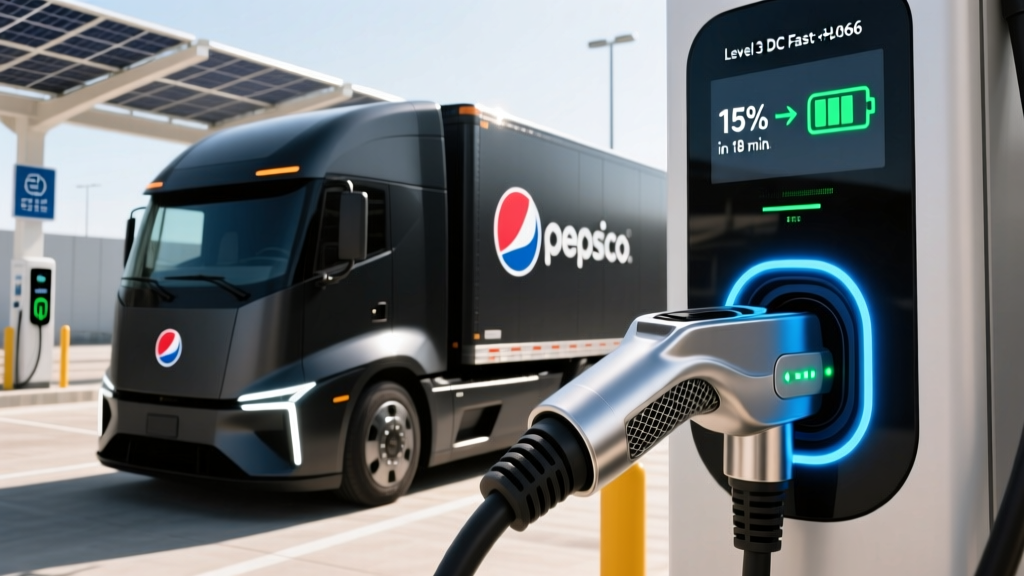
When PepsiCo began scaling its fleet of Tesla Semi electric Class 8 trucks, the company didn't just buy vehicles — it had to fundamentally rethink the electrical infrastructure at its distribution centers. The PepsiCo electric truck charging upgrade involved megawatt-scale DC fast charging, utility coordination, and depot-level power management that most consumer EV owners will never encounter. But the core principles — matching charger power to battery capacity, understanding electrical service limits, and budgeting for installation — apply directly to anyone installing a home Level 2 charger or evaluating public DC fast charging networks in 2026.
This guide extracts the practical charging lessons from PepsiCo's fleet electrification and translates them into actionable data for passenger EV owners. Whether you're wiring a 48-amp home charger for a Ford F-150 Lightning or a 32-amp unit for a Hyundai Ioniq 5, the physics and economics are the same: you need the right connector, enough electrical capacity, and a clear understanding of what each charging level actually delivers.
Charging Levels Explained: kW Speeds and Miles Added Per Hour
The single most important distinction in EV charging is between kW (kilowatts — the rate of power delivery, like water pressure) and kWh (kilowatt-hours — the total energy stored or delivered, like gallons in a tank). A charger rated at 11.5 kW delivers energy at that rate; a battery with 77 kWh of usable capacity stores that much total energy. Confusing these two is the most common EV literacy gap.
Here's what each level actually adds in real-world conditions:
| Level | Voltage / Amps | Max Power (kW) | Miles of Range Added Per Hour | Typical Use Case |
|---|---|---|---|---|
| Level 1 (AC) | 120V / 12A | 1.4 kW | 3–5 mi/hr | Emergency / overnight trickle for PHEVs |
| Level 2 (AC) | 240V / 32–48A | 7.7–11.5 kW | 20–44 mi/hr | Primary home and workplace charging |
| DC Fast (Level 3) | 400–800V DC | 50–350+ kW | 150–1,000+ mi/hr (peak) | Road trips, fleet depot charging |
For context, the Tesla Semi that PepsiCo deploys can accept DC fast charging at up to 1.2 megawatts (1,200 kW) — roughly 100 times the power of a typical home Level 2 charger. That's how a 500+ kWh battery pack can recover significant range in 30–45 minutes. For passenger EVs, DC fast chargers in the 150–350 kW range are the practical ceiling in 2026, with vehicles like the Hyundai Ioniq 5 (peak 240 kW, 10–80% in ~18 minutes) and the Porsche Taycan (peak 320 kW on 800V architecture, 10–80% in ~16 minutes) leading the pack.
Home Charger Installation: Electrical Requirements, Panel Upgrades, and Real Costs
The PepsiCo electric truck charging upgrade required utility-grade transformers and new medium-voltage service feeds. Your home installation is smaller in scale but follows the same logic: you must match your charger's amperage draw to your electrical panel's available capacity, and you may need to upgrade.
Electrical Requirements by Charger Size
Most home Level 2 chargers run on a dedicated 240V circuit. The National Electrical Code (NEC) requires that continuous loads (like EV charging) use no more than 80% of a circuit's rated capacity. That means:
- A 40-amp circuit supports a 32-amp charger (7.7 kW)
- A 50-amp circuit supports a 40-amp charger (9.6 kW)
- A 60-amp circuit supports a 48-amp charger (11.5 kW)
Do You Need a Panel Upgrade?
Homes built before 2000 often have 100-amp or 150-amp main panels. If your panel is already near capacity (running central AC, electric dryer, electric range, and water heater), adding a 48-amp EV circuit could push you over. A licensed electrician will perform a load calculation to determine if your existing panel can handle the added draw. If not, upgrading to a 200-amp panel typically costs $1,500–$3,000 before the charger installation even begins.
Newer homes (post-2010) with 200-amp service usually accommodate a Level 2 charger without a panel upgrade. Some homeowners opt for a smart load-management device (like the Emporia Smart Load Center or Span drive panel) that dynamically shares capacity between the EV charger and other appliances — avoiding a panel upgrade entirely.
| Component | Typical Range | Notes |
|---|---|---|
| Level 2 Charger (Equipment) | $350–$750 | 32A–48A hardwired or NEMA 14-50 plug |
| Electrical Permit | $50–$200 | Varies by municipality; required for code compliance |
| Electrician Labor (Standard Install) | $500–$1,500 | Run from panel to garage/carport; shorter runs = lower cost |
| Panel Upgrade (if needed) | $1,500–$3,000 | 100A → 200A upgrade; not always necessary |
| Conduit, Wire, and Misc. Materials | $100–$400 | Depends on run length and local code (e.g., metal conduit) |
| Total (No Panel Upgrade) | $900–$2,650 | Most common scenario for modern homes |
| Total (With Panel Upgrade) | $2,400–$5,650 | Older homes with 100A or 150A service |
The IRS §30D tax credit does not cover home charger equipment for most buyers in 2026 — the Alternative Fuel Vehicle Refueling Property Credit (Form 8911) expired for most residential installations after 2025, though some census-tract-based exceptions remain. Check irs.gov or consult a tax professional before assuming eligibility.
Connector Compatibility: NACS, CCS1, CHAdeMO, and What You Need in 2026
PepsiCo's Tesla Semi fleet uses the NACS (North American Charging Standard) connector — the same plug now adopted by nearly every major automaker for 2025–2026 model-year vehicles. The connector landscape has shifted dramatically, and buying the wrong home charger could limit your compatibility.
| Connector | Brands Using It (2026) | Adapter Needed? |
|---|---|---|
| NACS (Tesla) | Tesla, Ford, GM, Rivian, Volvo, Polestar, Hyundai/Kia (new models), Mercedes-Benz | CCS-to-NACS adapter for older CCS vehicles (~$200–$300) |
| CCS1 | Legacy models: older VW ID.4, BMW i4 (pre-2025), some Stellantis EVs | NACS-to-CCS adapter if using Tesla Superchargers |
| CHAdeMO | Nissan Leaf (discontinued 2025), Mitsubishi Outlander PHEV (legacy) | Limited public infrastructure; no practical adapter path |
Practical recommendation for 2026 buyers: Install a NACS-connector home charger if your current or next EV uses NACS. If you own a CCS1 vehicle and plan to keep it, a CCS1 charger still works — and adapters are available for the transition. CHAdeMO is effectively end-of-life for new vehicles.
Charging Cost Per Mile: Home vs. Public vs. Gas in 2026
One reason PepsiCo invested in depot charging is economics: electricity at fleet scale costs significantly less per mile than diesel. The same math applies at the household level, though your savings depend heavily on where and when you charge.
| Scenario | Rate ($/kWh) | Vehicle Efficiency | Cost Per Mile |
|---|---|---|---|
| Home charging (off-peak utility rate) | $0.10–$0.15 | 3.0 mi/kWh (avg EV) | $0.033–$0.050 |
| Home charging (standard residential rate) | $0.16–$0.22 | 3.0 mi/kWh | $0.053–$0.073 |
| Public Level 2 (ChargePoint, workplace) | $0.25–$0.49 | 3.0 mi/kWh | $0.083–$0.163 |
| DC Fast Charging (Electrify America, EVgo) | $0.35–$0.65 | 3.0 mi/kWh | $0.117–$0.217 |
| Gas vehicle (28 MPG combined, $3.40/gal) | — | 28 MPG | $0.121 |
At home off-peak rates, an EV costs roughly 3–5 cents per mile to fuel — about one-third the cost of a 28 MPG gas car. Even at DC fast-charging rates, EVs are often cost-competitive with gas, though frequent DC fast charging erodes the savings advantage and accelerates battery degradation due to sustained high-temperature exposure.
For fleet operators like PepsiCo, the calculus is even more favorable: commercial electricity rates plus depot charging infrastructure amortized over hundreds of trucks can bring per-mile fuel costs below $0.03.
Equipment Recommendations: Best Home Level 2 Chargers in 2026
Based on power output, connector flexibility, smart features, and build quality, here are the top home Level 2 chargers for 2026:
ChargePoint Home Flex (NACS)
- Power Output: Up to 11.5 kW (48A) on a 60A circuit; adjustable down to 16A
- Connector: NACS (native); J1772 adapter included for legacy vehicles
- Cable Length: 23 feet
- Smart Features: Wi-Fi, app scheduling, Alexa integration, energy tracking
- Price: ~$599 (equipment only)
- Best For: NACS-vehicle owners wanting flexible amperage and smart scheduling
Emporia Vue Level 2 EV Charger
- Power Output: Up to 11.5 kW (48A) on a 60A circuit
- Connector: NACS (2026 model); J1772 version also available
- Cable Length: 24 feet
- Smart Features: Integrates with Emporia home energy monitor, solar-aware scheduling, load management
- Price: ~$499
- Best For: Homes with solar panels or Emporia energy monitoring ecosystem
Tesla Wall Connector (NACS)
- Power Output: Up to 11.5 kW (48A) on a 60A circuit
- Connector: NACS (native); includes J1772 adapter in box
- Cable Length: 24 feet
- Smart Features: Wi-Fi, OTA updates, power-sharing between multiple units, Tesla app integration
- Price: ~$475
- Best For: Tesla owners and multi-EV households (power-sharing allows two units on one 60A circuit)
Grizzl-E Smart (NACS/CCS)
- Power Output: Up to 10 kW (40A) on a 50A circuit
- Connector: Available in NACS or CCS1 configurations
- Cable Length: 24 feet
- Smart Features: OCPP-compatible, works with multiple energy management platforms, outdoor-rated (NEMA 4)
- Price: ~$449
- Best For: Outdoor installations, cold-climate durability, and open-protocol smart charging
Charging time examples for common battery sizes (Level 2, 11.5 kW / 48A):
- Hyundai Ioniq 5 (84 kWh usable, 10–80%): ~5.2 hours
- Tesla Model Y Long Range (75 kWh usable, 10–80%): ~4.6 hours
- Ford F-150 Lightning Extended Range (131 kWh usable, 10–80%): ~8.1 hours
- Chevrolet Equinox EV (85 kWh usable, 10–80%): ~5.3 hours
All of these comfortably complete an overnight charge — the core advantage of Level 2 home charging. You wake up with a full battery every morning, eliminating the "gas station stop" entirely for daily driving.
Safety, Code, and Installation Best Practices
PepsiCo's fleet depot installations must meet rigorous commercial electrical codes. Home installations are governed by the NEC (National Electrical Code) and local amendments. Key requirements and best practices:
- Dedicated circuit: Your Level 2 charger must be on its own dedicated breaker — it cannot share a circuit with other appliances. This is non-negotiable per NEC Article 625.
- GFCI protection: The 2023 NEC (adopted in most jurisdictions by 2026) requires GFCI protection for all EV charging outlets. Hardwired chargers are typically exempt from this requirement, which is one reason many electricians prefer hardwired installations — it eliminates nuisance GFCI trips that some EV owners experience with NEMA 14-50 receptacles.
- Outdoor rating: If your charger is mounted outside (carport, driveway wall), it must be rated NEMA 3R or NEMA 4 (weatherproof). All chargers listed above meet this standard, but verify before purchasing for outdoor use.
- Permit and inspection: Most municipalities require an electrical permit for EV charger installation. The permit ensures a city or county inspector verifies the work meets code. Skipping the permit risks insurance claim denials and problems during home sale inspections.
- Wire gauge: A 60-amp circuit requires 6 AWG copper wire (or 4 AWG aluminum). Your electrician will size wire based on circuit amperage and run length — longer runs may require thicker wire to prevent voltage drop.
Charging Time Examples: What to Expect at Each Level
Understanding real charging times requires knowing that DC fast charging does not sustain peak kW for the entire session. The charge curve tapers significantly above 80% state of charge (SoC) to protect battery health. Here's what to expect:
| Vehicle | Battery (kWh usable) | Level 2 at 11.5 kW | DC Fast (Peak kW) | DC Fast 10–80% Time |
|---|---|---|---|---|
| Hyundai Ioniq 5 | 84 kWh | ~5.2 hrs | 240 kW (800V) | ~18 min |
| Tesla Model Y LR | 75 kWh | ~4.6 hrs | 250 kW | ~22 min |
| Ford F-150 Lightning ER | 131 kWh | ~8.1 hrs | 150 kW | ~41 min |
| Chevrolet Blazer EV | 102 kWh | ~6.3 hrs | 190 kW | ~30 min |
| BMW iX xDrive50 | 105 kWh | ~6.5 hrs | 200 kW | ~31 min |
The charge curve taper means the last 20% (80–100%) can take nearly as long as the first 80% on DC fast charging. This is why road-trip strategy focuses on 10–80% sessions and why Level 2 home charging — which completes overnight regardless of taper — remains the optimal daily charging method.
Frequently Asked Questions
How much does it cost to install a home EV charger?
A typical Level 2 home charger installation costs $900–$2,650 when no panel upgrade is needed. This includes the charger unit ($350–$750), electrician labor ($500–$1,500), permit ($50–$200), and materials ($100–$400). If your home needs a 200-amp panel upgrade, add $1,500–$3,000, bringing the total to $2,400–$5,650.
How fast will each charging level add range?
Level 1 (120V) adds 3–5 miles per hour. Level 2 (240V, 32–48A) adds 20–44 miles per hour depending on amperage and vehicle efficiency. DC fast charging adds 150–1,000+ miles per hour at peak, but sessions are typically limited to 10–80% SoC (15–40 minutes) due to charge-curve taper.
Which connector/charger is compatible with my EV?
For 2026 model-year vehicles, most new EVs use NACS (Tesla's connector standard). Legacy CCS1 vehicles still on the road can use CCS1 chargers or adapters. Check your vehicle's charge port — if it's a 2025+ Ford, GM, Rivian, Hyundai, Kia, or Tesla, it likely uses NACS. CHAdeMO is no longer used on new vehicles.
How much does charging cost per mile vs gas?
Home charging at off-peak rates costs 3–5 cents per mile (at $0.10–$0.15/kWh and 3 mi/kWh efficiency). A comparable 28 MPG gas car at $3.40/gallon costs about 12 cents per mile. Even public DC fast charging at $0.35–$0.65/kWh costs 12–22 cents per mile — competitive with or cheaper than gas.
What electrical upgrades might I need?
The most common upgrade is a panel replacement from 100A or 150A to 200A service ($1,500–$3,000). You may also need a new dedicated circuit run from your panel to the charger location, conduit installation (required in many jurisdictions for exposed wiring), and a GFCI breaker if using a receptacle rather than hardwired connection. A licensed electrician's load calculation will determine what's needed.
What can passenger EV owners learn from PepsiCo's electric truck charging upgrade?
PepsiCo's fleet charging buildout demonstrates that charging infrastructure planning must happen before or alongside vehicle purchase — not after. The same principle applies at home: assess your electrical panel capacity, choose the right charger amperage for your circuit, and budget for installation before your EV arrives. Fleet operators also optimize for off-peak charging to minimize electricity costs — a practice every home EV owner should adopt through scheduled charging in their charger app.