Driving an electric vehicle through New Jersey means you will almost certainly rely on the NJ Turnpike corridor at some point. Fortunately, the NJ Turnpike Tesla Superchargers network has expanded considerably, offering reliable DC fast charging at service areas from Holmdel to Ridgefield Park. But relying solely on public fast charging is expensive and unnecessary if you can charge at home. This guide covers everything from Supercharger locations and speeds to the real cost of installing a Level 2 home charger — with exact numbers, not marketing fluff.
NJ Turnpike Tesla Supercharger Locations and Speeds
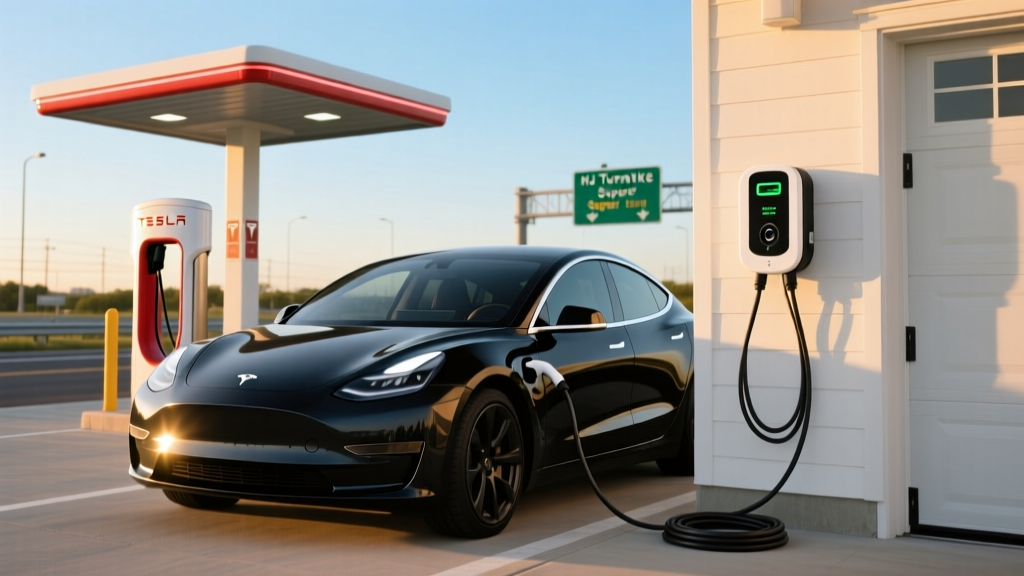
Tesla has strategically placed Supercharger stations along the New Jersey Turnpike at major service plazas. As of early 2026, these stations feature V3 and V4 Supercharger cabinets capable of delivering up to 250 kW peak power. With the broader Supercharger network now open to non-Tesla EVs via the built-in Magic Dock (NACS connector) or adapters, these stops serve a wider range of vehicles than ever.
Key NJ Turnpike Supercharger locations include:
- Holmdel (Exit 116) — Garden State Parkway adjacent, V3 stalls, 250 kW peak
- Joyce Kilmer Service Area (Exit 78) — Between Exits 74 and 82, V3 stalls
- Clara Barton Service Area — Northbound between Exits 5 and 6
- Thomas Edison Service Area — Southbound, paired with Clara Barton
- Ridgefield Park (I-80/95 interchange) — Northern corridor access
At 250 kW, a Tesla Model Y Long Range (75 kWh usable battery) can add roughly 170 miles of range in 15 minutes, assuming you arrive at a low state of charge and the battery is preconditioned. Real-world charge sessions typically taper significantly above 60% SoC, so a 10-80% session takes approximately 22-28 minutes depending on ambient temperature and battery chemistry.
Real-World Supercharger Tip: Peak 250 kW rates only sustain for the first 10-15% of the charge session on most vehicles. Expect average sustained rates of 120-150 kW for a 10-80% session. In cold weather (below 35°F), add 5-8 minutes unless your vehicle has active battery preconditioning.
Charging Levels Explained: kW, Miles Per Hour, and When to Use Each
Understanding charging speed requires separating kW (kilowatts) — the rate of power delivery — from kWh (kilowatt-hours) — the energy stored in your battery. Think of kW as the flow rate of a hose and kWh as the size of the bucket. A 48-amp Level 2 charger delivers about 11.5 kW of power; if you charge for one hour, you add roughly 11.5 kWh of energy to your battery.
| Level | Voltage | Max Power (kW) | Miles of Range Added/Hour | Best Use Case |
|---|---|---|---|---|
| Level 1 (120V) | 120V AC | 1.2-1.9 kW | 3-5 miles | Overnight top-off, PHEVs, emergencies |
| Level 2 (240V) | 240V AC | 3.3-19.2 kW | 12-70 miles | Daily home charging, workplace |
| DC Fast Charge | 400-800V DC | 50-350 kW | 150-1,000+ miles | Road trips, rapid top-ups |
For context, a 75 kWh battery (like in a Tesla Model Y or Ford Mustang Mach-E Extended Range) charged from 10% to 80% takes:
- Level 1 (1.4 kW): ~50 hours — impractical for full charges
- Level 2 (11.5 kW / 48A): ~4.5 hours — overnight-friendly
- DC Fast (150 kW sustained avg): ~25-30 minutes — road-trip standard
- DC Fast (250 kW peak, V3 Supercharger): ~18-22 minutes with preconditioning
Connector Compatibility: NACS, CCS1, CHAdeMO, and What You Need
The connector landscape has consolidated significantly. Tesla's North American Charging Standard (NACS) has been adopted by Ford, GM, Rivian, Volvo, BMW, and most other major automakers starting with 2025-2026 model-year vehicles. If you drive a non-Tesla EV from a legacy model year, you likely have a CCS1 port and will need a NACS-to-CCS adapter to use Tesla Superchargers.
| Connector | Brands Using It (Native) | DC Fast Availability | Adapter Needed for Superchargers? |
|---|---|---|---|
| NACS (Tesla) | Tesla (all years), Ford (2025+), GM (2025+), Rivian (2025+), Volvo/Polestar (2025+) | Tesla Supercharger, Electrify America (select), EVgo (select) | No — native |
| CCS1 | Hyundai/Kia, VW/ID.4, BMW (pre-2025), Mercedes EQ, most pre-2025 EVs | Electrify America, EVgo, ChargePoint, Ionity | Yes — CCS-to-NACS adapter (~$200-250) |
| CHAdeMO | Nissan Leaf (legacy), Mitsubishi Outlander PHEV (older) | Limited and declining | Not compatible — use CHAdeMO stations |
If you plan to use NJ Turnpike Tesla Superchargers with a CCS-equipped vehicle, purchase an approved NACS-to-CCS1 adapter. Tesla sells one for approximately $250, and third-party options from Lectron and A2Z are available for $180-$220. Confirm that your vehicle's manufacturer has approved Supercharger access for your specific model via the Tesla app.
Home Level 2 Charger Installation: Costs, Electrical Requirements, and Panel Upgrades
The single most impactful upgrade for EV ownership is a dedicated Level 2 home charger. Most EV owners do 80-90% of their charging at home, and the economics are dramatically better than public DC fast charging.
Electrical Requirements
A typical Level 2 home charger requires a 240V dedicated circuit, similar to what powers an electric dryer or oven. The most common setups are:
- 40-amp circuit with a 32-amp continuous charger (7.7 kW) — sufficient for most overnight charging
- 50-amp circuit with a 40-amp continuous charger (9.6 kW) — faster, recommended for larger batteries
- 60-amp circuit with a 48-amp continuous charger (11.5 kW) — fastest residential option, requires substantial panel capacity
What Electrical Upgrades Might I Need?
If your home has a 100-amp electrical panel (common in homes built before 1990), adding a 50-amp EV circuit may require a panel upgrade to 200 amps. This is the single biggest cost variable in home charger installation. A load calculation performed by a licensed electrician will determine whether your existing panel has sufficient headroom.
| Component | Simple Install (Panel Has Capacity) | Complex Install (Panel Upgrade Needed) |
|---|---|---|
| Level 2 Charger Equipment | $400 - $700 | $400 - $700 |
| Electrical Permit | $50 - $200 | $100 - $300 |
| Electrician Labor (240V circuit run) | $300 - $800 | $500 - $1,200 |
| Panel Upgrade (100A to 200A) | N/A | $1,500 - $3,500 |
| Conduit, Wire, Junction Box | $100 - $300 | $150 - $400 |
| Total Estimated Cost | $850 - $2,000 | $2,650 - $6,100 |
Some New Jersey utilities, including PSE&G and JCP&L, offer rebates of $500-$1,500 for residential EV charger installation. Check with your utility for current incentive programs before scheduling work. The federal Alternative Fuel Vehicle Refueling Property Credit (IRS Form 8911) may cover up to 30% of charger equipment and installation costs (capped at $1,000) for eligible taxpayers in qualifying census tracts.
Level 2 Home Charger Equipment Recommendations
Not all Level 2 chargers are equal. Below are three proven options that balance reliability, smart features, and value for 2026 EV owners.
ChargePoint Home Flex
- Power Output: Up to 12 kW (50A) on a 60A circuit; configurable down to 16A
- Connector: NACS (native Tesla) or J1772 with NACS adapter included
- Cable Length: 23 feet
- Smart Features: Wi-Fi, Alexa integration, scheduled charging, energy tracking via app
- Price: ~$600-$650
Grizzl-E Smart
- Power Output: Up to 10 kW (40A) on a 50A circuit
- Connector: J1772 (NACS adapter available separately)
- Cable Length: 24 feet
- Smart Features: Wi-Fi, OCPP support, adjustable amperage via app, outdoor-rated (NEMA 4)
- Price: ~$550-$600
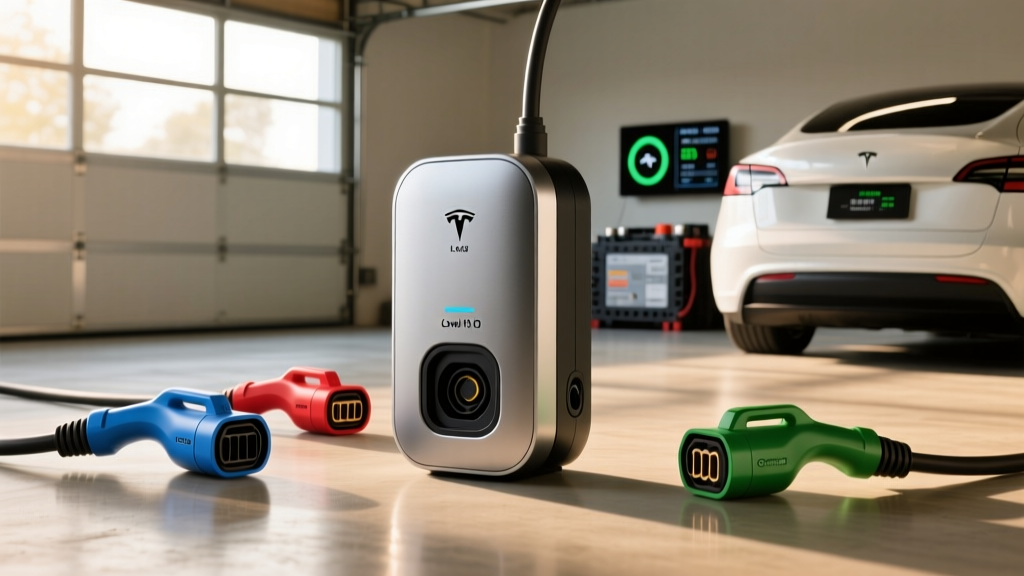
Tesla Wall Connector
- Power Output: Up to 11.5 kW (48A) on a 60A circuit
- Connector: NACS (native); J1772 adapter included for non-Tesla EVs
- Cable Length: 24 feet
- Smart Features: Wi-Fi, over-the-air updates, power sharing (link multiple units on one circuit), load management
- Price: ~$475
For most homeowners with a Tesla or NACS-equipped vehicle, the Tesla Wall Connector offers the best value at under $500 with excellent build quality. If you own a CCS-equipped vehicle and want maximum configurability, the ChargePoint Home Flex is the stronger pick.
Charging Cost Per Mile: Home vs. Public vs. Gas
The economics of EV charging depend heavily on where you plug in. Here is a realistic breakdown using a 2026 Tesla Model Y Long Range (approximately 3.5 miles per kWh efficiency) and a comparable gas-powered crossover at 27 MPG combined.
| Charging Scenario | Rate ($/kWh) | Cost Per Mile | Annual Cost (12,000 mi) |
|---|---|---|---|
| Home (off-peak utility rate, NJ avg) | $0.10-$0.14/kWh | $0.03-$0.04 | $360-$480 |
| Home (standard NJ residential rate) | $0.17-$0.19/kWh | $0.05-$0.055 | $600-$660 |
| Public Level 2 (ChargePoint, EVgo) | $0.25-$0.39/kWh | $0.07-$0.11 | $840-$1,320 |
| Tesla Supercharger (NJ Turnpike avg) | $0.28-$0.36/kWh | $0.08-$0.10 | $960-$1,200 |
| Electrify America DC Fast | $0.35-$0.48/kWh | $0.10-$0.14 | $1,200-$1,680 |
| Gas Vehicle (27 MPG, $3.40/gal) | $3.40/gallon | $0.13 | $1,560 |
Even at NJ Turnpike Tesla Supercharger rates (~$0.32/kWh average in 2026), a Model Y owner pays roughly $0.09 per mile — about 30% less than a gas vehicle. But home charging at off-peak rates drops that to $0.03-$0.04 per mile, making the EV roughly 75% cheaper to fuel than gas. The takeaway: home charging is where the real savings live. Superchargers are a road-trip convenience, not a daily strategy.
Safety and Code Considerations for Home Charger Installation
Level 2 charger installation is not a DIY project. New Jersey requires a licensed electrician and an electrical permit for any new 240V circuit. Key code and safety requirements include:
- Dedicated circuit: Your EV charger must be on its own dedicated breaker — it cannot share a circuit with other appliances.
- GFCI protection: The NEC (National Electrical Code) requires GFCI protection for outdoor receptacles. Many hardwired chargers have built-in ground-fault protection, which simplifies compliance.
- Outdoor rating: If your charger is mounted outside or in an unenclosed carport, it must be rated NEMA 3R or NEMA 4 (weatherproof). The Grizzl-E Smart and ChargePoint Home Flex both carry outdoor ratings.
- Wire gauge: A 50-amp circuit requires 6 AWG copper wire; a 60-amp circuit requires 4 AWG. Undersized wire is a fire hazard and will fail inspection.
- Load calculation: Your electrician must perform a load calculation per NEC Article 220 to verify your panel can handle the additional draw without overloading the service.
For homes with solar panels or battery storage systems, your electrician should also evaluate whether the EV charger circuit should be positioned upstream or downstream of the solar inverter connection, which affects net metering credits and backup power behavior.
Frequently Asked Questions
How much does it cost to install a home EV charger in New Jersey?
A straightforward installation on an existing 200-amp panel with nearby garage access typically costs $850-$2,000 including equipment, labor, and permit. If your home needs a panel upgrade from 100A to 200A, total costs can range from $2,650-$6,100. NJ utility rebates and the federal refueling property credit (up to $1,000) can offset a portion of these costs.
How fast will each charging level add range to my EV?
Level 1 (120V) adds 3-5 miles per hour — suitable only for PHEVs with small batteries or emergency top-offs. Level 2 (240V, 48A) adds 30-40 miles per hour for most EVs, fully recharging overnight. DC fast charging at 150+ kW can add 150-250 miles in 20-30 minutes, but sustained speeds depend on battery size, chemistry, temperature, and state of charge.
Can I use NJ Turnpike Tesla Superchargers with a non-Tesla EV?
Yes, provided your vehicle manufacturer has enabled Tesla Supercharger access and you have the correct connector. Vehicles with native NACS ports (2025+ Ford, GM, Rivian) can plug in directly. CCS-equipped vehicles require a NACS-to-CCS adapter (~$200-$250) and must be registered in the Tesla app for billing. CHAdeMO vehicles (older Nissan Leaf) are not compatible.
How much does charging cost per mile vs. gas?
At home on off-peak rates ($0.12/kWh), an efficient EV like the Model Y costs about $0.03-$0.04 per mile. A comparable gas crossover at 27 MPG and $3.40/gallon costs $0.13 per mile. Even at public DC fast charger rates ($0.32-$0.40/kWh), EVs still save 20-35% per mile vs. gas — but the savings are maximized with home charging.
What electrical upgrades might my home need for a Level 2 charger?
Homes with a 200-amp panel and available breaker slots typically need no upgrade — just a new dedicated 240V circuit. Homes with 100-amp service, older wiring (knob-and-tube or aluminum), or panels already near capacity will likely need a panel upgrade to 200 amps, which costs $1,500-$3,500 in the NJ area. A licensed electrician's load calculation is the definitive answer.
Do I need a smart charger, or will a basic unit work?
A basic ("dumb") Level 2 charger works fine for charging — it delivers power when plugged in. Smart chargers add scheduled charging (to exploit off-peak utility rates), energy monitoring, remote start/stop, and integration with solar or time-of-use plans. If your NJ utility offers time-of-use pricing, a smart charger pays for itself by ensuring you charge during the cheapest hours (typically 11 PM - 6 AM).
Whether you are planning your first EV road trip down the NJ Turnpike or evaluating your garage for a Level 2 installation, the numbers tell a clear story: home charging delivers the best economics and convenience, while the expanding Supercharger network makes longer trips practical. Get a load calculation from a licensed electrician, choose a charger that matches your vehicle's connector, and you will be set up for years of reliable, affordable EV ownership.