If you've driven the New Jersey Turnpike in an electric vehicle over the past few years, you likely relied on the Tesla Supercharger stations tucked into service plazas like Joyce Kilmer and Molly Pitcher. In late 2024 and into 2025, the New Jersey Turnpike Authority (NJTA) began phasing out Tesla-exclusive Supercharger infrastructure at several plazas, replacing it with universal, multi-standard DC fast charging networks. The New Jersey Turnpike Tesla Supercharger removal caught some Tesla owners off guard — and forced all EV drivers to rethink how they charge along one of the East Coast's busiest corridors.
This guide breaks down exactly what happened, what replaced those stalls, and — most importantly — how to build a reliable charging strategy whether you're commuting locally or road-tripping the I-95 corridor. We'll also cover the home charging setup that makes public charging a supplement, not a lifeline.
Why the NJ Turnpike Removed Tesla-Exclusive Superchargers
The original Supercharger installations at NJ Turnpike service plazas were part of an earlier era when Tesla operated a proprietary, closed network. As Tesla began opening its Supercharger network to non-Tesla EVs via the NACS (North American Charging Standard) connector and Magic Dock adapters, and as federal NEVI (National Electric Vehicle Infrastructure) funding mandated open-access charging with CCS1 compatibility, the NJTA moved to modernize its plaza charging.
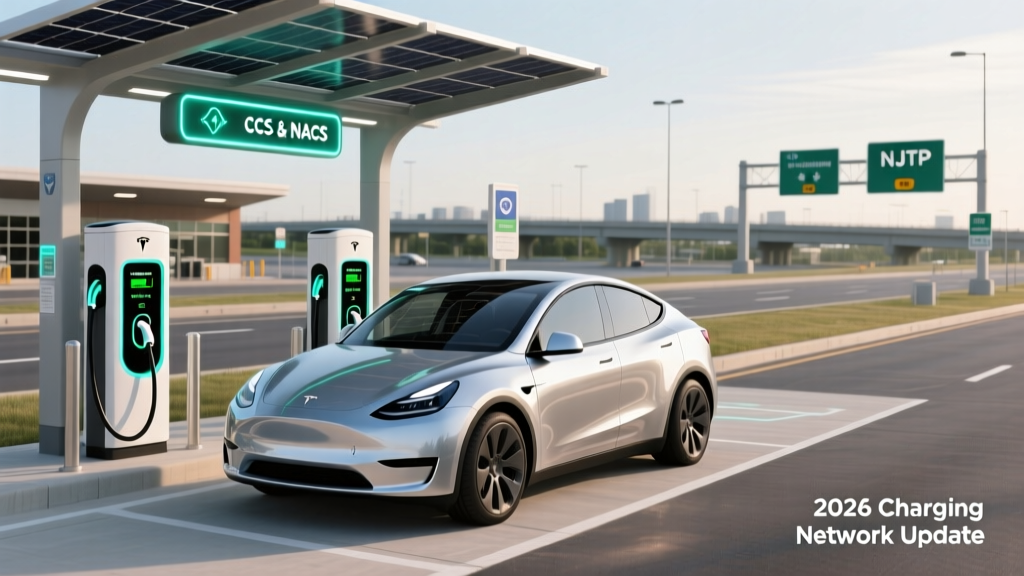
The transition involved replacing Tesla-exclusive hardware with universal DC fast chargers — typically 150–350 kW units offering both NACS and CCS1 connectors. For Tesla drivers, the practical impact is minimal: your car can still use NACS stalls, and the new universal chargers at plazas like Joyce Kilmer (Exit 8), Molly Pitcher (Exit 9A), and Cheesequake (Garden State Parkway adjacent) now serve all EV brands. Non-Tesla drivers benefit enormously, gaining reliable 150+ kW charging where previously only Teslas could stop.
However, during the transition period, some plazas experienced reduced stall counts or temporary outages. If you're planning a trip in 2026, always check real-time availability in your vehicle's nav or apps like PlugShare and A Better Routeplanner before relying on a single plaza.
Charging Levels Explained: What Speeds Actually Mean
Before we get into Turnpike-specific strategy, let's establish the three charging levels every EV owner must understand. The critical distinction: kW (kilowatts) measures power — how fast energy flows into your battery. kWh (kilowatt-hours) measures energy — how much your battery holds. Confusing them is the most common EV literacy mistake.
| Level | Voltage / Power | Typical kW | Miles of Range Added per Hour | Best For |
|---|---|---|---|---|
| Level 1 | 120V / 15A | 1.4–1.9 kW | 3–5 mi/hr | Overnight top-ups, PHEVs, emergencies |
| Level 2 | 240V / 20–80A | 3.3–19.2 kW | 12–70 mi/hr | Daily home charging, workplace, destinations |
| DC Fast | 400–800V DC | 50–350 kW | 150–1,200+ mi/hr (peak) | Road trips, corridor travel, quick top-ups |
Real-world context: A Tesla Model Y (75 kWh usable battery, ~310 EPA miles) charging on a 9.6 kW Level 2 home charger adds roughly 35 miles of range per hour — enough to fully replenish overnight. On a 250 kW DC fast charger, that same Model Y peaks at ~250 kW but tapers as the battery fills; expect a 10–80% session in roughly 18–22 minutes. The charge curve matters: peak kW is only sustained between ~10–50% state of charge (SoC). Above 80%, speeds drop dramatically to protect battery health.
NJ Turnpike Charging in 2026: What's Available Now
Following the Supercharger removal and replacement cycle, here's what the NJ Turnpike corridor offers EV drivers as of early 2026:
- Joyce Kilmer Service Area (Exit 8, NB & SB): Universal DC fast chargers, 150–350 kW, NACS + CCS1 connectors. Typically 6–8 stalls per direction.
- Molly Pitcher Service Area (Exit 9A): Upgraded universal chargers with NACS + CCS1, 150–250 kW.
- Cheesequake Service Area (Garden State Parkway, nearby alternative): Mixed network chargers; verify connector availability.
- Adjacent off-Turnpike options: Electrify America, EVgo, and Tesla Supercharger stations in Edison, East Brunswick, and Cranbury remain available and often have higher stall counts.
For Tesla owners, the vehicle's built-in navigation will route you to the nearest compatible charger — whether that's a new universal NACS stall on the Turnpike or a legacy Supercharger a few miles off the corridor. For CCS1-equipped EVs (Hyundai Ioniq 5, Ford Mustang Mach-E, BMW i4, etc.), the Turnpike plazas now offer genuine fast-charging access for the first time.
Connector Compatibility: NACS, CCS1, CHAdeMO, and Adapters
The post-Supercharger NJ Turnpike chargers use dual-connector pedestals — meaning both NACS and CCS1 plugs are available at the same stall. Here's how the major EV brands map to connectors in 2026:
| Connector | Native Brands | Adapter Required For | Notes |
|---|---|---|---|
| NACS (Tesla) | Tesla (all), Rivian (2025+), Ford (2025+), GM (2025+), Volvo/Polestar (2025+) | Older CCS1 vehicles via NACS-to-CCS adapter | Now the dominant North American standard; opens Tesla Supercharger network |
| CCS1 | Hyundai/Kia (through 2024), BMW, VW/ID.4 (pre-2026), Mercedes, Stellantis | NACS vehicles via CCS-to-NACS adapter | Still widely available; NEVI-funded stations must include CCS1 |
| CHAdeMO | Nissan Leaf (legacy) | No adapter available to NACS/CCS | Declining; most new DC stations omit CHAdeMO |
Adapter reality check: If you drive a 2025+ Ford F-150 Lightning or GM Silverado EV with a native NACS port, you can use the new Turnpike chargers directly. If you drive a 2023 Hyundai Ioniq 5 with CCS1, you can also use those same stalls — the pedestal has both cables. The only drivers who need adapters are those trying to cross between ecosystems (e.g., a NACS vehicle at an older CCS-only station, or a CCS vehicle accessing Tesla Superchargers). Tesla sells an official CCS adapter (~$175) and third-party options from Lectron and A2Z exist. Always verify adapter compatibility with your specific model year before purchasing.
Home Charging Setup: The Real Foundation
Public fast charging is essential for road trips, but 80–90% of all EV charging happens at home. A properly installed Level 2 home charger eliminates daily range anxiety and costs a fraction of public DC charging. Here's what a 2026 home installation actually requires.
Electrical Requirements
A Level 2 home charger requires a dedicated 240-volt circuit, similar to what powers an electric dryer or oven. The most common configurations:
- 240V / 40A circuit → 32A continuous charging (7.7 kW): The most popular setup. Adds ~28–35 miles of range per hour for a typical EV. Sufficient for overnight charging of nearly all EVs.
- 240V / 50A circuit → 40A continuous (9.6 kW): Adds ~35–45 miles per hour. Recommended for larger batteries (100+ kWh trucks/SUVs) or households with two EVs sharing a charger.
- 240V / 60A circuit → 48A continuous (11.5 kW): Maximum common residential setup. Adds ~45–55 miles per hour. Requires a robust electrical panel.
Panel upgrade reality: Many homes built before 2000 have 100-amp electrical panels. Adding a 40–50A dedicated EV circuit may push total load beyond the panel's capacity, especially if you already have electric range, dryer, and central AC. A panel upgrade to 200A typically costs $1,500–$3,000 and may be required before any EV charger installation. Your licensed electrician will perform a load calculation per NEC Article 220 to determine if an upgrade is needed.
| Component | Typical Cost Range | Notes |
|---|---|---|
| Level 2 Charger (Equipment) | $350–$700 | Smart Wi-Fi chargers: ChargePoint Home Flex, Wallbox Pulsar Plus, Emporia Level 2 |
| Electrician Labor | $500–$2,000 | Depends on run length from panel, conduit, drywall work |
| Permit & Inspection | $50–$300 | Required in most NJ municipalities; varies by township |
| Panel Upgrade (if needed) | $1,500–$3,000 | 100A → 200A upgrade; not always required |
| Total (no panel upgrade) | $900–$3,000 | Most common scenario for newer homes |
| Total (with panel upgrade) | $2,400–$6,000 | Older homes with 100A service |
Federal incentive: The Residential Clean Energy Credit (IRC §25D) covers 30% of home charging equipment and installation costs, up to $1,000, through 2032. This is separate from the §30D vehicle purchase credit. Check irs.gov for current eligibility rules, as income and sourcing requirements may apply.
Cost to Charge: Home vs. Public vs. Gas
One of the strongest arguments for EV ownership is fuel cost savings — but only if you're charging smartly. Here's how costs break down in New Jersey as of early 2026:
| Charging Scenario | Cost per kWh | Efficiency (kWh/mi) | Cost per Mile | Annual Fuel Cost (12,000 mi) |
|---|---|---|---|---|
| Home, off-peak (NJ utility time-of-use) | $0.10–$0.14 | 0.28–0.33 | $0.03–$0.05 | $360–$600 |
| Home, standard rate | $0.17–$0.20 | 0.28–0.33 | $0.05–$0.07 | $600–$840 |
| Public Level 2 (workplace/destination) | $0.20–$0.35 | 0.28–0.33 | $0.06–$0.12 | $720–$1,440 |
| DC Fast Charging (public, 150–350 kW) | $0.35–$0.55 | 0.28–0.33 | $0.10–$0.18 | $1,200–$2,160 |
| Gas vehicle (25 MPG combined, $3.50/gal) | — | — | $0.14 | $1,680 |
The takeaway: Home off-peak charging delivers the lowest cost per mile — typically 3–5 cents, roughly one-quarter the cost of gasoline. Even public DC fast charging at $0.45/kWh costs roughly the same per mile as a 25 MPG gas car. The savings compound: over 5 years and 60,000 miles, home-charging an efficient EV like the Hyundai Ioniq 6 (0.25 kWh/mi) vs. fueling a 25 MPG gas car saves $4,000–$6,000 in energy costs alone.
Charging time examples for common battery sizes:
- 60 kWh battery (e.g., base Tesla Model 3 RWD): 10–80% at 150 kW DC fast charger ≈ 18–20 minutes. Home Level 2 at 9.6 kW: 0–100% ≈ 7 hours.
- 77 kWh battery (e.g., Ford Mustang Mach-E Extended Range): 10–80% at 150 kW ≈ 24–28 minutes. Home Level 2 at 7.7 kW: 0–100% ≈ 10 hours.
- 100 kWh battery (e.g., Rivian R1S, Tesla Model S): 10–80% at 250 kW ≈ 25–30 minutes. Home Level 2 at 11.5 kW: 0–100% ≈ 9 hours.
Recommended Home Charging Equipment for 2026
Based on real-world reliability, smart features, and value, here are the Level 2 chargers we recommend for NJ homeowners:
ChargePoint Home Flex
- Power: Up to 11.5 kW (48A on 60A circuit); adjustable down to 16A
- Connector: NACS (2025+ models) or J1772 (older stock); NACS native for new Teslas/Ford/GM
- Cable length: 23 feet
- Smart features: Wi-Fi, scheduling, energy tracking, Alexa integration
- Price: ~$550–$650
- Best for: Most homeowners; flexible amperage adapts to your panel capacity
Wallbox Pulsar Plus
- Power: Up to 11.5 kW (48A); compact form factor
- Connector: J1772 (NACS version available for 2025+ vehicles)
- Cable length: 25 feet
- Smart features: Wi-Fi + Bluetooth, load balancing, solar integration
- Price: ~$450–$550
- Best for: Tight garage spaces; solar-panel households wanting integrated management
Emporia Level 2 EV Charger
- Power: Up to 11.5 kW (48A)
- Connector: J1772 (NACS adapter available)
- Cable length: 24 feet
- Smart features: Wi-Fi, real-time energy monitoring, integrates with Emporia home energy panel
- Price: ~$350–$400
- Best for: Budget-conscious buyers who want smart features without premium pricing
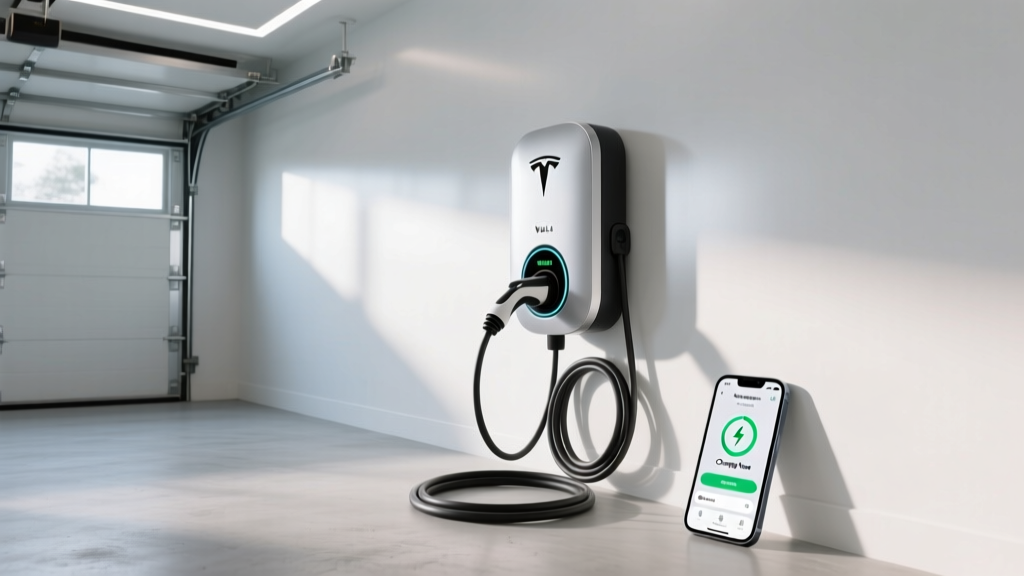
Tesla Wall Connector
- Power: Up to 11.5 kW (48A on 60A circuit)
- Connector: NACS native; includes J1772 adapter in box (2025+)
- Cable length: 24 feet
- Smart features: Wi-Fi, OTA updates, power sharing (link multiple units on one circuit)
- Price: ~$425–$475
- Best for: Tesla households; power-sharing feature ideal for two-EV garages
Safety, Code, and Installation Best Practices
EV charging draws sustained high current for hours — far longer than a dryer cycle. Proper installation is non-negotiable:
- Dedicated circuit: Your Level 2 charger must have its own dedicated breaker — never shared with other appliances. NEC 625 governs EV charging installations.
- GFCI protection: The 2023 NEC update requires GFCI protection for all EV charging outlets (receptacle-based installations). Hardwired chargers may not require a separate GFCI breaker, as many units have built-in ground-fault protection. Your electrician will advise based on local code adoption.
- Outdoor rating: If your charger is installed outdoors (driveway, exterior wall), it must be rated NEMA 4 (weather-resistant). All chargers listed above carry outdoor ratings, but the connector holster should be positioned to prevent water ingress.
- Permit and inspection: Most New Jersey municipalities require an electrical permit for EV charger installation. The inspection verifies proper wire gauge, breaker sizing, grounding, and GFCI compliance. Skipping the permit risks insurance claim denial if an electrical fire occurs.
- Wire gauge: A 48A continuous load requires 6 AWG copper wire (or 4 AWG aluminum) on a 60A breaker. Undersized wire is a fire hazard — never cut corners here.
NJ Turnpike Charging Strategy: Practical Tips for 2026
With the Supercharger removal behind us, here's how to optimize Turnpike corridor charging:
- Precondition your battery. If your EV supports it (Tesla, Hyundai E-GMP vehicles, BMW iX, etc.), navigate to the charger in your car's infotainment before arriving. This warms the battery to optimal temperature and unlocks peak charge rates — especially critical in NJ winters when cold batteries charge 30–50% slower.
- Charge to 80%, then move on. The charge curve tapers sharply above 80% SoC. Sitting at a DC fast charger from 80–100% can take as long as 10–80%. For road trips, charge to 80% and continue to your next stop or destination.
- Have backup plazas mapped. If Joyce Kilmer stalls are occupied or offline, Molly Pitcher is only 15 miles south. Off-Turnpike options in Edison and East Brunswick add redundancy.
- Use PlugShare or A Better Routeplanner. Real-time stall availability, user-reported status, and connector details are essential for corridor planning. Don't rely on a single plaza without checking.
- Leverage home charging for daily needs. If your daily commute is under 60 miles round-trip, you may never need public charging except for road trips. A home Level 2 charger handles daily driving at 3–5 cents per mile.
Frequently Asked Questions
How much does it cost to install a home EV charger?
A typical Level 2 home charger installation costs $900–$3,000 if your electrical panel has sufficient capacity. This includes the charger ($350–$700), electrician labor ($500–$2,000), and permits ($50–$300). If your home needs a panel upgrade from 100A to 200A service, add $1,500–$3,000, bringing the total to $2,400–$6,000. The federal Residential Clean Energy Credit (IRC §25D) covers 30% of equipment and installation, up to $1,000.
How fast will each charging level add range?
Level 1 (120V) adds 3–5 miles per hour — suitable only for PHEVs or emergency top-ups. Level 2 (240V, 7.7–11.5 kW) adds 28–55 miles per hour and fully charges most EVs overnight. DC fast charging (150–350 kW) adds 150–1,200+ miles per hour at peak, with a typical 10–80% session taking 18–30 minutes depending on battery size and charger power.
Which connector/charger is compatible with my EV?
In 2026, NACS is the dominant North American standard — native on Tesla, Rivian, Ford, GM, Volvo, and Polestar. CCS1 remains on many Hyundai/Kia, BMW, and VW models. The new NJ Turnpike universal chargers provide both NACS and CCS1 connectors at each pedestal. CHAdeMO (Nissan Leaf) is declining and not available at new Turnpike stations. Check your vehicle's charge port or owner's manual to confirm your connector type.
How much does charging cost per mile vs gas?
Home off-peak charging in New Jersey costs roughly $0.03–$0.05 per mile — about one-quarter the cost of gasoline at $3.50/gallon and 25 MPG. Even public DC fast charging at $0.45/kWh costs roughly $0.13–$0.18 per mile, comparable to or slightly above gas. The real savings come from consistent home charging. Over 5 years and 60,000 miles, an efficient EV charged primarily at home saves $4,000–$6,000 vs. a comparable gas vehicle.
What electrical upgrades might I need?
Homes with 100-amp electrical panels often need a 200-amp upgrade to safely support a 40–50A EV charger circuit alongside existing loads (dryer, range, HVAC). A licensed electrician performs a NEC Article 220 load calculation to determine if your panel can handle the additional draw. Newer homes (post-2000) with 200A service typically have sufficient headroom. The panel upgrade, if needed, costs $1,500–$3,000 and adds 1–2 days to the project timeline.
Can I still use Tesla Superchargers near the NJ Turnpike?
Yes. While the Turnpike Authority replaced Tesla-exclusive Superchargers at service plazas with universal chargers, standalone Tesla Supercharger stations remain operational in nearby Edison, East Brunswick, Cranbury, and other communities just off the corridor. Tesla's in-car navigation will route you to the nearest available option — whether that's a Turnpike universal charger or an off-highway Supercharger.
Does cold weather affect charging speed on the Turnpike?
Significantly. New Jersey winters (20–40°F) reduce battery temperature, which slows DC fast charging by 30–50% unless the battery is preconditioned. Cold also reduces usable range by 15–30% due to cabin heating demand and increased battery resistance. Always navigate to the charger using your EV's built-in nav (which triggers preconditioning) and plan for longer charge stops in winter. Expect a 10–80% session that takes 18 minutes in July to take 28–35 minutes in January.
The New Jersey Turnpike Tesla Supercharger removal marks a transition to a more inclusive, multi-standard charging corridor — one that ultimately benefits all EV drivers. With universal NACS + CCS1 chargers now in place, a solid home Level 2 setup, and a clear understanding of charging speeds, costs, and connector compatibility, you can drive the NJTP with confidence in 2026 and beyond.