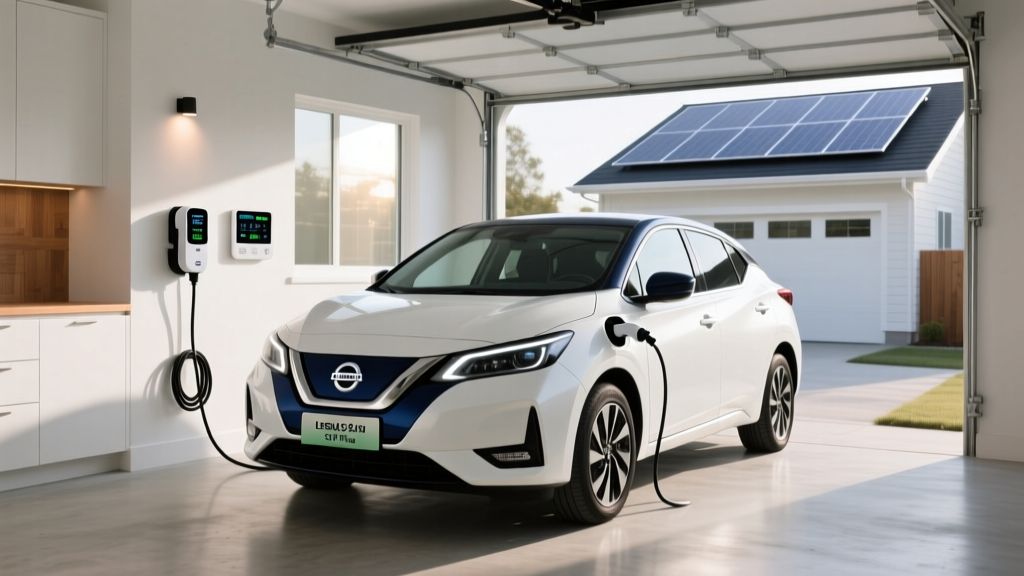
The 2025 Nissan Leaf SV Plus remains one of the most affordable long-range electric vehicles on the US market, but its charging ecosystem demands more planning than most newer EVs. With a 60 kWh (usable) lithium-ion battery and a CHAdeMO DC fast-charging port, Leaf owners face unique decisions around home charging equipment, public network compatibility, and adapter needs. This guide breaks down the real-world range, charging speeds at every level, home installation costs, and the exact equipment you need to keep a Leaf SV Plus powered efficiently in 2026.
2025 Nissan Leaf SV Plus: Range, Battery, and Efficiency Specs
Before plugging in, it's essential to understand what you're charging. The 2025 Leaf SV Plus is equipped with a 60 kWh usable battery pack (NMC chemistry) powering a 160 kW (214 hp) front-mounted electric motor. Here's the full spec snapshot:
| Spec | Value |
|---|---|
| EPA Range | 212 miles |
| Real-World Highway Range (70 mph, 70°F) | ~175–190 miles |
| Real-World Cold-Weather Range (30°F) | ~150–165 miles |
| Battery Capacity (Usable) | 60 kWh (NMC) |
| Combined MPGe | 121 MPGe |
| Efficiency | 28 kWh/100 mi |
| Max DC Fast Charge Rate | ~100 kW peak (CHAdeMO) |
| Onboard AC Charger | 6.6 kW (Level 2) |
| 0–60 mph | 6.5 seconds |
| Base MSRP (SV Plus) | $36,190 (before incentives) |
| Battery Warranty | 8 years / 100,000 miles |
For the latest official efficiency data, see the EPA's fuel economy site.
Charging Levels Explained: How Fast Will Each Level Add Range?
EV charging is measured in kilowatts (kW) — the rate of power delivery — while battery capacity is measured in kilowatt-hours (kWh), the total energy stored. Confusing these two is the single most common EV mistake. Think of kW as the speed of water flowing through a hose, and kWh as the size of the bucket you're filling.
| Level | Voltage | Max Power (kW) | Miles of Range Added/Hour | Full 0–100% Time (60 kWh) |
|---|---|---|---|---|
| Level 1 (Standard Outlet) | 120V | 1.2–1.4 kW | ~4–5 miles | ~45–50 hours |
| Level 2 (Home/Public AC) | 240V | 6.6 kW (Leaf limit) | ~22–25 miles | ~9–10 hours |
| DC Fast Charging | 400V+ | ~100 kW peak | ~150+ mi in 30 min | 10–80% in ~35–40 min |
Key detail: The Leaf SV Plus has a 6.6 kW onboard charger. Even if you install a 48-amp (11.5 kW) Level 2 home charger, the Leaf will only draw 6.6 kW. This is a hard vehicle-side limit. You won't damage anything by using a more powerful charger — the car simply takes what it needs — but you won't charge faster than 6.6 kW allows.
CHAdeMO vs CCS vs NACS: Connector Compatibility for the Leaf
The 2025 Nissan Leaf is one of the last mainstream EVs sold in the US with a CHAdeMO DC fast-charging connector. The industry has largely standardized on CCS1 (Combined Charging System), and Tesla's NACS connector is becoming the new North American standard adopted by Ford, GM, Rivian, and others starting in 2025–2026.
| Connector | Used By | Leaf Compatible? | Notes |
|---|---|---|---|
| CHAdeMO | Nissan Leaf, Mitsubishi Outlander PHEV | Yes (native) | Being phased out at new public stations |
| CCS1 | Hyundai, Kia, VW, BMW, Ford, GM (pre-2025) | No (no adapter available) | Current US standard for non-Tesla EVs |
| NACS (Tesla) | Tesla, Ford, GM, Rivian (2025+) | No (no adapter available) | Future dominant standard |
| J1772 (Level 2 AC) | All non-Tesla EVs | Yes (native) | Universal for AC charging |
Home Level 2 Charger Installation: Costs, Electrical Requirements, and Upgrades
Installing a Level 2 home charger is the single biggest quality-of-life upgrade for any EV owner. For the Leaf SV Plus, a 240V Level 2 charger will fully replenish the 60 kWh battery overnight in roughly 9–10 hours. Here's what's involved.
Electrical Requirements
A Level 2 charger requires a dedicated 240V circuit. For a 32-amp charger (7.7 kW output), you need a 40-amp breaker (EV chargers are considered "continuous loads" under NEC Article 625, requiring the breaker to be rated at 125% of the charger's draw). Since the Leaf maxes out at 6.6 kW (27.5 amps at 240V), a 32-amp charger is sufficient and avoids the need for a heavier 48-amp circuit.
Installation Cost Breakdown
| Component | Cost Range |
|---|---|
| Level 2 Charger (32A, 240V, hardwired or NEMA 14-50) | $350–$700 |
| Electrician Labor (standard install, panel within 20 ft) | $500–$1,200 |
| Electrical Permit | $50–$200 |
| Panel Upgrade (if needed: 100A → 200A service) | $1,500–$3,500 |
| Conduit, Wiring, and Misc Materials | $100–$400 |
| Total (no panel upgrade) | $1,000–$2,500 |
| Total (with panel upgrade) | $2,500–$6,000 |
Safety and Code Requirements
- Dedicated circuit: NEC 625.40 requires EVSE to be on its own dedicated branch circuit — no sharing with other appliances.
- GFCI protection: NEC 2020 and later require GFCI protection for outdoor receptacles used for EV charging. Hardwired installations may have different requirements depending on your jurisdiction.
- Outdoor rating: If your charger is installed outdoors, ensure it carries a NEMA 4 or NEMA 4X rating for weather resistance.
- Cable management: Use a holster or cable organizer to prevent tripping hazards and cord damage.
- Permit and inspection: Most jurisdictions require a permit and post-installation inspection. Skipping this can void home insurance coverage in the event of an electrical fire.
Level 2 Charger Recommendations for the Nissan Leaf SV Plus
Since the Leaf's onboard charger caps at 6.6 kW, you don't need the most powerful charger on the market. A quality 32-amp unit is the sweet spot — sufficient for the Leaf today, with enough headroom for a future EV upgrade. Here are three proven options:
ChargePoint Home Flex (up to 50A)
Power: Up to 12 kW (50A) / Leaf will draw 6.6 kW
Connector: J1772
Cable: 23 ft
Smart Features: Wi-Fi, app scheduling, energy tracking, Alexa integration
Price: ~$549
Verdict: Excellent app, future-proof amperage, UL-listed. Overkill for the Leaf but a smart long-term buy.
Emporia Level 2 EV Charger (48A)
Power: Up to 11.5 kW (48A) / Leaf draws 6.6 kW
Connector: J1772
Cable: 24 ft
Smart Features: Wi-Fi, solar integration, real-time energy monitoring, app control
Price: ~$399
Verdict: Best value smart charger. Ideal if you have or plan to add solar panels.
Grizzl-E Smart (40A)
Power: Up to 9.6 kW (40A) / Leaf draws 6.6 kW
Connector: J1772
Cable: 24 ft
Smart Features: Wi-Fi, OCPP-compatible, adjustable amperage, extreme cold-rated (-40°F)
Price: ~$449
Verdict: Built like a tank in Canada. Best for cold-climate garages and outdoor installs.
Cost to Charge: Leaf SV Plus vs Gasoline per Mile
Charging economics vary dramatically depending on where and when you plug in. Here's a breakdown based on the Leaf SV Plus's 28 kWh/100 mi efficiency:
| Scenario | $/kWh | Cost per 100 Miles | Cost per Mile |
|---|---|---|---|
| Home (national avg residential) | $0.16 | $4.48 | $0.045 |
| Home (off-peak TOU rate) | $0.08 | $2.24 | $0.022 |
| Public Level 2 (ChargePoint, EVgo) | $0.25–$0.35 | $7.00–$9.80 | $0.07–$0.10 |
| DC Fast Charging (EA, EVgo) | $0.35–$0.48 | $9.80–$13.44 | $0.10–$0.13 |
| Gasoline Comparison (25 MPG avg, $3.40/gal) | — | $13.60 | $0.136 |
The bottom line: Charging at home on an off-peak rate saves roughly 80% per mile compared to gasoline. Even public DC fast charging at peak rates approaches gas parity. The Leaf SV Plus's relatively modest 60 kWh battery keeps charging costs low — a full home charge at $0.16/kWh costs about $9.60 for 212 miles of EPA range.
DC Fast Charging: What to Expect on Road Trips
The Leaf SV Plus charges via CHAdeMO at up to ~100 kW peak on compatible DC fast chargers. However, like all EVs, the Leaf doesn't sustain peak speed for the entire session. Here's a realistic charge curve breakdown:
- 10–40% SoC: ~85–100 kW (fastest portion)
- 40–60% SoC: ~65–80 kW (moderate taper)
- 60–80% SoC: ~40–55 kW (significant taper)
- 80–100% SoC: ~15–20 kW (trickle charge — avoid unless necessary)
A typical 10–80% session takes approximately 35–40 minutes at a 100 kW CHAdeMO station. The Leaf's passive battery cooling system (it lacks active liquid cooling) can also cause charge speeds to drop in hot weather or after repeated back-to-back fast charges — a phenomenon known as "Rapidgate" that has affected Leafs since the 40 kWh generation. For road trips, plan charging stops around 30-minute breaks and avoid charging above 80% unless you need the extra range to reach your destination or next stop.
Federal Tax Credits and Incentives for Home Charging Equipment
Under IRS §30D and the Alternative Fuel Vehicle Refueling Property Credit (§30C), homeowners may qualify for a tax credit covering up to 30% of home EV charger equipment and installation costs, capped at $1,000. Eligibility depends on the charger being installed at your primary residence in an eligible census tract (typically lower-income or non-urban areas). Check the IRS §30C guidelines and consult a tax professional, as eligibility rules are location-specific and subject to change.
For the vehicle itself, the 2025 Nissan Leaf may qualify for the federal §30D clean vehicle credit (up to $7,500), but eligibility hinges on battery critical-mineral sourcing, buyer income caps ($150K single / $300K joint), and the vehicle's MSRP falling under the $55,000 cap for sedans. As of 2026, the Leaf's battery sourcing compliance has been inconsistent across model years — verify current eligibility on fueleconomy.gov before purchasing.
Frequently Asked Questions
How much does it cost to install a home EV charger for the Nissan Leaf?
A standard Level 2 installation (no panel upgrade) runs $1,000–$2,500 including the charger unit ($350–$700), electrician labor ($500–$1,200), permits ($50–$200), and materials. If your home needs a panel upgrade from 100A to 200A service, add $1,500–$3,500 to the total.
How fast will each charging level add range to my Leaf SV Plus?
Level 1 (120V outlet): ~4–5 miles per hour. Level 2 (240V): ~22–25 miles per hour (limited by the Leaf's 6.6 kW onboard charger). DC fast charging: ~150 miles in 30 minutes under optimal conditions (10–80% in ~35–40 minutes at a 100 kW CHAdeMO station).
Which connector is compatible with the 2025 Nissan Leaf?
The Leaf uses a J1772 connector for Level 1 and Level 2 AC charging (universal for all non-Tesla EVs) and a CHAdeMO connector for DC fast charging. There are no CCS1 or NACS adapters currently available for the Leaf's CHAdeMO port.
How much does charging cost per mile compared to gasoline?
Home charging at the national average rate of $0.16/kWh costs roughly $0.045/mile in the Leaf SV Plus. Off-peak rates can drop that to $0.022/mile. A comparable gas car at 25 MPG and $3.40/gallon costs $0.136/mile — roughly 3x more than home charging.
What electrical upgrades might I need for a home charger?
If your home has a 200-amp electrical panel with spare capacity, you likely need only a dedicated 40-amp breaker and a 240V circuit run to your garage or parking spot. Homes with 100-amp service, older wiring, or panels already near capacity may require a full panel upgrade ($1,500–$3,500). A licensed electrician will perform a load calculation to determine this.
Can I use a Tesla Supercharger with my Nissan Leaf?
No. Tesla Superchargers use the NACS connector, and there is no NACS-to-CHAdeMO adapter available for the Leaf. The Leaf is limited to CHAdeMO DC fast-charging stations and J1772 Level 2 stations.
Is the 2025 Leaf SV Plus eligible for the $7,500 federal tax credit?
Eligibility varies by model year production batch, buyer income, and current IRS battery-sourcing rules. The Leaf's MSRP ($36,190) falls well under the $55,000 sedan cap. However, critical-mineral and battery-component sourcing requirements under §30D have been a moving target. Verify at the point of sale and consult IRS guidance or a tax professional before relying on the credit.