Nissan Leaf S Range: What to Expect in 2026
The 2026 Nissan Leaf S continues to offer one of the most accessible entry points into the electric vehicle market. With its 40 kWh (usable) battery pack and EPA-estimated range of 149 miles, the Leaf S is engineered primarily for daily commuting and regional driving. However, as with all EVs, the EPA sticker is a laboratory-derived average. In real-world conditions—especially during highway driving at 70+ mph or in cold weather below 32°F—expect the Leaf S to deliver approximately 115 to 130 miles of range.
Real-World Range Reality
- EPA Estimate: 149 miles
- Highway (70 mph): ~125 miles
- Cold Weather (20°F): ~105–115 miles
- City/Stop-and-Go: ~155 miles (regen benefits)
Understanding how to replenish those miles efficiently is where a proper home charging setup becomes essential. Below, we detail the charging levels, equipment, and costs required to keep a Leaf S on the road.
Charging Levels: Speed and Range Added per Hour
The Nissan Leaf uses two distinct charging standards: CHAdeMO for DC Fast Charging and J1772 for Level 1 and Level 2 AC charging. It is critical to distinguish between kW (power—the rate of flow) and kWh (energy—the total capacity of the battery). A 40 kWh battery charged at a rate of 7.2 kW will take roughly 5.5 hours to fill from empty.
| Level | Voltage / Amperage | Max Power (kW) | Leaf S Range Added (mi/hr) | Use Case |
|---|---|---|---|---|
| Level 1 | 120V / 12A | 1.4 kW | ~4–5 miles | Emergency / Low-mileage drivers |
| Level 2 | 240V / 32A | 7.7 kW | ~22–25 miles | Daily home charging |
| DC Fast (CHAdeMO) | 400V+ DC | 50 kW | ~150+ miles (peak) | Road trips (limited network) |
For the Leaf S, a Level 2 home charger is the only practical way to ensure a full battery every morning. Relying on Level 1 (a standard wall outlet) would require nearly 30 hours for a full charge.
Home Charger Installation: Electrical Requirements and Costs
Installing a Level 2 charger requires a dedicated 240V circuit. For a 7.7 kW charger, a 40-amp breaker is standard, which provides roughly 32 amps of continuous power to the vehicle. The total cost of installation varies widely based on the distance from your electrical panel to the charging location and whether your home's panel can handle the extra load.
| Item | Estimated Cost Range | Notes |
|---|---|---|
| Level 2 Charger Equipment | $350 – $650 | Smart vs. non-smart; cable length |
| Electrician Labor & Materials | $600 – $1,500 | Conduit, wiring, breaker, permit |
| Electrical Panel Upgrade | $1,500 – $3,500 | Required if panel is under 200A |
| Total (No Panel Upgrade) | $950 – $2,150 | Most common for modern homes |
Always check for the Residential Clean Energy Credit, which may cover 30% of installation costs (up to $1,000) for qualifying homes.
Connector Compatibility: The CHAdeMO Challenge
One of the most significant considerations for Leaf owners in 2026 is the state of public charging. While the industry has largely standardized on NACS (Tesla) and CCS1, the Leaf remains one of the last holdouts using the CHAdeMO standard for DC Fast Charging.
| Connector Type | Leaf S Compatibility | Availability |
|---|---|---|
| J1772 (Level 2) | Native | Universal at home and public Level 2 |
| CHAdeMO (DC Fast) | Native | Declining; limited to older EA stations |
| CCS1 (DC Fast) | Not Compatible | Most common non-Tesla standard |
| NACS (Tesla) | Adapter Required (Level 2 only) | Growing via Tesla destination chargers |
While you can use a NACS-to-J1772 adapter for Tesla Level 2 destination chargers, there is currently no reliable adapter for using CCS1 or NACS DC Fast Chargers with a Leaf. This makes home Level 2 charging even more vital for the Leaf S owner.
Charging Time Examples and Battery Care
The Leaf S features a 40 kWh battery. Charging times depend on the State of Charge (SoC) and the power output of the station. Note that charging slows significantly above 80% to protect battery health.
- Level 1 (1.4 kW): ~28–30 hours (0–100%)
- Level 2 (7.7 kW): ~5.5 hours (0–100%)
- DC Fast (50 kW): ~45 minutes (10–80%)
To maximize the longevity of your Leaf's battery, Nissan recommends keeping the SoC between 20% and 80% for daily use. Avoid frequent use of DC Fast Charging, as the Leaf's air-cooled battery management system is more sensitive to heat than liquid-cooled systems found in more expensive EVs.
Equipment Recommendations for the Leaf S
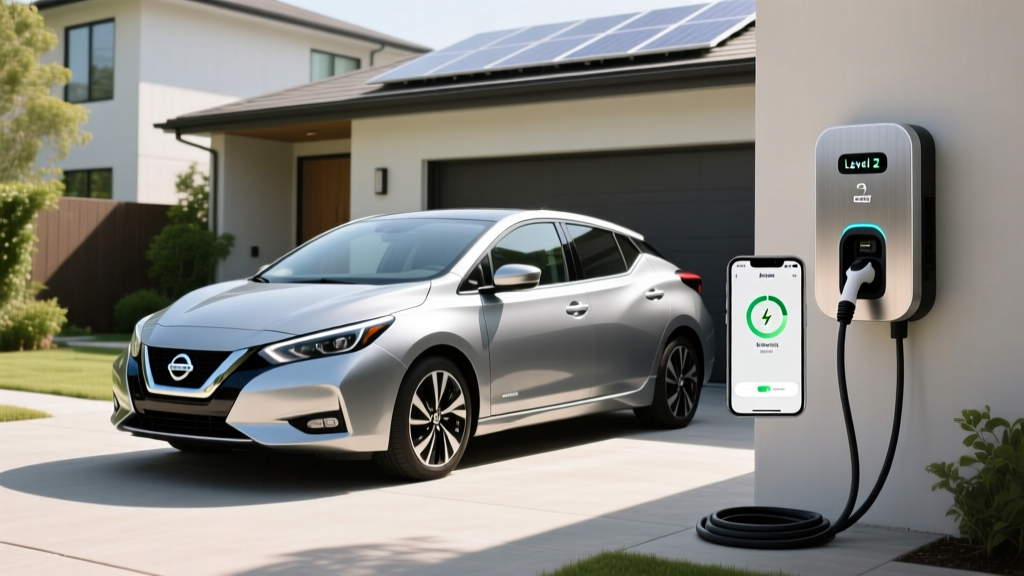
For a 2026 Leaf S, you need a J1772 Level 2 charger capable of at least 32 amps (7.7 kW). We recommend the following units based on reliability, smart features, and value:
Emporia Vue Level 2
- Power: 48A (11.5 kW) max
- Connector: J1772
- Price: ~$400
- Smart Features: Energy monitoring, solar integration
ChargePoint Home Flex
- Power: 50A (12 kW) max
- Connector: J1772
- Price: ~$600
- Smart Features: App scheduling, Alexa integration
Cost to Charge: EV vs. Gas
Charging a Leaf S is significantly cheaper than fueling a comparable gas vehicle. Based on the Leaf S's efficiency of 3.3 miles per kWh (112 MPGe), here is the cost per mile in different scenarios:
| Scenario | Rate ($/kWh) | Cost per Mile |
|---|---|---|
| Home (Off-Peak) | $0.13 | $0.039 |
| Public Level 2 | $0.35 | $0.106 |
| Gas Car (28 MPG @ $3.20/gal) | N/A | $0.114 |
At home, the Leaf S costs roughly three cents per mile to run—less than one-third the cost of a gas vehicle.
Safety and Code Considerations
When installing a home charger, safety and code compliance are non-negotiable. Ensure your installation includes:
- Dedicated Circuit: The charger must have its own breaker.
- GFCI Protection: Required by NEC for outdoor and garage outlets.
- Outdoor Rating: If installing outside, the unit must be NEMA 4 rated for weather resistance.
- Permitting: Most municipalities require an electrical permit and final inspection.
FAQ: Nissan Leaf S Range and Charging
Can I use a Tesla Supercharger with my Nissan Leaf S?
Currently, no. While adapters exist for Level 2 Tesla destination chargers, there is no adapter available that allows a CHAdeMO-equipped Leaf to use a Tesla Supercharger or any CCS1-based DC fast charger.
Does the Nissan Leaf S qualify for the federal tax credit?
As of 2026, the Nissan Leaf has largely been phased out of the federal §30D tax credit due to battery sourcing requirements. Always check the latest IRS guidance for final eligibility.
How long will my Leaf S battery last?
Nissan provides a warranty of 8 years/100,000 miles against capacity loss below 70%. With proper care (avoiding 100% SoC and extreme heat), these batteries typically last 10–15 years before significant degradation occurs.