Understanding the Real-World Range on a Nissan Leaf
If you own or are considering a Nissan Leaf, understanding what dictates its real-world range goes beyond the EPA sticker. The 2025 Nissan Leaf comes in two battery configurations: the standard 40 kWh pack (S trim) delivering an EPA-estimated 149 miles of range, and the larger 60 kWh pack (SV Plus) rated at 212 miles. But those numbers assume ideal conditions — moderate temperatures, mixed driving, and a fully charged battery.
EPA 212 miles (SV Plus 60 kWh) → Expect 170–190 miles on the highway at 70 mph, and as low as 140–160 miles in sub-freezing winter conditions. The standard 40 kWh Leaf S (EPA 149 miles) typically delivers 110–130 miles highway and 90–110 miles in cold weather. Source: fueleconomy.gov
The Leaf's air-cooled battery pack — unlike the liquid-cooled systems in competitors like the Chevrolet Bolt or Hyundai Ioniq 5 — makes it especially sensitive to temperature extremes and repeated DC fast charging. This thermal management limitation directly impacts how quickly you can charge and how much range you'll actually see day-to-day. A proper home charging setup is the single most impactful upgrade you can make to preserve battery health and maximize usable range on a Nissan Leaf over years of ownership.
Charging Levels Explained: Speeds in kW and Miles Per Hour
Before we discuss equipment, let's clarify the most fundamental distinction in EV charging: kW (kilowatts) measures the rate of power delivery — think of it as how fast water flows through a hose. kWh (kilowatt-hours) measures total energy stored — the size of the bucket. Your Leaf's battery capacity is measured in kWh; your charger's output is measured in kW.
| Level | Voltage / Amperage | Max Power (kW) | Miles of Range Added Per Hour | Best For |
|---|---|---|---|---|
| Level 1 | 120V / 12A | 1.4 kW | ~4–5 miles/hr | Overnight top-offs, low daily mileage |
| Level 2 | 240V / 32–48A | 7.7–11.5 kW | ~22–33 miles/hr | Daily home charging, full overnight recharge |
| DC Fast | 400V+ DC | 50–100 kW (Leaf max: ~100 kW on 60 kWh) | ~120–200 miles/hr (at peak) | Road trips, quick top-ups away from home |
The Nissan Leaf's onboard charger accepts up to 6.6 kW on Level 2 (240V), meaning even if you install a 48-amp (11.5 kW) home charger, the Leaf will only draw 6.6 kW. That's a hard limit set by the car, not the charger. On DC fast charging, the 60 kWh Leaf peaks around 100 kW via its CHAdeMO connector, but sustained rates drop significantly as the battery warms up and state of charge climbs past 60%.
Home Charger Installation: Electrical Requirements and Costs
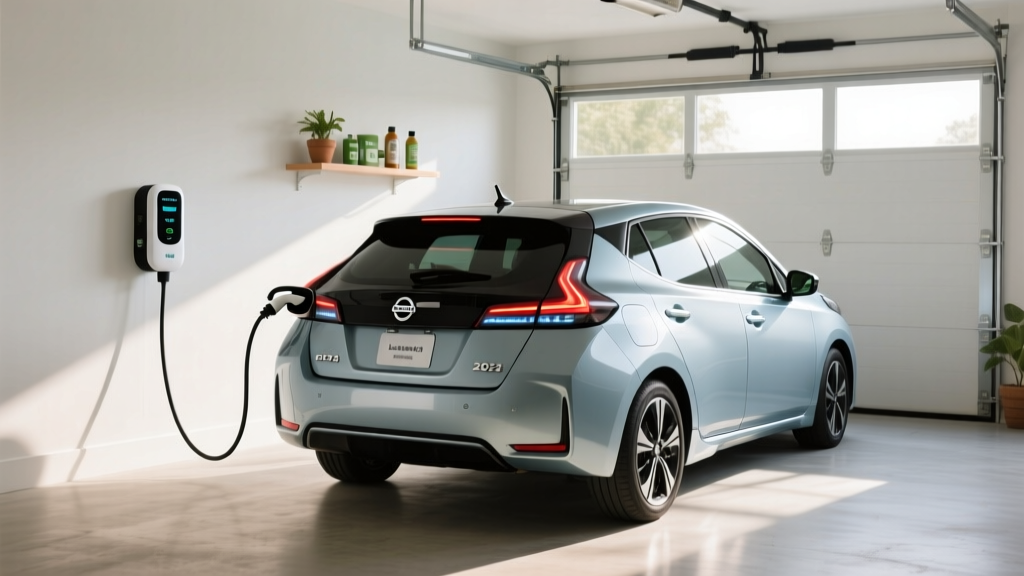
Installing a dedicated Level 2 home charger is the best way to ensure your Leaf reaches its full range each morning. Here's what the installation actually involves and what it costs.
Electrical Requirements
For a Level 2 charger delivering the Leaf's maximum 6.6 kW, you need a 240V circuit rated for at least 30 amps (a 24A continuous draw requires a circuit rated 25% higher per NEC code). If you want a more universal charger that could serve a future EV, a 50-amp circuit (supporting up to 40A continuous / 9.6 kW) is a smart upsell. Key considerations:
- Panel capacity: Most homes need at least a 100-amp main panel; 200-amp is preferred. If your panel is maxed out, a panel upgrade to 200A may cost $1,500–$3,000 before the charger install even begins.
- Dedicated circuit: The EV charger must have its own breaker — no sharing with dryers or ovens.
- GFCI protection: NEC 2020 and later require GFCI breakers for EV charging circuits in garages.
- Outdoor rating: If installing outside, you need a NEMA 4-rated (weatherproof) enclosure or a hardwired outdoor-rated unit.
Installation Cost Breakdown
| Component | Cost Range | Notes |
|---|---|---|
| Level 2 Charger Equipment | $200–$650 | Depends on brand, smart features, cable length |
| Electrician Labor (standard install) | $400–$1,200 | Varies by run length, wall type, local rates |
| Electrical Permit | $50–$250 | Required in most jurisdictions |
| Panel Upgrade (if needed) | $1,500–$3,000 | Older homes with 100A or less panels |
| Total (no panel upgrade) | $650–$2,100 | Typical for most modern homes |
| Total (with panel upgrade) | $2,150–$5,100 | Older homes needing 200A service |
Federal incentive: The §30C Alternative Fuel Vehicle Refueling Property Credit covers up to 30% of home charger equipment and installation costs, capped at $1,000, for installations in eligible census tracts. Confirm eligibility with a tax professional and consult the IRS §30C guidelines.
Connector Compatibility: CHAdeMO, CCS, and the NACS Transition
The Nissan Leaf uses the CHAdeMO DC fast-charging standard and a J1772 inlet for Level 1 and Level 2 AC charging. This is a critical detail because the industry has largely shifted toward CCS1 and, increasingly, NACS (the Tesla connector, now adopted by Ford, GM, Rivian, and others for 2025+ models).
| Connector | Used By | Nissan Leaf Compatible? |
|---|---|---|
| J1772 (AC Level 1/2) | All non-Tesla EVs sold in North America | ✅ Yes — native inlet |
| CHAdeMO (DC Fast) | Nissan Leaf, Mitsubishi Outlander PHEV (legacy) | ✅ Yes — native inlet |
| CCS1 (DC Fast) | Most non-Tesla EVs (Bolt, Ioniq, ID.4, etc.) | ❌ No — no adapter available |
| NACS (Tesla / new standard) | Tesla, Ford, GM, Rivian (2025+) | ❌ No — no adapter available |
What this means for Leaf owners: For home Level 2 charging, any J1772 charger will work perfectly. For public DC fast charging, you must seek out CHAdeMO-equipped stations — and the number of those is shrinking as networks prioritize CCS and NACS. Electrify America still supports some CHAdeMO stalls, but the writing is on the wall. This is a genuine long-term ownership consideration if you plan to road-trip frequently.
Cost to Charge: Per-Mile Economics vs. Gasoline
One of the strongest arguments for the Leaf is running cost. Here's what charging actually costs across different scenarios compared to a gasoline equivalent.
| Scenario | Rate ($/kWh) | Cost for Full 60 kWh Charge | Cost Per Mile (212 mi range) |
|---|---|---|---|
| Home Off-Peak (utility TOU rate) | $0.08–$0.12 | $4.80–$7.20 | $0.023–$0.034 |
| Home Standard Rate | $0.14–$0.18 | $8.40–$10.80 | $0.040–$0.051 |
| Public Level 2 (ChargePoint, etc.) | $0.20–$0.35 | $12.00–$21.00 | $0.057–$0.099 |
| DC Fast Charging (public) | $0.32–$0.52 | $19.20–$31.20 | $0.091–$0.147 |
| Gas Equivalent (28 MPG, $3.40/gal) | — | — | $0.121 |
At home off-peak rates, charging the Leaf costs roughly one-quarter to one-third what gasoline costs per mile. Even at public DC fast chargers — the most expensive scenario — the Leaf can still undercut gas on a per-mile basis, though the margin narrows. The Leaf SV Plus achieves 111 MPGe combined per the EPA, translating to roughly 30 kWh per 100 miles of driving.
Recommended Home Chargers for the Nissan Leaf
Since the Leaf caps at 6.6 kW AC charging, you don't need the most powerful charger on the market — but investing in a quality unit with smart features pays dividends in scheduling, monitoring, and future-proofing.
ChargePoint Home Flex (J1772)
- Power Output: Up to 9.6 kW (40A) — Leaf will draw 6.6 kW max
- Connector: J1772 (directly compatible)
- Cable Length: 23 feet
- Smart Features: Wi-Fi, app scheduling, Alexa integration, energy tracking
- Price: ~$550
- Verdict: Best overall for Leaf owners — flexible amperage setting, robust app, future-proof if you add a second EV
Emporia Level 2 EV Charger
- Power Output: Up to 11.5 kW (48A)
- Connector: J1772
- Cable Length: 24 feet
- Smart Features: Wi-Fi, real-time energy monitoring, solar integration, load management
- Price: ~$400
- Verdict: Best budget smart charger — excellent energy monitoring pairs well with solar panels
Grizzl-E Smart (J1772)
- Power Output: Up to 9.6 kW (40A)
- Connector: J1772
- Cable Length: 24 feet
- Smart Features: Wi-Fi, OCPP support, adjustable amperage, outdoor-rated (NEMA 4)
- Price: ~$450
- Verdict: Best for outdoor installs — Canadian-built, rugged, handles extreme cold well
Charging Times: How Long to Fill a Nissan Leaf Battery
Knowing your charging times helps you plan your routine. Here's what to expect for the two Leaf battery sizes across all charging levels.
| Scenario | 40 kWh (S Trim) | 60 kWh (SV Plus) |
|---|---|---|
| Level 1 (120V, 1.4 kW) 10–80% | ~20 hours | ~30 hours |
| Level 2 (240V, 6.6 kW) 10–80% | ~4.5 hours | ~6.5 hours |
| DC Fast (50 kW CHAdeMO) 10–80% | ~40 minutes | ~60 minutes |
| DC Fast (100 kW CHAdeMO) 10–80% | N/A (40 kWh limited to ~50 kW) | ~35–45 minutes |
Charge curve reality: The Leaf's DC fast charging rate does not stay at peak. A 60 kWh Leaf hitting a 100 kW CHAdeMO station will peak around 80–100 kW only between roughly 10–40% state of charge, then taper to 40–50 kW through 60%, and drop further to 20 kW or below past 80%. Charging past 80% on DC fast is painfully slow — plan your road-trip stops to charge from 10% to 80% and move on.
The Leaf's passive (air-cooled) battery thermal management also means that repeated DC fast charges on the same day — or fast charging in hot weather — will cause the car to throttle charging speed to protect the battery. This phenomenon, often called "Rapidgate," has improved in newer model years but remains a real limitation compared to liquid-cooled competitors.
Battery Longevity: Preserving Your Leaf's Range Over Time
The Leaf's air-cooled battery demands more mindful charging habits than liquid-cooled EVs. Nissan provides an 8-year/100,000-mile battery warranty covering capacity loss below 9 bars (out of 12) on the battery health display — roughly equivalent to dropping below 66–70% of original capacity.
To maximize long-term range retention:
- Avoid daily 100% charges: Set your charge limit to 80% for daily driving; charge to 100% only when you need the full range.
- Minimize DC fast charging: Rely on Level 2 at home; use DC fast charging only for road trips.
- Avoid charging in extreme heat: If possible, charge during cooler morning or evening hours in summer.
- Don't store at low SoC: If leaving the car unused for weeks, keep it around 50–60%.
Real-world degradation data from Leaf owners suggests 5–10% capacity loss over the first 3–5 years under typical use, with faster degradation in hot climates and for owners who rely heavily on DC fast charging. A replacement 60 kWh battery pack currently runs $8,000–$12,000 including labor — a significant expense that underscores the importance of proper charging habits.
Frequently Asked Questions
How much does it cost to install a home EV charger for a Nissan Leaf?
Expect $650–$2,100 for a standard installation (equipment + electrician + permit) if your electrical panel has sufficient capacity. Older homes needing a panel upgrade to 200A service can see total costs of $2,150–$5,100. The §30C federal tax credit may offset up to $1,000 (30% of costs) if you're in an eligible census tract.
How fast will each charging level add range to my Leaf?
Level 1 (120V) adds about 4–5 miles per hour. Level 2 (240V at 6.6 kW) adds roughly 22 miles per hour. DC fast charging at peak rate can add 120–200 miles per hour, but the Leaf's charge curve means sustained rates are lower — plan for 35–60 minutes for a 10–80% session depending on battery size and charger power.
Which connector and charger is compatible with the Nissan Leaf?
For home AC charging, the Leaf uses the J1772 connector — any J1772 Level 2 charger will work. For DC fast charging, the Leaf uses CHAdeMO. There are no adapters to use CCS1 or NACS DC fast chargers with a Leaf. This limits public fast-charging options as the industry shifts toward NACS.
How much does charging a Leaf cost per mile compared to gas?
Charging at home on off-peak rates costs $0.023–$0.034 per mile. Even on standard home rates, it's $0.040–$0.051 per mile. A comparable gas car at 28 MPG and $3.40/gallon costs $0.121 per mile. Home charging saves $0.07–$0.10 per mile, or roughly $700–$1,000 per year for a driver covering 10,000 miles annually.
What electrical upgrades might I need for a Level 2 charger?
You'll need a dedicated 240V circuit — typically 30A minimum for the Leaf (which draws up to 27.5A at its 6.6 kW max). If your home has an older 100-amp electrical panel that's near capacity, you may need a panel upgrade to 200A, which costs $1,500–$3,000. A licensed electrician should perform a load calculation before installation. Always pull a permit — it ensures the work meets NEC code and protects your home insurance coverage.