The Nissan LEAF Range Question: EPA Sticker vs Real-World Miles
If you're researching the Nissan LEAF, you've likely typed "what is Nissan LEAF range" into a search engine and found conflicting answers. The short version: the 2025 Nissan LEAF comes in two battery configurations with EPA-estimated ranges of 149 miles (40 kWh battery, S trim) and 212 miles (60 kWh battery, SV Plus trim). But the real-world answer depends heavily on how you drive, the weather, and — critically — how you charge.
- LEAF S (40 kWh): EPA 149 mi → Expect 120–135 mi highway, ~100–110 mi in freezing weather
- LEAF SV Plus (60 kWh): EPA 212 mi → Expect 175–195 mi highway, ~145–165 mi in freezing weather
Source: fueleconomy.gov
The LEAF's air-cooled battery pack (unlike the liquid-cooled systems in the Hyundai Ioniq 5 or Tesla Model 3) is more susceptible to temperature extremes. In sustained 95°F+ heat or below-20°F cold, expect the upper end of range loss. Highway driving at 75 mph also cuts range by roughly 15–20% compared to the EPA combined cycle, which blends city and highway.
Understanding kW vs kWh: The EV Charging Fundamentals
Before we talk charging speeds, let's clear up the single most common confusion in EV ownership: kW (kilowatts) measures power — the rate of energy delivery. kWh (kilowatt-hours) measures energy — the total capacity of the battery.
Think of it like plumbing: kW is the width of the pipe (how fast water flows), and kWh is the size of the tank (how much water it holds). A 40 kWh LEAF battery charged at a 6.6 kW Level 2 charger takes roughly 6 hours from empty. That same battery at a 50 kW DC fast charger could reach 80% in about 40 minutes — but only if the charge curve cooperates (more on that below).
Charging Levels Explained: Speeds, Times, and Range Added
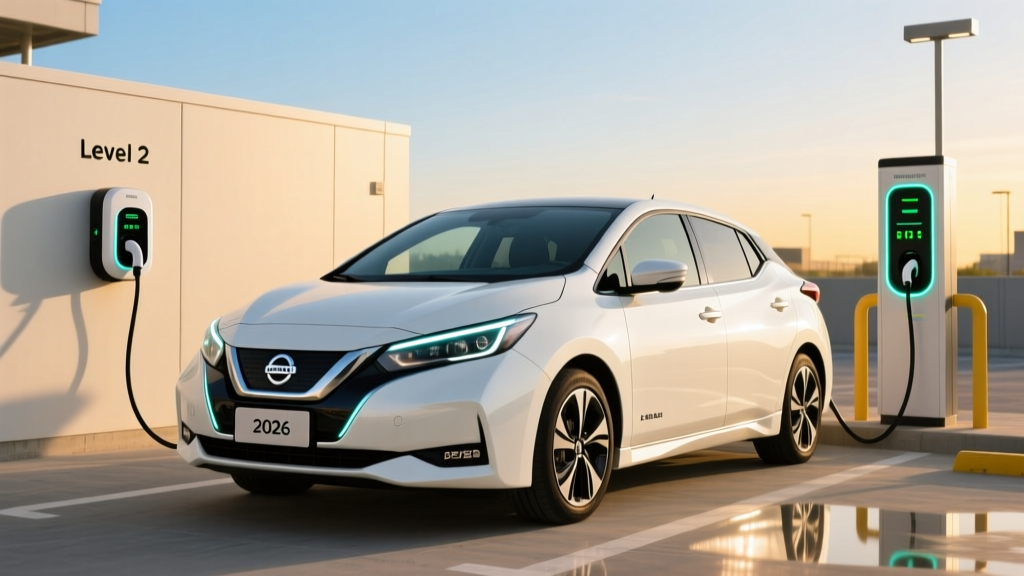
The LEAF uses the CHAdeMO connector for DC fast charging and a J1772 connector for Level 1 and Level 2 AC charging. This matters because the broader EV industry has largely standardized on CCS1 and is now migrating to NACS (Tesla's connector). The LEAF remains the most prominent CHAdeMO vehicle sold in the US, which has real implications for public charging access.
| Level | Voltage / Power | Connector | Miles of Range Added per Hour | Typical Use Case |
|---|---|---|---|---|
| Level 1 | 120V / 1.4 kW | J1772 | ~3–5 mi/hr | Emergency / overnight trickle |
| Level 2 | 240V / 6.6 kW | J1772 | ~22–25 mi/hr | Home daily charging |
| DC Fast | Up to 50 kW (40 kWh) / 100 kW (60 kWh) | CHAdeMO | ~90–170 mi in 30 min | Road trips / public stations |
Charging Time Examples: 10–80% State of Charge
- LEAF S (40 kWh) on Level 2 (6.6 kW): ~4.5 hours from 10–80%
- LEAF SV Plus (60 kWh) on Level 2 (6.6 kW): ~6.5 hours from 10–80%
- LEAF S (40 kWh) on 50 kW DC fast: ~40 minutes from 10–80%
- LEAF SV Plus (60 kWh) on 100 kW DC fast: ~45 minutes from 10–80%
Charge curve reality check: The LEAF's DC fast charging rate peaks early in the session and tapers significantly above 80% SoC. The 60 kWh model may hit 100 kW briefly at low SoC, but sustained average is closer to 55–65 kW across the full 10–80% window. Plan your road-trip stops accordingly.
Home Charger Installation: Electrical Requirements and Costs
How much does it cost to install a home EV charger? For a Level 2 setup capable of fully utilizing the LEAF's 6.6 kW onboard charger, expect a total project cost between $800 and $3,500+, depending on your home's electrical panel and the distance from panel to charger location.
| Component | Low Estimate | High Estimate | Notes |
|---|---|---|---|
| Level 2 Charger (hardware) | $300 | $700 | 32A–40A, J1772 connector, 20–25 ft cable |
| Electrician labor | $300 | $1,500 | Depends on run length, wall type, conduit |
| Electrical permit | $50 | $200 | Required in most jurisdictions |
| Panel upgrade (if needed) | $1,500 | $3,500+ | 100A → 200A service upgrade for older homes |
| Total (no panel upgrade) | $650 | $2,400 | Typical scenario for modern homes |
| Total (with panel upgrade) | $2,150 | $5,900+ | Older homes with 100A or less service |
Electrical Requirements for the LEAF
The LEAF's onboard charger maxes out at 6.6 kW, which translates to 240V on a 30-amp circuit (or 27.5A continuous draw, since the NEC requires circuits to be rated at 125% of continuous load). A 40A circuit with a 32A charger is the sweet spot — it gives you headroom and future-proofs for a next EV with a larger onboard charger.
Panel upgrade gotcha: Homes built before 1990 often have 100-amp electrical service. Adding a 40A EV circuit to an already-loaded 100A panel may require a full service upgrade to 200A. Get a load calculation from your electrician before committing. Some utilities offer rebates for panel upgrades tied to EV adoption — check with your local provider.
Connector Compatibility: CHAdeMO in a CCS/NACS World
Which connector and charger is compatible with my EV? For the LEAF, the answer is straightforward but comes with a long-term caveat:
| Connector | Type | LEAF Compatible? | Adapters Available? | Network Availability Trend |
|---|---|---|---|---|
| J1772 | AC (Level 1/2) | Yes (native) | N/A — standard | Universal on all non-Tesla AC chargers |
| CHAdeMO | DC Fast | Yes (native) | N/A | Declining — most new stations skip CHAdeMO |
| CCS1 | DC Fast | No (not compatible) | No reliable adapter exists | Widely available (EA, EVgo, etc.) |
| NACS (Tesla) | DC Fast / AC | No (not compatible) | CHAdeMO-to-NACS adapters limited/unavailable | Expanding rapidly (Supercharger network opening) |
The honest assessment: CHAdeMO's future in the US is uncertain. Electrify America still maintains CHAdeMO connectors at many stations, but new installations increasingly prioritize CCS1 and NACS. If DC fast charging access is critical to your use case (frequent road trips, no home charging), the LEAF's CHAdeMO limitation is a real ownership factor to weigh. For primarily home-charged daily driving, it's a non-issue since you'll use the universal J1772 connector.
Cost to Charge: LEAF vs Gas per Mile
How much does charging cost per mile vs gas? The LEAF's efficiency is rated at approximately 111 MPGe combined (SV Plus) or roughly 30 kWh per 100 miles. Using that figure:
| Scenario | Rate | Cost per 100 Miles | Cost per Mile |
|---|---|---|---|
| Home charging (off-peak utility rate) | $0.10/kWh | $3.00 | $0.03 |
| Home charging (national avg residential) | $0.16/kWh | $4.80 | $0.048 |
| Public Level 2 (network pricing) | $0.30/kWh | $9.00 | $0.09 |
| DC Fast Charging (public) | $0.40/kWh | $12.00 | $0.12 |
| Gas car (30 MPG, $3.50/gal) | $3.50/gal | $11.67 | $0.117 |
| Gas car (30 MPG, $4.50/gal) | $4.50/gal | $15.00 | $0.15 |
Even at public DC fast charging rates, the LEAF undercuts a 30 MPG gas car on a per-mile basis in most US markets. At home off-peak rates, the savings are dramatic — roughly 75% cheaper per mile than gasoline. Over 12,000 miles/year, home charging saves approximately $1,000–$1,400 annually vs gas at current prices.
Recommended Home Chargers for the Nissan LEAF
Since the LEAF maxes out at 6.6 kW AC charging, you don't need a 48A charger — but buying one future-proofs your garage for your next EV. Here are three solid options, all using the J1772 connector the LEAF requires:
Emporia Vue Smart Charger (40A)
- Power output: 9.6 kW max (LEAF will draw 6.6 kW)
- Connector: J1772 (24 ft cable)
- Smart features: Wi-Fi, scheduling, energy monitoring, solar integration
- Price: ~$399
- Best for: Budget-conscious buyers who want app control and energy tracking
ChargePoint Home Flex (50A)
- Power output: 12 kW max (adjustable down to 16A–50A)
- Connector: J1772 (23 ft cable)
- Smart features: Wi-Fi, Alexa, scheduling, charge session history
- Price: ~$649
- Best for: Versatile amperage settings, strong app ecosystem, future-proofing
Grizzl-E Smart (40A)
- Power output: 9.6 kW max
- Connector: J1772 (24 ft cable)
- Smart features: OCPP-compatible, app scheduling, firmware updates
- Price: ~$499
- Best for: Cold-climate durability (rated to -40°F), Canadian-built, rugged enclosure
Safety, Code, and Installation Best Practices
What electrical upgrades might I need? Beyond the panel question, proper EV charger installation involves several code and safety requirements:
- Dedicated circuit: Your Level 2 charger must be on its own dedicated breaker — no sharing with other outlets or appliances.
- GFCI protection: NEC 2020 and later requires GFCI protection for EV charging circuits in garages. Many modern chargers have built-in GFCI; confirm with your electrician to avoid nuisance tripping from double-GFCI setups.
- Outdoor rating: If installing outside, the charger must carry a NEMA 4 (or better) weather rating. All three chargers recommended above are outdoor-rated.
- Hardwired vs plug: Hardwired installations (no plug, direct wire to charger) are generally preferred for 40A+ circuits — they eliminate the failure point of a receptacle and may be required by code in some jurisdictions for circuits above 40A. A NEMA 14-50 receptacle offers portability but requires a 50A breaker.
- Permit and inspection: Nearly all jurisdictions require an electrical permit for new 240V circuits. The inspection ensures your install meets NEC standards — don't skip it. Unpermitted work can void home insurance claims.
LEAF Ownership Context: Pricing, Battery Warranty, and Tax Credits
For the 2025 model year, the Nissan LEAF starts at approximately $28,140 (S trim, 40 kWh) and $36,140 (SV Plus, 60 kWh) before destination. The LEAF's battery warranty covers 8 years / 100,000 miles against capacity loss below 9 bars (out of 12) on the capacity gauge — roughly equivalent to 66% of original capacity, which is a less generous threshold than the industry-standard 70%.
Federal tax credit status: Under current IRS §30D rules, the LEAF's eligibility for the up-to-$7,500 clean vehicle credit depends on battery component and critical mineral sourcing requirements that change annually. The LEAF has historically struggled to meet full credit thresholds due to battery sourcing. Check the fueleconomy.gov tax credit tracker for the latest eligibility before purchasing. Income caps ($150K single / $300K joint) and the point-of-sale transfer option also apply.
Frequently Asked Questions
What is Nissan LEAF range on the highway?
The 40 kWh LEAF S delivers roughly 120–135 real-world highway miles at 70–75 mph. The 60 kWh SV Plus manages about 175–195 miles under the same conditions. Both fall short of their EPA combined ratings because highway driving is less efficient for EVs (no regenerative braking benefit at steady speed, plus aerodynamic drag increases with the square of velocity).
Can I use a Tesla Supercharger with my Nissan LEAF?
Not directly. The LEAF uses CHAdeMO for DC fast charging, and Tesla Superchargers use NACS. As of early 2026, no reliable, widely available CHAdeMO-to-NACS adapter exists for consumer purchase. Tesla's Supercharger network opening to non-Tesla vehicles currently applies only to CCS1-equipped vehicles via Tesla's Magic Dock adapter at select stations.
How long does a Nissan LEAF battery last?
Nissan's lithium-ion packs have demonstrated reasonable longevity, but the air-cooled design leads to faster degradation than liquid-cooled competitors. Real-world data from LEAF owners suggests the 40 kWh pack may lose 15–25% capacity over 8 years in moderate climates, and more in hot climates (Arizona, Texas). The 60 kWh pack, with slightly better thermal mass, tends to degrade more slowly. Monitor your State of Health via the LEAF's dashboard capacity bars or the LeafSpy app with an OBD-II dongle.
Is a panel upgrade required for Level 2 charging?
Not always. If your home has 200-amp service and available breaker slots, a 40A dedicated circuit is typically straightforward. If you have 100-amp service (common in pre-1990 homes) or your panel is near capacity, a load calculation by a licensed electrician will determine whether an upgrade to 200A is necessary. Budget $1,500–$3,500 for a panel upgrade if needed.
How much does it cost to charge a Nissan LEAF at home per month?
At the national average residential rate of $0.16/kWh and driving 1,000 miles per month (300 kWh consumed at 30 kWh/100 mi), expect roughly $48/month in electricity. With off-peak time-of-use rates ($0.10/kWh), that drops to about $30/month. Compare this to $117–$150/month in gasoline for a 30 MPG vehicle at current fuel prices.