Nissan LEAF e+ 62 kWh: Power Output, HP, and Why Charging Setup Matters
The Nissan LEAF e+ (also badged LEAF PLUS in the US) packs a 62 kWh battery and a 160 kW (214 hp) electric motor — making it the most capable LEAF variant ever sold. But pairing that larger battery with the right charging infrastructure is where many owners stumble. The LEAF e+ uses the CHAdeMO DC fast-charging standard in a market rapidly shifting to NACS, and its 100 kW peak DC charge rate means you need the right home and public charging strategy to make the most of its 212-mile EPA range.
This guide covers everything a current or prospective LEAF e+ owner needs: exact charging speeds at every level, home installation requirements and costs, connector compatibility (including the Tesla/NACS adapter question), and what you'll actually pay per mile versus gas. We'll also break down the power output and HP figures buyers search for when cross-shopping the LEAF e+ against rivals.
Motor output: 160 kW / 214 hp / 250 lb-ft torque
Battery: 62 kWh usable, laminated lithium-ion (NMC chemistry)
EPA range: 212 miles (SV PLUS trim); expect ~175–190 mi highway, ~150–165 mi in cold weather
0–60 mph: ~6.8 seconds
On-board charger (Level 2): 6.6 kW (J1772)
DC fast charge peak: 100 kW (CHAdeMO)
MPGe: 111 city / 94 hwy / 104 combined (fueleconomy.gov)
Understanding kW vs kWh: The Single Most Important EV Distinction
Before we map out charging speeds, let's settle the most common EV confusion:
- kW (kilowatts) = power, or the rate of energy flow. Think of it as the width of a hose. A 100 kW DC charger delivers energy faster than a 6.6 kW Level 2 charger.
- kWh (kilowatt-hours) = energy, or the total amount stored. The LEAF e+ battery holds 62 kWh — that's the size of the "tank."
The LEAF e+ 62 kWh's power output rating of 160 kW (214 hp) refers to what the motor can deliver to the wheels. Its charging input is a separate figure: 6.6 kW on Level 2 AC, and up to 100 kW on DC fast charge. These numbers determine how quickly you refill that 62 kWh tank.
Charging Levels Explained: Speeds, Range Added, and LEAF e+ Times
| Level | Voltage / Amps | Power (kW) | Miles of Range / Hour | LEAF e+ 10–80% Time |
|---|---|---|---|---|
| Level 1 (120V outlet) | 120V / 12A | ~1.4 kW | ~4–5 mi/hr | ~42+ hours (not practical) |
| Level 2 (240V home/public) | 240V / 32A | 6.6 kW (LEAF max) | ~22–25 mi/hr | ~7 hours (10–80%) |
| DC Fast (CHAdeMO) | 400V+ DC | 100 kW peak | ~180–200 mi/hr (peak) | ~45 minutes (10–80%) |
Real-world charging curve reality: The LEAF e+ peaks near 100 kW only between roughly 10–40% State of Charge (SoC). Above 60%, the rate tapers significantly — often dropping below 40 kW by 80%. This is normal lithium-ion behavior managed by the Battery Management System (BMS) to protect cell longevity, but it means a "100 kW charger" does not deliver 100 kW for the full session. Plan road-trip stops around 10–70% for the fastest throughput, then top off more slowly if needed.
Level 1 warning for the 62 kWh battery: At 1.4 kW, Level 1 charging adds roughly 50 miles overnight (10 hours). For a 212-mile battery, a full Level 1 charge from empty takes over 40 hours. Level 1 works as a maintenance trickle if your daily driving is under 30 miles, but it's inadequate as a primary charging strategy for the e+.
Home Charger Installation: Electrical Requirements, Costs, and Panel Upgrades
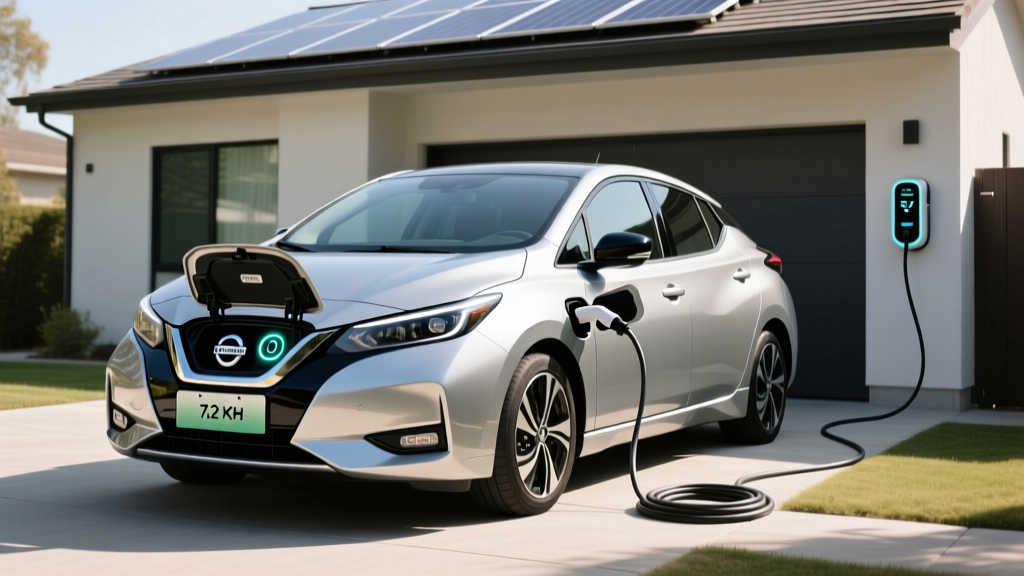
The LEAF e+ has a 6.6 kW on-board charger, which means it can accept up to 32 amps at 240 volts. You don't need a 48A or 80A charger — the car will cap intake at 6.6 kW regardless. A properly sized 40-amp circuit with a 32A continuous-draw charger is the sweet spot.
Electrical Requirements for a LEAF e+ Home Charger
- Circuit: Dedicated 240V / 40-amp breaker (supports 32A continuous draw per NEC 80% rule)
- Wire gauge: 8 AWG copper (or 6 AWG aluminum) for runs up to 50 feet; larger gauge for longer runs
- Outlet option: NEMA 14-50 (if using a plug-in charger) or hardwired connection (preferred for reliability and to avoid GFCI nuisance trips)
- Panel capacity: Your main panel must have room for a double-pole 40A breaker and sufficient total load capacity
Do You Need a Panel Upgrade?
This is the hidden cost that catches many homeowners off guard. If your home has a 100-amp main panel (common in pre-1990 construction), adding a 40A EV circuit may exceed your panel's capacity — especially if you're also running electric range, dryer, and HVAC. A licensed electrician will perform a load calculation per NEC Article 220 to determine if an upgrade to 200A service is needed.
| Component | Low Estimate | High Estimate | Notes |
|---|---|---|---|
| Level 2 charger (hardware) | $300 | $700 | J1772 connector, 32A, 240V |
| Electrician labor (standard install) | $500 | $1,500 | Short run from panel, no upgrades |
| Permit & inspection | $50 | $300 | Varies by municipality |
| Panel upgrade (if needed, 100A → 200A) | $1,500 | $4,000 | Older homes; not always required |
| Total (no panel upgrade) | $850 | $2,500 | Most newer homes |
| Total (with panel upgrade) | $2,350 | $6,500 | Older or high-load homes |
Federal incentive note: The IRS §30D residential clean energy credit previously covered 30% of home charger equipment and installation costs (up to $1,000). As of 2026, this credit has expired for most taxpayers unless renewed by Congress. Check irs.gov for current status. Some utilities and states still offer rebates — check your local provider.
Connector Compatibility: CHAdeMO, NACS, and the LEAF's Adapter Challenge
The Nissan LEAF e+ uses two connectors:
- J1772 for Level 1 and Level 2 AC charging (the universal North American AC standard)
- CHAdeMO for DC fast charging (the Japanese-origin standard)
This is a critical ownership factor in 2026. The EV charging industry has overwhelmingly adopted NACS (North American Charging Standard) — Tesla's connector, now used by Ford, GM, Rivian, Hyundai, and most major automakers. Electrify America, EVgo, and other networks are adding NACS cables, and some new stations are NACS-only.
| Connector | Use Case | LEAF e+ Compatible? | Adapter Available? |
|---|---|---|---|
| J1772 | Level 1 & 2 AC (home, public) | ✅ Native | Not needed |
| NACS (Tesla) | Level 2 AC (Tesla destinations) | ⚠️ With adapter | Yes — J1772-to-NACS adapters ~$150–250 |
| CHAdeMO | DC fast charging | ✅ Native | Not needed |
| CCS1 | DC fast charging (legacy non-Tesla) | ❌ Not compatible | No safe CHAdeMO↔CCS adapter exists |
| NACS (DC / Supercharger) | Tesla Supercharger DC fast | ❌ Not compatible | No CHAdeMO-to-NACS DC adapter exists |
Level 2 Charger Equipment Recommendations for the LEAF e+
Since the LEAF e+ caps AC intake at 6.6 kW (32A), you don't need an expensive 48A or 80A unit. Here are proven options matched to the car's capabilities:
Power: 48A max (LEAF draws 32A)
Connector: J1772
Cable: 24 ft
Smart features: Wi-Fi, app scheduling, solar integration, energy monitoring
Price: ~$399
Best for: Budget-conscious buyers who want smart scheduling for off-peak rates
Power: Up to 50A (adjustable; set to 40A circuit)
Connector: J1772
Cable: 23 ft
Smart features: Wi-Fi, Alexa, app control, charge scheduling, Alexa integration
Price: ~$549
Best for: Reliable brand with strong app ecosystem and UL certification
Power: 40A max
Connector: J1772
Cable: 24 ft
Smart features: OCPP-compatible, app control, firmware updates
Price: ~$449
Best for: Cold-climate durability (rated to -40°F), rugged build
Power: 40A (32A continuous)
Connector: J1772
Cable: 25 ft
Smart features: Wi-Fi, app scheduling, energy tracking
Price: ~$499
Best for: Simple setup, long cable, proven track record
Key selection criteria: All four chargers above deliver at least 32A / 6.6 kW — matching the LEAF e+'s on-board charger maximum. Choosing a 40A or 48A unit future-proofs your install if you later switch to a vehicle with a higher AC acceptance rate (many newer EVs accept 11.5 kW or 19.2 kW AC).
Cost to Charge the LEAF e+: Per-Mile Economics vs Gas
The LEAF e+ achieves roughly 3.0–3.3 miles per kWh in mixed driving (based on its 104 MPGe combined EPA rating). Let's translate that into real costs.
| Charging Scenario | $/kWh | Cost / Mile | Full 62 kWh Charge |
|---|---|---|---|
| Home (off-peak utility rate) | $0.08–$0.12 | $0.025–$0.037 | $4.96–$7.44 |
| Home (standard residential avg) | $0.15–$0.18 | $0.047–$0.056 | $9.30–$11.16 |
| Public Level 2 (network pricing) | $0.25–$0.40 | $0.078–$0.125 | $15.50–$24.80 |
| DC Fast (CHAdeMO public) | $0.35–$0.55 | $0.11–$0.17 | $21.70–$34.10 |
| Gas car comparison (28 MPG, $3.40/gal) | — | $0.121 | — |
The takeaway: Charging at home on off-peak rates makes the LEAF e+ roughly 3–4× cheaper per mile than a comparable gas car. Public DC fast charging at peak rates can approach or exceed gas costs per mile — which is why home Level 2 charging is the economic backbone of EV ownership.
For a driver covering 12,000 miles/year with 80% home charging at $0.12/kWh and 20% public DC at $0.45/kWh, annual fuel cost runs approximately $620. A gas car at 28 MPG and $3.40/gallon would cost $1,457 — a savings of over $800/year with the LEAF e+.
Safety, Electrical Code, and Best Practices
Home EV charging is safe when installed correctly, but cutting corners creates fire and shock risk. Follow these non-negotiables:
- Dedicated circuit: Your Level 2 charger must be on its own dedicated breaker — never shared with other appliances. NEC 625.41 requires this.
- GFCI considerations: NEC 2020+ requires GFCI protection for 14-50 receptacles in garages. However, GFCI breakers can nuisance-trip with some EV chargers. Many electricians recommend hardwiring the charger (which exempts it from the receptacle GFCI requirement) for more reliable operation.
- Outdoor rating: If your charger is mounted outside, ensure it carries a NEMA 4 (weatherproof) rating. All chargers recommended above are outdoor-rated.
- Permit and inspection: Most jurisdictions require an electrical permit for a new 240V circuit. Skipping this can void homeowner's insurance coverage for electrical fires. Budget $50–$300 and schedule the inspection.
- Cable management: Use a holster or cable organizer to keep the charging cable off the ground — prevents damage, tripping hazards, and water exposure at the connector end.
- Never use extension cords: EV charging draws sustained high current. Extension cords (even heavy-duty ones) create voltage drop and heat buildup.
Frequently Asked Questions: Nissan LEAF e+ Charging
How much does it cost to install a home EV charger for the LEAF e+?
A standard Level 2 installation (40A circuit, short wire run, no panel upgrade) typically costs $850–$2,500 including equipment, electrician labor, and permit. If your home needs a panel upgrade from 100A to 200A service, add $1,500–$4,000. Get at least two quotes from licensed electricians and confirm they perform a NEC Article 220 load calculation.
How fast will each charging level add range to my LEAF e+?
Level 1 (120V): roughly 4–5 miles per hour. Level 2 (240V, 32A): roughly 22–25 miles per hour — a full overnight session adds 150+ miles. DC fast charging (CHAdeMO, 100 kW peak): can add up to ~90 miles in 20 minutes under ideal conditions, but the charge curve tapers significantly above 60% SoC.
Which connector and charger is compatible with my LEAF e+?
For Level 1 and Level 2 AC charging, the LEAF e+ uses the J1772 connector — universal across all non-Tesla EVs in North America. Any J1772 Level 2 charger works. For DC fast charging, the LEAF uses CHAdeMO. There is no adapter to use CCS1 or NACS DC fast chargers with a LEAF. A J1772-to-NACS adapter (~$150–250) lets you use Tesla destination chargers (Level 2 AC only), but not Tesla Superchargers.
How much does charging the LEAF e+ cost per mile versus gas?
At home off-peak rates ($0.10/kWh), the LEAF e+ costs roughly $0.03 per mile. At standard residential rates ($0.16/kWh), about $0.05 per mile. A comparable gas car at 28 MPG and $3.40/gallon costs about $0.12 per mile. Home charging saves 60–75% per mile; public DC fast charging at $0.45/kWh costs roughly $0.14 per mile — slightly more than gas.
What electrical upgrades might I need for a home charger?
Most homes with a 200A panel and available breaker slots need only a new 240V/40A circuit — no major upgrade. Homes with 100A panels, full breaker panels (no physical space), or high existing electrical loads may need a panel upgrade to 200A service, a sub-panel addition, or a load-management device (like the Emporia Vue with smart load balancing). Your electrician's load calculation will determine this.
Does the LEAF e+ battery degrade, and does charging speed affect it?
All lithium-ion batteries degrade. The LEAF e+ uses passive (air-cooled) battery thermal management rather than liquid cooling, which makes it more susceptible to heat-related degradation from repeated DC fast charging in hot climates. Nissan covers the battery for 8 years/100,000 miles against capacity loss below 9 bars (out of 12) on the capacity gauge. To maximize longevity: favor Level 2 home charging, avoid frequent 100% charges (80% daily is ideal), and minimize DC fast charging in high ambient temperatures.
Is the Nissan LEAF e+ still worth buying in 2026 given the CHAdeMO situation?
It depends on your use case. If you primarily commute under 60 miles daily and charge at home, the LEAF e+ remains a solid, affordable used-EV option — many 2019–2023 models are available for $14,000–$22,000 and may qualify for the used clean vehicle credit (up to $4,000, income-limited). For frequent road trips, the declining CHAdeMO infrastructure is a legitimate limitation compared to NACS-equipped vehicles with Supercharger access.
Sources: EPA fueleconomy.gov — Nissan LEAF SV PLUS, Nissan USA LEAF specifications, IRS Residential Clean Energy Credit.