For Nissan Leaf owners, maximizing driving range isn't just about how you drive—it's fundamentally about how you charge. While the Leaf's EPA-estimated range peaks at 212 miles for the SV Plus trim (and 149 miles for the standard S trim), real-world range can fluctuate based on charging habits, battery health, and infrastructure access. This guide breaks down exactly how to charge a Nissan Leaf at home and on the road to preserve battery longevity and extract every usable mile from its lithium-ion pack.
Understanding Nissan Leaf Battery Specs and Real-World Range
Before plugging in, know what you're working with. The 2025 Nissan Leaf comes in two battery configurations:
- Standard (S trim): 40 kWh usable battery, 149 miles EPA range, 114 MPGe combined
- Plus (SV Plus trim): 60 kWh usable battery, 212 miles EPA range, 109 MPGe combined
Real-World Range Reality: EPA estimates assume mixed driving at moderate temperatures. Expect 120–135 miles highway from the 40 kWh pack and 170–190 miles from the 60 kWh pack at 70 mph. In cold weather (below 32°F), range can drop 20–30% due to battery chemistry limitations and cabin heating demands. The Leaf uses passive air cooling on the standard battery and liquid cooling on Plus models, which affects sustained fast-charging performance.
The Leaf's battery chemistry is NMC (nickel manganese cobalt), which offers higher energy density than LFP but is more sensitive to heat and sustained 100% state-of-charge storage. Nissan provides an 8-year/100,000-mile battery warranty covering capacity loss below 66% of original capacity—among the more conservative thresholds in the industry.
Charging Levels Explained: kW, Miles Per Hour, and Leaf Compatibility
EV charging is measured in kilowatts (kW)—the rate of power delivery—not kilowatt-hours (kWh), which is the energy stored. Confusing these is the most common EV literacy mistake. Here's how each level performs with the Leaf:
| Level | Power Source | Max kW | Miles Added/Hour | 10–80% Time (60 kWh) |
|---|---|---|---|---|
| Level 1 | 120V standard outlet | 1.2–1.4 kW | 4–5 miles | ~48 hours |
| Level 2 | 240V dedicated circuit | 6.6 kW (Leaf onboard limit) | 22–25 miles | ~7–8 hours |
| DC Fast | 480V public station | 50 kW (CHAdeMO) / 100 kW (newer Plus) | 150–180 miles | ~40–60 minutes |
Critical Leaf Limitation: The Leaf's onboard charger maxes out at 6.6 kW AC. Even if you install a 48-amp (11.5 kW) Level 2 charger, the Leaf will only draw 6.6 kW. This means investing in a higher-output charger won't speed up home charging for the Leaf specifically—but it may benefit a future EV or a second vehicle.
Home Level 2 Charger Installation: Electrical Requirements and Costs
Level 2 home charging is the practical sweet spot for Leaf owners. Here's what's required:
- Electrical spec: 240V dedicated circuit, 30-amp breaker minimum (supports 24A continuous draw, matching the Leaf's 6.6 kW limit). A 40-amp circuit (32A continuous) provides headroom for future vehicles.
- Wiring: 10 AWG copper for 30A circuits; 8 AWG for 40A circuits.
- Panel capacity: Your electrical panel must have two available slots and sufficient amperage headroom (typically 200A service for modern homes). Older homes with 100A panels often need an upgrade.
- Permits: Most jurisdictions require an electrical permit and post-install inspection. This is non-negotiable for insurance and code compliance.
| Component | Typical Cost Range | Notes |
|---|---|---|
| Level 2 EVSE (charger unit) | $350–$700 | Smart WiFi-enabled models |
| Electrician labor | $500–$2,000 | Varies by wire run distance |
| Electrical permit | $50–$200 | Local jurisdiction dependent |
| Panel upgrade (if needed) | $1,500–$4,000 | Required for 100A or older panels |
| Total (no panel upgrade) | $900–$2,900 | Typical scenario |
| Total (with panel upgrade) | $2,400–$6,900 | Older homes |
Panel Upgrade Reality: If your home has a 100-amp panel, is over 30 years old, or already has high-draw appliances (electric oven, dryer, HVAC), budget for a panel upgrade. Get a quote from a licensed electrician before committing to a charger purchase. The federal §30D tax credit does not cover home charging equipment for 2025, though some state and utility programs do—check AFDC for local incentives.
Connector Compatibility: CHAdeMO vs. CCS vs. NACS
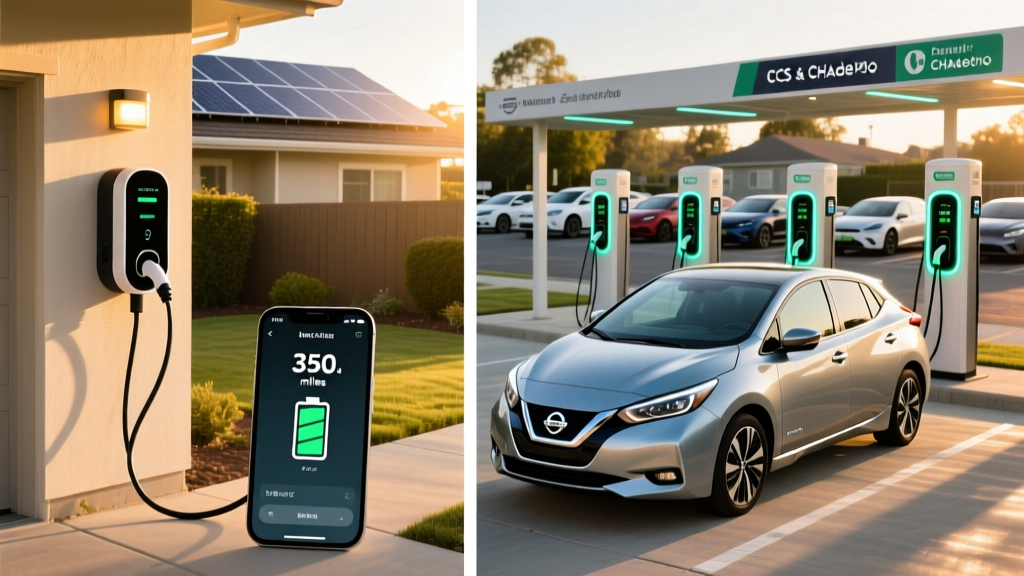
The Nissan Leaf uses the CHAdeMO connector for DC fast charging and the J1772 connector for Level 1/2 AC charging. This is increasingly an outlier as the North American market shifts toward NACS (Tesla's connector, now adopted by Ford, GM, Rivian, and others) and CCS1.
| Connector | Used By | Leaf Compatible? | Adapter Needed? |
|---|---|---|---|
| J1772 | Level 1/2 AC (most non-Tesla EVs) | Yes (native) | No |
| CHAdeMO | DC Fast (Leaf, Mitsubishi Outlander PHEV) | Yes (native) | No |
| CCS1 | DC Fast (GM, Ford, VW, Hyundai, Kia) | No | No reliable adapter exists |
| NACS (Tesla) | Tesla Superchargers, Ford, GM, Rivian | No | No adapter for DC fast |
The CHAdeMO Challenge: CHAdeMO infrastructure is shrinking in the U.S. as networks prioritize CCS and NACS. Before purchasing a Leaf, verify DC fast-charger availability along your common routes using apps like PlugShare. If you frequently drive corridors with limited CHAdeMO coverage, the Leaf's fast-charging utility is significantly reduced.
Cost to Charge: Home vs. Public vs. Gas Comparison
Charging economics depend heavily on where and when you plug in. Here's the cost breakdown for a 60 kWh Leaf Plus (assuming 85% charging efficiency):
| Scenario | $/kWh | Full Charge Cost | Cost Per Mile |
|---|---|---|---|
| Home (off-peak utility rate) | $0.12 | $7.20 | $0.034 |
| Home (peak rate, no TOU plan) | $0.22 | $13.20 | $0.062 |
| Public Level 2 (ChargePoint, EVgo) | $0.35 | $21.00 | $0.099 |
| DC Fast (Electrify America, EVgo) | $0.48 | $28.80 | $0.136 |
| Gas car (25 MPG, $3.50/gal) | — | — | $0.140 |
Key Insight: Home off-peak charging makes the Leaf roughly 4x cheaper per mile than a comparable gas car. However, exclusive reliance on DC fast charging nearly erases the cost advantage. Time-of-use (TOU) utility plans are essential for maximizing savings—schedule charging for overnight hours (typically 11 PM–6 AM).
Recommended Level 2 Chargers for Nissan Leaf
Given the Leaf's 6.6 kW onboard limit, prioritize reliability, cable length, and smart features over raw power output:
ChargePoint Home Flex
- Power Output: Up to 12 kW (50A), configurable down to 6.6 kW (30A) for Leaf optimization
- Connector: J1772 (native Leaf compatible)
- Cable Length: 23 feet
- Smart Features: WiFi, app scheduling, Alexa integration, energy tracking
- Price: $599–$699
- Verdict: Best overall for smart scheduling and utility TOU integration
Emporia Level 2 EV Charger
- Power Output: Up to 11.5 kW (48A), adjustable
- Connector: J1772
- Cable Length: 24 feet
- Smart Features: WiFi, real-time energy monitoring, solar integration
- Price: $399–$449
- Verdict: Best value with excellent energy monitoring
Grizzl-E Smart
- Power Output: Up to 10 kW (40A)
- Connector: J1772
- Cable Length: 24 feet
- Smart Features: WiFi, OCPP protocol (future-proof for utility programs)
- Price: $499–$549
- Verdict: Rugged build, ideal for outdoor/garage installs in extreme climates
Safety, Code, and Maintenance Considerations
Level 2 charger installation must comply with NEC (National Electrical Code) Article 625:
- Dedicated circuit: The EVSE must have its own breaker—no shared circuits with other appliances.
- GFCI protection: Required for outdoor installations; recommended (and often mandated) for indoor garage installs.
- Outdoor rating: If installing outside, the EVSE must be NEMA 4 rated (weatherproof). All recommended chargers above meet this standard.
- Cable management: Use a holster or retractable reel to prevent tripping hazards and cable damage.
Leaf Battery Care Tip: Avoid routinely charging to 100% unless you need the full range for a trip. Set your Leaf's charge timer or use your EVSE's app to stop at 80–85% for daily use. This significantly slows long-term degradation. The Leaf's battery management system (BMS) includes a top-end buffer, but minimizing time at 100% state-of-charge extends NMC chemistry lifespan.
Frequently Asked Questions
How much does it cost to install a home EV charger for a Nissan Leaf?
Expect $900–$2,900 for a typical installation (charger + electrician + permit) if your electrical panel has capacity. If a panel upgrade is needed, costs rise to $2,400–$6,900. The Leaf's 6.6 kW limit means you can use a 30-amp circuit, which is less expensive than the 50-amp circuits required by higher-power EVs.
How fast will each charging level add range to my Leaf?
Level 1 (120V): 4–5 miles per hour. Level 2 (240V): 22–25 miles per hour. DC Fast (CHAdeMO): 150–180 miles in 30 minutes under ideal conditions, though charging slows significantly above 80% state-of-charge due to the Leaf's charge curve taper.
Which connector and charger is compatible with my Nissan Leaf?
For home Level 1/2 charging, any J1772 connector works natively. For DC fast charging, the Leaf requires CHAdeMO stations. There is no reliable adapter to use CCS or NACS (Tesla Supercharger) DC fast chargers with the Leaf.
How much does charging cost per mile vs. gas?
With home off-peak charging at $0.12/kWh, the Leaf costs approximately $0.034 per mile—about 4x cheaper than a 25 MPG gas car at $3.50/gallon ($0.14/mile). Public DC fast charging at $0.48/kWh raises the cost to $0.136/mile, nearly matching gas.
What electrical upgrades might I need for a Level 2 charger?
If your home has a 100-amp electrical panel, is over 30 years old, or already has multiple high-draw electric appliances, you likely need a panel upgrade to 200 amps ($1,500–$4,000). A licensed electrician can assess your panel's available amperage and breaker slots before installation.
Does the Nissan Leaf qualify for the federal EV tax credit?
As of 2025, new Nissan Leaf purchases may qualify for up to $3,750 under IRS §30D, depending on battery sourcing requirements, buyer income caps ($150K single / $300K joint), and MSRP limits ($55K for cars). The Leaf's MSRP falls well under the cap. Verify current eligibility at IRS.gov, as critical mineral sourcing rules change annually.
For official range and efficiency data, refer to fueleconomy.gov. For charging infrastructure and incentive lookup, use the Alternative Fuels Data Center.