The Nissan Leaf remains one of the most accessible battery-electric vehicles on the US market, and for 2026 it continues to offer two battery configurations that serve distinctly different driving needs. But buying a Leaf is only half the equation — understanding how to charge it efficiently at home, what connectors you're dealing with, and what your real costs per mile will look like determines whether ownership is a smooth experience or a frustrating one.
This guide breaks down the 2026 Nissan Leaf range, charging speeds at every level, home installation requirements and costs, connector compatibility (including the CHAdeMO situation), and the real cost-per-mile math versus gasoline. We'll also recommend specific Level 2 equipment that pairs well with the Leaf's onboard charger limitations.
2026 Nissan Leaf Range, Battery & Efficiency Specs
For 2026, Nissan offers the Leaf in two primary configurations. The standard Leaf S carries a 40 kWh battery pack (usable capacity), while the Leaf SV PLUS steps up to a 60 kWh pack. Both use lithium-ion NMC (nickel manganese cobalt) chemistry — not the LFP (lithium iron phosphate) packs becoming common in some competitors.
| Spec | Leaf S (40 kWh) | Leaf SV PLUS (60 kWh) |
|---|---|---|
| EPA Range | 149 miles | 212 miles |
| Battery Chemistry | NMC Lithium-Ion | NMC Lithium-Ion |
| Motor Output | 110 kW (147 hp) | 160 kW (214 hp) |
| 0–60 mph | ~7.9 sec | ~6.5 sec |
| EPA Efficiency (Combined) | 111 MPGe | 109 MPGe |
| Max DC Fast Charge Rate | 50 kW (CHAdeMO) | 50 kW (CHAdeMO) |
| Onboard AC Charger | 6.6 kW | 6.6 kW |
| Battery Warranty | 8 yr / 100,000 mi | 8 yr / 100,000 mi |
| Base MSRP | ~$28,140 | ~$36,190 |
Charging Levels Explained: How Fast Will Each Level Add Range?
Understanding the three charging levels is essential for any Leaf owner. A critical distinction: kW (kilowatts) measures power — how fast energy flows into the battery. kWh (kilowatt-hours) measures energy — the total capacity of the battery itself. Think of kW as the flow rate of a hose and kWh as the size of the bucket.
| Level | Voltage / Amperage | Power (kW) | Miles of Range Added Per Hour | Full Charge Time (0–100%) |
|---|---|---|---|---|
| Level 1 (Standard Outlet) | 120V / 12A | ~1.4 kW | ~4–5 miles | ~43 hours |
| Level 2 (Home/Public AC) | 240V / 32A | 6.6 kW (Leaf max) | ~22–25 miles | ~9.5 hours |
| DC Fast Charging (CHAdeMO) | 400V+ DC | 50 kW peak | ~150–180 miles (in 30 min) | 10–80% in ~45 min |
Level 1 is a last-resort option. Plugging into a standard 120V household outlet using the Leaf's included trickle-charge cable adds roughly 4–5 miles of range per hour. It's fine for topping off a PHEV, but for a 60 kWh BEV, a full charge takes nearly two days. Use this only for overnight emergencies or if your daily commute is under 20 miles.
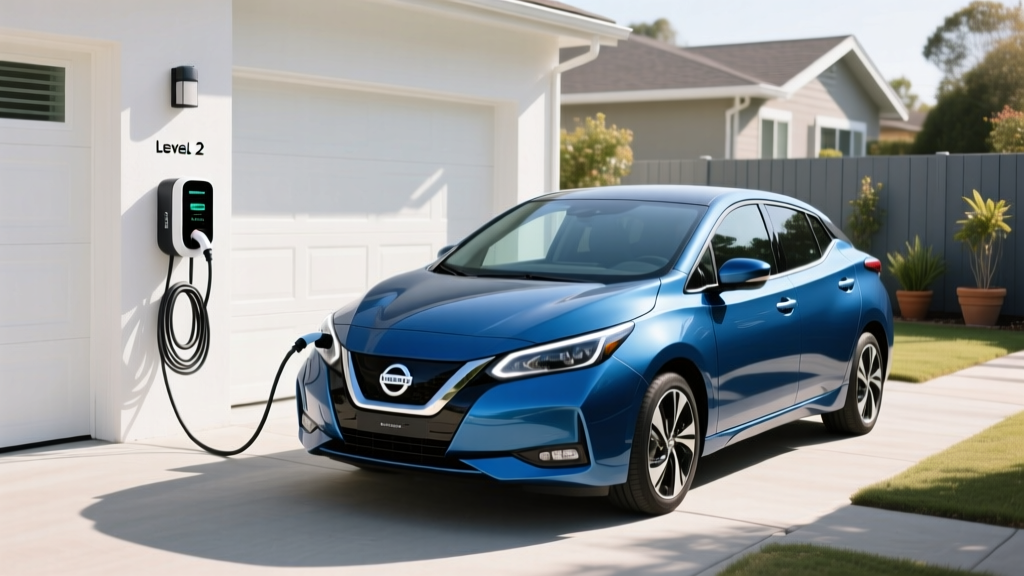
Level 2 is the backbone of practical EV ownership. A 240V circuit — the same voltage as an electric dryer — delivers 6.6 kW to the Leaf (its onboard charger caps at this rate, so a 48A charger won't charge it any faster). This adds roughly 22–25 miles per hour, meaning a full overnight charge easily replenishes the battery.
DC Fast Charging bypasses the onboard charger entirely, sending direct current straight to the battery. The Leaf uses the CHAdeMO connector standard and peaks at approximately 50 kW. A 10–80% charge takes roughly 45 minutes. Note that the Leaf's lack of active thermal management means repeated DC fast charges in hot weather can trigger charge-speed throttling to protect the battery — a phenomenon known as "Rapidgate" that Nissan has partially addressed via software updates but hasn't fully eliminated.
Home Level 2 Charger Installation: Requirements, Costs & Upgrades
Installing a Level 2 charger at home is the single most impactful upgrade for daily EV convenience. Here's what's involved electrically and financially.
Electrical Requirements
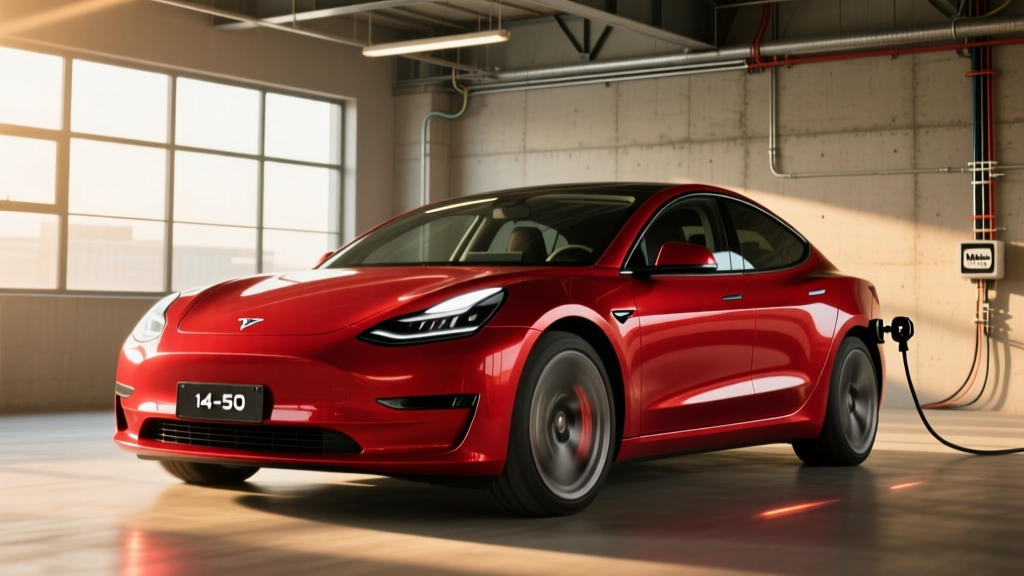
The Leaf's 6.6 kW onboard charger means you need a 240V circuit rated for at least 30 amps (a 32A continuous draw requires a 40A breaker per NEC code, which mandates circuits be rated 125% above continuous load). A NEMA 14-50 outlet or a hardwired wall unit are the two standard approaches.
- Panel capacity: Your home's electrical panel must have sufficient amperage headroom. Most modern homes with 200A service can accommodate a 40A EV circuit without issue. Older homes with 100A panels may require a panel upgrade — a significant added cost.
- Dedicated circuit: The EV charger must be on its own dedicated breaker — not shared with other appliances.
- GFCI protection: NEC 2020 and later require GFCI (Ground Fault Circuit Interrupter) protection for EV charging outlets in garages. Hardwired units typically have this built in.
- Outdoor rating: If your charger is installed outdoors (carport, driveway), the unit and outlet must carry a NEMA 4 or NEMA 4X weather-resistance rating.
- Permit: Most jurisdictions require an electrical permit for a new 240V circuit. Your electrician typically pulls this, and a city inspector verifies the work.
How Much Does It Cost to Install a Home EV Charger?
Costs vary widely based on your home's electrical infrastructure, the distance from panel to charger location, and local labor rates. Here's a realistic breakdown:
| Component | Simple Install (Panel Adjacent) | Complex Install (Long Run / Panel Upgrade) |
|---|---|---|
| Level 2 Charger Unit | $300–$600 | $400–$700 |
| Electrician Labor | $300–$600 | $1,000–$2,500 |
| Electrical Permit | $50–$150 | $50–$200 |
| Panel Upgrade (if needed) | $0 | $1,500–$3,500 |
| Conduit, Wiring, Misc. | $50–$200 | $200–$600 |
| Total Estimated Cost | $700–$1,550 | $3,150–$7,500 |
Recommended Level 2 Chargers for the Nissan Leaf
Because the Leaf's onboard charger maxes out at 6.6 kW (approximately 32A at 240V), you don't need to overspend on a 48A or 80A unit. A quality 32A charger perfectly matches the Leaf's capability. That said, buying a 40A or 48A unit provides future-proofing if you upgrade to a vehicle with a larger onboard charger later.
Emporia Vue Level 2 Charger
- Power Output: 48A max (11.5 kW) — Leaf will draw 32A / 6.6 kW
- Connector: J1772 (directly compatible with Leaf)
- Cable Length: 24 ft
- Smart Features: Wi-Fi, energy monitoring via Emporia app, scheduled charging, solar integration
- Price: ~$399
- Best For: Budget-conscious buyers wanting smart features and energy tracking
ChargePoint Home Flex
- Power Output: Configurable up to 50A (12 kW) — set to 32A for Leaf or higher for future vehicles
- Connector: J1772
- Cable Length: 23 ft
- Smart Features: Wi-Fi, ChargePoint app, Alexa integration, flexible amperage settings
- Price: ~$549
- Best For: Flexibility and ecosystem reliability; strong public-network brand
Enel X JuiceBox 48
- Power Output: 48A max (11.5 kW)
- Connector: J1772
- Cable Length: 25 ft
- Smart Features: Wi-Fi, JuiceNet app, energy scheduling, usage reports
- Price: ~$499
- Best For: Mid-range option with solid build quality and scheduling controls
All three units use the J1772 connector, which is natively compatible with the Nissan Leaf's AC charging port. No adapter is needed for Level 2 home or public AC charging.
Connector Compatibility: CHAdeMO, CCS & the NACS Question
The 2026 Nissan Leaf occupies a unique — and increasingly awkward — position in the connector landscape. Here's the situation:
| Connector Type | Use Case | Leaf Compatibility | Adapter Needed? |
|---|---|---|---|
| J1772 | Level 1 & Level 2 AC charging | ✅ Native | No |
| CHAdeMO | DC Fast Charging | ✅ Native | No |
| CCS1 (Combo) | DC Fast Charging (most non-Tesla EVs) | ❌ Not compatible | No reliable CHAdeMO→CCS adapter exists |
| NACS (Tesla) | Tesla Supercharger network | ❌ Not compatible | No — Tesla's adapter program covers CCS vehicles, not CHAdeMO |
This is the Leaf's most significant limitation in 2026. The broader EV industry has standardized on CCS1 for DC fast charging (and is now transitioning to NACS, the Tesla connector, which Ford, GM, Rivian, Hyundai, and most others have adopted). CHAdeMO — the DC fast standard the Leaf has used since its 2011 debut — is effectively a legacy connector in the US market.
What this means practically: CHAdeMO-equipped DC fast chargers are still available at many Electrify America, EVgo, and older ChargePoint stations, but new installations overwhelmingly favor CCS and NACS. If you frequently road-trip, the Leaf's CHAdeMO-only DC fast charging limits your options compared to CCS or NACS vehicles. You'll want to plan routes using apps like PlugShare or A Better Routeplanner and filter for CHAdeMO-compatible stations.
There is currently no commercially available adapter that converts a CHAdeMO vehicle to CCS or NACS for DC fast charging. The electrical protocols and communication handshakes differ fundamentally. Do not attempt to use unofficial adapters — they pose serious safety and battery-damage risks.
Cost to Charge: Per-Mile Math vs. Gasoline
One of the strongest arguments for the Leaf is operating cost. Let's break down the real numbers.
| Scenario | Rate ($/kWh) | Cost for Full Charge (0–100%) | Cost Per Mile (212 mi range) |
|---|---|---|---|
| Home — Off-Peak Utility Rate | $0.09 | $5.40 | $0.025 |
| Home — Average US Residential | $0.16 | $9.60 | $0.045 |
| Public Level 2 (ChargePoint, etc.) | $0.25–$0.39 | $15.00–$23.40 | $0.07–$0.11 |
| DC Fast Charging (EVgo, EA) | $0.35–$0.55 | $21.00–$33.00 | $0.10–$0.16 |
For comparison, a gasoline vehicle averaging 28 MPG at $3.40/gallon costs approximately $0.12 per mile in fuel alone. The Leaf charged at home at average residential rates costs roughly $0.045 per mile — about 62% less per mile. Even at public DC fast charging rates, the Leaf is typically cheaper per mile than a gas car, though the margin narrows considerably.
Over 15,000 annual miles, home-charging the Leaf at $0.16/kWh costs approximately $680 per year in electricity. The equivalent gas car burns $1,821 per year in fuel. That's an annual savings of roughly $1,140 — or $5,700 over five years — before factoring in the Leaf's reduced maintenance costs (no oil changes, fewer brake replacements due to regenerative braking).
According to fueleconomy.gov, the Leaf SV PLUS achieves 109 MPGe combined, making it one of the more efficient EVs in its class, though less efficient than the Hyundai Ioniq 6 or Tesla Model 3 due to its older platform aerodynamics.
DC Fast Charging Realities: Charge Curves & Thermal Limits
The Leaf's 50 kW peak DC fast charge rate is modest by 2026 standards — competitors like the Hyundai Ioniq 5 peak at 240 kW, and the Tesla Model 3 at 250 kW. But peak rate is only part of the story; the charge curve matters equally.
Here's what a typical CHAdeMO DC fast charge session looks like in the Leaf SV PLUS:
- 10–30% SoC: Charges near the 50 kW peak. Approximately 15 minutes.
- 30–60% SoC: Rate gradually tapers to ~40 kW. Approximately 20 minutes.
- 60–80% SoC: Further taper to ~25–30 kW. Approximately 15 minutes.
- 80–100% SoC: Very slow trickle — not recommended at DC fast stations. Charge to 80% and move on.
Total 10–80% time: approximately 45–50 minutes. This is significantly slower than the 18–20 minute 10–80% times offered by 800V-architecture vehicles on 350 kW chargers, but adequate for the Leaf's smaller battery and intended use case as a commuter and regional driver.
Federal Tax Credits & Incentives for Home Charging
The Alternative Fuel Vehicle Refueling Property Credit (IRS Form 8911) offers a credit of up to 30% of the cost of home EV charger installation, capped at $1,000, for equipment placed in service in a qualifying census tract (generally low-income or non-urban areas). This is separate from the §30D New Clean Vehicle Credit that may apply to the Leaf purchase itself.
For the vehicle credit, the Leaf's MSRP falls under the $55,000 cap for sedans/hatchbacks. However, eligibility depends on battery component sourcing requirements, buyer income caps ($150K single / $300K joint), and other criteria that change annually. Consult the IRS or a tax professional for your specific situation. Some states and utilities offer additional rebates for Level 2 charger installation — check the AFDC state incentive database for details in your area.
Frequently Asked Questions
How much does it cost to install a home EV charger for the Nissan Leaf?
A straightforward installation with adequate panel capacity typically costs $700–$1,550 including the charger unit, electrician labor, permit, and materials. If your home requires an electrical panel upgrade from 100A to 200A service, total costs can reach $3,150–$7,500. Always get a site-specific quote from a licensed electrician.
How fast will each charging level add range to the Leaf?
Level 1 (120V) adds roughly 4–5 miles per hour. Level 2 (240V at 32A) adds approximately 22–25 miles per hour — a full overnight charge for either battery size. DC fast charging at 50 kW adds approximately 150–180 miles in 30 minutes, with a 10–80% session taking about 45 minutes.
Which connector and charger is compatible with my Nissan Leaf?
For AC charging (Level 1 and Level 2), the Leaf uses the standard J1772 connector — compatible with virtually all home chargers and public AC stations. For DC fast charging, the Leaf uses CHAdeMO. It is not compatible with CCS1 or NACS (Tesla Supercharger) connectors, and no safe adapter currently exists to bridge this gap.
How much does charging the Leaf cost per mile compared to gas?
Charging at home at the US average residential rate of $0.16/kWh costs approximately $0.045 per mile. A comparable gasoline car at 28 MPG and $3.40/gallon costs about $0.12 per mile. Home charging saves roughly 62% per mile, or about $1,140 annually at 15,000 miles per year.
What electrical upgrades might I need for a Level 2 charger?
You need a dedicated 240V circuit with a 40A breaker (to support 32A continuous charging). If your panel has a spare double-pole slot and sufficient amperage headroom, installation is straightforward. Homes with 100A panels or no available slots may require a panel upgrade to 200A service, adding $1,500–$3,500 to the project.
Can I use a Tesla Supercharger with the 2026 Nissan Leaf?
No. The Leaf uses the CHAdeMO DC fast charging standard. Tesla's Supercharger network uses the NACS connector, and Tesla's adapter program supports CCS-equipped vehicles, not CHAdeMO. There is currently no adapter that allows a Leaf to charge at a Supercharger or CCS station.
Is the 2026 Nissan Leaf a good choice for road trips?
The SV PLUS's 212-mile EPA range (real-world ~175–190 miles highway) is workable for regional trips with planning. However, the 50 kW CHAdeMO charging speed and shrinking CHAdeMO station network make long-distance travel slower and less convenient than in CCS or NACS vehicles that charge at 150–250 kW. The Leaf excels as a commuter and daily driver; road-trippers should consider the infrastructure limitations carefully.