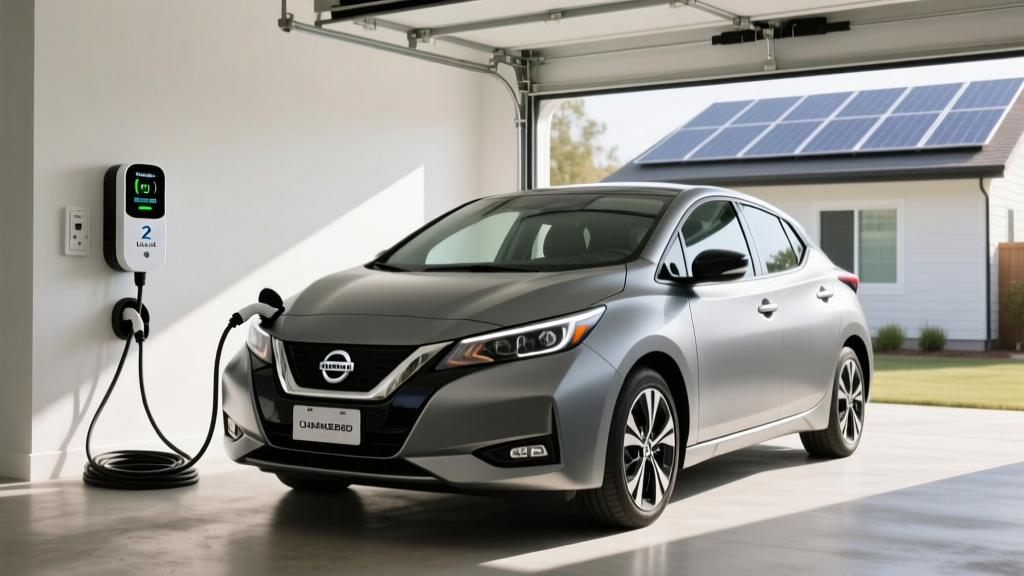
If you own a 2019 Nissan Leaf — or are shopping for one on the used market — understanding its real-world range, charging behavior, and home charging setup is the difference between daily convenience and range frustration. The 2019 Leaf was a pivotal model year: Nissan offered two battery packs (40 kWh and 62 kWh), two different DC fast-charge connectors depending on trim, and a CHAdeMO port that behaves very differently from the CCS or NACS chargers dominating today's networks. This guide breaks down the 2019 Nissan Leaf range you can actually expect, how fast each charging level replenishes it, and exactly what it takes to set up Level 2 charging at home in 2026.
2019 Nissan Leaf Range: EPA Sticker vs. Real-World Miles
The 2019 Leaf shipped in two battery configurations. The standard Leaf S/SV/SL carried a 40 kWh usable battery (NMC chemistry, air-cooled), while the Leaf S PLUS / SV PLUS / SL PLUS packed a larger 62 kWh usable battery. EPA range figures tell only part of the story.
40 kWh Leaf (S/SV/SL): EPA 150 mi | Real-world highway (70 mph): ~120–130 mi | Cold weather (30°F): ~100–115 mi
62 kWh Leaf PLUS: EPA 226 mi | Real-world highway (70 mph): ~185–200 mi | Cold weather (30°F): ~155–170 mi
Source: fueleconomy.gov. Real-world estimates based on owner-reported data and independent testing. Highway and cold-weather conditions reduce range 15–30%.
The Leaf's air-cooled battery thermal management system is the key variable here. Unlike liquid-cooled packs in modern EVs (Tesla, Hyundai, Ford), the Leaf relies on passive air cooling. This means sustained highway driving in hot weather, repeated DC fast charging, or charging in high ambient temperatures triggers charge-rate throttling — commonly called "Rapidgate" in Leaf communities. On a 90°F day after highway driving, your 50 kW CHAdeMO peak may drop to 20–30 kW, extending a 10–80% session from ~45 minutes to well over an hour.
| Spec | 40 kWh Leaf | 62 kWh Leaf PLUS |
|---|---|---|
| Battery (usable) | 40 kWh, NMC | 62 kWh, NMC |
| EPA Range | 150 mi | 226 mi |
| Efficiency (combined) | 111 MPGe | 108 MPGe |
| Motor Output | 110 kW (147 hp) | 160 kW (214 hp) |
| 0–60 mph | ~7.9 sec | ~6.5 sec |
| DC Fast Charge Port | CHAdeMO (50 kW peak) | CHAdeMO (100 kW peak*) |
| Level 2 Onboard Charger | 6.6 kW | 6.6 kW |
| Battery Warranty | 8 yr / 100,000 mi | 8 yr / 100,000 mi |
*100 kW peak requires compatible CHAdeMO station; most public CHAdeMO chargers in the U.S. max out at 50 kW.
Charging Levels Explained: How Fast Each Adds Range to Your Leaf
Before plugging in, it's essential to understand the difference between kW (kilowatts) and kWh (kilowatt-hours). kW measures the rate of energy delivery — like water pressure from a hose. kWh measures the total energy stored or delivered — like gallons in a bucket. Your Leaf's 40 kWh battery holds 40 kilowatt-hours of energy; a 6.6 kW charger delivers energy at 6.6 kilowatts per hour.
| Level | Power (kW) | Voltage / Amperage | Miles of Range Added per Hour | Full Charge Time (40 kWh) | Full Charge Time (62 kWh) |
|---|---|---|---|---|---|
| Level 1 (120V outlet) | 1.2–1.4 kW | 120V / 12A | ~4–5 mi/hr | ~28–35 hours | ~44–52 hours |
| Level 2 (240V home/public) | 6.6 kW (Leaf max) | 240V / 30–40A circuit | ~22–25 mi/hr | ~6–7 hours | ~9.5–10 hours |
| DC Fast (CHAdeMO 50 kW) | 50 kW peak | DC direct to battery | ~150–180 mi/hr (peak) | 10–80% in ~45 min | 10–80% in ~60 min |
| DC Fast (CHAdeMO 100 kW)* | 100 kW peak | DC direct to battery | ~250+ mi/hr (peak, brief) | N/A | 10–80% in ~45 min* |
*100 kW CHAdeMO stations are rare in the U.S. — most Leaf PLUS owners will charge at 50 kW stations. Sustained rates depend heavily on battery temperature.
For daily driving, Level 2 is the sweet spot. A 6.6 kW home charger fully replenishes the 40 kWh Leaf overnight and handles the 62 kWh model with a longer but still practical session. Level 1 is only viable as a trickle top-up if your daily commute is under 30 miles round-trip.
CHAdeMO in 2026: Connector Compatibility and the Adapter Problem
The 2019 Leaf uses the CHAdeMO DC fast-charging standard and a J1772 inlet for Level 1 and Level 2 AC charging. This matters enormously in 2026 because the U.S. charging industry has decisively shifted toward NACS (Tesla's connector, now adopted by Ford, GM, Rivian, Hyundai, and most major automakers) and CCS1.
| Charging Type | Leaf Port | Compatible With | Adapter Available? |
|---|---|---|---|
| Level 1 / Level 2 (AC) | J1772 | All public J1772 stations, home chargers with J1772 cable | J1772-to-NACS adapters exist for Tesla destination chargers |
| DC Fast Charge | CHAdeMO | CHAdeMO stations (Electrify America legacy, some EVgo, independent networks) | No reliable CHAdeMO-to-CCS or CHAdeMO-to-NACS adapter exists as of 2026 |
The hard truth for Leaf owners in 2026: CHAdeMO infrastructure is shrinking. Electrify America has largely pivoted to CCS, and new deployments overwhelmingly favor NACS and CCS. Your DC fast-charging options are increasingly limited to legacy CHAdeMO stations, which tend to be older 50 kW units. This doesn't affect home or Level 2 public charging at all — J1772 remains universal — but it does constrain road-trip flexibility.
Home Level 2 Charger Installation: Costs, Electrical Requirements, and Panel Upgrades
Installing a dedicated Level 2 charger at home is the single highest-impact upgrade for any Leaf owner. Here's what's involved electrically and financially.
Electrical Requirements
A Level 2 charger for the 2019 Leaf needs a 240V dedicated circuit. Since the Leaf's onboard charger maxes out at 6.6 kW, you need a circuit rated for at least 30 amps (which supports up to 7.2 kW continuous draw, with the 80% NEC derating rule). A 40-amp circuit is the most common installation and gives you headroom for future EVs with higher onboard chargers.
- Minimum circuit: 240V / 30A (supports 6.6 kW continuous)
- Recommended circuit: 240V / 40A (supports up to 9.6 kW, future-proof)
- Wire gauge: 8 AWG copper for 40A; 10 AWG for 30A
- Breaker: Dedicated double-pole breaker (30A or 40A)
- Outlet type: NEMA 14-50 (if using a plug-in charger) or hardwired connection
Panel Upgrade Considerations
Homes built before 2000 often have 100-amp electrical panels. Adding a 40-amp EV circuit to an already-loaded 100A panel may require a panel upgrade to 200 amps, which is the single biggest cost variable in EV charger installation. Signs you might need an upgrade: your panel is near capacity (few open breaker slots), you have electric heating/cooking, or your electrician flags a load calculation that exceeds 80% of panel capacity.
| Item | Simple Install (panel has capacity) | Complex Install (panel upgrade needed) |
|---|---|---|
| Level 2 Charger (equipment) | $350–$650 | $350–$650 |
| Electrician labor (run circuit, mount charger) | $400–$900 | $600–$1,200 |
| Permit and inspection | $50–$200 | $50–$200 |
| Electrical panel upgrade (100A → 200A) | N/A | $1,500–$3,500 |
| Conduit/wire (long runs over 50 ft) | $100–$300 | $150–$400 |
| Total Estimated Cost | $900–$2,050 | $2,650–$5,950 |
Costs vary by region, electrician rates, and garage-to-panel distance. Always get 2–3 quotes from licensed electricians. Some utilities offer rebates of $250–$500 for Level 2 installation — check with your provider.
Charging Cost per Mile: Leaf vs. Gasoline Car in 2026
One of the strongest arguments for the 2019 Leaf is operating cost. The Leaf's efficiency — roughly 30 kWh per 100 miles (combined) — makes it one of the cheapest vehicles to "fuel" on the road. Here's how charging costs compare to gasoline.
| Scenario | Cost per kWh | Cost per 100 mi (Leaf) | Cost per Mile | Gas Car (30 MPG, $3.40/gal) |
|---|---|---|---|---|
| Home charging (off-peak utility rate) | $0.10–$0.14 | $3.00–$4.20 | $0.03–$0.04 | $0.11/mi |
| Home charging (standard rate) | $0.15–$0.20 | $4.50–$6.00 | $0.05–$0.06 | $0.11/mi |
| Public Level 2 (ChargePoint, etc.) | $0.25–$0.49 | $7.50–$14.70 | $0.08–$0.15 | $0.11/mi |
| DC Fast Charge (CHAdeMO public) | $0.35–$0.55 | $10.50–$16.50 | $0.11–$0.17 | $0.11/mi |
At home on off-peak rates, the Leaf costs roughly $0.03–$0.04 per mile — about a third of what a 30 MPG gasoline car costs at 2026 fuel prices. Even public DC fast charging is roughly cost-competitive with gas, though it's clearly not where you want to charge regularly. The savings case is strongest when you charge at home overnight on a time-of-use (TOU) plan. According to fueleconomy.gov, the 2019 Leaf's annual fuel cost is estimated at roughly $600 compared to $1,650 for a comparable 25 MPG gasoline vehicle.
Recommended Level 2 Chargers for the 2019 Nissan Leaf
Since the Leaf's onboard charger caps at 6.6 kW, any 32-amp or higher Level 2 charger will max out the Leaf's charging capability. Investing in a 40- or 48-amp unit future-proofs your garage for your next EV. All chargers below use a J1772 connector, which plugs directly into the Leaf.
Power: 48A / 11.5 kW (hardwired) or 40A / 9.6 kW (NEMA 14-50)
Cable: 24 ft
Smart Features: Wi-Fi, app scheduling, energy monitoring, load management
Price: ~$399
Best value smart charger. Load management feature can avoid panel upgrades by dynamically limiting draw.
Power: Up to 50A / 12 kW (adjustable via dip switch: 16A–50A)
Cable: 23 ft
Smart Features: Wi-Fi, app scheduling, Alexa integration, energy reports
Price: ~$549
Amperage flexibility is excellent for older panels — set to 32A for a 40A circuit if needed.
Power: 40A / 9.6 kW
Cable: 24 ft
Smart Features: Wi-Fi, app control, OCPP compatibility
Price: ~$449
Built in Canada, rated to -40°F. Excellent for unheated garages and outdoor installs (NEMA 4 rated).
Power: 48A / 11.5 kW
Cable: 24 ft (built-in NACS plug + J1772 adapter included)
Smart Features: Wi-Fi, OTA updates, Power-Share for two units
Price: ~$599
Future-proof: charges your Leaf via included J1772 adapter today, and your next NACS-equipped EV natively.
For Leaf-only use, the Emporia Vue or ChargePoint Home Flex at 32–40 amps is ideal. You'll charge at the Leaf's 6.6 kW maximum regardless, but the higher-rated unit means your electrical infrastructure is ready for a future EV with a larger onboard charger.
Safety, Code, and Installation Best Practices
EV charger installation isn't a DIY project. The National Electrical Code (NEC) and most local jurisdictions require permits and inspections for new 240V circuits. Key safety requirements include:
- Dedicated circuit: Your EV charger must have its own breaker — no sharing with other appliances.
- GFCI protection: NEC 2020 and later require GFCI protection for outdoor receptacles used for EV charging. Hardwired installations may have different requirements depending on jurisdiction.
- Outdoor rating: If mounting outdoors, the charger must be rated NEMA 3R or NEMA 4 (weather-resistant). All recommended chargers above meet this standard.
- Wire sizing: Undersized wire on a long run causes voltage drop and fire risk. Your electrician will calculate the correct gauge based on circuit length.
- Load calculation: A licensed electrician will perform a NEC Article 220 load calculation to verify your panel can handle the added circuit. This is where panel upgrades get flagged.
Frequently Asked Questions
How much does it cost to install a home EV charger for my 2019 Nissan Leaf?
A straightforward Level 2 installation on an existing panel with available capacity typically costs $900–$2,050 (charger + electrician + permit). If your home needs a 200-amp panel upgrade, expect $2,650–$5,950 total. The charger itself is $350–$650; the rest is labor, materials, and permitting.
How fast will each charging level add range to my Leaf?
Level 1 (120V) adds roughly 4–5 miles per hour — fine for overnight trickle but inadequate for daily driving of more than 30 miles. Level 2 (240V, 6.6 kW) adds about 22–25 miles per hour and fully charges overnight. DC fast charging on CHAdeMO at 50 kW adds roughly 150–180 miles per hour at peak, reaching 10–80% in about 45 minutes for the 40 kWh model.
Which connector and charger is compatible with my 2019 Leaf?
For Level 1 and Level 2, your Leaf uses the J1772 connector — universal across all non-Tesla Level 2 chargers. For DC fast charging, it uses CHAdeMO. There is no reliable CHAdeMO-to-CCS or CHAdeMO-to-NACS adapter available in 2026, so you're limited to CHAdeMO-equipped fast-charging stations.
How much does charging cost per mile compared to gas?
Charging at home on off-peak rates costs approximately $0.03–$0.04 per mile — about one-third the cost of gasoline at $3.40/gallon and 30 MPG. Standard home rates bring it to $0.05–$0.06/mile. Public DC fast charging can approach gas-equivalent costs at $0.11–$0.17/mile, so home charging is where the savings live.
What electrical upgrades might I need for a Level 2 charger?
The most common upgrade is a panel upgrade from 100A to 200A ($1,500–$3,500) if your existing panel lacks capacity. You'll also need a new dedicated 240V circuit with a double-pole breaker, proper-gauge wiring, and potentially a NEMA 14-50 receptacle or hardwired connection. Homes with modern 200A panels and open breaker slots usually need nothing beyond the new circuit.
Is the 2019 Leaf's battery degrading? What should I check?
Nissan provides an 8-year/100,000-mile battery warranty covering capacity loss below 9 bars (out of 12) on the dashboard capacity gauge. Air-cooled batteries degrade faster than liquid-cooled packs, especially in hot climates. Check the Leaf's battery health bars on the instrument cluster — a 2019 model in 2026 should still show 11–12 bars under normal use. Per Nissan's battery information, typical degradation is 10–15% over 7 years in moderate climates.
Does the 2019 Leaf qualify for any tax credits in 2026?
The federal §30D new-vehicle tax credit does not apply to used purchases. However, the Used Clean Vehicle Credit (§25E) offers up to $4,000 or 30% of the sale price (whichever is less) for used EVs purchased from a dealer for $25,000 or less. Income caps apply ($75,000 single / $150,000 joint). The 2019 Leaf often qualifies since used prices in 2026 typically fall well below $25,000. Verify current rules at irs.gov.
The 2019 Nissan Leaf remains one of the most affordable used EVs on the market, and with a proper Level 2 home charging setup, it's an excellent daily commuter. Its limitations — CHAdeMO connector, air-cooled battery, and real-world range that falls short of EPA estimates in extreme conditions — are manageable if you understand them upfront. Install the right home charger, map your local CHAdeMO stations, and the Leaf delivers outstanding cost-per-mile efficiency for years to come.