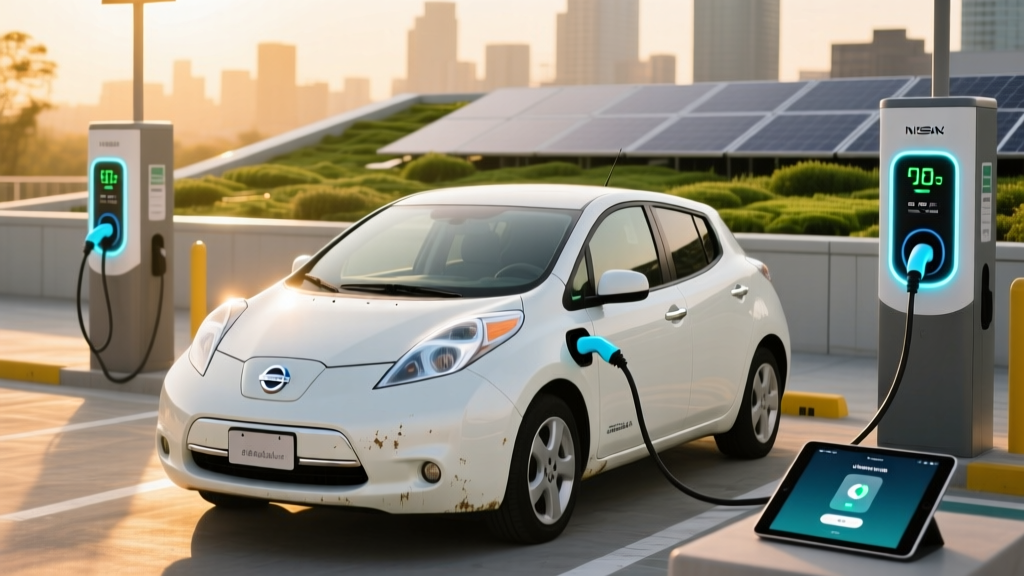
The first-generation Nissan Leaf launched in December 2010 as the world's first mass-market battery-electric vehicle. By the 2012 model year, Nissan had refined the formula, but the underlying hardware remained unchanged: a 24 kWh lithium-manganese-oxide (LMO) battery pack paired with an 80 kW (107 hp) AC synchronous motor. If you're evaluating a used 2012 Leaf today, the most critical metric isn't the original EPA window sticker — it's what the degraded battery actually delivers in 2026.
This guide covers the real-world range you should expect from a 13-year-old Leaf battery, the charging infrastructure you'll need (including the CHAdeMO connector challenge), home installation costs, and whether this pioneer EV still makes financial sense as a commuter car.
2012 Nissan Leaf Range: EPA Sticker vs. 2026 Reality
When new, the EPA rated the 2012 Nissan Leaf at 73 miles of combined range with a consumption of 99 MPGe (34 kWh/100 miles). That number was modest even then, but it reflected a 100% state-of-health (SoH) battery. After more than a decade of charge cycles, thermal exposure, and calendar aging, that figure has shrunk considerably.
- EPA original: 73 miles (100% SoH, new battery)
- Average 2026 battery (70–80% SoH): 50–60 miles mixed driving
- Well-preserved battery (85%+ SoH): 60–70 miles mixed driving
- Highway at 70 mph: 40–55 miles (EVs lose efficiency at speed)
- Cold weather (below 32°F): 35–50 miles (no heat pump; resistive heater draws ~4 kW)
The 2012 Leaf's battery management system includes a ~2 kWh buffer at the top and bottom, meaning the usable capacity when new was roughly 21–22 kWh. At 75% SoH, you're working with approximately 16–17 usable kWh. Given the car's real-world efficiency of roughly 3.5–4.0 miles per kWh (depending on speed and climate), 55–65 miles is realistic in mild weather.
The Leaf's instrument cluster displays a "guess-o-meter" range estimate that fluctuates based on recent driving behavior. For a more reliable assessment, check the battery health bars on the dash (the far-right gauge cluster). A 2012 Leaf showing 9 or fewer bars out of 12 has experienced significant degradation and will deliver closer to 40–50 miles in practice.
2012 Leaf Charging Speeds by Level
Understanding the difference between kW (power — the rate of energy flow) and kWh (energy — the battery's capacity) is essential. Think of kW as how fast water flows from a hose, and kWh as the size of the bucket you're filling. The 2012 Leaf's bucket holds 24 kWh total, and the hose sizes vary dramatically by charging level.
| Level | Voltage / Amperage | Max Power | Miles Added/Hour | 0–100% Time | Best For |
|---|---|---|---|---|---|
| Level 1 (120V) | 120V / 12A | ~1.4 kW | ~4–5 mi/hr | ~20–22 hours | Overnight trickle; emergencies |
| Level 2 (240V) | 240V / 30A max | ~6.6 kW | ~20–24 mi/hr | ~4–5 hours | Daily home charging |
| DC Fast (CHAdeMO) | Up to 50 kW | ~50 kW peak | ~120–150 mi/hr (tapered) | ~30 min (10–80%) | Road trips; quick top-ups |
Level 1 uses a standard household 120V outlet and the portable cordset that came with the Leaf. At ~1.4 kW, it adds roughly 4–5 miles of range per hour. Fully recharging a depleted 24 kWh pack takes over 20 hours — impractical for daily use but fine for topping off between short commutes.
Level 2 is the practical standard for home charging. The 2012 Leaf's onboard charger is rated at 6.6 kW (some early builds shipped with a 3.3 kW unit — verify via the charge port label). At 6.6 kW, a full charge takes roughly 4 hours, making overnight replenishment effortless. The car uses a J1772 connector for Level 1 and Level 2 AC charging.
DC Fast Charging on the 2012 Leaf uses the CHAdeMO connector standard — not the CCS1 connector found on most modern EVs, and not the NACS (Tesla) connector. The Leaf's DC fast charge port is a separate, larger inlet located next to the J1772 port behind the nose badge. Peak charge rate is approximately 50 kW, but the small 24 kWh battery reaches its charge-curve taper early. Expect a 10–80% charge in roughly 25–35 minutes at a compatible CHAdeMO station. Above 80%, charging slows dramatically to protect the cells.
CHAdeMO Connector Compatibility in 2026
The biggest infrastructure challenge for 2012 Leaf owners in 2026 is CHAdeMO's declining presence. The industry has consolidated around CCS1 (used by Ford, GM, Hyundai, VW, BMW, and others) and NACS (Tesla's standard, now adopted by nearly all major automakers for 2025+ models). CHAdeMO, once backed by Nissan and Mitsubishi, is being phased out at most public charging networks.
| Connector | Used By (2026) | 2012 Leaf Compatible? | Adapter Available? |
|---|---|---|---|
| J1772 (Level 1/2) | All EVs (universal AC standard) | Yes — native | N/A |
| CHAdeMO (DC Fast) | Nissan Leaf, Mitsubishi Outlander PHEV (legacy) | Yes — native | N/A |
| CCS1 (DC Fast) | Ford, GM, Hyundai, VW, BMW, Rivian, most others | No | CHAdeMO-to-CCS adapters exist but are rare and expensive (~$400+) |
| NACS / Tesla (DC Fast) | Tesla (all), Ford, GM, Rivian, Hyundai, others (2025+) | No | No practical adapter for DC charging |
Electrify America, once the largest CHAdeMO provider, has been prioritizing CCS1 and NACS connectors at new stations. Some legacy CHAdeMO stalls remain, particularly at older installations, but availability is shrinking. Before relying on DC fast charging for road trips, use apps like PlugShare or A Better Routeplanner to verify CHAdeMO availability along your route.
For Level 2 charging, the J1772 connector remains universal, so home charging is unaffected by the connector wars. If you have access to a Tesla Wall Connector or NACS-equipped public Level 2 charger, a simple J1772-to-NACS adapter (~$150–$200) will work for AC charging.
Home Charger Installation: Costs, Electrical Requirements & Upgrades
Installing a Level 2 home charger is the single most impactful upgrade for any EV owner. For the 2012 Leaf, a 240V / 30A circuit delivering 6.6 kW is ideal and matches the car's onboard charger limit.
Electrical Requirements
- Circuit: Dedicated 240V / 40A breaker (allows 32A continuous draw per NEC 80% rule)
- Wire gauge: 6 AWG copper (or 4 AWG aluminum) for runs up to ~50 feet
- Outlet type: NEMA 14-50 (if using a plug-in charger) or hardwired junction box
- GFCI protection: Required by NEC 2020+ for EV outlets in garages and outdoor locations
Panel Upgrade Considerations
Most modern homes with 200A electrical service can accommodate a 40A EV circuit without a panel upgrade. However, older homes — particularly those with 100A service common in pre-1990 construction — may require a panel upgrade or a load-management device. A licensed electrician will perform a load calculation to determine if your panel has sufficient headroom.
| Item | Cost Range | Notes |
|---|---|---|
| Level 2 EV charger (hardware) | $250 – $700 | Depends on brand, power, smart features |
| Electrician labor (standard install) | $400 – $1,200 | Varies by run length, wall type, conduit needs |
| Permit & inspection | $50 – $200 | Required in most jurisdictions |
| Panel upgrade (if needed) | $1,500 – $3,500 | 100A → 200A service upgrade; not always needed |
| Total (no panel upgrade) | $700 – $2,100 | Most common scenario |
| Total (with panel upgrade) | $2,200 – $5,600 | Older homes with 100A service |
The federal Residential Clean Energy Credit (IRS §25D) covers 30% of the cost of EV charging equipment and installation, up to $1,000, through 2032. This applies to the charger hardware and electrician labor but not a panel upgrade. Consult a tax professional to confirm eligibility.
Recommended Level 2 Chargers for the 2012 Leaf
Since the Leaf's onboard charger maxes out at 6.6 kW, you don't need a 48A charger. However, installing a higher-capacity unit (32A–40A) is smart practice — it future-proofs your setup for your next EV. Here are three proven options:
- Power output: Up to 48A (11.5 kW on 60A circuit)
- Connector: J1772 (native for Leaf)
- Cable length: 24 ft
- Smart features: Wi-Fi, app scheduling, energy monitoring, solar integration
- Price: ~$350–$400
- Verdict: Best value; overkill for the Leaf but excellent for future EVs
- Power output: Configurable 16A–50A (up to 12 kW)
- Connector: J1772 (or NACS version available)
- Cable length: 23 ft
- Smart features: Wi-Fi, app control, Alexa, scheduling, amperage adjustable
- Price: ~$550–$700
- Verdict: Flexible amperage lets you match your circuit; proven reliability
- Power output: Up to 48A (11.5 kW)
- Connector: NACS native; J1772 adapter included (~$50 accessory)
- Cable length: 24 ft
- Smart features: Wi-Fi, OTA updates, power sharing with second unit
- Price: ~$450 (charger) + ~$50 (adapter)
- Verdict: Premium build; ideal if your household also has a Tesla
For a 2012 Leaf, any of these chargers will deliver the car's maximum 6.6 kW. Set the ChargePoint Home Flex to 32A on a 40A circuit for a cost-effective, code-compliant install that fully serves the Leaf while leaving room for future upgrades.
Charging Cost per Mile: Leaf vs. Gas Car
The 2012 Leaf consumes approximately 34 kWh per 100 miles (EPA combined), or 0.34 kWh per mile. Actual consumption varies from 0.28 kWh/mile (city, mild weather) to 0.40 kWh/mile (highway, cold weather). Using the EPA figure for comparison:
| Scenario | $/kWh | Cost per Mile | Cost for 50-Mile Day |
|---|---|---|---|
| Home charging (off-peak utility rate) | $0.10 | $0.034 | $1.70 |
| Home charging (national avg. residential) | $0.17 | $0.058 | $2.90 |
| Public Level 2 (network pricing) | $0.30 | $0.102 | $5.10 |
| DC Fast Charging (CHAdeMO station) | $0.40 | $0.136 | $6.80 |
| Gas car (30 MPG, $3.50/gal) | — | $0.117 | $5.85 |
Even at public DC fast-charging rates, the 2012 Leaf costs roughly the same per mile as a 30 MPG gas car. At home off-peak rates, the Leaf's fuel cost drops to roughly one-third of a gas vehicle. Over 12,000 miles of annual driving, home-charging savings can total $700–$1,000 per year compared to gasoline at $3.50/gallon.
The catch: the Leaf's limited range and shrinking CHAdeMO infrastructure mean you'll likely do 90%+ of your charging at home, which is where the economics are best. Public charging is a convenience backup, not a primary strategy for this car.
Safety & Electrical Code Essentials
EV charging draws sustained high current for hours — unlike most household loads that cycle on and off. This makes proper installation critical:
- Dedicated circuit: Your EV charger must have its own breaker — never share a circuit with other appliances.
- Continuous load derating: NEC requires circuits to be rated at 125% of the continuous draw. A 32A charger needs a 40A breaker; a 40A charger needs a 50A breaker.
- GFCI protection: Required for all EV receptacles in garages, outdoors, and unfinished spaces per NEC 2020 and later.
- Outdoor-rated equipment: If installing outside, ensure the charger carries a NEMA 4 (weatherproof) rating and that the connector holster protects the plug from rain and debris.
- Permit and inspection: Most municipalities require an electrical permit and post-install inspection. Skipping this risks insurance coverage denial if a fire occurs.
Always hire a licensed electrician experienced with EV charger installations. The combination of high-amperage continuous loads and evolving NEC requirements makes this a poor DIY candidate.
2012 Leaf Battery Health: Degradation & Replacement
The 2012 Leaf's LMO chemistry is more susceptible to heat-driven degradation than the NMC and LFP packs used in modern EVs. Nissan's original battery warranty guaranteed 70% capacity retention at 5 years / 60,000 miles — a threshold most 2012 Leafs passed years ago.
Key degradation factors for the 2012 Leaf:
- Heat exposure: Leafs in hot climates (Arizona, Texas, Southern California) degrade faster. Battery temperatures above 95°F accelerate cell wear, and the 2012 Leaf lacks active liquid cooling.
- DC fast charging frequency: Frequent 50 kW CHAdeMO sessions generate heat that compounds degradation. Owners who relied primarily on Level 2 charging tend to see better SoH retention.
- Calendar aging: Even garaged Leafs lose capacity over time. At 13+ years, expect 65–85% SoH for most surviving packs.
Nissan offers battery replacement through dealerships. A new 24 kWh pack (or refurbished equivalent) costs approximately $5,500–$7,500 installed as of 2025–2026. Third-party battery refurbishment shops can sometimes replace individual degraded modules for $2,000–$4,000, but availability varies by region. Given that a 2012 Leaf's market value typically ranges from $3,500 to $7,000, a full battery replacement often exceeds the car's worth — making it an economic decision that depends on how much utility you still get from the vehicle.
Is the 2012 Leaf Still Practical in 2026?
- Your daily commute is under 35 miles round-trip
- You can install a Level 2 charger at home
- You find one with 9+ battery health bars at a low price (under $5,000)
- You need an ultra-low-cost second car for errands and local driving
- You accept that CHAdeMO DC fast charging is a declining resource
- Your commute exceeds 40 miles or includes highway driving
- You live in a cold climate where winter range drops below 40 miles
- You can't charge at home (public CHAdeMO access is unreliable)
- You need a primary vehicle for road trips or longer drives
- Battery health is below 8 bars — the cost to replace outweighs the car's value
The 2012 Nissan Leaf remains a remarkably practical urban runabout when its battery is healthy and you charge at home. At $0.03–$0.06 per mile on home electricity, it's one of the cheapest vehicles to "fuel" on the road. But its aging LMO battery, passive thermal management, and orphaned CHAdeMO connector make it a niche choice in 2026 — best suited as a budget commuter for informed buyers who understand exactly what they're getting.
Frequently Asked Questions
How much does it cost to install a home EV charger for a 2012 Nissan Leaf?
A typical Level 2 home installation (40A circuit, 240V, NEMA 14-50 outlet) costs $700–$2,100 including the charger hardware ($250–$700), electrician labor ($400–$1,200), and permit ($50–$200). If your home has 100A electrical service and needs a panel upgrade to 200A, add $1,500–$3,500. The federal §25D tax credit covers 30% of equipment and installation costs, up to $1,000.
How fast will each charging level add range to the 2012 Leaf?
Level 1 (120V) adds roughly 4–5 miles per hour. Level 2 (240V, 6.6 kW) adds approximately 20–24 miles per hour, fully charging the 24 kWh battery in 4–5 hours. DC fast charging (CHAdeMO, 50 kW) can add roughly 50–60 miles in 15–20 minutes, but the small battery tapers charge speed above 80% SoC.
Which connector does the 2012 Nissan Leaf use?
The 2012 Leaf uses a J1772 connector for Level 1 and Level 2 AC charging — this is the universal AC standard. For DC fast charging, it uses a CHAdeMO connector, which is a separate inlet behind the front badge. CHAdeMO is being phased out in favor of CCS1 and NACS, so verify station availability before planning road trips.
How much does charging a 2012 Leaf cost per mile compared to gas?
At home on off-peak electricity ($0.10/kWh), the Leaf costs about $0.034 per mile. At the national average residential rate ($0.17/kWh), it's roughly $0.058 per mile. A comparable 30 MPG gas car at $3.50/gallon costs about $0.117 per mile. Home charging saves $600–$1,000 annually over 12,000 miles.
What electrical upgrades might I need for a home charger?
Homes with 200A electrical service typically need only a dedicated 40A breaker and appropriate wiring — no panel upgrade required. Homes with 100A service (common in pre-1990 construction) may need a panel upgrade to 200A, costing $1,500–$3,500. Alternatively, a smart load-management device can allow EV charging on a smaller panel by dynamically reducing charger amperage when other appliances are running.
Can I use a Tesla Supercharger with my 2012 Leaf?
No. Tesla Superchargers use the NACS connector and proprietary communication protocols. There is no practical adapter to connect a CHAdeMO-equipped 2012 Leaf to a Tesla Supercharger for DC fast charging. For Level 2 AC charging, a J1772-to-NACS adapter (~$150–$200) allows you to use Tesla Wall Connectors and destination chargers.