If you've just taken delivery of an electric vehicle—or are about to—your next critical decision is picking the right new EV charger for your home. While public DC fast-charging networks continue to expand, the reality of EV ownership is that 80% to 90% of your charging will happen where you park overnight. Getting your home setup right means waking up to a full battery every morning, avoiding the premium prices of public charging, and eliminating range anxiety for daily driving.
This guide walks through exactly what you need: the physics of charging speeds, what your electrical panel can handle, realistic installation costs, which connector your vehicle requires, and specific hardware recommendations for 2026. We'll also tackle the critical distinction between kW (power—the rate of charging) and kWh (energy—the size of your battery), because confusing the two is the most common mistake new EV owners make.
Understanding EV Charging Levels and Speeds
EV charging is categorized into three levels based on voltage and power delivery. The speed at which your vehicle charges depends on the charger's power output (measured in kilowatts, or kW) and your vehicle's onboard charger capacity. Your battery's capacity is measured in kilowatt-hours (kWh)—the total energy it stores.
Think of it this way: kW is how fast water flows through a hose; kWh is how big the bucket is. A higher-kW charger fills your battery faster, but only up to the limit your vehicle can accept.
| Level | Voltage | Power (kW) | Miles of Range per Hour | Typical Use Case |
|---|---|---|---|---|
| Level 1 | 120V AC | 1.2–1.9 kW | 3–5 miles | Overnight trickle, PHEVs, low-mileage drivers |
| Level 2 | 240V AC | 3.3–19.2 kW | 12–75 miles | Home daily charging, workplace, destination |
| DC Fast | 400–800V DC | 50–350 kW | 150–1,200 miles | Road trips, highway corridors, rapid top-ups |
Level 1 uses a standard household 120V outlet and the portable cord that came with your EV. It's fine for plug-in hybrids with small batteries (10–18 kWh) or BEV owners who drive fewer than 30 miles daily. For a 75 kWh battery, Level 1 adds roughly 4 miles per hour—a full charge takes over 24 hours.
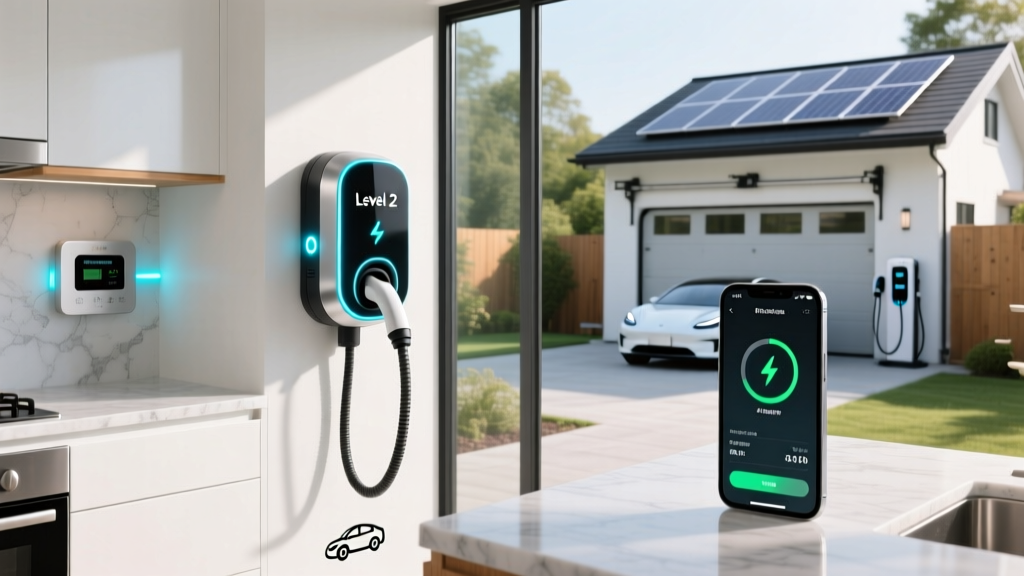
Level 2 requires a 240V circuit, the same voltage as your electric dryer or oven. This is the standard home-charging solution. Most new EV chargers for home use deliver 7.7 kW to 11.5 kW on a 40A to 48A circuit, adding 25–45 miles of range per hour. An overnight session of 8–10 hours fully replenishes nearly any EV battery.
DC Fast Charging bypasses the vehicle's onboard charger and feeds DC current directly to the battery. These are the 150–350 kW stations you'll find at highway rest stops and retail locations. They're essential for road trips but not practical or necessary for home installation due to their extreme power requirements and cost.
Real-World Charging Time Examples
Charging times vary based on battery size, state of charge, and ambient temperature. The figures below assume a battery preconditioned to optimal temperature and charging from 10% to 80% state of charge (SoC).
Charging Time Reference (10–80% SoC)
- Tesla Model Y (75 kWh battery, NMC): Level 2 at 11.5 kW = ~5.5 hours | DC Fast at 250 kW peak = ~25 minutes
- Hyundai Ioniq 5 (77.4 kWh battery, NMC): Level 2 at 10.9 kW = ~6 hours | DC Fast at 235 kW peak = ~18 minutes
- Ford F-150 Lightning Extended Range (131 kWh battery, NMC): Level 2 at 19.2 kW = ~6.5 hours | DC Fast at 150 kW peak = ~45 minutes
- Chevrolet Equinox EV (85 kWh battery, NMC): Level 2 at 11.5 kW = ~6 hours | DC Fast at 150 kW peak = ~35 minutes
Critical caveat: DC fast charging follows a tapering curve. A charger rated for 250 kW peak will only sustain that rate between roughly 10–40% SoC. Above 80%, charging slows dramatically to protect battery health—often dropping to 30–50 kW. This is why manufacturers quote 10–80% times rather than 0–100%.
Cold weather (below 40°F) can increase Level 2 charging times by 20–30% and DC fast charging times by 40–50% unless your vehicle has an active battery preconditioning system. If you're shopping for a new EV charger for an unheated garage in a cold climate, consider a unit with integrated cable management to prevent stiffness.
Home Installation: Electrical Requirements and Costs
Installing a Level 2 home charger is an electrical project that requires a licensed electrician, permits, and potentially a panel upgrade. Here's what's involved.
Electrical Specifications
Most Level 2 chargers require a dedicated 240V circuit with the following common configurations:
- 40-amp circuit: Delivers up to 32A continuous (9.6 kW). Requires 8 AWG copper wire. Suitable for most EVs and the most common residential install.
- 50-amp circuit: Delivers up to 40A continuous (9.6 kW) or 48A continuous (11.5 kW) depending on charger. Requires 6 AWG copper wire.
- 60-amp circuit: Delivers up to 48A continuous (11.5 kW). Requires 6 AWG copper wire. Ideal for larger batteries like the F-150 Lightning or Rivian R1T.
The National Electrical Code (NEC) requires that continuous loads (like EV charging) not exceed 80% of a circuit's rated capacity. A 40A circuit can safely deliver 32A continuously.
Panel Upgrade Considerations
Your home's electrical panel has a total amperage capacity—typically 100A, 150A, or 200A in modern homes. Adding a 40–60A EV circuit consumes a significant portion of that capacity. If your panel is already near capacity (running electric heat, a large electric range, and multiple high-draw appliances), you may need a panel upgrade to 200A or even 400A service.
Panel upgrade costs: Upgrading from 100A to 200A service typically costs $1,500–$3,500 including permits and utility coordination. A 400A upgrade can exceed $5,000. This is often the single largest variable in EV charger installation cost.
Installation Cost Breakdown
| Component | Cost Range | Notes |
|---|---|---|
| Level 2 charger unit | $350–$800 | Smart Wi-Fi-enabled units cost more; dumb units are cheaper |
| Electrical permit | $50–$200 | Varies by municipality; some jurisdictions waive for EV installs |
| Electrician labor (standard install) | $400–$1,200 | Short run from panel to garage; includes wiring, conduit, outlet or hardwire |
| Electrician labor (long/complex run) | $1,200–$2,500 | Long conduit runs, attic crawls, concrete trenching, or detached garage |
| Panel upgrade (if needed) | $1,500–$3,500 | 100A to 200A upgrade; 400A upgrades cost more |
| Total (no panel upgrade) | $800–$2,200 | Most common scenario for homes with adequate panel capacity |
| Total (with panel upgrade) | $2,300–$5,700 | Older homes or those with high existing electrical loads |
Federal incentive: The Alternative Fuel Vehicle Refueling Property Credit (IRS Form 8911) provides a tax credit of up to 30% of the cost of home EV charger installation, capped at $1,000. This credit applies to both the equipment and installation labor. Eligibility depends on your census tract meeting certain income or rural-area criteria. Consult IRS guidance or a tax professional to confirm eligibility.
Connector Compatibility: NACS, CCS, and CHAdeMO
The connector landscape has shifted dramatically. As of 2026, the North American Charging Standard (NACS)—originally developed by Tesla—has become the dominant connector for new electric vehicles. Here's what you need to know:
| Connector Type | Brands Using It | Home Charging Notes |
|---|---|---|
| NACS (J3400) | Tesla (all), Ford, GM, Rivian, Volvo, Polestar, Mercedes-Benz, BMW, Hyundai/Kia (2025+), Toyota, Subaru, Lucid | Compact connector; native Tesla Supercharger access; adapters available for CCS vehicles |
| CCS1 (Combined Charging System) | Volkswagen ID.4, Audi e-tron (older), some remaining 2024–2025 models from various brands | Larger connector; Electrify America network native; NACS adapters widely available |
| CHAdeMO | Nissan Leaf (legacy); discontinued for new models | Declining infrastructure; not recommended for new EV purchases |
For your new EV charger purchase: If your vehicle has a NACS port, buy a NACS-equipped charger. If your vehicle has CCS1, buy a CCS1 charger or a NACS charger with a CCS adapter (many 2026 chargers now ship with both connector options or offer swap-able connector heads).
According to fueleconomy.gov, all light-duty EVs sold in the US support Level 2 AC charging via either NACS or CCS1. The connector difference only matters for DC fast charging and home charger selection.
Cost to Charge: Home vs. Public vs. Gas
One of the strongest economic arguments for home charging is the per-mile cost advantage. Here's how scenarios compare:
| Charging Method | Cost per kWh | Cost per Mile* | Annual Cost (12,000 mi) |
|---|---|---|---|
| Home Level 2 (off-peak utility rate) | $0.08–$0.14 | $0.025–$0.045 | $300–$540 |
| Home Level 2 (standard utility rate) | $0.13–$0.20 | $0.04–$0.065 | $480–$780 |
| Public Level 2 (network charging) | $0.25–$0.49 | $0.08–$0.16 | $960–$1,920 |
| DC Fast Charging (public) | $0.35–$0.65 | $0.11–$0.21 | $1,320–$2,520 |
| Gasoline (25 MPG combined, $3.50/gal) | N/A | $0.14 | $1,680 |
*Based on an EV efficiency of 3.0–3.5 miles per kWh (typical for a midsize crossover like the Tesla Model Y or Hyundai Ioniq 5). Larger vehicles like the F-150 Lightning achieve 2.0–2.5 mi/kWh, increasing per-mile costs proportionally.
Key takeaway: Home charging on an off-peak rate plan delivers fuel costs 70–80% lower than gasoline. Even at standard residential rates, home charging costs roughly half what gasoline does per mile. Public DC fast charging, while convenient for road trips, can equal or exceed gasoline costs in some markets.
Many utilities now offer time-of-use (TOU) rate plans that provide significantly discounted rates during overnight hours (typically 11 PM – 6 AM). If you're installing a new EV charger, contact your utility about EV-specific rate plans before your first billing cycle.
Best New EV Chargers for Home Use (2026)
Here are specific hardware recommendations based on power output, reliability, smart features, and value:
Tesla Wall Connector
- Power: Up to 11.5 kW (48A)
- Connector: NACS native
- Cable length: 24 ft
- Smart features: Wi-Fi, OTA updates, power sharing (link multiple units), access control
- Price: ~$475
- Best for: Tesla owners and NACS-equipped vehicles
ChargePoint Home Flex
- Power: Up to 12 kW (50A), configurable 16–50A
- Connector: NACS or CCS1 (selectable at purchase)
- Cable length: 23 ft
- Smart features: Wi-Fi, app scheduling, Alexa integration, energy tracking
- Price: ~$599–$649
- Best for: Flexibility across connector types, adjustable amperage
Emporia Level 2 EV Charger
- Power: Up to 11.5 kW (48A)
- Connector: NACS or J1772 (with adapter)
- Cable length: 24 ft
- Smart features: Wi-Fi, solar integration, energy monitoring, load management
- Price: ~$399
- Best for: Budget-conscious buyers, solar homes
Grizzl-E Smart
- Power: Up to 10 kW (40A)
- Connector: NACS or J1772
- Cable length: 24 ft
- Smart features: Wi-Fi, OCPP protocol, adjustable amperage, outdoor-rated
- Price: ~$449
- Best for: Outdoor installs, extreme temperature environments (-40°F rated)
Installation tip: Most chargers can be either plugged into a NEMA 14-50 outlet or hardwired directly to the circuit. Hardwiring eliminates the outlet (saving ~$50–$100 in parts) and allows some chargers to deliver their full rated amperage (a NEMA 14-50 outlet is limited to 40A continuous). Hardwired installations also don't require GFCI breakers in most jurisdictions, which can save $100–$150 and prevent nuisance tripping.
Safety, Code, and Smart Features
When selecting and installing your new EV charger, keep these safety and code considerations in mind:
- Dedicated circuit: Your EV charger must be on its own dedicated circuit—never shared with other appliances. This prevents overloads and ensures consistent charging performance.
- GFCI protection: The 2020 NEC requires GFCI protection for outlets used for EV charging (not required for hardwired installations in most jurisdictions). GFCI breakers for 240V circuits cost $100–$150 and can occasionally nuisance-trip with some charger models.
- Outdoor rating: If your charger will be installed outdoors (driveway, exterior wall), ensure it carries a NEMA 4 or IP65 weather-resistance rating. All chargers listed above meet this standard.
- UL/ETL listing: Only purchase chargers with UL or ETL certification. Uncertified units from unknown brands may lack critical safety features and can void your home insurance coverage.
- Load management: If your electrical panel is near capacity but you want to avoid a full panel upgrade, consider a smart charger with load-management capabilities (like the Emporia or certain ChargePoint models). These monitor your home's total electrical draw and dynamically reduce charging speed to prevent overloading the panel.
- Cable management: For garage installs, a cable organizer or retractable reel prevents tripping hazards and keeps the connector clean.
Frequently Asked Questions
How much does it cost to install a home EV charger?
A standard Level 2 home charger installation costs $800–$2,200 when no panel upgrade is needed. This includes the charger unit ($350–$800), electrician labor ($400–$1,200), and permit fees ($50–$200). If your home needs a panel upgrade from 100A to 200A service, total costs rise to $2,300–$5,700. The federal Alternative Fuel Vehicle Refueling Property Credit can offset up to $1,000 (30% of total cost) if your census tract qualifies.
How fast will each charging level add range?
Level 1 (120V) adds 3–5 miles of range per hour. Level 2 (240V) adds 12–75 miles per hour depending on the charger's kW output and your vehicle's onboard charger limit. DC fast charging adds 150–1,200 miles per hour at peak rates, though charging tapers significantly above 80% SoC. For a typical midsize EV with a 75 kWh battery, a 48A Level 2 charger adds roughly 35–40 miles per hour of charging.
Which connector/charger is compatible with my EV?
As of 2026, most new EVs use the NACS connector (Tesla, Ford, GM, Rivian, Hyundai, Kia, BMW, Mercedes, Volvo, and others). The Volkswagen ID.4 and some remaining 2024–2025 models use CCS1. The Nissan Leaf uses CHAdeMO (legacy only). Check your vehicle's charge port or owner's manual to confirm. If buying a new EV charger, match the connector to your vehicle—or select a unit with a swappable connector head for future flexibility.
How much does charging cost per mile vs. gas?
Home charging on a standard residential rate ($0.13–$0.20/kWh) costs roughly $0.04–$0.065 per mile for a midsize EV. Gasoline at $3.50/gallon and 25 MPG combined costs $0.14 per mile. Home charging is 55–70% cheaper per mile than gasoline. Off-peak utility rates can push home charging costs below $0.03 per mile.
What electrical upgrades might I need?
The most common upgrade is a panel capacity increase from 100A to 200A service, needed when your existing panel is near capacity with other high-draw appliances. You may also need a new conduit run from the panel to the charger location (especially for detached garages or long distances), a dedicated 40–60A 240V circuit with appropriate wire gauge, and potentially a GFCI breaker if installing a plug-in outlet rather than hardwiring. Your electrician will perform a load calculation to determine if a panel upgrade is necessary.
Sources: fueleconomy.gov, IRS Alternative Fuel Vehicle Refueling Property Credit, manufacturer specifications.