Why the NEMA 14-30 Adapter Matters for Tesla Owners
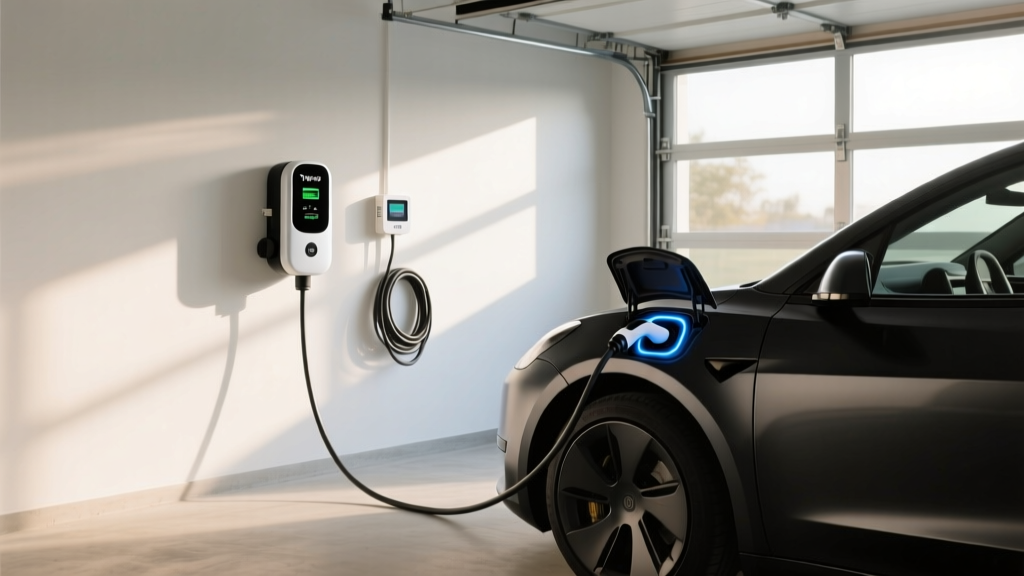
If you own a Tesla—or any EV with a NACS charge port in the expanding North American Charging Standard ecosystem—you have likely searched for a practical way to charge at home without spending $2,000+ on a dedicated wall connector installation. The NEMA 14-30 adapter for Tesla Mobile Connector is one of the most accessible entry points into Level 2 home charging, leveraging the same 240V outlet many homes already have for electric dryers.
But before you plug in, you need to understand exactly what this adapter delivers in real-world charging speed, whether your electrical panel can handle it, what the install costs look like, and where it fits in the broader EV charging landscape. This guide breaks it all down with exact numbers—no fluff, no marketing spin.
Understanding EV Charging Levels: kW and Miles Per Hour
The single most important distinction in EV charging is between kW (kilowatts), which measures power—the rate at which energy flows into your battery—and kWh (kilowatt-hours), which measures energy capacity—how much total energy your battery holds. Think of kW as the width of a hose and kWh as the size of the bucket.
Here is how the three charging levels break down in real-world performance:
| Charging Level | Voltage / Amperage | Power (kW) | Miles of Range Added Per Hour | Typical Use Case |
|---|---|---|---|---|
| Level 1 (Standard Outlet) | 120V / 12A | ~1.4 kW | 3–5 mi/hr | Emergency trickle, PHEVs |
| Level 2 (NEMA 14-30) | 240V / 24A | ~5.76 kW | 18–22 mi/hr | Home overnight (budget) |
| Level 2 (NEMA 14-50) | 240V / 40A | ~9.6 kW | 30–38 mi/hr | Home overnight (standard) |
| Level 2 (Wall Connector) | 240V / 48A | ~11.5 kW | 35–44 mi/hr | Home overnight (fastest AC) |
| DC Fast Charging | 400–800V DC | 50–350 kW | 150–800+ mi/hr (peak) | Road trips, quick top-ups |
The NEMA 14-30 sits in the middle of Level 2 options. A full overnight charge (10 hours) on a 14-30 outlet will add approximately 180–220 miles of range—enough to fully replenish most EV batteries from near-empty, including a Tesla Model 3 Long Range (75 kWh usable) or a Hyundai Ioniq 5 (77.4 kWh usable).
NEMA 14-30 Electrical Requirements and What Your Panel Needs
The NEMA 14-30 is a 240-volt, 30-amp, 4-prong outlet (two hot wires, one neutral, one ground). It is commonly found in homes built after the 1990s as an electric dryer outlet. Here is what you need to know before using or installing one for EV charging:
- Circuit rating: 30A breaker, which means continuous draw is limited to 80% (24A) per the National Electrical Code (NEC). This is why Tesla's Mobile Connector pulls 24A on a 14-30, not the full 30A.
- Wire gauge: Minimum 10 AWG copper for a 30A circuit. If your existing dryer circuit uses older aluminum wiring or undersized gauge, an electrician will need to re-run the line.
- Dedicated circuit: Your EV charger should be on a dedicated circuit—not shared with a dryer or other large appliance. Running a dryer and charging an EV simultaneously on the same 30A circuit will trip the breaker.
- Panel capacity: Most modern homes have 100A or 200A main panels. A 30A / 240V circuit draws roughly 5.76 kW. If your panel is already near capacity (e.g., electric range, HVAC, water heater all on a 100A panel), you may need a panel upgrade to 200A—which is a significant added cost.
Permit and Code Requirements
Most jurisdictions require an electrical permit for any new 240V circuit installation. The permit ensures the work meets NEC code and is inspected for safety. Typical requirements include:
- Dedicated circuit with correct breaker size
- GFCI protection for outdoor outlets (NEC 2020 and later require GFCI on 240V receptacles in garages and outdoors in many jurisdictions)
- Outdoor-rated (NEMA 3R or NEMA 4) receptacle and cover if installed outside
- Proper wire gauge and conduit where required
Home EV Charger Installation Cost Breakdown
How much does it cost to install a home EV charger using a NEMA 14-30 outlet? The answer depends heavily on your existing electrical setup. Here is a realistic cost range for 2026:
| Cost Component | Simple Install (Existing Panel, Short Run) | Complex Install (New Circuit, Longer Run) | Panel Upgrade Required |
|---|---|---|---|
| Electrical Permit | $50–$150 | $50–$200 | $100–$250 |
| Electrician Labor (2–6 hrs) | $300–$600 | $600–$1,500 | $1,000–$2,500 |
| Materials (Wire, Breaker, Outlet, Conduit) | $100–$250 | $250–$500 | $300–$700 |
| Panel Upgrade (if needed) | N/A | N/A | $1,500–$3,500 |
| EVSE Equipment (Tesla Mobile Connector + 14-30 Adapter) | $230–$280 | $230–$280 | $230–$280 |
| Total Estimated Cost | $680–$1,280 | $1,130–$2,480 | $3,130–$7,230 |
For comparison, a dedicated Tesla Wall Connector (hardwired, 48A / 11.5 kW) on a 60A circuit will typically cost $1,200–$3,000 for a straightforward install, or more if a panel upgrade is required. The NEMA 14-30 route is often 40–60% cheaper, making it the pragmatic choice for budget-conscious EV owners who charge overnight and don't need the fastest possible Level 2 speed.
Federal Tax Credit for Home Charging Equipment
The IRS Residential Clean Energy Credit (which replaced the Alternative Fuel Vehicle Refueling Property Credit for home installations in many cases) may cover up to 30% of home charging equipment and installation costs, capped at $1,000 per year. Eligibility depends on your income, whether you live in a qualifying census tract, and current-year IRS rules. Consult a tax professional to confirm your eligibility—rules and qualifying areas change.
Charging Time Examples: What to Expect With a NEMA 14-30
At 5.76 kW continuous (24A × 240V), here is how long common EV batteries take to charge from 10% to 80% on a NEMA 14-30 outlet. Note: Charging above 80% slows significantly due to battery management system (BMS) tapering, which is why most EV owners target 80% for daily use.
| Vehicle | Battery (Usable kWh) | 10–80% Charge (kWh Needed) | Estimated Time on NEMA 14-30 |
|---|---|---|---|
| Tesla Model 3 RWD | 57.5 kWh (LFP) | ~40.3 kWh | ~7.0 hours |
| Tesla Model 3 Long Range | 75 kWh (NMC) | ~52.5 kWh | ~9.1 hours |
| Tesla Model Y Long Range | 75 kWh (NMC) | ~52.5 kWh | ~9.1 hours |
| Ford Mustang Mach-E Extended Range | 91 kWh (NMC) | ~63.7 kWh | ~11.1 hours |
| Hyundai Ioniq 5 Long Range | 77.4 kWh (NMC) | ~54.2 kWh | ~9.4 hours |
| Chevrolet Equinox EV | 85 kWh (NMC) | ~59.5 kWh | ~10.3 hours |
For most daily driving scenarios—30 to 60 miles of commuting—you only need to replenish 10–20 kWh overnight, which takes just 2–4 hours on a NEMA 14-30. The full 10–80% charge is relevant mainly after road trips or when you arrive home with a depleted battery.
Connector Compatibility: NACS, CCS1, and Adapter Needs
As of 2026, the North American charging connector landscape has shifted heavily toward NACS (the Tesla-designed connector now standardized as SAE J3400). Most new EVs from Ford, GM, Rivian, Volvo, Hyundai, and others now ship with NACS ports. CCS1 vehicles are still on the road, and CHAdeMO remains on older Nissan Leaf models.
| Connector Type | Brands Using It (2026) | Tesla Mobile Connector Compatible? | Adapter Needed? |
|---|---|---|---|
| NACS (J3400) | Tesla, Ford, GM, Rivian, Volvo, Polestar, Hyundai (2025+), Kia (2025+) | Yes — native fit | None for Tesla Mobile Connector |
| CCS1 | VW ID.4 (pre-2025), older BMW i4/iX, some Stellantis models | No — CCS1 port won't accept NACS plug | Tesla CCS1 adapter or third-party NACS-to-CCS adapter for home charger |
| CHAdeMO | Nissan Leaf (all years), Mitsubishi Outlander PHEV | No | No widely available NACS-to-CHAdeMO adapter |
If you drive a non-Tesla EV with a CCS1 port and want to use Tesla's Mobile Connector with a NEMA 14-30 adapter, you will need Tesla's CCS1 adapter (approximately $175) or a third-party equivalent. Conversely, if you have a Tesla and need to use a CCS public charger, Tesla sells a CCS1 adapter that works at Electrify America and other CCS networks.
Cost to Charge: Home vs. Public vs. Gas
One of the strongest arguments for home Level 2 charging is cost. Here is a breakdown of what you can expect to pay per kWh and per mile in 2026, compared to a gasoline vehicle averaging 28 MPG:
| Charging Scenario | Avg. Cost per kWh | Cost per Mile (at 3.5 mi/kWh) | Annual Cost (12,000 mi) |
|---|---|---|---|
| Home Off-Peak (Time-of-Use Rate) | $0.08–$0.12 | $0.023–$0.034 | $275–$410 |
| Home Standard Rate | $0.13–$0.18 | $0.037–$0.051 | $445–$615 |
| Public Level 2 (ChargePoint, etc.) | $0.25–$0.49 | $0.071–$0.140 | $855–$1,680 |
| DC Fast Charging (EA, Tesla Supercharger) | $0.30–$0.55 | $0.086–$0.157 | $1,030–$1,885 |
| Gasoline (28 MPG, $3.50/gal) | $0.125/mile | $0.125 | $1,500 |
Home charging on a NEMA 14-30 at off-peak rates saves roughly $1,000–$1,200 per year compared to gasoline. Even at standard residential rates, you save $900+. The savings shrink if you rely primarily on public DC fast charging, which can approach or exceed gasoline costs per mile in some markets.
Equipment Recommendations for NEMA 14-30 Charging
Here are specific, current-model EVSE options that work with a NEMA 14-30 outlet, along with their key specs:
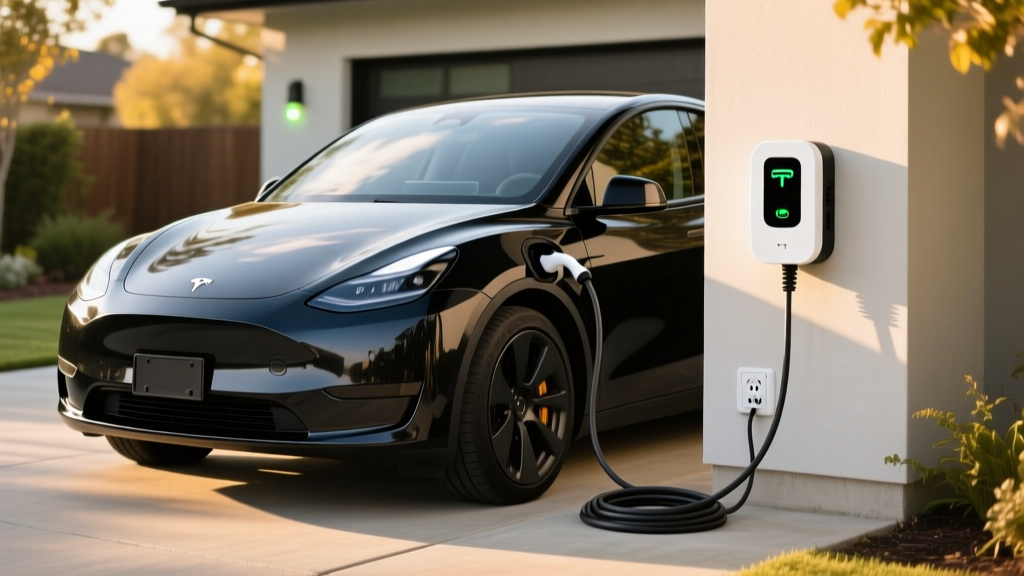
Tesla Mobile Connector (Gen 2)
- Price: ~$200 (connector bundle) + ~$35 (NEMA 14-30 adapter tip)
- Max Power Output: 5.76 kW (24A @ 240V on 14-30)
- Connector: NACS (native Tesla)
- Cable Length: 20 feet
- Smart Features: None built-in (no Wi-Fi/app scheduling); rely on vehicle's scheduled charging via Tesla app
- Best For: Tesla owners wanting the lowest-cost Level 2 solution
Lectron V-BOX Pro (NEMA 14-30 Plug)
- Price: ~$280–$350
- Max Power Output: 5.76 kW (24A @ 240V)
- Connector: NACS or J1772 (configurable)
- Cable Length: 18 feet
- Smart Features: Basic LED status indicator; no app
- Best For: Non-Tesla EV owners needing a portable 14-30 option
Emporia Level 2 EV Charger (Hardwired or 14-50; can use on 14-30 circuit at reduced amperage)
- Price: ~$350–$400
- Max Power Output: Up to 11.5 kW (48A hardwired); configurable to 24A for 14-30 circuit
- Connector: NACS (2025+ models) or J1772
- Cable Length: 24 feet
- Smart Features: Wi-Fi, app scheduling, energy monitoring, solar integration
- Best For: Owners who may upgrade to a 14-50 or hardwired circuit later; want smart features now
Safety, Code, and Best Practices
Charging an EV on a NEMA 14-30 is safe when done correctly, but there are critical code and safety points to observe:
- Never use an extension cord. Tesla explicitly warns against extension cords with the Mobile Connector. Voltage drop over length can cause overheating and fire risk. If the outlet is too far from your parking spot, have an electrician relocate the outlet or install a longer dedicated circuit.
- Inspect the outlet regularly. NEMA 14-30 outlets in older homes may have worn contacts. A loose plug connection generates heat. If the plug feels warm (not just slightly warm, but hot) after 30 minutes of charging, stop and have an electrician inspect or replace the receptacle.
- Use a GFCI breaker or GFCI-protected outlet for any outdoor installation. NEC 2020 and 2023 codes require GFCI protection on 240V receptacles in garages in many jurisdictions. Check with your local AHJ (Authority Having Jurisdiction).
- Outdoor installations must use weather-rated equipment. The receptacle must be NEMA 3R or 4 rated with an in-use weatherproof cover. The Tesla Mobile Connector control box is rated for indoor/outdoor use, but the connection point must be protected from direct water ingress.
- Do not daisy-chain adapters. Using a 14-30 to 14-50 adapter pigtail introduces additional connection points and potential failure modes. Install the correct outlet for your equipment.
Frequently Asked Questions
How fast will a NEMA 14-30 charge my Tesla?
At 24A continuous on a 240V circuit, the NEMA 14-30 delivers approximately 5.76 kW. For a Tesla Model 3 Long Range, this translates to roughly 20–22 miles of range per hour. A full overnight session (8–10 hours) adds 160–220 miles—more than enough for daily driving needs.
Can I use my existing dryer outlet for EV charging?
Technically yes, but only if you unplug the dryer while charging. Sharing a 30A circuit between a dryer and an EV charger will overload the breaker. The safer approach is to have an electrician install a dedicated 14-30 outlet on its own 30A circuit near your parking spot.
Is a NEMA 14-50 worth the extra cost over a 14-30?
If your panel has capacity and the circuit run is short, the incremental cost of a 14-50 (50A breaker, 6 AWG wire) over a 14-30 may be only $200–$500 more in labor and materials. The 14-50 enables 9.6 kW (40A) charging—nearly double the speed. If you drive 100+ miles daily or frequently arrive home with a low battery, the 14-50 is worth it. For most commuters driving under 50 miles daily, the 14-30 is sufficient.
How much does charging at home cost vs. gas?
At the national average residential electricity rate of ~$0.16/kWh and a typical EV efficiency of 3.5 miles per kWh, home charging costs approximately $0.046 per mile. A comparable gasoline car at 28 MPG and $3.50/gallon costs $0.125 per mile—roughly 2.7× more. Over 12,000 miles per year, that is a savings of approximately $950.
What electrical upgrades might I need?
The most common upgrades are: (1) a new dedicated 30A circuit with 10 AWG wire and a NEMA 14-30 receptacle ($400–$900), (2) upgrading from a 100A to a 200A main service panel if your existing panel lacks capacity ($1,500–$3,500), or (3) installing a smart panel or load-management device like the Emporia Smart Panel or Span.IO panel to avoid a full upgrade. A licensed electrician can perform a load calculation to determine your exact needs.
Which connector and charger is compatible with my EV?
If your EV has a NACS port (all Teslas, plus Ford, GM, Rivian, and 2025+ Hyundai/Kia/Volvo models), Tesla's Mobile Connector with the NEMA 14-30 adapter works natively. If your EV has a CCS1 port, you need a CCS1-to-NACS adapter (Tesla sells one for ~$175) or a third-party J1772/CCS charger. CHAdeMO vehicles (Nissan Leaf) cannot use Tesla equipment without an adapter that does not currently exist in the consumer market.