Why the NACS to CHAdeMO Adapter Matters in 2026
The North American Charging Standard (NACS) has won the connector war. Ford, GM, Rivian, Volvo, Hyundai, and nearly every major automaker now ship vehicles with native NACS ports. But tens of thousands of CHAdeMO-equipped EVs — primarily the Nissan Leaf, Mitsubishi Outlander PHEV, and older Kia Soul EV — still need access to public fast-charging networks that are rapidly converting to NACS-only infrastructure.
A NACS to CHAdeMO adapter bridges that gap, allowing legacy EVs to plug into Tesla Superchargers and other NACS-equipped stations. But these adapters come with real limitations around charging speed, protocol compatibility, and cost. This guide covers exactly what works, what doesn't, and what it costs to keep a CHAdeMO vehicle charged in an increasingly NACS-dominant world.
Understanding Charging Levels: Speed, Power, and What Each Adds
Before evaluating adapters, you need clarity on the three charging levels and what they deliver in practical terms. Power is measured in kilowatts (kW) — the rate of energy transfer — while battery capacity is measured in kilowatt-hours (kWh), the total energy stored.
| Level | Power (kW) | Voltage / Amperage | Miles of Range Added per Hour | Typical Use Case |
|---|---|---|---|---|
| Level 1 | 1.2 – 1.9 kW | 120V / 12–16A | 3 – 5 miles | Overnight trickle, emergency top-up |
| Level 2 | 3.3 – 19.2 kW | 240V / 16–80A | 12 – 75 miles | Home, workplace, destination |
| DC Fast | 50 – 350 kW | 200–900V DC | 150 – 1,000+ miles (theoretical) | Road trips, highway corridors |
For a Nissan Leaf with a 62 kWh battery and 212 miles of EPA range, a Level 2 home charger at 7.2 kW (the Leaf's onboard charger limit) will add roughly 25 miles of range per hour — enough to fully replenish overnight. DC fast charging is where the NACS adapter enters the picture.
Connector Compatibility: NACS, CCS1, and CHAdeMO Explained
The three DC fast-charging connectors in North America serve different vehicle generations:
| Connector | Vehicles Using It (2026) | Station Availability Trend | Adapter Needed? |
|---|---|---|---|
| NACS (Tesla) | Tesla (all), Ford, GM, Rivian, Volvo, Hyundai/Kia (2025+), most new EVs | Rapidly expanding — dominant standard | Native on most new EVs |
| CCS1 | VW ID.4 (pre-2025), BMW i4/iX, older Hyundai/Kia, Chevy Bolt | Declining — many stations adding NACS | CCS-to-NACS adapters available |
| CHAdeMO | Nissan Leaf, Mitsubishi Outlander PHEV, older Kia Soul EV | Shrinking — limited new deployments | NACS-to-CHAdeMO or CCS-to-CHAdeMO adapters |
The CHAdeMO situation is uniquely difficult. Unlike CCS-to-NACS adapters — which Tesla and third-party manufacturers sell for $150–$250 — NACS-to-CHAdeMO adapters are rare, expensive, and technically challenging because CHAdeMO uses the CAN bus communication protocol rather than the PLC (Power Line Communication) protocol used by CCS and NACS.
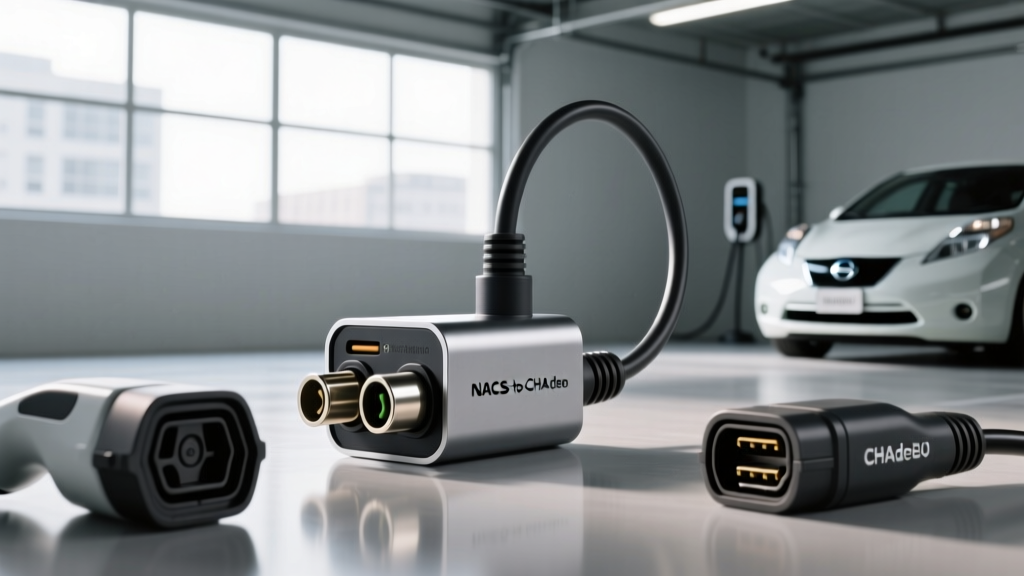
What NACS-to-CHAdeMO Adapters Actually Exist?
As of early 2026, the NACS-to-CHAdeMO adapter market is limited:
- Setec NACS-to-CHAdeMO adapter — One of the few commercially available options, priced around $400–$600. Supports DC fast charging at up to 50 kW (limited by CHAdeMO protocol and adapter electronics, not the station).
- Quick Charge Power CHAdeMO adapter — Fleet-oriented product, typically sold B2B, pricing varies.
- Crowdfunding / small-batch adapters — Several startups have attempted CHAdeMO-to-NACS adapters with mixed delivery records. Verify shipping status and FCC/UL certification before purchasing.
Home Charging Setup: Electrical Requirements and Installation Costs
Regardless of your vehicle's DC fast-charging connector, home Level 2 charging is where 80%+ of EV charging happens. Here's what a proper installation requires.
Electrical Requirements for Level 2 Home Charging
- Circuit: A dedicated 240V circuit, typically 40A or 50A, on a double-pole breaker
- Charger amperage: EVSE rated for 32A–48A continuous draw (NEC requires circuits rated at 125% of continuous load, so a 40A charger needs a 50A breaker)
- Wire gauge: 6 AWG copper for 50A circuits; 4 AWG for 60A circuits
- NEMA outlet vs. hardwired: NEMA 14-50 outlet offers portability; hardwired connections allow higher amperage and eliminate the GFCI breaker requirement in some jurisdictions
Panel Upgrade Considerations
Homes with 100A electrical panels often cannot support a 40–50A EV charger circuit without a panel upgrade to 200A. A licensed electrician will perform a load calculation (NEC Article 220) to determine available capacity. If your panel is near capacity — common in homes with electric dryers, electric ranges, and central AC — an upgrade may be mandatory.
| Component | Cost Range | Notes |
|---|---|---|
| Level 2 EVSE (charger unit) | $300 – $700 | Varies by power output, cable length, smart features |
| Electrician labor (standard install) | $500 – $1,500 | Depends on run length, wall material, conduit needs |
| Electrical permit | $50 – $200 | Required in most jurisdictions; varies by locality |
| Panel upgrade (100A → 200A) | $1,500 – $3,500 | Only if load calculation requires it; common in older homes |
| Total (no panel upgrade) | $850 – $2,400 | Most straightforward garage installs |
| Total (with panel upgrade) | $2,350 – $5,900 | Older homes, long conduit runs, complex retrofits |
Charging Time Examples: What to Expect with CHAdeMO Vehicles
Here are realistic 10–80% charging times for common CHAdeMO-equipped vehicles across charging scenarios:
| Vehicle | Battery (kWh) | Level 2 @ 7.2 kW | CHAdeMO DC @ 50 kW | CHAdeMO DC @ 100 kW (where supported) |
|---|---|---|---|---|
| Nissan Leaf SV Plus (2024) | 62 kWh | ~6.5 hours | ~60 minutes | ~45 minutes |
| Nissan Leaf S (40 kWh) | 40 kWh | ~4 hours | ~40 minutes | ~30 minutes |
| Mitsubishi Outlander PHEV | 20 kWh | ~2.5 hours | ~25 minutes | N/A (CHAdeMO on PHEV typically ~22 kW max) |
Real-world caveat: CHAdeMO charging speed tapers significantly above 80% state of charge. A 50 kW session may average only 30–35 kW across the full 10–80% session due to battery thermal management and the vehicle's charge curve. In cold weather (below 32°F / 0°C), expect 20–30% slower charging speeds unless the vehicle has preconditioned the battery.
Cost to Charge: Home vs. Public vs. Gas
Charging economics depend heavily on where and when you plug in. Here's a realistic cost comparison using a Nissan Leaf SV Plus (62 kWh battery, ~212 miles EPA range, ~3.5 miles/kWh efficiency):
| Scenario | Rate | Cost for Full Charge (0–100%) | Cost per Mile |
|---|---|---|---|
| Home (off-peak utility rate) | $0.10/kWh | $6.20 | $0.029 |
| Home (average utility rate) | $0.16/kWh | $9.92 | $0.047 |
| Public Level 2 (ChargePoint, etc.) | $0.25–$0.49/kWh | $15.50–$30.38 | $0.073–$0.143 |
| DC Fast (Electrify America, EVgo) | $0.35–$0.55/kWh | $21.70–$34.10 | $0.102–$0.161 |
| Gasoline equivalent (30 MPG @ $3.40/gal) | $3.40/gallon | $24.03 (for 212 miles) | $0.113 |
Home charging at off-peak rates is roughly one-quarter the per-mile cost of gasoline. Even public DC fast charging is competitive with gas on a per-mile basis, though convenience and time costs differ. According to fueleconomy.gov, the 2024 Nissan Leaf achieves 111–114 MPGe combined, translating to roughly $0.04–$0.05 per mile at average residential electricity rates.
Equipment Recommendations: Level 2 Chargers for CHAdeMO Vehicles
CHAdeMO vehicles use the J1772 connector for Level 2 AC charging (the same connector used by CCS vehicles). This means any standard J1772 Level 2 charger works — you don't need a CHAdeMO-specific unit for home charging. Here are proven options:
Emporia Level 2 Smart Charger
- Power: 48A (11.5 kW at 240V)
- Connector: J1772 (NACS version also available)
- Cable length: 24 ft
- Smart features: Wi-Fi, app scheduling, energy monitoring, solar integration
- Price: ~$400
- Best for: Budget-conscious buyers who want smart scheduling
ChargePoint Home Flex
- Power: Up to 50A (12 kW at 240V), configurable
- Connector: J1772 (NACS pigtail option available)
- Cable length: 23 ft
- Smart features: Wi-Fi, Alexa, app scheduling, amperage adjustable
- Price: ~$550–$700
- Best for: Flexibility across different circuit sizes
Tesla Wall Connector (with J1772 adapter)
- Power: 48A (11.5 kW at 240V)
- Connector: NACS native (J1772 adapter sold separately, ~$100–$200)
- Cable length: 24 ft
- Smart features: Wi-Fi, OTA updates, power sharing between units
- Price: ~$450 (charger) + $100–$200 (adapter)
- Best for: Multi-EV households with both Tesla and non-Tesla vehicles
Grizzl-E Smart
- Power: 40A (9.6 kW at 240V)
- Connector: J1772
- Cable length: 24 ft
- Smart features: Wi-Fi, OCPP compatible, adjustable amperage
- Price: ~$450
- Best for: Outdoor installs, extreme cold climates (rated to -40°F)
Note for Nissan Leaf owners: The Leaf's onboard charger maxes out at 6.6 kW (27.5A at 240V), so a 48A charger will not charge it faster than a 32A unit. However, buying a higher-amperage charger future-proofs your installation for a future EV with a larger onboard charger.
Safety, Code, and Permit Considerations
A Level 2 home charger installation is electrical work governed by the National Electrical Code (NEC) and local building codes. Key requirements include:
- Dedicated circuit: The EVSE must have its own dedicated breaker — it cannot share a circuit with other appliances
- GFCI protection: NEC 2020 and later requires GFCI protection for receptacles used for EV charging (NEMA 14-50 outlets). Hardwired installations may be exempt in some jurisdictions
- Outdoor rating: If installing outdoors, the EVSE must carry a NEMA 4 or NEMA 4X rating for weather resistance. All units listed above meet this standard
- Permit: Most municipalities require an electrical permit for EVSE installation. Your electrician typically pulls this, and an inspector verifies the work
- Utility notification: Some utilities require notification before installing a Level 2 charger, particularly if you want time-of-use rate plans
Never install a Level 2 charger on a circuit shared with high-draw appliances (dryer, range, HVAC). Overloading a shared circuit creates a fire hazard and will fail inspection.
Frequently Asked Questions
How much does it cost to install a home EV charger?
A standard Level 2 home charger installation costs $850–$2,400 when no panel upgrade is needed. This includes the charger unit ($300–$700), electrician labor ($500–$1,500), and permit fees ($50–$200). If your home needs a panel upgrade from 100A to 200A, add $1,500–$3,500, bringing the total to $2,350–$5,900. Always get a load calculation from a licensed electrician before committing to equipment.
How fast will each charging level add range?
Level 1 (120V standard outlet) adds 3–5 miles per hour. Level 2 (240V home charger) adds 12–75 miles per hour depending on the charger amperage and vehicle's onboard charger capacity — a Nissan Leaf on a 7.2 kW Level 2 charger gains roughly 25 miles per hour. DC fast charging adds 100–200+ miles in 20–30 minutes, but CHAdeMO vehicles are typically limited to 50–100 kW peak charging speeds.
Which connector and charger is compatible with my CHAdeMO EV?
For home Level 2 charging, your CHAdeMO vehicle (Nissan Leaf, Mitsubishi Outlander PHEV) uses the J1772 connector — any standard J1772 Level 2 charger works. For DC fast charging at NACS stations, you need a NACS-to-CHAdeMO adapter (limited availability, $400–$600). For DC fast charging at CCS stations, you need a CCS-to-CHAdeMO adapter. Native CHAdeMO stations still exist but are declining in number.
How much does charging cost per mile compared to gas?
Home charging at off-peak rates ($0.10/kWh) costs roughly $0.029 per mile in a Nissan Leaf — about one-quarter the cost of gasoline at $3.40/gallon in a 30 MPG vehicle ($0.113/mile). Even at average residential rates ($0.16/kWh), EV charging costs ~$0.047 per mile. Public DC fast charging at $0.35–$0.55/kWh is roughly comparable to gasoline on a per-mile basis ($0.10–$0.16/mile).
What electrical upgrades might I need for a home charger?
The most common upgrade is a panel capacity increase from 100A to 200A, required when your home's existing electrical load leaves insufficient headroom for a 40–50A EV circuit. Other potential upgrades include: running new conduit from the panel to the garage (especially if the panel is far from the parking spot), upgrading the meter socket, or installing a sub-panel. A licensed electrician performs a load calculation per NEC Article 220 to determine exact requirements.
Can I use a NACS-to-CHAdeMO adapter at any Tesla Supercharger?
Not always. Tesla has opened many Supercharger stalls to non-Tesla vehicles via the "Magic Dock" NACS connector, but protocol compatibility with CHAdeMO through third-party adapters is inconsistent. Some stalls may not complete the communication handshake required to initiate charging. Before relying on an adapter for a road trip, test it at a single Supercharger stall near home. According to NHTSA and industry reports, adapter-related charging failures are not uncommon with protocol-mismatched connections.
Is it worth buying a NACS-to-CHAdeMO adapter, or should I upgrade my vehicle?
If you drive a Nissan Leaf with 150,000+ miles or an aging CHAdeMO vehicle and plan to keep it for 2–3 more years, a $400–$600 adapter may extend its useful life. However, if you're within 1–2 years of replacing the vehicle anyway, the adapter investment is harder to justify — that money is better applied toward a new NACS-native EV. The CHAdeMO ecosystem is shrinking, and long-term adapter support is uncertain.
Sources: EPA Fuel Economy — Nissan Leaf, IRS §30D EV Tax Credit Rules, National Electrical Code (NEC) Articles 220 and 625. Adapter availability and pricing reflect market conditions as of early 2026; verify current stock and UL/FCC certification with manufacturers before purchase.