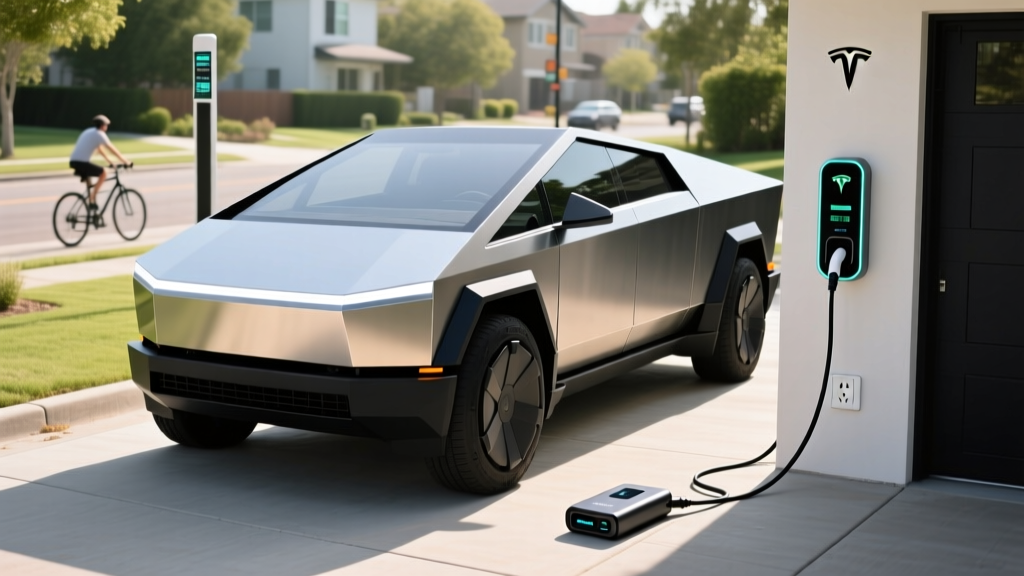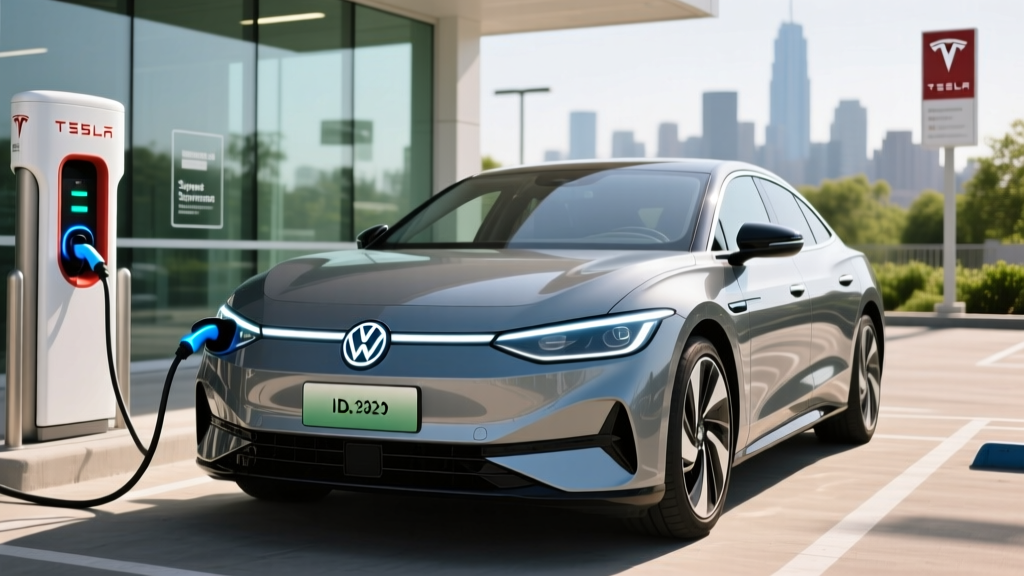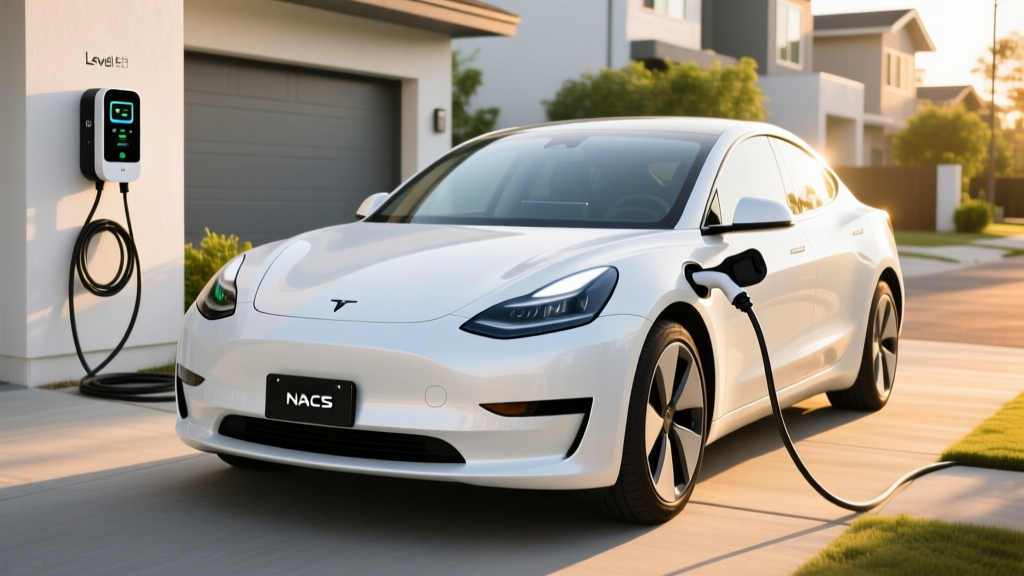
The North American Charging Standard (NACS) has rapidly become the dominant EV connector in the United States. Originally developed by Tesla and opened to the industry in late 2022, the NACS plug type is now standard on every new Tesla and has been adopted by Ford, GM, Rivian, Hyundai, Kia, BMW, and most other major automakers for their 2025 and 2026 model-year vehicles. If you are buying an EV today or planning a home charging installation, understanding NACS — its physical design, charging capabilities, compatibility with older connectors, and what it means for your garage — is essential.
This guide covers the NACS plug type in full context: how it performs across Level 1, Level 2, and DC fast charging; which vehicles use it natively versus with adapters; what a home installation actually costs; and how charging on NACS compares to CCS1 and CHAdeMO in real-world use.
What Is the NACS Plug Type and Why Does It Matter?
NACS is a compact, five-pin connector that handles both AC charging (Level 1 and Level 2) and DC fast charging through a single plug. That is its defining advantage: unlike CCS1, which uses a separate J1772 upper section for AC and a bulky two-pin lower section for DC, NACS uses one small connector for everything. The plug is roughly half the size of a CCS1 connector and significantly lighter, which matters when you are handling a thick DC fast-charging cable in cold weather or tight parking spaces.
Tesla designed the connector for its Supercharger network, which now exceeds 30,000 stalls in North America. When Ford, GM, and others committed to adopting NACS starting in 2025, it effectively became the de facto national standard. As of 2026, the vast majority of new EVs sold in the US either ship with a native NACS port or include a NACS adapter in the box.
Charging Levels and Speeds: What NACS Delivers
The NACS plug type supports all three charging levels used in the US. Here is what each level delivers in practice, measured in kW of power and approximate miles of range added per hour of charging.
| Charging Level | Voltage | Power (kW) | Miles of Range Per Hour | Typical Use Case |
|---|---|---|---|---|
| Level 1 (120V) | 120V AC | 1.0–1.4 kW | 3–5 mi/hr | Overnight trickle; emergencies |
| Level 2 (240V) | 240V AC | 3.3–19.2 kW | 12–75 mi/hr | Home daily charging; workplace |
| DC Fast Charging | 400–800V DC | 50–350 kW | 150–1,000+ mi/hr (peak) | Road trips; rapid top-ups |
A few real-world charging-time examples for common battery sizes, using DC fast charging from 10% to 80% state of charge:
- 75 kWh battery (e.g., Tesla Model Y Long Range) on a 250 kW Supercharger: approximately 25–28 minutes. Peak rate sustains around 200–250 kW up to roughly 50% SoC, then tapers to 100 kW and below above 70%.
- 100 kWh battery (e.g., Ford F-150 Lightning Extended Range) on a 350 kW charger: approximately 35–42 minutes. The charge curve tapers significantly above 80% to protect battery longevity.
- 58 kWh battery (e.g., Hyundai Ioniq 5 Standard Range) on a 250 kW charger: approximately 18–22 minutes. The Ioniq 5's 800V architecture enables sustained high-power charging longer than most 400V vehicles.
On Level 2 at home, a typical 11.5 kW (48-amp) NACS wall connector will fully recharge a 75 kWh battery in roughly 7–8 hours — ideal for overnight replenishment. A 19.2 kW (80-amp) setup can cut that to about 4.5 hours, but requires a dedicated 100-amp circuit and is uncommon in residential installations.
Connector Compatibility: Which EVs Use NACS?
The connector landscape in 2026 has largely consolidated around NACS, but millions of CCS1 and CHAdeMO vehicles remain on the road. Here is where things stand.
| Connector | Vehicles Using It (2026) | AC Charging | DC Fast Charging | Adapter Needed? |
|---|---|---|---|---|
| NACS | Tesla (all), Ford, GM, Rivian, Hyundai, Kia, BMW, Volvo, Mercedes, Honda, Nissan (new models) | Yes (native) | Yes (native) | CCS1→NACS adapter for legacy CCS1 chargers |
| CCS1 | Older model-year VW ID.4, pre-2025 Hyundai/Kia, Stellantis EVs, legacy models | Yes (via J1772 upper) | Yes (native) | NACS→CCS1 adapter to use Tesla Superchargers |
| CHAdeMO | Nissan Leaf (legacy), Mitsubishi Outlander PHEV (older) | Yes (via J1772) | Yes (native) | Limited adapters; network declining |
If you own a CCS1-equipped EV from a pre-2025 model year, you can purchase a NACS-to-CCS1 adapter (typically $200–$300) to access Tesla Superchargers that have opened to non-Tesla vehicles. Ford and Rivian were the first non-Tesla automakers to gain Supercharger access with adapters in 2024, and most NACS-adopting brands now have native access or approved adapter pathways as of 2026.
CHAdeMO is effectively a legacy standard in the US. No new vehicles sold in 2026 use it, and Electrify America and other networks have largely stopped installing new CHAdeMO stalls. If you drive a Nissan Leaf, plan your road trips around remaining CHAdeMO infrastructure or invest in a third-party adapter if one is available for your model.
Home Charger Installation: Electrical Requirements and Costs
Installing a Level 2 NACS home charger is the single most impactful upgrade for daily EV ownership. Most EV owners do 80–90% of their charging at home, and a properly installed Level 2 unit eliminates range anxiety for everyday driving.
Electrical Requirements
A standard Level 2 NACS charger requires a 240-volt dedicated circuit. The most common residential setup is a 60-amp breaker feeding a 48-amp continuous charger (the National Electrical Code requires circuits to be rated at 125% of the continuous load, so a 48-amp charger needs a 60-amp breaker). This delivers up to 11.5 kW of charging power.
Key electrical considerations:
- Panel capacity: Most modern homes have a 200-amp main panel, which typically has enough spare capacity for a 60-amp EV circuit. Older homes with 100-amp panels will likely need a panel upgrade ($1,500–$3,000) or a smart load-management device that throttles the charger when other high-draw appliances are running.
- Wire gauge: A 60-amp circuit typically requires 6 AWG copper wire (or 4 AWG aluminum). Longer runs from the panel to the charger location may require thicker wire to prevent voltage drop.
- Hardwired vs plug: Chargers rated above 40 amps (continuous) must be hardwired per NEC — they cannot use a NEMA 14-50 receptacle. If you want the flexibility to unplug and take your charger with you, you are limited to 32-amp (40-amp breaker) units using a NEMA 14-50 outlet.
- GFCI protection: The 2023 NEC (and continuing into 2026 code cycles) requires GFCI protection for EV charging circuits. Many modern EVSE units have built-in GFCI, but your electrician will verify code compliance for your jurisdiction.
- Permit: Most municipalities require an electrical permit for a new 240V circuit. Permit costs vary widely — typically $50–$250 — and an inspection is required after installation.
Installation Cost Breakdown
| Cost Component | Low End | High End | Notes |
|---|---|---|---|
| EVSE hardware (Level 2 NACS charger) | $300 | $750 | Varies by brand, power, smart features |
| Electrician labor | $400 | $1,500 | Depends on run length, wall type, conduit |
| Electrical materials (wire, conduit, breaker) | $100 | $400 | Longer wire runs increase cost |
| Permit and inspection | $50 | $250 | Varies by municipality |
| Panel upgrade (if needed) | $1,500 | $3,500 | Only if existing panel lacks capacity |
| TOTAL (no panel upgrade) | $850 | $2,900 | Typical for most homes with 200A panel |
| TOTAL (with panel upgrade) | $2,350 | $6,400 | Older homes with 100A service |
The single biggest cost variable is the distance from your electrical panel to the charger location. A panel in the garage next to where you park might mean a 15-foot wire run and a $900 total bill. A panel in the basement on the opposite side of the house from your driveway could mean 80 feet of conduit and wire, pushing costs above $2,500.
Always hire a licensed electrician and pull a permit. Unpermitted EV charger installations can void homeowners insurance claims related to electrical fires and may cause issues during a home sale. For a final assessment of your panel's capacity, defer to a licensed electrician who can perform a load calculation per NEC Article 220.
Cost to Charge: NACS at Home vs Public vs Gas
One of the strongest arguments for EV ownership is lower per-mile energy cost, but the savings depend heavily on where and when you charge. Here are realistic $/kWh scenarios and a cost-per-mile comparison.
| Charging Scenario | Cost per kWh | Cost per Mile* | Annual Cost (12,000 mi) |
|---|---|---|---|
| Home, off-peak utility rate | $0.08–$0.12 | $0.024–$0.036 | $288–$432 |
| Home, standard rate (no TOU) | $0.14–$0.18 | $0.042–$0.054 | $504–$648 |
| Public Level 2 (workplace, retail) | $0.20–$0.35 | $0.060–$0.105 | $720–$1,260 |
| DC Fast Charging (Supercharger, EA) | $0.28–$0.48 | $0.084–$0.144 | $1,008–$1,728 |
| Gasoline (28 MPG avg, $3.40/gal) | — | $0.121 | $1,457 |
*Based on an EV efficiency of 3.3 miles per kWh (roughly 30 kWh/100 mi), which is typical for a midsize crossover like the Tesla Model Y or Hyundai Ioniq 5. More efficient vehicles like the Lucid Air achieve closer to 4.5 mi/kWh; larger vehicles like the F-150 Lightning average around 2.0–2.5 mi/kWh.
The takeaway: home charging on an off-peak rate is roughly one-quarter to one-third the per-mile cost of gasoline. Even exclusive DC fast charging is cost-competitive with gas in most markets. But if you rely entirely on public DC fast chargers at $0.40+/kWh, your fuel savings narrow considerably. This is why home charging access is the most important factor in EV ownership satisfaction.
According to fueleconomy.gov, the average EV owner who charges primarily at home saves $800–$1,200 per year compared to a comparable gasoline vehicle, depending on local electricity and fuel prices.
Recommended NACS Level 2 Home Chargers
Not all Level 2 NACS chargers are equal. Here are four well-regarded units available in 2026, spanning different power levels, price points, and feature sets.
Tesla Wall Connector
- Power output: 11.5 kW (48 amps)
- Connector: Native NACS
- Cable length: 24 ft
- Smart features: Wi-Fi, OTA updates, load sharing between multiple units, Power-Share with Tesla Powerwall
- Price: ~$450
- Best for: Tesla owners; cleanest integration with NACS-native vehicles
ChargePoint Home Flex (NACS)
- Power output: Up to 12 kW (50 amps), adjustable down to 16A
- Connector: Native NACS (2025+ model)
- Cable length: 23 ft
- Smart features: Wi-Fi, app scheduling, Alexa integration, flexible amperage dial for panel-limited homes
- Price: ~$550
- Best for: Homes with limited panel capacity (dial down amps without replacing unit)
Emporia Vue Level 2 Charger
- Power output: 11.5 kW (48 amps)
- Connector: Native NACS
- Cable length: 24 ft
- Smart features: Wi-Fi, energy monitoring, solar integration with Emporia Vue panel monitor, scheduled charging
- Price: ~$350
- Best for: Budget-conscious buyers; solar-panel owners who want charging-to-solar matching
Grizzl-E Smart (NACS)
- Power output: 11.5 kW (48 amps) or 9.6 kW (40 amps, NEMA 14-50 plug version)
- Connector: Native NACS
- Cable length: 24 ft
- Smart features: Wi-Fi, OCPP compatibility, adjustable amperage, extreme cold rating (-40°F)
- Price: ~$450–$550
- Best for: Cold-climate owners; outdoor installations (IP67 rated)
All four units are NEMA 4 or NEMA 4X rated for indoor/outdoor use, are UL-listed (or equivalent), and support hardwired installation. The ChargePoint and Grizzl-E offer adjustable amperage, which is valuable if your electrician determines your panel cannot support a full 60-amp circuit — you can dial the charger down to 32 or 40 amps without buying a new unit.
Safety, Code, and Installation Best Practices
EV charging draws sustained high current for hours — a fundamentally different load profile than most household appliances. Follow these guidelines:
- Dedicated circuit: Your EV charger must be on its own dedicated breaker. Never share a circuit with other outlets or appliances.
- Outdoor rating: If installing outdoors, ensure the EVSE is rated NEMA 4 (weather-resistant) and the connector holster protects the plug from rain, snow, and debris. The NACS connector is designed to be weather-sealed when mated, but an exposed plug face can accumulate moisture.
- Cable management: A 24-foot cable is heavy. Use a wall-mounted cable organizer or retractable reel to prevent tripping hazards and cable damage.
- Load calculation: Before installation, your electrician should perform an NEC Article 220 load calculation to confirm your panel can handle the additional 48–60 amps. If you already have electric heating, an electric water heater, and an electric dryer, you may be closer to your panel's limit than you think.
- Utility rebates: Many utilities offer rebates of $250–$500 for installing a smart Level 2 charger, especially if you enroll in a time-of-use rate plan. Check with your local utility before purchasing equipment — some programs require specific charger models.
NACS vs CCS1: Real-World Charging Network Access
The NACS plug type's biggest practical advantage is not the connector itself — it is access to the Tesla Supercharger network. As of 2026, Superchargers represent roughly 60% of all DC fast-charging stalls in the US, and they consistently outperform competing networks in uptime and reliability. According to J.D. Power EV charging studies, Tesla Superchargers have maintained a significant lead in customer satisfaction over Electrify America, EVgo, and other public networks.
Non-Tesla EVs with native NACS ports can now access Superchargers directly in most regions. CCS1 vehicles can use approved adapters, though some Supercharger stalls remain Tesla-only due to space constraints or cable-length limitations (the Supercharger cable is optimized for the Tesla charge-port location on the driver's rear quarter panel — vehicles with charge ports in other locations may find the cable does not reach comfortably).
If you are choosing between a remaining CCS1 vehicle and a NACS-native vehicle in 2026, the charging-access gap is a meaningful factor. NACS vehicles have first-class access to the largest, most reliable fast-charging network in the country. CCS1 vehicles rely primarily on Electrify America, EVgo, and ChargePoint DC stations, which have improved significantly but still trail Superchargers in station density and uptime.
Frequently Asked Questions
How much does it cost to install a home EV charger with a NACS plug?
A typical Level 2 NACS home charger installation costs between $850 and $2,900 if your electrical panel has sufficient capacity. This includes the charger hardware ($300–$750), electrician labor ($400–$1,500), materials ($100–$400), and permit ($50–$250). If your home needs a panel upgrade from 100A to 200A service, add $1,500–$3,500 to the total.
How fast will each charging level add range to my EV?
Level 1 (120V) adds roughly 3–5 miles per hour. Level 2 (240V, 48 amps) adds 30–45 miles per hour for a typical midsize EV. DC fast charging at 250 kW can add 150–250 miles in 15–20 minutes, though the charge rate tapers significantly above 80% state of charge to protect the battery.
Which connector and charger is compatible with my EV?
If you own a 2025 or 2026 model-year EV from Tesla, Ford, GM, Rivian, Hyundai, Kia, BMW, Volvo, or most other major brands, your vehicle has a native NACS port. Older CCS1 vehicles can use a NACS-to-CCS1 adapter ($200–$300) to access Superchargers. Check your owner's manual or the fueleconomy.gov database for your specific vehicle's connector type.
How much does EV charging cost per mile compared to gas?
At a typical home off-peak rate of $0.10/kWh, an average EV (3.3 mi/kWh) costs about $0.03 per mile — roughly one-quarter the cost of gasoline at $3.40/gallon and 28 MPG ($0.12/mile). Even at public DC fast-charging rates of $0.35–$0.48/kWh, per-mile costs are competitive with or slightly below gasoline.
What electrical upgrades might I need for a home charger?
The most common upgrade is a panel capacity increase if your existing service is 100 amps and already near its load limit. Other potential upgrades include adding a 240V circuit with appropriate wire gauge and breaker, installing a GFCI breaker if required by local code, and possibly upgrading your utility meter socket. A licensed electrician can perform a load calculation to determine exactly what your home needs.
Can I use a J1772 or CCS1 charger with a NACS-equipped vehicle?
Yes. For AC Level 2 charging at public J1772 stations, most NACS vehicles ship with a J1772-to-NACS adapter (or one can be purchased for $50–$100). For DC fast charging at CCS1 stations, a CCS1-to-NACS adapter ($200–$300) allows access. Tesla includes a CCS adapter with new vehicles, and third-party options are widely available.
The NACS plug type has won the connector war in North America. For new EV buyers in 2026, it simplifies the ownership equation: one plug for home and road, access to the largest fast-charging network, and a growing ecosystem of compatible home chargers. Plan your home installation carefully — get a proper load calculation, pull a permit, and choose a charger with adjustable amperage for future flexibility — and you will have the most convenient, cost-effective fueling setup available.