The Problem With NACS Extension Cables for EV Charging
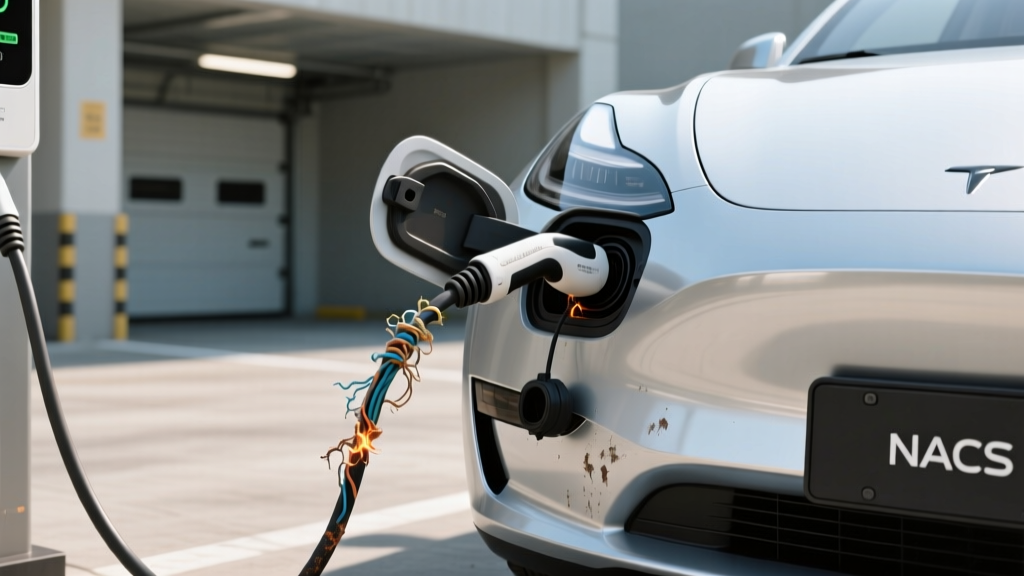
If you've been shopping for a way to stretch the reach of your Tesla or NACS-equipped EV charger, you've likely searched for a NACS extension cable and found a murky landscape of third-party listings, questionable adapters, and conflicting advice. Here's the unvarnished truth: extension cables designed to plug between a Level 2 EV charger and your vehicle are not certified by any major safety testing laboratory (UL, ETL, CSA) for EV charging applications, and using one introduces real fire, warranty, and liability risks.
The North American Charging Standard (NACS) connector — now the dominant EV plug in the U.S. as automakers from Ford to Hyundai adopt it for 2025-2026 models — was engineered by Tesla for direct vehicle-to-charger connections. Extension cables introduce additional connection points that increase electrical resistance, generate heat under sustained 32A-48A loads, and bypass the integrated safety systems built into certified charging equipment.
Rather than risk a $50,000 battery pack or your home's electrical system on an uncertified cable, this guide walks through the correct solutions: buying a charger with a longer cable, relocating your charger, or installing a second charging point. We'll also cover everything you need to know about proper home EV charging setup — from panel capacity to real installation costs.
Why Extension Cables Fail Under EV Charging Loads
EV charging is not like plugging in a lamp. A Level 2 home charger pulling 40 amps at 240 volts delivers 9.6 kW (kilowatts — the unit of power) continuously for hours. That sustained high-current load is fundamentally different from the intermittent draw of power tools or appliances, and it's why the National Electrical Code (NEC) treats EV charging circuits as continuous loads requiring conductors rated at 125% of the circuit amperage.
Here's what happens when you add an uncertified NACS extension cable into that circuit:
- Connection resistance: Each additional plug/socket junction adds milliohms of resistance. At 40A sustained, even small resistance generates measurable heat — and heat degrades connectors over time.
- No independent certification: As of early 2026, no major NACS extension cable has received UL 2252 (EV cable) or UL 2594 (EV supply equipment) certification. Listings on marketplace sites frequently cite irrelevant standards.
- Ground continuity risk: Extension cables may not maintain proper ground-fault protection signaling between the charger's GFCI system and the vehicle, potentially disabling a critical safety mechanism.
- Warranty voidance: Both Tesla and third-party charger manufacturers (ChargePoint, Wallbox, Emporia) specify in their installation manuals that only the factory-supplied cable may be used. Damage caused by an extension cable is not covered under warranty.
The Right Solutions: Longer Cables, Relocation, and Second Chargers
Instead of an extension cable, here are the three safe alternatives ranked by cost and practicality:
1. Buy a Charger With a Longer Factory Cable
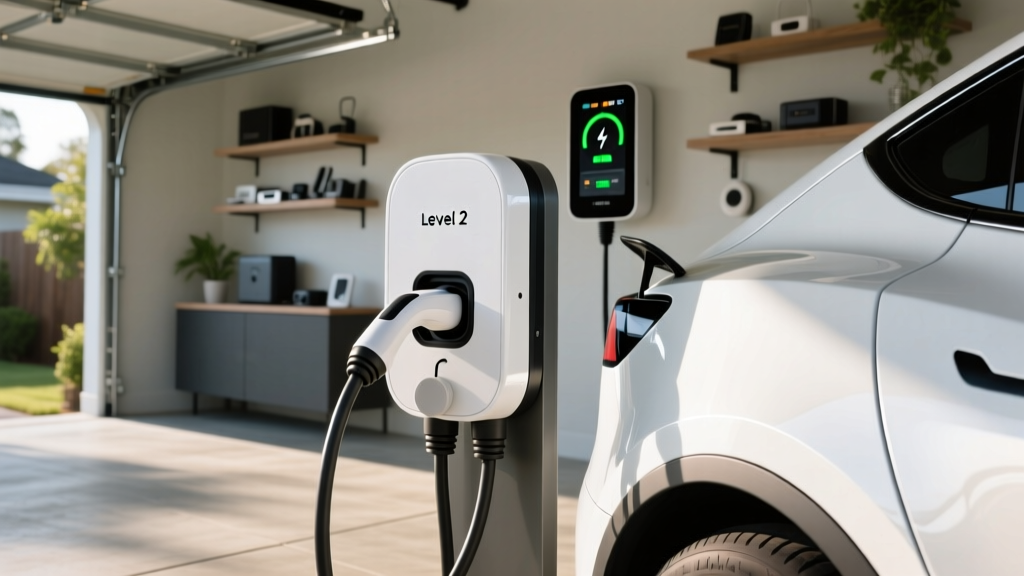
Most quality Level 2 chargers ship with 18-25 foot cables. If your current charger has a short cable (some budget units ship with just 12 feet), upgrading to a model with a 25-foot cable solves most reach problems without any safety compromise. See our equipment recommendations below.
2. Relocate Your Charger
If your charger was installed in a suboptimal location, a licensed electrician can move it. The cost is typically $200-$500 for a simple relocation on the same circuit, plus any drywall patching. This is far safer and often cheaper than the cumulative risk of an extension cable.
3. Install a Second Charging Point
For large garages or detached structures, adding a second 240V circuit and charger is the premium solution. If your panel has spare capacity, expect $800-$2,000 for the additional circuit and installation. This also adds home value.
Understanding EV Charging Levels: Speeds and Range Added
Before sizing your home setup, understand what each charging level delivers. Power is measured in kW (the rate of energy flow), while your battery stores energy measured in kWh (kilowatt-hours). Think of kW as the size of the pipe and kWh as the size of the tank.
| Level | Voltage | Max Power (kW) | Miles of Range Added Per Hour | Typical Use |
|---|---|---|---|---|
| Level 1 | 120V AC | 1.4–1.9 kW | 3–5 mi/hr | Overnight trickle; PHEV top-ups |
| Level 2 (Home/Public) | 240V AC | 7.2–19.2 kW | 20–60 mi/hr | Daily home charging; destination |
| DC Fast Charging | 400–800V DC | 50–350 kW | 150–1,000+ mi/hr | Road trips; rapid top-ups |
For context, a typical 2026 EV with a 75 kWh battery (EPA range ~300 miles) charging at a 48A / 11.5 kW Level 2 home charger will go from 10% to 80% in approximately 5–6 hours — perfect for overnight charging. That same vehicle on a 250 kW DC fast charger will hit 10-80% in roughly 18-25 minutes, though charging speed tapers significantly above 80% to protect battery health.
Home Charger Installation: Electrical Requirements and Real Costs
Installing a Level 2 home charger is an electrical project, not a plug-and-play purchase. Here's what's involved:
Electrical Requirements
- Circuit: A dedicated 240V circuit — typically 40A, 50A, or 60A — with copper conductors sized to NEC continuous-load rules (wire rated at 125% of the breaker: e.g., 6 AWG for a 60A breaker, 8 AWG for a 50A breaker).
- Breaker: A double-pole breaker in your main or sub-panel.
- Receptacle vs. hardwired: NEMA 14-50 outlets offer portability; hardwired installations eliminate the receptacle as a failure point and allow higher amperage (some 48A chargers require hardwiring because NEC limits plug-in loads to 40A on a 50A circuit).
- GFCI protection: NEC 2020 and later require GFCI breakers for EV receptacles in garages. Some EVSE units have built-in ground-fault detection, which is why hardwired installations are often simpler.
Panel Capacity: The Upgrade Question
Before installing any Level 2 charger, your electrician will perform a load calculation on your electrical panel. A typical 200A panel can usually accommodate a 40-60A EV circuit. Older homes with 100A or 150A service may need a panel upgrade — a significant added cost but one that also increases your home's electrical capacity for future needs (heat pumps, solar, etc.).
| Component | Low Estimate | High Estimate | Notes |
|---|---|---|---|
| Level 2 Charger (Equipment) | $300 | $750 | 32A–48A smart chargers; see picks below |
| Electrical Permit | $50 | $250 | Varies by municipality; required for code compliance |
| Electrician Labor (Standard Install) | $400 | $1,200 | Short run from panel to garage on same wall |
| Conduit & Wiring (Long Run) | $200 | $1,500 | If panel is far from charge point; attic/crawlspace routing |
| Panel Upgrade (if needed) | $1,500 | $4,000 | 100A→200A service upgrade; not always required |
| Total (No Panel Upgrade) | $950 | $3,700 | Most homes fall in $1,200–$2,000 range |
| Total (With Panel Upgrade) | $2,450 | $7,700 | Older homes with 100A service |
Some utility companies offer rebates of $250-$500 for installing a smart Level 2 charger, and the federal Residential Clean Energy Credit may cover 30% of charger and installation costs (up to $1,000) through 2032 — check current IRS guidelines and your tax professional for eligibility.
Connector Compatibility: NACS, CCS1, and CHAdeMO
The connector landscape has consolidated dramatically. As of 2026, NACS is the dominant standard in North America, but legacy vehicles still use CCS1 or CHAdeMO. Here's how compatibility breaks down:
| Connector | Automakers Using It | Home Charger Availability | Adapter Needed? |
|---|---|---|---|
| NACS (Tesla standard) | Tesla, Ford, GM, Rivian, Volvo, Polestar, Hyundai, Kia, BMW, others transitioning 2025-2026 | Tesla Wall Connector, ChargePoint Home Flex (NACS), Emporia Level 2 | CCS-to-NACS adapters available for older chargers; ~$150-$250 |
| CCS1 (Combined Charging System) | Volkswagen, some Stellantis models, pre-2025 Ford/GM/Hyundai/Kia vehicles | ChargePoint Home Flex, Wallbox Pulsar Plus, Emporia Vue | NACS-to-CCS1 adapter for charging at Tesla Superchargers; ~$200 |
| CHAdeMO | Nissan Leaf (legacy); discontinued for new models | Limited new equipment | No practical adapter to NACS; legacy infrastructure only |
If you own a NACS-equipped vehicle (any Tesla, or a 2025-2026 Ford, GM, Rivian, etc.) and are buying a new home charger, choose a NACS-native unit. If you have a CCS1 vehicle, buy a CCS1 charger — or buy a NACS charger with a certified adapter. Never use an extension cable between an adapter and the vehicle; the combined connection points compound resistance and heat risk.
Charging Cost Per Mile: EV vs. Gas
One of the strongest arguments for home charging is cost. Here's how EV charging compares to gasoline on a per-mile basis:
| Scenario | Cost Per kWh / Gallon | Vehicle Efficiency | Cost Per Mile |
|---|---|---|---|
| Home Charging (Off-Peak TOU Rate) | $0.08–$0.14/kWh | 3.5 mi/kWh (286 Wh/mi) | $0.02–$0.04 |
| Home Charging (Standard Rate) | $0.15–$0.22/kWh | 3.5 mi/kWh | $0.04–$0.06 |
| Public Level 2 (ChargePoint, etc.) | $0.25–$0.49/kWh | 3.5 mi/kWh | $0.07–$0.14 |
| DC Fast Charging (Electrify America, Tesla) | $0.30–$0.55/kWh | 3.0 mi/kWh (highway) | $0.10–$0.18 |
| Gasoline (28 MPG combined) | $3.30/gallon | 28 mi/gallon | $0.12 |
| Gasoline (40 MPG hybrid) | $3.30/gallon | 40 mi/gallon | $0.08 |
Even at public DC fast-charging rates, most EVs match or beat the per-mile cost of a 28 MPG gas car. At home off-peak rates, EVs cost roughly one-quarter to one-third as much per mile. Over 15,000 miles per year, that's $1,200-$1,500 in annual fuel savings for a typical EV owner charging primarily at home, per EPA data on EV efficiency.
Recommended Level 2 Home Chargers (NACS and CCS1)
These are the chargers we recommend based on build quality, certification, smart features, and cable length — all are UL or ETL listed and eliminate any temptation to use an extension cable:
Tesla Wall Connector (Gen 4)
- Connector: NACS (native)
- Max Power: 11.5 kW (48A hardwired)
- Cable Length: 24 feet
- Smart Features: Wi-Fi, OTA updates, load sharing between units, access control
- Price: ~$475
- Best For: Tesla and NACS-equipped EVs; best value at 48A
ChargePoint Home Flex
- Connector: NACS or CCS1 (configurable)
- Max Power: 12 kW (50A, adjustable down)
- Cable Length: 23 feet
- Smart Features: Wi-Fi, app scheduling, Alexa integration, utility demand-response
- Price: ~$550–$700
- Best For: Multi-EV households; flexible amperage settings
Emporia Level 2 EV Charger
- Connector: NACS or J1772 variants
- Max Power: 11.5 kW (48A)
- Cable Length: 24 feet
- Smart Features: Wi-Fi, energy monitoring, solar integration with Emporia Vue panel
- Price: ~$400
- Best For: Budget-conscious buyers wanting smart features and solar pairing
Wallbox Pulsar Plus
- Connector: NACS or CCS1
- Max Power: 11.5 kW (48A)
- Cable Length: 25 feet (longest in class)
- Smart Features: Wi-Fi/Bluetooth, Power Sharing, Eco-Smart solar mode
- Price: ~$550–$650
- Best For: Maximum cable reach without an extension cable
All four chargers above offer 23-25 foot cables, which covers the vast majority of garage layouts. If you need more reach, the correct solution is to relocate the charger or add a second unit — not to insert an uncertified NACS extension cable into a high-amperage circuit.
Safety, Code, and Installation Best Practices
Whether you're installing a new charger or evaluating an existing setup, these code requirements and best practices protect your home and your vehicle:
- Dedicated circuit: Your EV charger must be on its own dedicated breaker — never shared with other appliances. NEC Article 625 classifies EV charging as a continuous load.
- GFCI protection: Required for receptacle-based installations in garages (NEC 2020+). Hardwired chargers with integrated ground-fault detection may not require a GFCI breaker — confirm with your electrician.
- Outdoor rating: If your charger is outdoors, both the unit and the receptacle must carry a NEMA 3R or 4 (weatherproof) rating. Use an in-use cover for receptacles.
- Permit and inspection: Every jurisdiction requires a permit for new 240V circuits. The inspection ensures your installation meets code — and it protects your insurance coverage in the event of an electrical fire.
- No extension cords or cables: NEC and all EVSE manufacturer instructions prohibit extension cords. This includes NACS extension cables, CCS extension cables, and J1772 extensions — none carry proper safety certification for sustained EV charging loads.
- Cable management: Use a wall-mounted cable organizer or retractor to keep your charger cable off the floor and protected from vehicle traffic in the garage.
For detailed code requirements, reference the National Fire Protection Association's NEC resources and consult a licensed electrician familiar with EV installations in your area.
Frequently Asked Questions
How much does it cost to install a home EV charger?
A standard Level 2 home charger installation costs $1,200–$2,000 in most homes when no panel upgrade is needed. This includes the charger ($300–$750), electrician labor ($400–$1,200), permits ($50–$250), and wiring materials. If your home needs a panel upgrade from 100A to 200A service, add $1,500–$4,000. Always get a licensed electrician's quote — and don't skip the permit.
How fast will each charging level add range?
Level 1 (120V) adds roughly 3–5 miles per hour. Level 2 (240V, 40-48A) adds 20–45 miles per hour depending on the vehicle's onboard charger capacity. DC fast charging (50–350 kW) can add 150–1,000+ miles per hour at peak rates, though charging tapers significantly above 80% state of charge. For daily driving, a 48A Level 2 charger fully replenishes most EVs overnight.
Which connector is compatible with my EV?
If you drive a Tesla or a 2025-2026 model from Ford, GM, Rivian, Hyundai, Kia, BMW, Volvo, or Polestar, your vehicle likely uses NACS. Older non-Tesla EVs (pre-2025 VW, Hyundai, Kia, Ford) typically use CCS1. The Nissan Leaf uses CHAdeMO. Check your vehicle's charge port or owner's manual. For home charging, match your charger connector to your vehicle — or use a certified adapter (not an extension cable).
How much does EV charging cost per mile vs. gas?
Home charging at off-peak rates costs $0.02–$0.04 per mile — roughly one-third the cost of gasoline at $3.30/gallon in a 28 MPG vehicle ($0.12/mile). Even public DC fast charging at $0.35–$0.55/kWh costs $0.10–$0.18 per mile, comparable to or cheaper than gas. A typical EV owner driving 15,000 miles/year and charging primarily at home saves $1,200–$1,500 annually on fuel.
What electrical upgrades might I need for a home charger?
Most homes with 200A electrical service can accommodate a 40-60A Level 2 charger circuit without upgrades. Homes with 100A or 150A service may need a panel upgrade ($1,500–$4,000). Your electrician will perform a load calculation to determine if your panel has capacity. Other potential upgrades include running new conduit for long wire runs (panel far from garage) or adding a sub-panel for detached garages.
Is a NACS extension cable ever safe to use?
No. As of 2026, no NACS extension cable carries UL or ETL certification for EV charging. The NEC prohibits extension cords for EVSE installations. The sustained 32-48A loads of Level 2 charging generate heat at any additional connection point, creating a fire risk that factory cables and properly installed circuits are designed to eliminate. Buy a charger with a longer cable (24-25 feet) or relocate your charger instead.