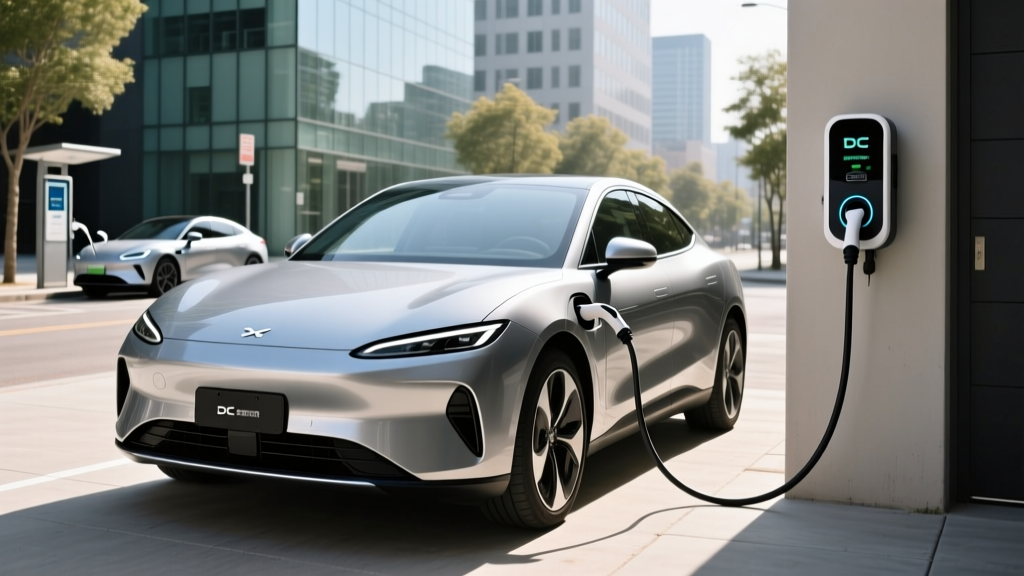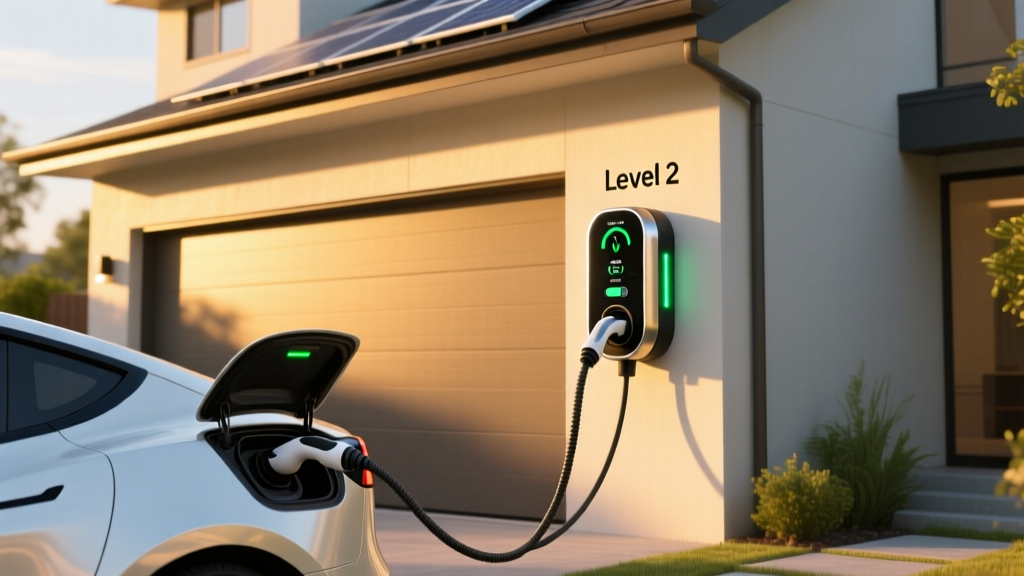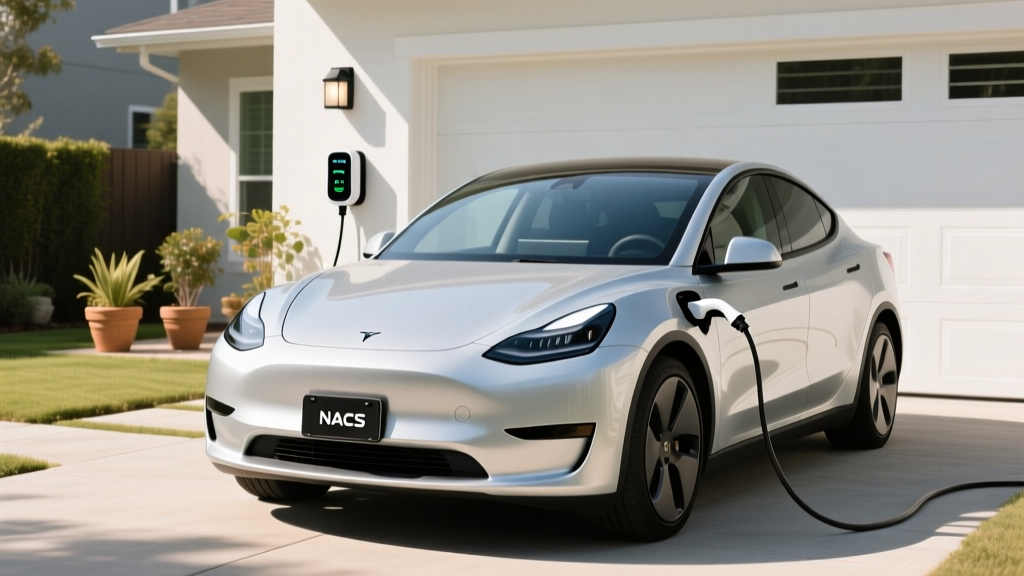
The North American Charging Standard (NACS) has won the connector war. As of the 2025 model year, nearly every major automaker — Ford, GM, Rivian, Hyundai, Kia, BMW, Volvo, and others — has adopted the NACS connector on new electric vehicles. Tesla's proprietary plug is now the industry standard, and that shift fundamentally changes how you plan your home charging setup and navigate public networks.
If you're buying or already own a NACS-equipped EV, this guide covers every practical detail: electrical requirements for a home Level 2 installation, real-world charging speeds at each level, which adapters you might still need, what it actually costs per mile, and specific charger hardware worth your money.
Understanding NACS and What It Means for Your EV
NACS (SAE J3400) is physically smaller and lighter than the legacy CCS1 connector. It handles both AC Level 2 charging and DC fast charging through the same port — no separate combo connector needed. For new NACS EV owners, this means:
- Home charging: You can plug directly into any NACS-equipped Level 2 wall connector, or use a J1772-to-NACS adapter with the thousands of existing J1772 stations in homes and workplaces.
- Public DC fast charging: You get native access to Tesla's Supercharger network (over 28,000 stalls in North America as of early 2026) plus growing NACS-native stations from Electrify America, EVgo, and others.
- Legacy CCS stations: You'll need a CCS1-to-NACS adapter (typically $150–$250) to use older CCS-equipped DC fast chargers still common at many public sites.
| Connector | Native Vehicles | Adapter Needed For |
|---|---|---|
| NACS (J3400) | Tesla (all), Ford (2025+), GM (2025+), Rivian (2025+), Hyundai/Kia (2025+), BMW, Volvo, Mercedes | CCS1 adapter for legacy DC stations |
| CCS1 | Legacy 2024-and-earlier non-Tesla EVs (VW ID.4 pre-refresh, older Bolt EV, etc.) | NACS adapter for Superchargers |
| CHAdeMO | Nissan Leaf (discontinued after 2025) | No reliable DC adapter to NACS/CCS exists |
The practical takeaway: if you're buying a 2025 or 2026 EV from almost any manufacturer, you're getting a NACS port. Plan your charging infrastructure accordingly.
Charging Levels Explained: Speeds, Power, and Real-World Range Added
Before choosing equipment, understand the three charging tiers available to NACS EV owners. Power is measured in kilowatts (kW) — the rate of energy delivery. Energy stored in your battery is measured in kilowatt-hours (kWh). These are not interchangeable: kW is how fast water flows through the hose, kWh is how full the bucket gets.
| Level | Voltage / Amps | Power (kW) | Miles of Range Added per Hour | Typical Use Case |
|---|---|---|---|---|
| Level 1 | 120V / 12A | 1.4 kW | 3–5 mi/hr | Overnight trickle; PHEVs or very low daily mileage |
| Level 2 | 240V / 32–48A | 7.7–11.5 kW | 25–44 mi/hr | Primary home and workplace charging |
| DC Fast Charge | 400–800V DC | 50–350 kW | 150–1,200+ mi/hr (peak) | Road trips; 10–80% in 18–45 min depending on vehicle |
Level 1 reality check: A standard 120V outlet delivers roughly 1.4 kW. For a 75 kWh battery (like the Ford Mustang Mach-E Extended Range), going from 20% to 80% would take over 30 hours. Level 1 is viable only for plug-in hybrids with small batteries (10–20 kWh) or BEV owners who drive under 30 miles daily and can charge 10+ hours overnight.
Level 2 is where most NACS EV owners live: A 48-amp, 240V circuit delivers 11.5 kW, adding roughly 35–44 miles of range per hour depending on your vehicle's efficiency (measured in kWh/100mi or MPGe). An overnight charge of 8 hours at this rate replenishes 280–350 miles — enough to refill nearly any EV battery from near-empty to full.
DC fast charging is for road trips: Peak rates of 150–350 kW sound extraordinary, but no EV sustains peak rate for the full session. Charge curves taper significantly above 80% State of Charge (SoC) to protect battery health. A vehicle rated at 250 kW peak might average 120–150 kW over a 10–80% session.
Home Charger Installation: Electrical Requirements and Real Costs
Installing a Level 2 home charger is the single highest-impact upgrade any NACS EV owner can make. Here's what the electrical work actually involves and what you'll pay.
Electrical Requirements for a 48-Amp Level 2 Charger
A 48-amp charger requires a dedicated 60-amp circuit (National Electrical Code mandates circuits be rated at 125% of continuous load — EV charging is classified as continuous). That means:
- Circuit breaker: 60A double-pole breaker in your main panel
- Wire gauge: 6 AWG copper (or 4 AWG aluminum) for runs up to ~50 feet; thicker wire for longer runs to minimize voltage drop
- Voltage: 240V (same as a clothes dryer or electric range)
- Connector: Hardwired (recommended for 48A+) or NACS plug into a 240V receptacle (NEMA 14-50 or 14-60)
For a 40-amp charger, you need a 50-amp circuit with a NEMA 14-50 outlet or hardwire — this is the most common residential setup and covers most EVs' onboard charger limits.
Panel Capacity: The Hidden Cost Driver
Your home's electrical panel has a maximum amperage rating — typically 100A, 150A, or 200A in US homes. Adding a 60A circuit to a 100A panel that's already near capacity is a fire hazard and will fail inspection. A licensed electrician will perform a load calculation (NEC Article 220) to determine if your panel can handle the added circuit.
If you need a panel upgrade from 100A to 200A, expect to pay $1,500–$3,500 on top of the charger installation. This is the single biggest variable in home charging cost and the one most online guides gloss over.
| Component | Simple Install (Panel Has Capacity, Short Run) | Complex Install (Panel Upgrade + Long Run) |
|---|---|---|
| Level 2 Charger Hardware (40–48A, NACS) | $400–$700 | $400–$700 |
| Electrician Labor (2–4 hrs simple / 6–10 hrs complex) | $300–$600 | $800–$1,500 |
| Electrical Materials (wire, conduit, breaker) | $100–$300 | $200–$500 |
| Permit and Inspection | $50–$200 | $50–$200 |
| Panel Upgrade (100A → 200A, if needed) | $0 | $1,500–$3,500 |
| Total Estimated Cost | $850–$1,800 | $2,950–$6,400 |
Federal incentive note: The IRS Residential Clean Energy Credit (IRC §25D) does not cover EV chargers for most taxpayers after 2022. However, the Alternative Fuel Vehicle Refueling Property Credit (IRC §30C) offers up to $1,000 for home charger installation if you live in an eligible census tract (typically lower-income or rural areas). Check your eligibility on the IRS site or with a tax professional before counting on this credit.
NACS Home Charger Equipment Picks for 2026
With NACS now the dominant standard, charger manufacturers have released native NACS models alongside their J1772 versions. For a NACS EV, buying a native NACS charger eliminates the need for a daily adapter swap. Here are top picks based on power output, build quality, smart features, and value.
Tesla Wall Connector (NACS)
- Power: Up to 11.5 kW (48A at 240V)
- Cable length: 24 feet
- Connector: Native NACS
- Smart features: Wi-Fi, over-the-air updates, Power Sharing (link multiple units on one circuit), load management, access control via Tesla app
- Price: ~$475
- Best for: Tesla owners and anyone wanting a proven, high-output unit at a competitive price. Works with all NACS EVs, not just Teslas.
ChargePoint Home Flex (NACS Version)
- Power: Up to 12 kW (50A at 240V) — configurable down to 16A for lower-capacity circuits
- Cable length: 23 feet
- Connector: Native NACS (2025+ model) or J1772 with adapter
- Smart features: Wi-Fi, ChargePoint app scheduling, Alexa integration, energy reporting, flexible amperage settings
- Price: ~$650
- Best for: Homes with varied circuit capacity (the adjustable amperage is a standout feature) and non-Tesla NACS EV owners wanting a third-party ecosystem.
Emporia Level 2 EV Charger (NACS)
- Power: Up to 11.5 kW (48A at 240V)
- Cable length: 24 feet
- Connector: Native NACS
- Smart features: Wi-Fi, Emporia energy monitoring integration (pair with Emporia Vue home energy monitor for solar-aware charging), scheduling, load management
- Price: ~$400
- Best for: Budget-conscious buyers and solar-panel owners who want to charge only when excess solar production is available.
Grizzl-E Smart (NACS)
- Power: Up to 10 kW (40A at 240V)
- Cable length: 24 feet
- Connector: Native NACS
- Smart features: Wi-Fi, OCPP protocol support, basic app scheduling
- Price: ~$450
- Best for: Cold-climate owners (rated to -40°F) and those wanting a rugged, Canadian-built unit. Slightly lower amperage than competitors.
Key buying advice: Match your charger's amperage to your vehicle's onboard charger limit. The Ford F-150 Lightning accepts up to 19.2 kW (80A) AC — one of the few EVs that benefits from a 60A+ charger. Most other NACS EVs (Tesla Model Y, Hyundai Ioniq 5, GM Ultium vehicles) max out at 11.5 kW (48A) or 7.7 kW (32A) on AC. Buying a 48A charger for a vehicle with a 32A onboard charger wastes money without speeding up charging.
Public Charging with a NACS EV: Superchargers, Networks, and DC Fast Charging
The NACS connector's biggest advantage is native access to the Tesla Supercharger network — widely regarded as the most reliable DC fast charging infrastructure in North America. Here's what to expect in 2026.
Tesla Supercharger Network (NACS Native)
Non-Tesla NACS EVs can use Tesla Superchargers via the Tesla app (select "Charge Your Non-Tesla"). Pricing varies by location and time of day but typically ranges from $0.28–$0.48/kWh. Supercharger V3 stalls deliver up to 250 kW; V4 stalls, now rolling out at new stations, support up to 350 kW for compatible vehicles.
Real-world charging times for common NACS EVs at a 250 kW Supercharger:
- Tesla Model Y (75 kWh battery): 10–80% in ~25 minutes (peak ~250 kW, sustained average ~130 kW)
- Ford Mustang Mach-E Extended Range (91 kWh usable): 10–80% in ~32 minutes (peak ~150 kW — the Mach-E's onboard DC limit)
- Hyundai Ioniq 5 (77.4 kWh): 10–80% in ~18 minutes at 800V-capable chargers (peak ~240 kW). Note: the Ioniq 5's 800V architecture charges significantly faster than 400V vehicles, but only at chargers that can deliver the voltage.
- Chevrolet Equinox EV (85 kWh): 10–80% in ~30 minutes (peak ~190 kW)
Other Public DC Networks
Electrify America, EVgo, and ChargePoint are progressively adding NACS connectors to new and retrofitted stations. As of mid-2026, expect roughly 30–40% of non-Tesla DC fast chargers to have at least one NACS cable. For CCS1-only stations, you'll need a CCS-to-NACS adapter — Tesla sells one for ~$250, and third-party options (A2Z, Lectron) run $150–$200.
Preconditioning matters: Most NACS EVs will precondition (warm) the battery when you navigate to a DC fast charger in the vehicle's infotainment system. This can cut your 10–80% charge time by 5–10 minutes in cold weather. Always navigate to the charger rather than just driving there — the car needs 15–30 minutes of advance notice to heat the battery to optimal charging temperature.
Cost to Charge: Home vs. Public vs. Gas — The Per-Mile Math
Charging cost is where EV ownership economics shine or disappoint, depending entirely on where and when you plug in. Here's the real math.
| Scenario | Rate | Cost per Mile (at 3.0 mi/kWh / 33 kWh/100mi) |
|---|---|---|
| Home — Off-Peak Utility Rate | $0.08–$0.12/kWh | $0.024–$0.036/mile |
| Home — Standard Residential Rate | $0.13–$0.18/kWh | $0.039–$0.054/mile |
| Home — Peak / Time-of-Use High | $0.25–$0.40/kWh | $0.075–$0.12/mile |
| Public Level 2 (Workplace, Retail) | $0.20–$0.35/kWh | $0.06–$0.105/mile |
| DC Fast Charge (Supercharger / EA) | $0.30–$0.48/kWh | $0.09–$0.144/mile |
| Gasoline Car (30 MPG combined, $3.40/gal) | $3.40/gallon | $0.113/mile |
| Gasoline Car (25 MPG combined, $3.40/gal) | $3.40/gallon | $0.136/mile |
The bottom line: If you charge primarily at home on off-peak or standard rates, your NACS EV costs $0.03–$0.05 per mile to "fuel" — roughly one-third to one-quarter the cost of a 30 MPG gas car. Even DC fast charging at $0.40/kWh is competitive with a 25 MPG gas vehicle. The cost advantage erodes only if you rely exclusively on expensive public DC fast chargers and live in a high-electricity-rate state.
For a driver covering 12,000 miles per year with 80% home charging at $0.14/kWh and 20% public DC at $0.38/kWh:
- Annual EV fuel cost: 12,000 mi × [(9,600 mi × $0.042/mi) + (2,400 mi × $0.114/mi)] = ~$678/year
- Annual gas car fuel cost (30 MPG, $3.40/gal): 12,000 ÷ 30 × $3.40 = ~$1,360/year
- Annual savings: ~$682/year, or $3,410 over five years
Safety, Code Compliance, and Installation Best Practices
EV charging draws high current for hours at a stretch — this is not the same as plugging in a dryer for 45 minutes. Here's what safe, code-compliant installation requires.
- Dedicated circuit: Your Level 2 charger must have its own dedicated circuit — not shared with other appliances. A 60A charger needs a 60A breaker serving only that outlet or hardwire.
- GFCI protection: NEC 2020 and later requires GFCI (Ground Fault Circuit Interrupter) protection for all EV charging outlets. Hardwired chargers typically have GFCI built into the unit. If you use a receptacle (NEMA 14-50), your electrician must install a GFCI breaker — these cost $50–$120 more than standard breakers.
- Outdoor rating: If your charger is installed outdoors (garage exterior, driveway post), the unit must carry a NEMA 4 or IP65 weather rating. All chargers listed above meet this standard, but verify the specific model's rating.
- Permit and inspection: Most US jurisdictions require an electrical permit for a new 240V circuit. The permit fee is typically $50–$200, and an inspector will verify wire gauge, breaker sizing, grounding, and GFCI compliance. Skipping the permit risks voiding your homeowner's insurance if an electrical fire occurs.
- Wire sizing: Undersized wire causes voltage drop, heat buildup, and potential fire. For a 60A circuit with a run under 50 feet, 6 AWG copper is standard. Runs over 100 feet may require 4 AWG to maintain voltage within 3% drop. Your electrician will calculate this.
- EVSE listing: Only purchase chargers that are UL-listed or ETL-listed (Intertek). Uncertified chargers from overseas marketplaces may lack critical safety protections and will fail inspection.
NACS EV Charging FAQ
How much does it cost to install a home EV charger for my NACS EV?
A straightforward installation (adequate panel capacity, short wire run, no structural obstacles) typically costs $850–$1,800 total including the charger hardware, electrician labor, materials, and permit. If your home needs a 200A panel upgrade, the total can reach $3,000–$6,400. Always get 2–3 quotes from licensed electricians who have EV charger installation experience.
How fast will each charging level add range to my NACS EV?
Level 1 (120V) adds 3–5 miles per hour. Level 2 (240V, 48A) adds 25–44 miles per hour depending on your vehicle's efficiency. DC fast charging at 150–250 kW adds 150–1,200+ miles per hour at peak rates, though charge-curve taper means a realistic 10–80% session takes 18–45 minutes depending on your vehicle's battery size and DC charge acceptance rate.
Which connector and charger is compatible with my NACS EV?
If your EV has a NACS port (Tesla, 2025+ Ford, GM, Rivian, Hyundai/Kia, BMW, Volvo, and others), you need a NACS-connector Level 2 charger for home use. For legacy CCS1 public DC chargers, you'll need a CCS1-to-NACS adapter. J1772 Level 2 public chargers work with a J1772-to-NACS adapter (often included with the vehicle).
How much does charging cost per mile vs. gas?
Home charging at average US residential rates ($0.14/kWh) costs roughly $0.04–$0.05 per mile for an efficient EV. A 30 MPG gas car at $3.40/gallon costs about $0.11 per mile. That's roughly a 60% fuel cost reduction for home charging. DC fast charging at $0.35–$0.48/kWh costs $0.10–$0.14 per mile — comparable to a fuel-efficient gas car.
What electrical upgrades might I need for a Level 2 charger?
The most common upgrade is a panel capacity increase (from 100A to 200A service) if your existing panel is near capacity. Other potential needs: a new sub-panel if your main panel has no open breaker slots, conduit installation for exterior wire runs, or a utility service upgrade if your home's incoming service is under 100A (rare in homes built after 1980). A licensed electrician's load calculation will determine exactly what's required.
Can I use a Tesla Supercharger with my non-Tesla NACS EV?
Yes. Tesla has opened its Supercharger network to all NACS-equipped EVs. Use the Tesla app to initiate a session at any Supercharger stall marked as supporting non-Tesla vehicles. Expect pricing between $0.28–$0.48/kWh depending on location and time of day. Some Supercharger stalls have shorter cables designed for Tesla's charge-port location (rear driver-side); depending on your EV's port location, you may need to park at an angle or use a stall designated for non-Tesla vehicles with longer cables.