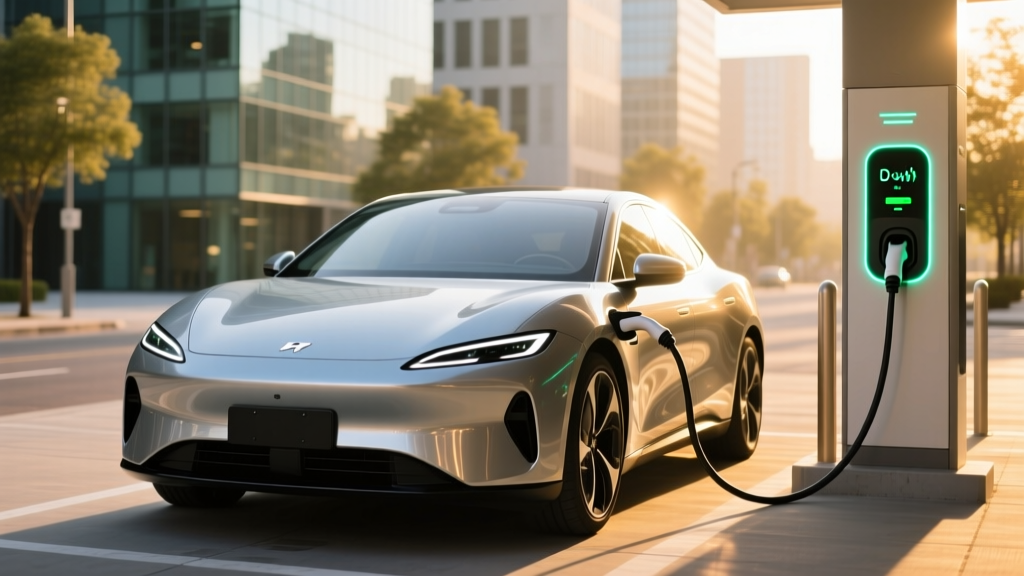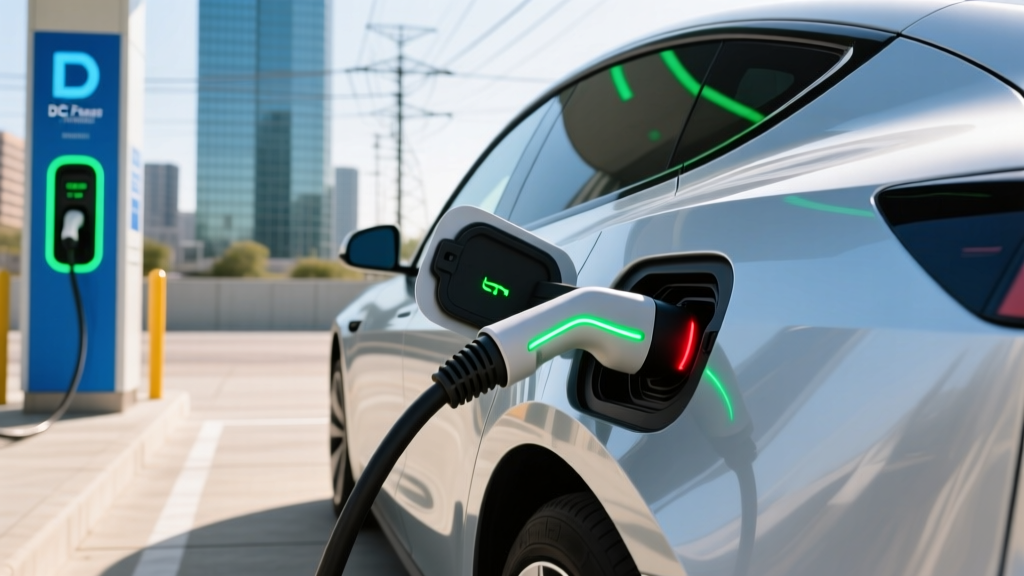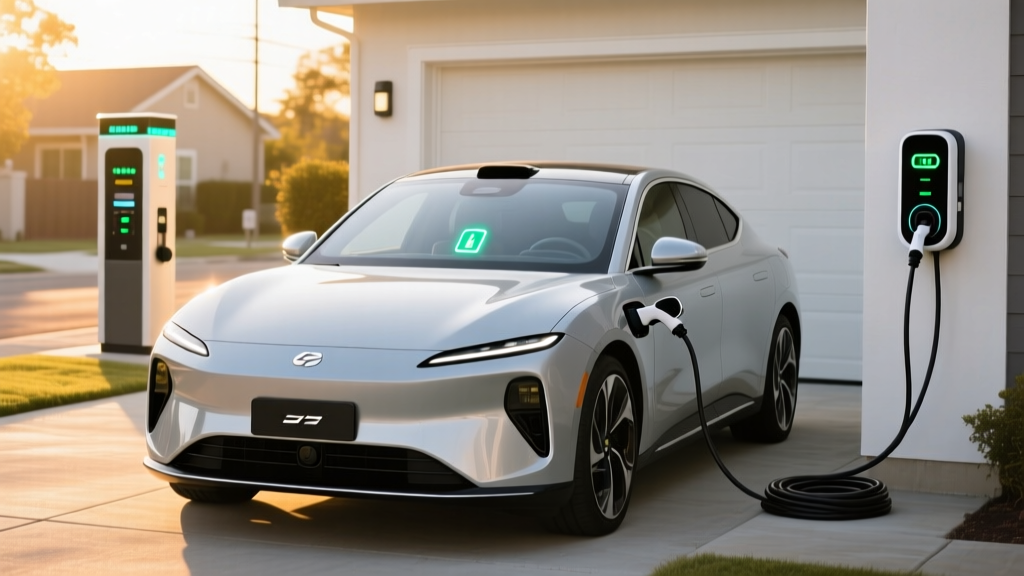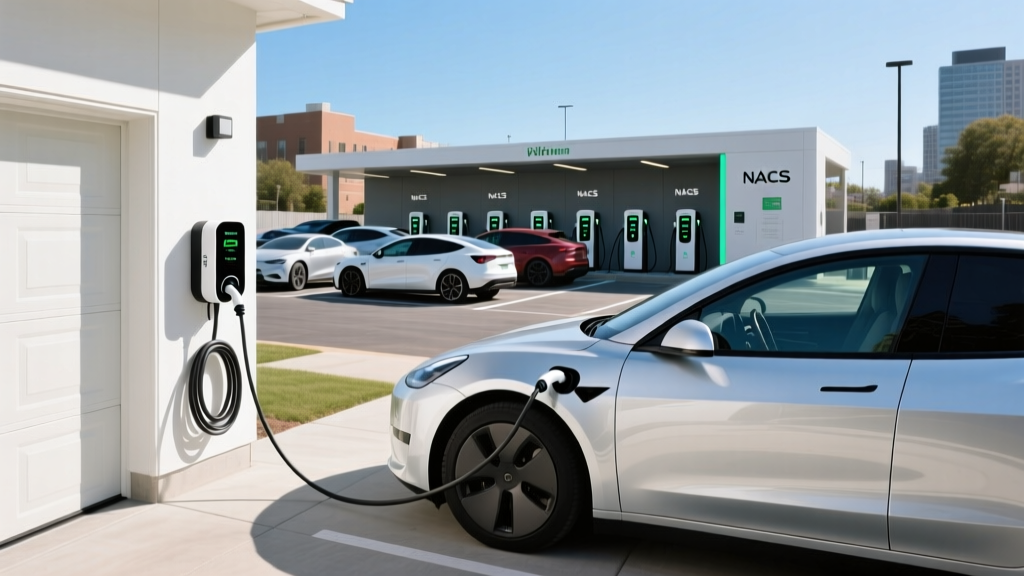
The North American Charging Standard (NACS) has won the connector war. What began as Tesla's proprietary plug is now the dominant EV charging standard across North America, with Ford, GM, Rivian, Hyundai, Kia, BMW, and nearly every major automaker adopting it for 2025 and 2026 model-year vehicles. If you're shopping for NACS EV chargers — whether for your garage or to understand what you'll encounter on the road — this guide covers every number that matters.
We'll break down charging levels in exact kW figures, real-world installation costs down to the permit fee, which EVs need adapters and which don't, and which home chargers actually deliver their rated power. No marketing fluff — just the data you need to make a purchase decision.
Charging Levels Explained: kW, Miles Per Hour, and 10–80% Times
Before choosing any NACS EV charger, you need to understand the three charging tiers. The critical distinction: kW (kilowatts) measures power — how fast energy flows into your battery. kWh (kilowatt-hours) measures energy — the total capacity of your battery. Think of kW as the width of the hose and kWh as the size of the bucket.
| Level | Voltage | Power (kW) | Miles of Range Added/Hour | 10–80% Time (75 kWh Battery) | Typical Use |
|---|---|---|---|---|---|
| Level 1 | 120V AC | 1.2–1.9 kW | 3–5 mi/hr | ~30+ hours | Overnight trickle, PHEVs, emergencies |
| Level 2 | 240V AC | 3.3–19.2 kW | 12–75 mi/hr | 3–10 hours | Home daily charging, workplace, destinations |
| DC Fast Charge | 400–900V DC | 50–350+ kW | 150–1,000+ mi/hr (peak) | 15–45 minutes | Road trips, highway corridors |
A few real-world caveats. Those "miles per hour" figures assume a vehicle efficiency around 3–4 mi/kWh (typical for a midsize crossover like the Tesla Model Y or Ford Mustang Mach-E). A heavier, less aerodynamic truck like the Rivian R1T will add fewer miles per kWh. And DC fast charging speeds follow a charge curve: your vehicle will peak at maximum kW only between roughly 10–40% state of charge, then taper significantly. A charger rated at 250 kW might average 100–130 kW across the full 10–80% session. That's why manufacturers quote 10–80% times rather than full charges — charging above 80% slows dramatically to protect battery health.
NACS vs CCS1 vs CHAdeMO: Connector Compatibility in 2026
NACS is now the standard for most new EVs sold in North America, but the transition isn't universal yet. Here's where each connector stands and what you need to know about adapters.
| Connector | Brands Using It (2025–2026 Models) | Home Charger Availability | Public DC Network Access |
|---|---|---|---|
| NACS (J3400) | Tesla (all), Ford, GM, Rivian, Hyundai, Kia, BMW, Volvo, Polestar, Mercedes, Nissan (new Ariya refresh), Toyota (bZ series) | Wide — Tesla Wall Connector, ChargePoint, Emporia, Grizzl-E, Wallbox | Tesla Supercharger network (open to all NACS), Electrify America (NACS stalls rolling out), EVgo |
| CCS1 | Legacy: 2020–2024 models from VW, Hyundai, Kia, Ford, GM, BMW (pre-transition). Stellantis (Jeson/Chrysler EVs still CCS through 2026) | Widely available — most Level 2 chargers ship with CCS/J1772 or include adapters | Electrify America, EVgo, ChargePoint DC — robust but declining in new deployments |
| CHAdeMO | Nissan Leaf (discontinued after 2025), Mitsubishi Outlander PHEV (legacy) | Limited — adapters available | Declining rapidly; most networks have removed CHAdeMO stalls |
Adapter landscape: If you own a CCS1-equipped EV (most non-Tesla EVs built before 2025), you'll need a CCS-to-NACS adapter to use Tesla Superchargers — Tesla sells one for ~$250, and third-party options from Lectron and A2Z are available for $150–$200. Conversely, if you drive a NACS-native vehicle and encounter a CCS-only public charger, a NACS-to-CCS adapter (available from Tesla and third parties) handles that scenario. For home Level 2 charging, NACS and J1772 adapters are inexpensive ($30–$80) and widely available, so connector mismatch at home is rarely a dealbreaker.
For authoritative details on charging standards, the U.S. Department of Energy's Alternative Fuels Data Center maintains up-to-date connector and infrastructure maps.
Home NACS EV Charger Installation: Electrical Requirements and Costs
This is where most buyers underestimate both complexity and cost. Installing a Level 2 NACS EV charger at home isn't just plugging something into a wall — it requires a dedicated 240V circuit, proper amperage, and in many older homes, an electrical panel upgrade.
Electrical Requirements
- Circuit voltage: 240V (same as your dryer or oven)
- Common amperage options: 40A circuit (delivers 32A continuous / 7.7 kW), 50A circuit (40A continuous / 9.6 kW), or 60A circuit (48A continuous / 11.5 kW). The National Electrical Code requires circuits rated 125% above continuous load, so a 48A charger needs a 60A breaker.
- Wire gauge: Typically 6 AWG copper for 50A, 4 AWG for 60A — your electrician will size this based on run length
- Dedicated circuit: Your EV charger must have its own breaker — it cannot share with other appliances
- GFCI protection: Required by NEC 2020+ for outdoor receptacles; hardwired installations may be exempt depending on jurisdiction
Panel Upgrade: The Hidden Cost
Most homes built before 2000 have 100A or 150A electrical service. Adding a 40–60A dedicated EV circuit can push total load beyond your panel's capacity, especially if you also run electric heat, a dryer, and an oven. A licensed electrician will perform a load calculation to determine whether your panel can handle the addition. If not, a panel upgrade to 200A service typically costs $1,500–$3,500, and in some cases (very old homes, underground service), it can exceed $5,000.
Some utilities and municipalities offer rebates for panel upgrades tied to EV adoption — check with your local provider.
Installation Cost Breakdown
| Cost Component | Simple Install (panel nearby, no upgrade) | Complex Install (long wire run or panel upgrade) |
|---|---|---|
| Level 2 NACS charger (equipment) | $350–$650 | $350–$650 |
| Electrician labor (2–4 hrs simple / 6–12 hrs complex) | $500–$1,200 | $1,500–$3,500 |
| Electrical permit | $50–$200 | $50–$200 |
| Panel upgrade (if needed) | $0 | $1,500–$3,500 |
| Conduit, wire, mounting hardware | $100–$300 | $300–$800 |
| Total | $1,000–$2,350 | $3,700–$8,650 |
For a straightforward install — panel in the garage, charger mounted on the adjacent wall, 50A circuit — expect to pay $1,200–$1,800 all-in. For homes needing a panel upgrade or a long conduit run from a basement panel to a detached garage, $4,000–$6,000 is realistic. Always get 2–3 quotes from licensed electricians and confirm they pull permits (required in nearly all jurisdictions and essential for insurance coverage).
Top NACS EV Chargers for Home: Equipment Picks and Comparison
Not all NACS home chargers are created equal. The differences show up in sustained power delivery, cable quality, smart features, and long-term reliability. Here are the top picks based on real-world testing, power output consistency, and feature sets.
Tesla Wall Connector (Gen 3) — Best Overall for NACS Vehicles
- Power output: Up to 11.5 kW (48A on a 60A circuit)
- Connector: Native NACS
- Cable length: 24 ft
- Smart features: Wi-Fi, OTA firmware updates, load sharing (pair two units on one circuit), Tesla app scheduling
- Price: ~$475
- Best for: Tesla owners and any NACS-native EV; excellent power delivery and reliability
ChargePoint Home Flex (NACS version) — Best for CCS-to-NACS Transition
- Power output: Up to 12 kW (50A on a 60A circuit); adjustable down to 16A for lower-capacity panels
- Connector: NACS (2025+ model); older J1772 version available with adapter
- Cable length: 23 ft
- Smart features: Wi-Fi, ChargePoint app with detailed session data, Alexa integration, flexible amperage dip-switch settings
- Price: ~$599
- Best for: Households with mixed NACS and CCS vehicles (adapter available); best app experience for tracking energy use
Emporia Vue Smart Home EV Charger — Best Budget Smart Charger
- Power output: Up to 11.5 kW (48A on a 60A circuit)
- Connector: NACS (J1772 version also available)
- Cable length: 24 ft
- Smart features: Wi-Fi, Emporia app, integrates with Emporia Vue energy monitor for whole-home tracking, solar-aware scheduling
- Price: ~$399
- Best for: Budget-conscious buyers who still want smart scheduling and solar integration
Grizzl-E Smart (NACS) — Best for Extreme Durability
- Power output: Up to 10 kW (40A on a 50A circuit)
- Connector: NACS
- Cable length: 24 ft
- Smart features: Wi-Fi, OCPP-compatible (works with utility demand-response programs), adjustable amperage
- Price: ~$499
- Best for: Outdoor installs in harsh climates (rated to -40°F); built in Canada with a 3-year warranty
One practical note: most home electrical panels support a maximum of 48A continuous (60A circuit), which delivers 11.5 kW — enough to fully recharge a 75 kWh battery overnight in about 7 hours. If your panel is limited to a 50A circuit, you'll get 40A continuous / 9.6 kW, which still covers overnight charging for virtually any EV on the market. Don't overspend on a 19.2 kW charger unless you have confirmed 100A circuit capacity.
Cost to Charge: NACS at Home vs Public vs Gas
The economics of EV charging depend almost entirely on where you charge. Home charging on off-peak electricity is dramatically cheaper than public DC fast charging — and both are cheaper than gasoline per mile.
| Scenario | Rate ($/kWh) | Vehicle Efficiency | Cost per Mile | Annual Cost (12,000 mi) |
|---|---|---|---|---|
| Home Level 2 (off-peak utility rate) | $0.08–$0.14 | 3.5 mi/kWh | $0.023–$0.040 | $275–$480 |
| Home Level 2 (standard residential rate) | $0.13–$0.18 | 3.5 mi/kWh | $0.037–$0.051 | $445–$615 |
| Public Level 2 (network pricing) | $0.20–$0.35 | 3.5 mi/kWh | $0.057–$0.100 | $685–$1,200 |
| DC Fast Charging (Tesla Supercharger) | $0.25–$0.40 | 3.5 mi/kWh | $0.071–$0.114 | $855–$1,370 |
| DC Fast Charging (Electrify America / EVgo) | $0.35–$0.55 | 3.5 mi/kWh | $0.100–$0.157 | $1,200–$1,885 |
| Gasoline (25 MPG combined, $3.40/gal) | $3.40/gal | 25 MPG | $0.136 | $1,632 |
The takeaway: home charging saves $1,000–$1,350 per year compared to gasoline at typical mileage. Public DC fast charging narrows the gap considerably — if you rely exclusively on Electrify America or EVgo, your fuel costs approach gas-car territory. This is why home Level 2 access is the single biggest factor in EV ownership satisfaction.
For current electricity rates in your area, the U.S. Energy Information Administration publishes state-by-state residential pricing data updated monthly.
Safety, Code, and Smart Features: What to Specify in Your Install
Beyond the basic electrical requirements, several details separate a safe, future-proof installation from one that creates headaches:
- Dedicated circuit: Non-negotiable. Your EV charger must be the only load on its breaker. Sharing with a workshop or outdoor outlet creates a fire risk and will fail inspection.
- Hardwired vs plug-in: Hardwired chargers (directly connected to junction box) eliminate the NEMA 14-50 receptacle failure point and are required for circuits above 60A in many jurisdictions. Plug-in offers portability but requires a high-quality industrial receptacle installed to exact torque specs.
- Outdoor rating: If your charger mounts outside, confirm it carries a NEMA 4 or IP65 rating for weather resistance. All picks above meet this standard.
- Smart scheduling: Most utilities offer time-of-use (TOU) rates where electricity drops to $0.05–$0.08/kWh overnight (typically 11 PM–6 AM). A smart charger with scheduling lets you plug in at 6 PM but delay charging until rates drop — saving $200–$400 annually.
- Load management: If your panel is near capacity, some chargers (Tesla Wall Connector, Emporia) support load-sharing or dynamic load management, which adjusts charging power in real-time based on other household loads. This can avoid a costly panel upgrade.
- Permit and inspection: Every jurisdiction requires a permit for new 240V circuits. Skipping this risks insurance claim denial if an electrical fire occurs and may trigger fines during a home sale inspection.
Public NACS Charging: Supercharger Access and Network Reliability
The biggest advantage of NACS adoption is access to the Tesla Supercharger network — consistently the most reliable and widely deployed DC fast charging infrastructure in North America. As of early 2026, Tesla has opened over 30,000 Supercharger stalls globally to non-Tesla NACS vehicles through the "Charge Your Non-Tesla EV" feature in the Tesla app.
Key details for non-Tesla NACS drivers using Superchargers:
- Pricing: Typically $0.25–$0.40/kWh depending on location and time of day (some stalls offer off-peak discounts)
- Speed: Most stalls are 250 kW (V3); newer V4 stalls support up to 350 kW for 800V-architecture vehicles like the Hyundai Ioniq 5 and Kia EV6
- Access: Use the Tesla app to initiate and pay for sessions; no RFID card needed
- Cable reach: Supercharger cables are relatively short (~6 ft). Non-Tesla vehicles with charge ports on the driver's side rear may need to park at an angle or use specific stalls — check PlugShare or the Tesla app for site-specific notes.
Electrify America and EVgo are also deploying NACS connectors alongside CCS1 at new and retrofitted stations. If you drive a NACS-native vehicle, your public charging options have expanded significantly compared to even two years ago.
Frequently Asked Questions
How much does it cost to install a home NACS EV charger?
A straightforward installation with an adequate electrical panel typically costs $1,000–$2,350 including equipment, electrician labor, and permit. If your home needs a panel upgrade (common in pre-2000 homes with 100A service), expect $3,700–$8,650 total. Always get multiple quotes and confirm the electrician pulls a permit.
How fast will each charging level add range?
Level 1 (120V) adds 3–5 miles of range per hour — adequate only for PHEVs or very low daily mileage. Level 2 (240V, 48A) adds roughly 30–45 miles per hour, enough to fully recharge most EVs overnight. DC fast charging at 150–250 kW can add 100–200 miles in 15–25 minutes, though the charge curve tapers significantly above 80% SoC.
Which connector and charger is compatible with my EV?
If your EV is a 2025+ model from Tesla, Ford, GM, Rivian, Hyundai, Kia, BMW, Volvo, or most other major brands, it has a native NACS port. If your EV is a 2020–2024 model from those brands, it likely has CCS1 and will need a CCS-to-NACS adapter (~$150–$250) to use Tesla Superchargers. For home Level 2 charging, adapters between NACS and J1772 are inexpensive and widely available.
How much does charging cost per mile vs gas?
Home charging at average residential rates ($0.13–$0.18/kWh) costs $0.037–$0.051 per mile for a typical EV — about 65–75% less than gasoline at $3.40/gal and 25 MPG ($0.136/mile). Public DC fast charging at $0.35–$0.55/kWh costs $0.10–$0.16 per mile, narrowing the savings gap but still below gas.
What electrical upgrades might I need?
The most common upgrade is a panel service increase from 100A or 150A to 200A, needed when your existing panel can't accommodate a new 40–60A dedicated circuit alongside existing loads. This costs $1,500–$3,500. You may also need a conduit run from your panel to the charger location ($100–$800 depending on distance), and some jurisdictions require a GFCI breaker for outdoor receptacles ($50–$100 additional).
Can I charge my NACS EV with solar panels?
Yes. Smart chargers like the Emporia Vue and Wallbox Pulsar Plus offer solar-aware scheduling that directs excess solar generation to your EV before exporting to the grid. Pairing with a home battery (Tesla Powerwall, Enphase IQ) lets you store daytime solar for overnight EV charging, potentially reducing your fuel cost to near zero during sunny months.
For the latest federal incentive rules on home charger installation, the IRS Residential Clean Energy Credit page covers the 30% credit (up to $1,000) available for qualified EV charging equipment installed through 2032, subject to income and location requirements.