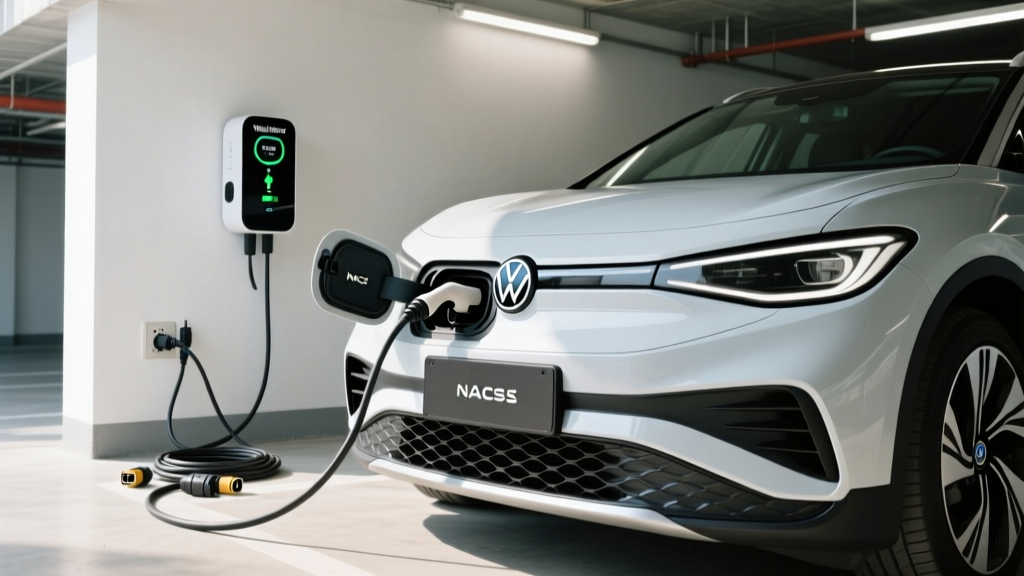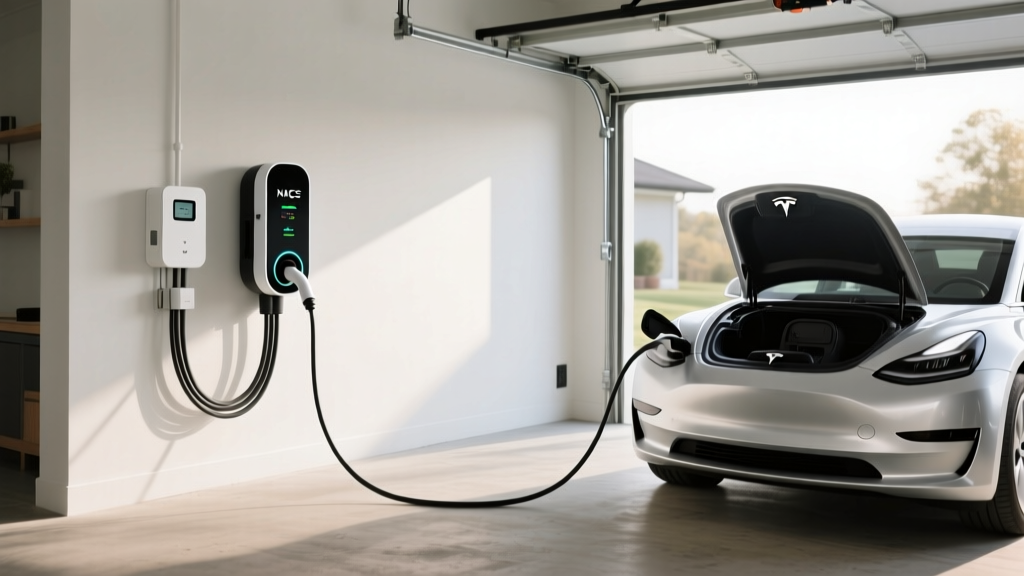
If you've bought or are shopping a new electric vehicle in North America, you've likely encountered the term NACS EV charger. The North American Charging Standard, originally developed by Tesla and now adopted by nearly every major automaker, has become the de facto plug for Level 2 home charging and DC fast charging alike. But choosing the right NACS home charger — and getting it installed safely — involves more than picking a brand off a shelf.
This guide breaks down exactly what NACS means for your home setup, what electrical work you'll need, what it costs, and which chargers deliver the best real-world performance in 2026. We'll keep the physics straight: kW (kilowatts) is power — how fast energy flows into your car. kWh (kilowatt-hours) is energy — the total capacity of your battery. You'll see both used precisely below.
What Is NACS and Why Does It Matter for Home Charging?
NACS (North American Charging Standard) uses a compact, two-pin connector that handles both AC Level 2 charging at home and DC fast charging on the road — without the bulky CCS1 Combo plug. Tesla opened the specification in late 2022, and by the 2025 model year, Ford, GM, Rivian, Volvo, Polestar, Mercedes-Benz, BMW, Hyundai, Kia, and others had transitioned to NACS as their native charge port.
For home charging, this means a growing ecosystem of NACS EV chargers (technically called Electric Vehicle Supply Equipment, or EVSE) now natively plug into Tesla and non-Tesla vehicles alike — no adapter required. If your EV still has a J1772 or CCS1 port, adapters are available, but we'll cover compatibility in detail below.
Charging Levels Explained: How Fast Will Each Level Add Range?
Before choosing a charger, understand the three charging levels and what they actually deliver in miles per hour of charging. These figures assume average EV efficiency of roughly 3–4 miles per kWh.
| Level | Voltage / Amps | Power (kW) | Miles of Range / Hour | Typical Use |
|---|---|---|---|---|
| Level 1 | 120V / 12A | 1.4 kW | 3–5 mi/hr | Overnight trickle; PHEV top-ups |
| Level 2 | 240V / 32–48A | 7.7–11.5 kW | 25–44 mi/hr | Primary home charging |
| DC Fast | 400–800V DC | 50–350 kW | 150–1,000+ mi/hr (peak) | Road trips; public stations |
For a typical BEV with a 75–100 kWh battery, a 48-amp Level 2 NACS EV charger (delivering 11.5 kW) will add roughly 35–44 miles of range per hour. That means a full charge from 10% to 80% takes approximately 5–7 hours — ideal for overnight charging. Level 1, by contrast, would take 40+ hours for the same session and is only practical for plug-in hybrids with smaller batteries or as an emergency backup.
Which Connector and Charger Is Compatible with My EV?
The connector landscape has simplified dramatically since the NACS transition, but you still need to verify what your vehicle accepts natively. Here's the current compatibility matrix for the major standards:
| Connector | Native Vehicle Brands | Adapter Needed? |
|---|---|---|
| NACS | Tesla (all), Ford, GM, Rivian, Volvo, Polestar, Mercedes-Benz, BMW, Hyundai, Kia, Nissan (2026+), Honda (2026+) | No — native for listed brands |
| J1772 | Older non-Tesla EVs (2024 and earlier models from many brands) | NACS-to-J1772 adapter needed for NACS chargers (~$100–$200) |
| CCS1 | Legacy DC fast-charge port on pre-2025 non-Tesla EVs (VW ID.4, older Ioniq 5, etc.) | NACS-to-CCS1 adapter for DCFC (~$180–$250); J1772 adapter for AC |
| CHAdeMO | Nissan Leaf (pre-2026), Mitsubishi Outlander PHEV (older) | CHAdeMO adapter (limited availability; CHAdeMO infrastructure declining) |
If you're buying a NACS EV charger for home Level 2 use, it outputs AC power through the NACS plug. For vehicles with a native NACS port, it's plug-and-play. For older J1772-equipped EVs, a simple NACS-to-J1772 adapter (such as the Lectron or A2Z adapter, typically $100–$180) bridges the gap. Note that these adapters work for AC Level 2 only — DC fast charging adapters involve different pin configurations and higher safety requirements.
How Much Does It Cost to Install a Home NACS EV Charger?
This is the question that stops many EV shoppers in their tracks. The honest answer: it varies enormously based on your home's electrical panel, the distance from panel to garage or driveway, and local permit fees. Here's a realistic breakdown based on 2025–2026 electrician quotes across U.S. metro areas.
| Component | Simple Install (panel nearby) | Complex Install (long run / upgrades) |
|---|---|---|
| Level 2 NACS charger (hardware) | $350–$700 | $350–$700 |
| 240V / 50A dedicated circuit (breaker + wiring) | $200–$500 | $600–$1,500 |
| Electrician labor (2–8 hours @ $80–$150/hr) | $200–$400 | $600–$1,200 |
| Electrical permit & inspection | $50–$150 | $50–$200 |
| Electrical panel upgrade (100A → 200A, if needed) | $0 (not needed) | $1,500–$3,500 |
| TOTAL RANGE | $600–$1,750 | $3,100–$7,100 |
Some utilities offer rebates of $250–$500 for Level 2 charger installation, and the federal Alternative Fuel Vehicle Refueling Property Credit (30C) can cover up to 30% of hardware and installation costs, capped at $1,000, if you live in an eligible census tract. Check IRS guidance for current eligibility — it varies by location and is subject to change.
What Electrical Upgrades Might I Need?
Beyond the panel question, here's what a proper Level 2 NACS charger installation requires per the National Electrical Code (NEC):
- Dedicated circuit: A 40A charger needs a 50A breaker (NEC requires circuits rated at 125% of continuous load). A 48A charger needs a 60A breaker.
- Wire gauge: 6 AWG copper for 50A circuits; 4 AWG copper for 60A circuits, run in conduit where exposed.
- NEMA 14-50 outlet vs. hardwired: A NEMA 14-50 receptacle gives you portability — you can unplug the charger and take it when you move. Hardwired connections eliminate the outlet as a failure point and are required in some jurisdictions for circuits above 50A. Hardwired also qualifies for higher continuous draw in some installations.
- GFCI protection: NEC 2020 and later require GFCI (Ground Fault Circuit Interrupter) protection for all EV charging outlets. Quality NACS EV chargers also have built-in ground-fault detection as a redundant safety layer.
- Outdoor rating: If your charger mounts outside, it must carry a NEMA 4 (weatherproof) rating. Most major chargers meet this, but verify before buying if you lack a garage.
Charging Time Examples: 10% to 80% for Common Battery Sizes
Real-world charging times depend on your battery's usable capacity (in kWh), the charger's sustained power output (in kW), and the vehicle's onboard charger limit. Here are representative examples using a 48A / 11.5 kW NACS Level 2 charger:
| Vehicle (Example) | Usable Battery | Onboard Charger Limit | Energy Needed (10–80%) | Time at 11.5 kW |
|---|---|---|---|---|
| Tesla Model Y LR (2026) | 75 kWh (NMC) | 11.5 kW | 52.5 kWh | ~4.6 hours |
| Ford F-150 Lightning Ext. Range | 131 kWh (NMC) | 19.2 kW | 91.7 kWh | ~8.0 hours |
| Hyundai Ioniq 5 (2026, NACS) | 77.4 kWh (NMC) | 10.9 kW | 54.2 kWh | ~5.0 hours* |
| Chevrolet Equinox EV (2026) | 85 kWh (NMC) | 11.5 kW | 59.5 kWh | ~5.2 hours |
| Toyota bZ4X (2026, NACS) | 71.4 kWh (NMC) | 7.2 kW | 50.0 kWh | ~6.9 hours** |
*Ioniq 5's 10.9 kW onboard charger caps AC charging slightly below the charger's 11.5 kW output. **bZ4X's slower 7.2 kW onboard charger is the bottleneck — a more powerful charger won't speed it up. Always check your vehicle's onboard AC charge rate before overspending on a high-amp EVSE.
How Much Does Charging Cost Per Mile vs. Gas?
One of the strongest economic arguments for home EV charging is the per-mile cost advantage. Let's compare real scenarios using a mid-efficiency EV (3.5 miles/kWh, or ~110 MPGe) and a comparable gas car (28 MPG combined) at 2026 average prices.
| Scenario | Rate | Cost / Mile | Annual Cost (12,000 mi) |
|---|---|---|---|
| Home charging (off-peak TOU rate) | $0.09/kWh | $0.026 | $309 |
| Home charging (standard rate) | $0.16/kWh | $0.046 | $549 |
| Public Level 2 (network average) | $0.30/kWh | $0.086 | $1,029 |
| DC fast charging ( Electrify America / Tesla Supercharger) | $0.40/kWh | $0.114 | $1,371 |
| Gas car (28 MPG avg) | $3.40/gallon | $0.121 | $1,457 |
Home charging on an off-peak time-of-use (TOU) plan delivers fuel savings of roughly $1,100–$1,150 per year compared to gasoline at 12,000 miles driven. Even at standard residential rates, you save about $900/year. Public DC fast charging approaches gas-car costs, which is why home charging access is the single biggest factor in EV ownership satisfaction. For more on EV efficiency ratings, see fueleconomy.gov to look up your specific vehicle's kWh/100mi and MPGe figures.
Best NACS EV Chargers for Home Use in 2026
Based on real-world performance, reliability data, connector quality, and smart features, these are the top NACS home chargers currently available. All output 240V AC through a native NACS connector.
Tesla Wall Connector (Gen 4)
Power: 48A / 11.5 kW
Connector: Native NACS
Cable length: 24 ft
Smart features: Wi-Fi, OTA updates, access control, Power Share (load balancing with second unit), utility integration
Price: ~$475
Verdict: Best value for NACS-native vehicles. Clean design, reliable firmware, and 11.5 kW output covers nearly every EV's onboard charger limit. Works with non-Tesla NACS vehicles out of the box.
ChargePoint Home Flex (NACS)
Power: Up to 50A / 12 kW (adjustable 16–50A via DIP switch)
Connector: Native NACS (2025+ model) or J1772 with adapter
Cable length: 23 ft
Smart features: Wi-Fi, ChargePoint app scheduling, Alexa integration, detailed energy tracking, flexible amperage for panel-constrained homes
Price: ~$550–$650
Verdict: Best for homes needing adjustable amperage. If your panel can't spare 60A, dial the Flex down to 32A or 40A without buying a different unit.
Emporia Vue Smart EV Charger (NACS)
Power: 48A / 11.5 kW
Connector: Native NACS
Cable length: 24 ft
Smart features: Deep energy monitoring via Emporia Vue panel integration, solar-aware charging, TOU rate optimization, real-time cost tracking
Price: ~$400 (charger only; $350+ for Vue panel monitor if not already installed)
Verdict: Best for solar homes and energy nerds. Pairs with whole-home monitoring to charge only when solar is producing or rates are lowest.
Grizzl-E Smart (NACS)
Power: 40A / 9.6 kW
Connector: Native NACS (2025+ model)
Cable length: 24 ft
Smart features: Wi-Fi, OCPP protocol support, adjustable output (16/24/32/40A), rugged aluminum enclosure
Price: ~$400–$450
Verdict: Best for harsh climates and outdoor installs. Built in Canada, rated to -40°F, with a NEMA 4 enclosure. Slightly lower 9.6 kW output suits most EVs fine.
Enel X Way JuiceBox 48 (NACS)
Power: 48A / 11.5 kW
Connector: Native NACS
Cable length: 25 ft
Smart features: Wi-Fi, JuiceNet app scheduling, energy usage reports, utility demand-response program compatibility
Price: ~$500–$600
Verdict: Solid all-rounder with the longest cable in this list. Good utility program integration for demand-response discounts in supported regions.
Safety, Code, and Maintenance Considerations
A properly installed NACS EV charger should run for years with minimal attention. Still, a few safety and maintenance points deserve emphasis:
- Never use an extension cord with a Level 2 charger. The sustained 40–48A draw generates significant heat; extension cords are a fire risk and violate NEC code.
- Inspect the connector and cable annually for cracking, discoloration, or pin damage. NACS connectors are rated for 10,000+ mating cycles, but UV exposure and extreme temperatures can degrade cable jackets over time.
- Surge protection: While not universally required by code, a whole-panel surge protector ($150–$300 installed) guards your EVSE and vehicle onboard charger against lightning and grid spikes. Several EV owners have reported onboard charger failures after nearby lightning strikes.
- Software updates: Smart chargers (Tesla, ChargePoint, Emporia) receive over-the-air firmware updates that improve safety protocols and add features. Keep Wi-Fi connected for these updates.
- UL listing: Only buy chargers with a current UL (Underwriters Laboratories) or ETL listing. Off-brand chargers from marketplace sellers may lack proper safety certification — a serious risk for a device pulling 40+ amps continuously for hours.
Frequently Asked Questions
Can I use a Tesla Wall Connector with a non-Tesla EV?
Yes. The Tesla Gen 4 Wall Connector with a native NACS plug works with any vehicle that has a NACS charge port — including the Ford F-150 Lightning, Hyundai Ioniq 5 (2025+), GM Ultium-based vehicles, Rivian, and others. It will not work with J1772 or CCS1 vehicles without an adapter.
Is a hardwired NACS charger better than a NEMA 14-50 plug?
Hardwired eliminates the receptacle as a potential failure point (loose 14-50 outlets have caused fires in some installations) and may be required by your local jurisdiction for 60A circuits. However, a properly installed NEMA 14-50 with a quality industrial-grade receptacle (Hubbell or Bryant brand — not cheap residential-grade) gives you the flexibility to take the charger when you move. Both are safe when installed correctly by a licensed electrician.
Do I need a smart charger, or is a dumb charger fine?
A non-connected ("dumb") charger works perfectly for charging. Smart features add value if you want scheduled charging to hit off-peak electricity rates, energy usage tracking, remote start/stop, or utility demand-response enrollment. For TOU rate plans, the scheduling feature alone can save $150–$300/year by preventing accidental peak-rate charging.
Will a 48A charger work on a 40A circuit?
No. Per NEC continuous-load rules, a 48A charger requires a 60A breaker (48 × 1.25 = 60). A 40A charger requires a 50A breaker. Never undersize the breaker — it will trip under sustained load. Always match the charger's rated amperage to the correct breaker size, and have your electrician confirm wire gauge matches.
How does cold weather affect Level 2 charging speed?
Cold batteries accept charge more slowly due to lithium-ion chemistry limitations. Below 32°F, expect Level 2 charging to take 10–30% longer until the battery warms up. Most modern EVs with active thermal management (Tesla, Hyundai/Kia E-GMP, GM Ultium) will precondition the battery if you schedule charging through the vehicle's app, mitigating this slowdown. If your EV is parked in an unheated garage in sub-freezing weather, plan for slightly longer charge sessions in winter.
What's the difference between NACS and J1772 for home charging?
Both deliver AC power at 240V. J1772 is the older, larger 5-pin connector that was standard on non-Tesla EVs through 2024. NACS is more compact, uses fewer pins, and handles both AC Level 2 and DC fast charging with the same vehicle-side port. Electrically, a 48A NACS charger and a 48A J1772 charger deliver identical power — the difference is purely the physical connector shape. If your EV has a J1772 port, a NACS-to-J1772 adapter lets you use any NACS charger.