If you drive a non-Tesla EV with a CCS1 or CHAdeMO port, the rapid expansion of the Tesla Supercharger network — now open to all major automakers under the North American Charging Standard (NACS) — is both exciting and frustrating. The solution? A NACS DC adapter that lets your vehicle tap into Tesla's 17,000+ Supercharger stalls across North America. But not all adapters are created equal, and not every Supercharger stall supports non-Tesla vehicles yet.
This guide breaks down exactly how NACS DC adapters work, which ones are compatible with your EV, what charging speeds to expect, and how the broader charging landscape (including home Level 2 setup) fits into your ownership picture.
What Is a NACS DC Adapter and Why Do You Need One?
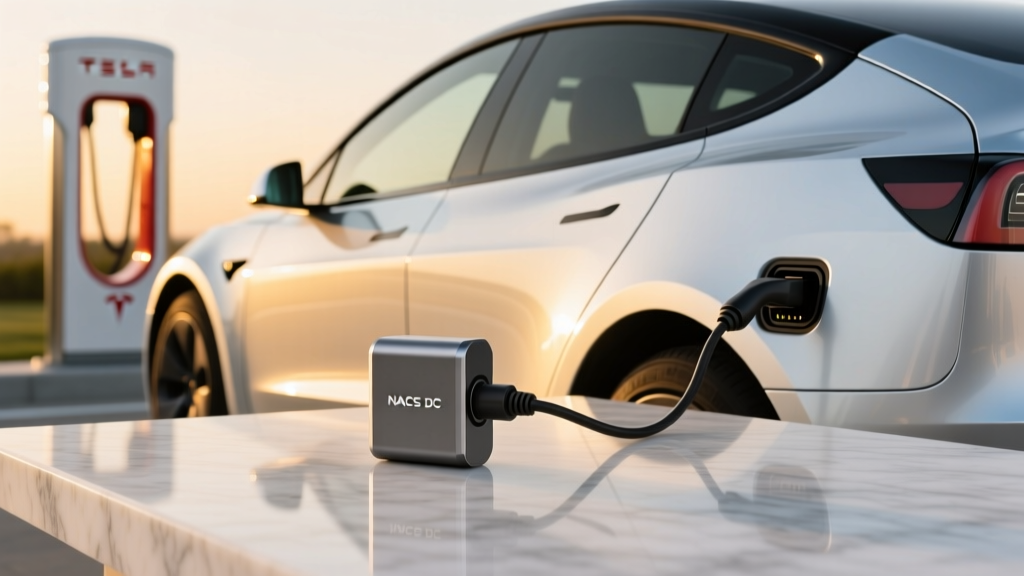
A NACS DC adapter is a physical connector that bridges your EV's native charge port (CCS1 or CHAdeMO) to a Tesla-style NACS plug found on Supercharger cables. It converts the mechanical and communication interface so your car can negotiate a DC fast-charge session on Tesla hardware.
Starting in late 2024, automakers including Ford, GM, Rivian, Volvo, Polestar, and Mercedes-Benz began shipping new EVs with native NACS ports. By the 2026 model year, virtually every new EV sold in North America uses NACS as its standard DC charging connector. But millions of CCS1 and CHAdeMO-equipped EVs remain on the road — and their owners need adapters to access the Supercharger network.
Charging Levels Explained: Speeds, kW, and Miles Per Hour
Before choosing an adapter, understand the three charging tiers available to EV owners. Each serves a different purpose in daily and long-distance driving.
| Level | Voltage | Power (kW) | Miles of Range Per Hour | Best For |
|---|---|---|---|---|
| Level 1 | 120V AC | 1.0–1.4 kW | 3–5 mi/hr | Overnight top-ups, PHEVs |
| Level 2 | 240V AC | 3.3–19.2 kW | 12–75 mi/hr | Daily home charging |
| DC Fast | 400–800V DC | 50–350 kW | 150–1,000+ mi/hr (peak) | Road trips, rapid top-ups |
Real-world context: A Level 2 home charger at 11.5 kW (48A) adds roughly 40–44 miles of range per hour for a mid-size SUV like the Ford Mustang Mach-E (EPA 312 mi, 91 kWh usable battery). That means a 10–80% charge takes about 6–7 hours overnight — plenty for daily driving. On a DC fast charger at 150 kW, that same 10–80% session takes roughly 28–35 minutes, depending on battery temperature and the charge curve taper above 80%.
NACS DC Adapter Compatibility: Which Connector Does Your EV Use?
Your EV's native charge port determines which NACS DC adapter you need. Here's the compatibility matrix for vehicles currently on the road:
| Native Connector | Vehicles (Examples) | NACS DC Adapter Needed? | Adapter Availability |
|---|---|---|---|
| NACS (native) | Tesla Model 3/Y/S/X, 2025+ Ford F-150 Lightning, 2025+ GM Ultium vehicles, 2025+ Rivian R1T/R1S, 2026 Hyundai Ioniq 5 (refresh) | No — plugs directly into Superchargers | N/A |
| CCS1 | 2022–2024 Ford Mach-E & F-150 Lightning, Hyundai Ioniq 5/6, Kia EV6/EV9, VW ID.4, BMW i4/iX, older GM Bolt EV/EUV | Yes — CCS1-to-NACS DC adapter | OEM (Ford, GM, Rivian) + aftermarket (Lectron, A2Z) |
| CHAdeMO | Nissan Leaf (2013–2025), Mitsubishi Outlander PHEV (older) | Yes — CHAdeMO-to-NACS adapter | Limited — CHAdeMO adapters are rarer and more expensive |
Important caveat: Not all Supercharger stalls are enabled for non-Tesla vehicles. Tesla uses a "Magic Dock" built into select stalls (primarily V3 Superchargers in urban areas) that physically accommodates CCS1 vehicles without an adapter. However, for the vast majority of Supercharger locations, you'll need your own NACS DC adapter. Check the Tesla app or your automaker's charging network map for stall-level compatibility before planning a trip.
NACS DC Adapter Options: OEM vs. Aftermarket
Several adapter solutions exist as of 2026, spanning OEM-supplied units and third-party products:
OEM Adapters (Automaker-Supplied)
Price: Often free or $100–$200 for eligible owners
Examples: Ford provides a complimentary CCS1-to-NACS adapter for F-150 Lightning and Mach-E owners who purchased before the native-NACS switchover. GM and Rivian offer similar programs.
Pros: Guaranteed compatibility, firmware support, warranty coverage
Cons: May require VIN verification; limited to specific models
Aftermarket Adapters
Price: $175–$400
Examples: Lectron CCS1-to-NACS adapter (~$230), A2Z EV CCS1-to-NACS adapter (~$180)
Pros: Works with any CCS1 vehicle, no VIN lock, readily available
Cons: Verify UL/ETL certification; warranty may not match OEM
CHAdeMO-to-NACS adapters are harder to find and typically cost $350–$500. Companies like Lectron and EVse offer limited-run units. Given that CHAdeMO is effectively a legacy standard (no new vehicles sold in the US use it), investment in a CHAdeMO adapter makes sense only if you own a Nissan Leaf and plan to keep it for several more years while relying on Supercharger access.
Charging speed with an adapter: Most CCS1-to-NACS adapters support up to 250 kW — matching Tesla's V3 Supercharger peak rate. However, your vehicle's onboard charge acceptance rate is the true bottleneck. A Hyundai Ioniq 5 (800V architecture) can accept up to 240 kW natively, so an adapter won't limit it. A Chevy Bolt EV, capped at ~55 kW DC, won't benefit from the adapter's full rating. Always check your vehicle's peak DC charge rate on fueleconomy.gov or the manufacturer's spec sheet.
Home Charging Setup: Electrical Requirements and Installation Costs
While NACS DC adapters solve road-trip charging, 80–90% of EV charging happens at home on Level 2. Here's what a proper home installation requires.
Electrical Requirements
A Level 2 home charger needs a 240V dedicated circuit, similar to what powers an electric dryer or oven. Common configurations:
- 40A circuit / 32A continuous — delivers 7.7 kW; requires a 50A breaker
- 48A circuit / 40A continuous — delivers 9.6 kW; requires a 60A breaker
- 60A circuit / 48A continuous — delivers 11.5 kW; requires a 75A breaker (or hardwired)
- 80A circuit / 64A continuous — delivers 15.4–19.2 kW; requires a 100A breaker and hardwired connection
The National Electrical Code (NEC) requires EV chargers to be treated as continuous loads, meaning the circuit must be rated at 125% of the charger's maximum draw. A 48A charger requires a 60A breaker, not a 50A.
Panel Upgrade Considerations
Many homes built before 2000 have 100A or 150A electrical panels. Adding a 60A EV circuit to an already-loaded panel may exceed capacity, requiring a panel upgrade to 200A — a significant added cost. Signs you may need an upgrade:
- Your panel is at or near capacity (electrician will perform a load calculation)
- You have an older fuse box instead of a breaker panel
- You already run multiple high-draw appliances (electric range, dryer, HVAC, hot tub)
Installation Cost Breakdown
| Component | Cost Range | Notes |
|---|---|---|
| Level 2 charger unit | $300–$750 | Varies by power output, cable length, smart features |
| Electrician labor (standard install) | $500–$1,500 | Depends on run length from panel, conduit, drywall work |
| Permit fees | $50–$300 | Required in most jurisdictions; varies by municipality |
| Panel upgrade (if needed) | $1,500–$4,000 | 200A upgrade; not needed in most newer homes |
| Total (no panel upgrade) | $850–$2,550 | Typical scenario for homes with adequate panel capacity |
| Total (with panel upgrade) | $2,350–$6,550 | Older homes or high-load situations |
The federal Residential Clean Energy Credit covers 30% of home EV charger equipment and installation costs (up to $1,000) through 2032, per IRS guidelines. Some utilities and states offer additional rebates — check your local provider. Always consult a licensed electrician for a site-specific quote and a tax professional for credit eligibility.
Recommended Level 2 Home Chargers (2026)
For NACS-native vehicles, most new chargers ship with a NACS connector. For CCS1 vehicles, you can either buy a CCS1-terminated charger or use a J1772/NACS charger with an adapter for Level 2 AC charging (note: NACS DC adapters are specifically for DC fast charging; AC Level 2 uses a different pinout).
ChargePoint Home Flex
Power: Up to 12 kW (50A) configurable
Connector: NACS or J1772 (selectable at purchase)
Cable: 23 ft
Smart features: Wi-Fi, app scheduling, energy tracking, Alexa
Price: ~$550–$650
Best for: Flexible amperage settings to match your circuit
Tesla Wall Connector
Power: Up to 11.5 kW (48A)
Connector: NACS native; J1772 adapter included
Cable: 24 ft
Smart features: Wi-Fi, OTA updates, Power-Share between two units, Tesla app
Price: ~$420
Best for: Tesla owners and NACS-native EVs; excellent value
Grizzl-E Smart
Power: Up to 10 kW (40A)
Connector: J1772 (use with NACS AC adapter for NACS vehicles)
Cable: 24 ft
Smart features: OCPP-compatible, app control, load sharing
Price: ~$450
Best for: Rugged outdoor installs (NEMA 4 rated), Canadian-built
Cost to Charge: Home vs. Public DC Fast Charging vs. Gas
Understanding real charging costs puts the value of Supercharger access (via your NACS DC adapter) into perspective.
| Scenario | Rate | Cost per kWh | Cost per Mile* |
|---|---|---|---|
| Home (off-peak utility rate) | $0.08–$0.14/kWh | $0.11 avg | $0.03–$0.04 |
| Home (standard rate) | $0.13–$0.20/kWh | $0.16 avg | $0.04–$0.06 |
| Tesla Supercharger (V3) | $0.25–$0.40/kWh | $0.32 avg | $0.09–$0.12 |
| Electrify America / EVgo | $0.30–$0.55/kWh | $0.42 avg | $0.12–$0.16 |
| Gas vehicle (28 MPG, $3.40/gal) | $3.40/gallon | N/A | $0.12 |
*Based on an EV averaging 3.0–3.5 miles per kWh (typical for a mid-size crossover like the Ioniq 5 or Model Y). Efficiency varies by vehicle, temperature, and driving style. Source: fueleconomy.gov
The takeaway: Home charging is 3–4x cheaper per mile than gas. Even DC fast charging at Supercharger rates is cost-competitive with gas — and substantially cheaper on road trips when you factor in that Superchargers are often located near amenities. Your NACS DC adapter unlocks the most reliable and widespread fast-charging network in North America.
DC Fast Charging Times: What to Expect with a NACS Adapter
Charging speed on a Supercharger with an adapter depends on three factors: the Supercharger generation (V2 at 150 kW, V3 at 250 kW, or V4 at up to 350 kW), your vehicle's peak charge acceptance rate, and battery state of charge (SoC).
Typical 10–80% charge times at a V3 Supercharger (250 kW) with a NACS DC adapter:
- Hyundai Ioniq 5 (84 kWh, 800V): ~18 minutes (peak ~240 kW, excellent charge curve)
- Ford F-150 Lightning (131 kWh extended): ~38–42 minutes (peak ~150 kW, large battery)
- Kia EV6 GT-Line (77.4 kWh, 800V): ~18 minutes (peak ~240 kW)
- VW ID.4 (82 kWh, 400V): ~28–32 minutes (peak ~170 kW)
- Chevy Bolt EV (65 kWh): ~55+ minutes (peak ~55 kW — adapter doesn't help here)
Charge curve reality: No EV sustains its peak kW rate for the entire session. Most vehicles hit peak rate between 10–30% SoC, then taper progressively. By 80% SoC, charge speed typically drops to 40–60% of peak. This is why manufacturers and reviewers quote "10–80%" times rather than "0–100%" — the final 20% can take as long as the first 70%.
Safety, Code Compliance, and Best Practices
Whether you're installing a home Level 2 charger or using a NACS DC adapter on the road, safety is non-negotiable.
Home Installation Safety
- Dedicated circuit: Your EV charger must have its own dedicated breaker — never share a circuit with other appliances
- GFCI protection: NEC 2023+ requires GFCI protection for outdoor receptacles used for EV charging; hardwired installations may have different requirements depending on jurisdiction
- Outdoor rating: If mounting outdoors, ensure the charger carries a NEMA 4 or NEMA 4X rating for weather resistance
- Permit and inspection: Most municipalities require an electrical permit and post-installation inspection — skipping this can void insurance coverage and create liability
- Use a licensed electrician: EV charging circuits carry sustained high current; improper wiring is a fire risk. Always hire a licensed, insured professional
NACS DC Adapter Safety
- Buy only adapters with UL or ETL certification — uncertified adapters from unknown sellers lack safety testing
- Inspect the adapter pins and housing before each use for signs of heat damage, corrosion, or cracking
- Never use a damaged adapter — DC fast charging at 250 kW generates significant heat at the connection point
- Store the adapter in a dry, protected case when not in use
Frequently Asked Questions
How much does it cost to install a home EV charger?
A standard Level 2 home charger installation (equipment + electrician + permit) typically costs $850–$2,550 if your electrical panel has sufficient capacity. If a panel upgrade to 200A is needed, add $1,500–$4,000. The federal Residential Clean Energy Credit covers 30% of equipment and installation (up to $1,000) through 2032.
How fast will each charging level add range?
Level 1 (120V) adds 3–5 miles per hour. Level 2 (240V) adds 12–75 miles per hour depending on amperage and vehicle efficiency. DC fast charging at 150–250 kW can add 150–1,000+ miles per hour at peak rate, though the charge curve tapers significantly above 80% SoC.
Which connector and charger is compatible with my EV?
Check your vehicle's charge port: NACS (Tesla and 2025+ Ford/GM/Rivian/Hyundai), CCS1 (most 2020–2024 non-Tesla EVs), or CHAdeMO (Nissan Leaf). For Supercharger access with CCS1, you need a CCS1-to-NACS DC adapter. For home Level 2, match the charger connector to your vehicle's port or use an AC adapter.
How much does charging cost per mile vs. gas?
Home charging averages $0.03–$0.06 per mile (depending on local electricity rates), while a 28 MPG gas vehicle at $3.40/gallon costs about $0.12 per mile. DC fast charging at Supercharger rates ($0.25–$0.40/kWh) costs $0.09–$0.12 per mile — competitive with gas but 2–3x more expensive than home charging.
What electrical upgrades might I need for a home charger?
You may need a panel upgrade (from 100A/150A to 200A) if your existing panel is near capacity. An electrician will perform a load calculation per NEC Article 220 to determine this. Homes built after 2000 with 200A service rarely need an upgrade. Other potential upgrades include running new conduit, adding a sub-panel, or upgrading the service drop from the utility.
Will a NACS DC adapter slow down my charging speed?
A quality CCS1-to-NACS adapter rated for 250 kW will not meaningfully reduce charging speed. The adapter is a passive mechanical and communication bridge. Your vehicle's onboard charge acceptance rate — not the adapter — determines peak speed. However, poorly manufactured adapters with high electrical resistance could theoretically cause slight efficiency loss and heat buildup, which is why UL/ETL certification matters.
Can I use a NACS DC adapter at non-Tesla fast chargers?
No. A NACS DC adapter converts your CCS1 or CHAdeMO port to NACS — it lets you plug into NACS-equipped chargers (primarily Tesla Superchargers). To use Electrify America, EVgo, or ChargePoint DC fast chargers, plug your vehicle's native CCS1 connector directly into those networks' CCS cables. If you drive a NACS-native vehicle and need to use a CCS1 charger, you'd need the reverse: a NACS-to-CCS1 adapter.