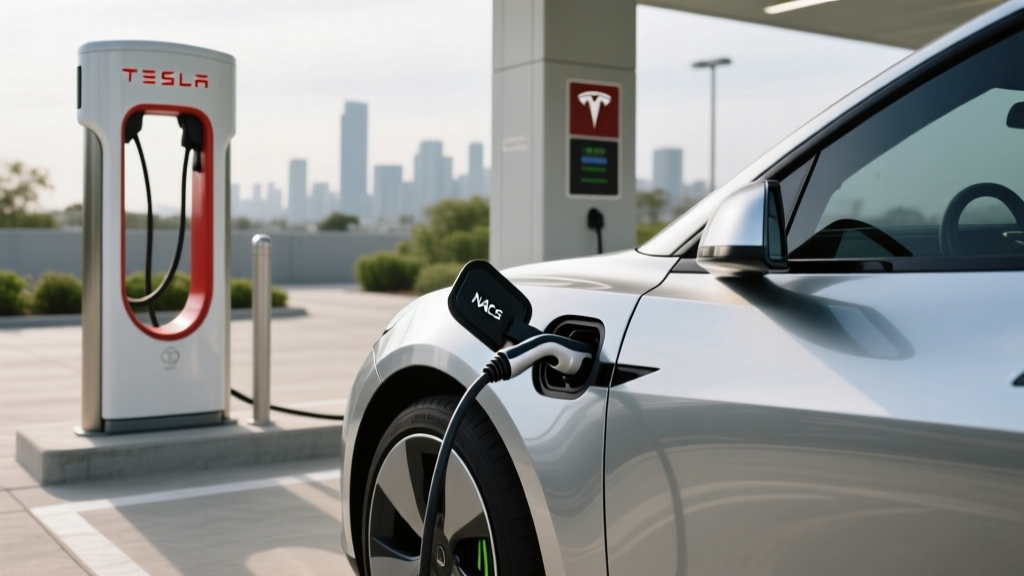
If you drive a non-Tesla EV in 2026, the single biggest upgrade to your road-trip experience is a NACS adapter for Tesla Supercharger access. With Tesla opening over 18,000 Supercharger stalls to CCS-equipped vehicles via its Magic Dock and NACS adapter ecosystem, a $150–$250 adapter can nearly double your fast-charging coverage overnight. But not every adapter works with every car, and charge speeds vary dramatically depending on your vehicle's native charging architecture.
This guide breaks down exactly which NACS adapter you need, how fast you'll actually charge, what it costs per mile compared to gas, and the home-charging setup that makes daily ownership effortless.
Why a NACS Adapter for Tesla Supercharger Access Matters Now
As of early 2026, the North American Charging Standard (NACS) has effectively won the connector war. Ford, GM, Rivian, Volvo, Polestar, Hyundai, and Kia now ship new EVs with native NACS ports. But if you own a 2022–2025 model with a CCS1 port — including the Hyundai Ioniq 5, Kia EV6, Ford Mustang Mach-E, BMW i4, and Volkswagen ID.4 — you need a CCS-to-NACS adapter to use Tesla's Supercharger network.
Tesla's Supercharger network consistently ranks highest for reliability in public charging surveys, with stall uptime above 96%. By comparison, Electrify America and other CCS-only networks have historically struggled with broken stalls and payment glitches. For road-trippers, a NACS adapter isn't a luxury — it's the difference between a 20-minute stop and a 45-minute wait at a dead charger.
Charging Levels Explained: How Fast Each Level Adds Range
Before choosing an adapter, understand the three charging levels and what they mean for your daily routine. Power is measured in kilowatts (kW) — the rate of energy flow — while battery capacity is measured in kilowatt-hours (kWh), the total energy stored. Confusing these is the most common EV mistake.
| Level | Power (kW) | Voltage | Miles of Range Per Hour | Best For |
|---|---|---|---|---|
| Level 1 (120V) | 1.0–1.4 kW | 120V / 12–15A | 3–5 mi/hr | Overnight trickle, PHEVs |
| Level 2 (240V) | 7.2–19.2 kW | 240V / 30–80A | 22–60 mi/hr | Daily home charging |
| DC Fast Charging | 50–350 kW | 200–800V DC | 150–1,000+ mi/hr | Road trips, rapid top-ups |
For context, a typical 75 kWh battery (like the Ford Mustang Mach-E Extended Range) charging at a 150 kW DC fast charger will go from 10% to 80% in roughly 30–35 minutes, depending on the vehicle's charge curve. At Level 2 (11.5 kW), that same battery takes about 6.5 hours from empty to full — perfect for overnight charging.
Which NACS Adapter Works With Your EV?
Not all adapters are created equal. The right NACS adapter for Tesla Supercharger access depends on your vehicle's native port and its maximum DC charge rate. Here's the compatibility landscape in 2026:
| Adapter Type | From (Vehicle) | To (Charger) | Compatible Vehicles | Price Range |
|---|---|---|---|---|
| CCS1-to-NACS | CCS1 port | NACS (Tesla) plug | Hyundai Ioniq 5/6, Kia EV6/EV9, Ford Mach-E, BMW i4/iX, VW ID.4, Rivian (pre-2025) | $150–$250 |
| CHAdeMO-to-NACS | CHAdeMO port | NACS plug | Nissan Leaf (2025+), Mitsubishi Outlander PHEV | $200–$300 |
| NACS-to-CCS1 | NACS port | CCS1 plug | Tesla Model 3/Y (to use non-Tesla CCS stations), 2025+ Ford/GM/Rivian | $150–$200 |
Top-Rated CCS-to-NACS Adapters for 2026
Tesla Official CCS Adapter: Sold through Tesla's shop, rated for up to 250 kW DC fast charging. Works with all CCS1 vehicles approved for Supercharger access via the Tesla app. Price: ~$175. This is the gold standard for reliability and firmware compatibility.
Lectron CCS-to-NACS Adapter: Rated for up to 300 kW DC and 48A AC (Level 2). Third-party option with solid reviews. Price: ~$160. Supports V2G communication protocol required by Tesla's network.
A2Z CCS-to-NACS Adapter: Budget option rated at 200 kW DC. Price: ~$130. Adequate for most current EVs whose peak charge rate is below 200 kW anyway.
Critical note: Your vehicle must be added to the Tesla app with its VIN before you can initiate a Supercharger session with an adapter. Tesla maintains a list of approved non-Tesla vehicles on its support site. Not every CCS vehicle is approved — check before buying an adapter.
Real-World Charge Speeds With a NACS Adapter
An adapter doesn't limit your charge speed — your vehicle's onboard charging architecture does. Here's what to expect at a V3 Tesla Supercharger (250 kW max) and V4 Supercharger (up to 350 kW) with popular CCS vehicles using a NACS adapter:
| Vehicle | Battery (kWh usable) | Peak DC Rate | 10–80% at V3 (250 kW stall) | 10–80% at V4 (350 kW stall) |
|---|---|---|---|---|
| Hyundai Ioniq 5 (2024–2026) | 77.4 kWh (NMC) | 240 kW (800V) | ~18–20 min | ~18 min (vehicle-limited) |
| Kia EV6 GT-Line AWD | 77.4 kWh (NMC) | 240 kW (800V) | ~18–20 min | ~18 min (vehicle-limited) |
| Ford Mustang Mach-E ER | 91 kWh (NMC) | 150 kW | ~35–38 min | ~35 min (vehicle-limited) |
| BMW i4 eDrive40 | 81.5 kWh (NMC) | 200 kW | ~28–31 min | ~28 min (vehicle-limited) |
| VW ID.4 Pro S | 82 kWh (NMC) | 175 kW | ~30–34 min | ~30 min (vehicle-limited) |
Key takeaway: If your EV peaks at 150 kW (like the Mach-E), a 350 kW V4 Supercharger won't charge you any faster. The adapter simply passes through whatever the vehicle can accept. The Hyundai Ioniq 5 and Kia EV6, with their 800V architecture, are the fastest-charging CCS vehicles on the Supercharger network.
Also remember that charge curves taper significantly above 80% State of Charge. A vehicle that charges at 240 kW from 10–50% may drop to 40 kW above 85%. For road trips, plan to charge to 80% and move on — the last 20% takes nearly as long as the first 70%.
Cost to Charge: Home vs. Public vs. Gas
Electricity pricing varies enormously by location and time of day. Here's a realistic cost breakdown across common scenarios, using a national-average vehicle efficiency of 3.0 miles/kWh (roughly 105 MPGe):
| Scenario | Price per kWh | Cost per Mile | Full 75 kWh Battery Cost | Equiv. Gas MPG (at $3.50/gal) |
|---|---|---|---|---|
| Home off-peak (utility rate) | $0.08–$0.12 | $0.027–$0.040 | $6.00–$9.00 | 88–130 MPG |
| Home standard rate | $0.14–$0.18 | $0.047–$0.060 | $10.50–$13.50 | 58–75 MPG |
| Tesla Supercharger (avg) | $0.25–$0.35 | $0.083–$0.117 | $18.75–$26.25 | 30–42 MPG |
| Electrify America / public DCFC | $0.30–$0.48 | $0.100–$0.160 | $22.50–$36.00 | 22–35 MPG |
| Gas car (28 MPG combined avg) | $3.50/gal | $0.125 | — | 28 MPG |
Home charging at off-peak rates delivers fuel costs equivalent to 100+ MPG. Even Tesla Supercharging at $0.30/kWh undercuts the average gas car on a cost-per-mile basis. Public DC fast charging on non-Tesla networks can, however, approach or exceed gas costs — which is exactly why a NACS adapter for Tesla Supercharger access makes financial sense. Tesla's pricing tends to be 20–30% lower than competing DC fast networks.
Home Level 2 Charger Installation: Costs, Electrical Requirements, and Equipment
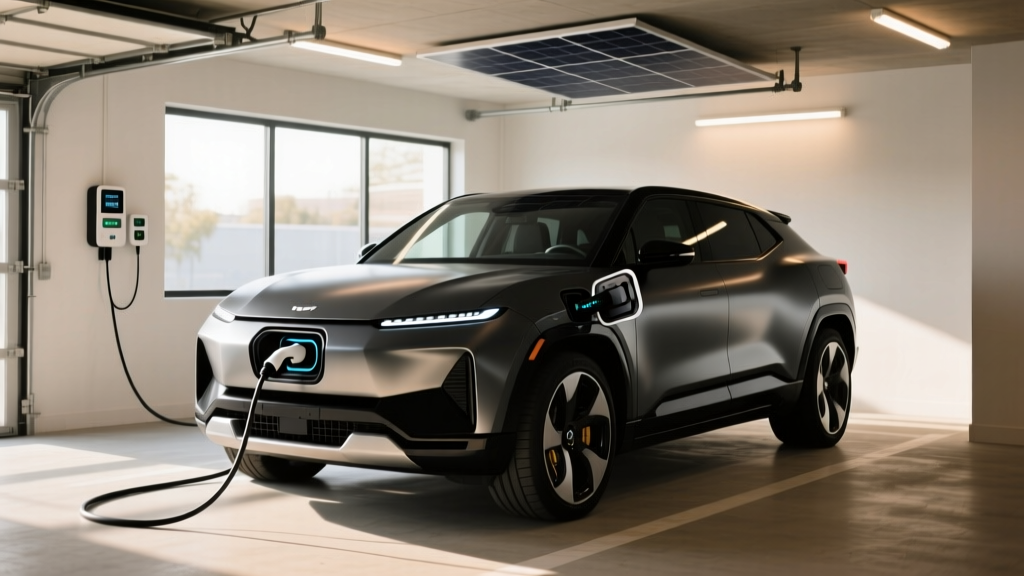
The best complement to your NACS adapter is a reliable home Level 2 charger. Here's what a 2026 installation actually involves and costs.
Electrical Requirements
A Level 2 charger requires a dedicated 240V circuit. The most common configurations:
- NEMA 14-50 outlet: 240V / 50A breaker, supports up to 40A continuous (9.6 kW). Most versatile option — allows charger swapping and RV use.
- Hardwired 60A circuit: 240V / 60A breaker, supports up to 48A continuous (11.5 kW). Higher power but requires an electrician for any charger replacement.
- Hardwired 80A circuit: 240V / 80A breaker, supports up to 64A continuous (15.4 kW). Only useful if your EV supports 19.2 kW AC charging (most cap at 11.5 kW).
Panel Upgrade: The Hidden Cost
Many homes built before 2000 have 100A electrical service panels. Adding a 50A EV circuit may require a panel upgrade to 200A, which costs $1,500–$3,500 depending on your utility and local code. Homes with 200A service usually have enough headroom. Your electrician will perform a load calculation per NEC Article 220 to determine if an upgrade is needed. Don't skip this step — an overloaded panel is a fire risk.
Installation Cost Breakdown
| Component | Simple Install (panel nearby, no upgrade) | Complex Install (long run or panel upgrade) |
|---|---|---|
| Level 2 Charger (equipment) | $350–$700 | $350–$700 |
| Electrician labor (2–6 hours) | $400–$900 | $1,200–$2,500 |
| Permit and inspection | $50–$200 | $50–$200 |
| Panel upgrade (if needed) | $0 | $1,500–$3,500 |
| Conduit, wiring, materials | $100–$300 | $300–$800 |
| Total | $900–$2,100 | $3,400–$7,700 |
Many utilities offer rebates of $250–$1,000 for Level 2 installations, and the federal 30% residential clean energy credit (IRS §25C) covers up to $1,000 of charger and installation costs through 2032. Check your utility's EV program before scheduling work.
Recommended Level 2 Chargers for 2026
ChargePoint Home Flex (NACS or J1772)
Power: Up to 12 kW (50A). Cable: 23 ft. Smart features: Wi-Fi, app scheduling, utility demand-response. Price: ~$550. Best all-around pick — works with any EV via adapter or native plug. UL-listed and Energy Star certified.
Tesla Wall Connector (NACS native)
Power: Up to 11.5 kW (48A). Cable: 24 ft. Smart features: Wi-Fi, OTA updates, Power-Share (load balancing between two units). Price: ~$475. Ideal for Tesla owners or NACS-native 2025+ vehicles. Non-Tesla EVs with NACS ports can use it directly.
Emporia Vue Level 2 Charger
Power: Up to 11.5 kW (48A). Cable: 24 ft. Smart features: integrated energy monitoring, solar-aware scheduling. Price: ~$400. Best budget smart charger — includes whole-home energy monitoring hardware.
Grizzl-E Smart (J1772 or NACS)
Power: Up to 10 kW (40A). Cable: 24 ft. Smart features: OCPP protocol, adjustable amperage via DIP switch. Price: ~$450. Built in Canada with a rugged aluminum enclosure — excellent for unheated garages and outdoor installations in cold climates.
Safety and Code Considerations
EV charging places sustained high-current loads on your home's electrical system. Adherence to the National Electrical Code (NEC) is not optional:
- Dedicated circuit: Your Level 2 charger must be on its own dedicated breaker — never shared with other appliances.
- GFCI protection: NEC 2020 and later require GFCI protection for all EV charging outlets. Hardwired chargers have internal GFCI, but outlet-based installs need a GFCI breaker (add $40–$80).
- Outdoor rating: If mounting outside, the charger must carry a NEMA 4 or IP65 rating. All four recommended chargers above meet this standard.
- Continuous load derating: Per NEC, a circuit must be rated 125% above the continuous load. A 40A charger requires a 50A breaker. This is why a "50A outlet" delivers only 40A to the car.
- Permit required: Nearly all jurisdictions require an electrical permit and inspection for new 240V circuits. Unpermitted work can void insurance coverage and cause issues at home sale.
Frequently Asked Questions
How much does it cost to install a home EV charger?
A straightforward Level 2 installation with an existing 200A panel and a short wiring run costs $900–$2,100 total (charger, electrician, permit). If your home needs a panel upgrade from 100A to 200A, expect $3,400–$7,700. Utility rebates and the federal §25C tax credit (30% of cost, up to $1,000) can offset a significant portion.
How fast will each charging level add range?
Level 1 (120V) adds 3–5 miles of range per hour — adequate only for plug-in hybrids or very low-mileage drivers. Level 2 (240V, 40–48A) adds 25–40 miles per hour, fully recharging most EVs overnight. DC fast charging adds 150–1,000+ miles per hour at peak rate, enabling 10–80% charges in 18–38 minutes depending on the vehicle.
Which connector and charger is compatible with my EV?
If your EV has a CCS1 port (most 2022–2025 non-Tesla EVs), you need a CCS-to-NACS adapter for Tesla Superchargers and can use any J1772/CCS public charger natively. If your EV has a NACS port (all Teslas, plus 2025+ Ford, GM, Rivian, Hyundai, Kia), you can use Tesla Superchargers directly and need a NACS-to-CCS adapter for older Electrify America or ChargePoint CCS stations. CHAdeMO vehicles (Nissan Leaf) need a CHAdeMO-to-NACS adapter, which is less common and more expensive.
How much does charging cost per mile compared to gas?
At home off-peak rates ($0.10/kWh), an EV costs roughly $0.03/mile — equivalent to a 117 MPG gas car. At Tesla Supercharger rates ($0.30/kWh), it costs about $0.10/mile — equivalent to 35 MPG. A gas car averaging 28 MPG at $3.50/gallon costs $0.125/mile. Home charging is 3–4× cheaper than gas; public DC fast charging is comparable to or slightly cheaper than gas depending on local pricing.
What electrical upgrades might I need for a home charger?
The most common upgrade is a panel capacity increase from 100A to 200A service ($1,500–$3,500). You may also need a new dedicated 240V circuit with appropriately sized wire (6 AWG copper for 50A, 4 AWG for 60A), a GFCI breaker ($40–$80), and a NEMA 14-50 outlet or hardwired junction box. Homes with older knob-and-tube or aluminum wiring may need partial rewiring. A licensed electrician's load calculation will determine exactly what's required — never guess on electrical capacity.
Do I need a special Tesla app account to use Superchargers with a NACS adapter?
Yes. You must download the Tesla app, create an account, add your non-Tesla vehicle by VIN, and link a payment method. Tesla's app will confirm whether your specific vehicle model is approved for Supercharger access. Sessions are initiated through the app or via Plug & Charge if your vehicle supports it.
Will using a third-party adapter void my vehicle's warranty?
Under the Magnuson-Moss Warranty Act, using a third-party adapter cannot void your vehicle's warranty unless the manufacturer can prove the adapter caused specific damage. That said, Tesla's official CCS adapter ($175) is the safest choice for Supercharger compatibility and firmware handshaking. Third-party adapters from Lectron and A2Z have strong track records but may require firmware updates for future Supercharger protocol changes.
A NACS adapter for Tesla Supercharger access is the highest-value accessory a CCS-equipped EV owner can buy in 2026. For $150–$250, you gain access to the most reliable fast-charging network in North America, reduce your road-trip charging costs by 20–30% versus competing networks, and eliminate the single biggest pain point of non-Tesla EV ownership. Pair it with a home Level 2 charger on a dedicated 240V circuit, and your total fuel cost drops to pennies per mile.