Understanding Mustang Mach-E Range and Charging Fundamentals
The Ford Mustang Mach-E delivers EPA-estimated ranges from 230 miles (Standard Range) to 320 miles (Extended RWD), but real-world range depends heavily on how and where you charge. Before diving into charging logistics, let's establish the baseline specs that affect your daily driving and charging decisions.
| Model Variant | Battery (kWh usable) | EPA Range | Real-World Range* | Peak DC Charge Rate |
|---|---|---|---|---|
| Select SR RWD | 70 kWh (LFP) | 230 mi | 185-210 mi | 115 kW |
| Premium ER RWD | 91 kWh (NMC) | 320 mi | 260-290 mi | 150 kW |
| GT ER AWD | 91 kWh (NMC) | 270 mi | 220-250 mi | 150 kW |
*Real-world range reflects highway driving at 70+ mph, moderate climate control use, and temperatures between 50-80°F. Expect 15-30% range reduction in sub-freezing weather or aggressive driving.
The distinction between kW (kilowatts) and kWh (kilowatt-hours) is critical: kW measures charging power (how fast energy flows), while kWh measures battery capacity (how much energy is stored). A 150 kW charger doesn't deliver 150 kWh—it delivers energy at a rate of 150 kW, which tapers as the battery fills.
Charging Levels: Speed, Range Added, and Use Cases
Every Mach-E owner needs to understand the three charging tiers and how they translate to actual range recovery.
| Level | Power (kW) | Voltage/Amps | Miles Added/Hour | Best For |
|---|---|---|---|---|
| Level 1 (120V) | 1.4-1.9 kW | 120V / 12-16A | 3-5 mi/hr | Overnight top-ups, low-mileage drivers |
| Level 2 (240V) | 7.7-11.5 kW | 240V / 32-48A | 25-38 mi/hr | Daily home charging, full overnight recharge |
| DC Fast | 50-150 kW | 400-800V DC | 150-250 mi in 20 min | Road trips, rapid replenishment |
Real-world charging time examples:
- Level 1 (120V outlet): 0-100% on a 91 kWh Extended Range battery takes 48-65 hours. Practical only for plug-in hybrids or very low daily mileage.
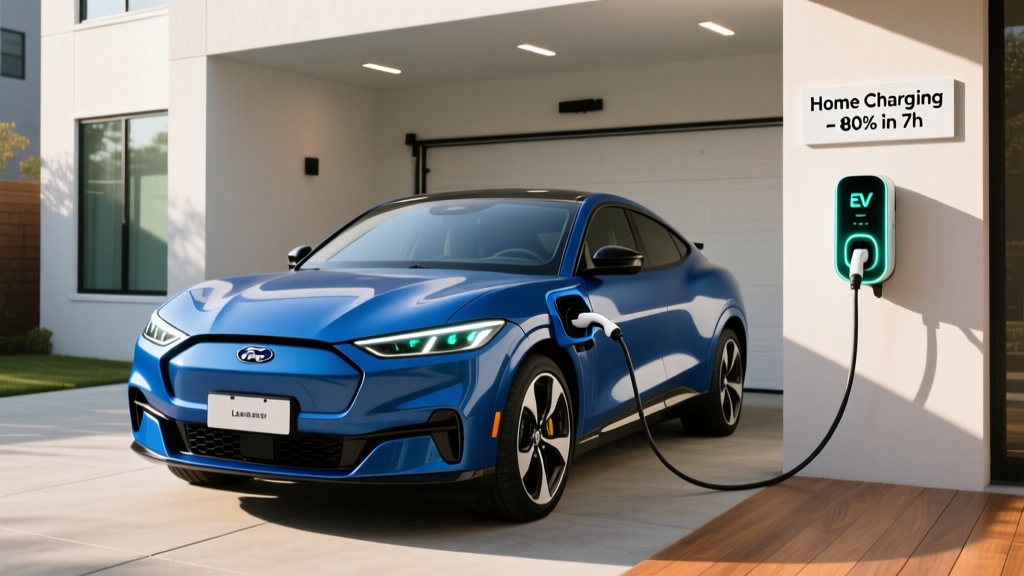
- Level 2 (240V, 48A/11.5 kW): 10-80% on a 91 kWh battery takes ~6 hours. This is the sweet spot for overnight home charging—plug in at 10 PM, wake up to a full battery by 6 AM.
- DC Fast Charging (150 kW peak): 10-80% on Extended Range models takes approximately 45 minutes under ideal conditions (battery preconditioned, ambient temp 60-80°F). Standard Range models peak at 115 kW, taking ~50 minutes for 10-80%.
Charge curve reality check: The Mach-E's 150 kW peak rate only sustains between 10-50% state of charge. From 50-80%, charging slows to 75-100 kW, and above 80% it drops below 50 kW to protect battery longevity. This is why we quote 10-80% times—charging to 100% at a DC fast charger wastes time and accelerates battery degradation.
Home Charger Installation: Electrical Requirements and Costs
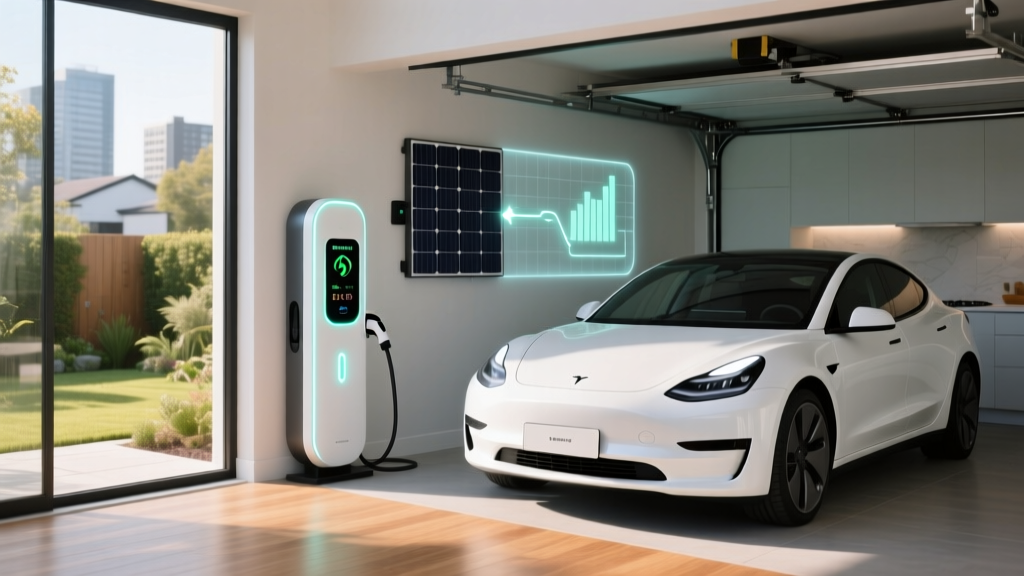
Installing a Level 2 home charger is the single most impactful upgrade for Mach-E ownership, but costs vary dramatically based on your home's electrical infrastructure.
Electrical Requirements for Level 2 Charging
A Level 2 charger requires a dedicated 240V circuit, similar to an electric dryer or oven. The amperage determines charging speed:
- 40A circuit (32A continuous): Delivers 7.7 kW, adding ~25 miles per hour. Requires 8-gauge copper wire.
- 50A circuit (40A continuous): Delivers 9.6 kW, adding ~31 miles per hour. Requires 6-gauge copper wire.
- 60A circuit (48A continuous): Delivers 11.5 kW, adding ~38 miles per hour. Requires 6-gauge copper wire (or 4-gauge for longer runs).
The Ford Mobile Charger included with your Mach-E maxes out at 32A (7.7 kW) on a 240V NEMA 14-50 outlet. For faster charging, you'll need a hardwired wall unit.
Installation Cost Breakdown
| Component | Simple Install (Panel Nearby) | Complex Install (Panel Upgrade/Long Run) |
|---|---|---|
| Level 2 Charger (40-48A) | $500-$750 | $500-$750 |
| Electrician Labor (2-4 hrs) | $400-$800 | $800-$1,500 |
| Electrical Permit | $50-$150 | $50-$200 |
| Wire/Conduit Materials | $100-$300 | $300-$800 |
| Panel Upgrade (if needed) | $0 | $1,500-$3,500 |
| Total | $1,050-$2,000 | $3,150-$6,750 |
When You Need a Panel Upgrade
Homes built before 2000 often have 100A or 150A electrical panels. Adding a 50A EV circuit to an already-loaded panel may require upgrading to 200A service—a $1,500-$3,500 expense. Signs you'll need an upgrade:
- Your panel is 100A or 150A total capacity
- You already run electric heat, electric water heater, and electric dryer simultaneously
- Your panel has no available breaker slots
- An electrician's load calculation shows you'd exceed 80% of panel capacity
Get quotes from 2-3 licensed electricians and ask specifically about load calculations per NEC Article 220. Some utilities offer rebates of $250-$1,000 for panel upgrades paired with EV charger installs—check with your local provider.
Connector Compatibility: NACS, CCS, and the Tesla Supercharger Network
Ford made a strategic pivot in 2024, transitioning the Mach-E from CCS1 to NACS (Tesla's North American Charging Standard). Your model year determines your connector and charging network access.
| Model Year | Built-In Connector | Tesla Supercharger Access | CCS Network Access |
|---|---|---|---|
| 2021-2023 | CCS1 | Requires NACS adapter ($200-$300) | Native (Electrify America, EVgo, etc.) |
| 2024-2026 | NACS | Native (full Supercharger network) | Requires CCS adapter (included or $200) |
Why this matters: Tesla's Supercharger network has superior reliability (98%+ uptime vs. ~80% for some CCS networks) and broader rural coverage. 2024+ Mach-E owners gain native access to 25,000+ Superchargers. Pre-2024 owners can purchase Ford's official NACS adapter or third-party options from Lectron or A2Z.
CHAdeMO connectors (used by the Nissan Leaf) are not compatible with the Mach-E under any circumstances—this is a dead standard in North America.
Cost to Charge: Home vs. Public vs. Gas Comparison
Electricity pricing varies by location, time of day, and charging speed. Here's what Mach-E owners actually pay per mile in 2026:
| Charging Scenario | Cost per kWh | Cost to Add 100 Miles | Cost per Mile |
|---|---|---|---|
| Home (off-peak, 10 PM-6 AM) | $0.08-$0.15 | $2.40-$4.50 | $0.024-$0.045 |
| Home (standard rate, anytime) | $0.12-$0.20 | $3.60-$6.00 | $0.036-$0.060 |
| Public Level 2 (workplace, mall) | $0.20-$0.35 | $6.00-$10.50 | $0.060-$0.105 |
| DC Fast (Electrify America, EVgo) | $0.35-$0.50 | $10.50-$15.00 | $0.105-$0.150 |
| Tesla Supercharger (2024+ models) | $0.28-$0.40 | $8.40-$12.00 | $0.084-$0.120 |
| Gas car baseline (28 MPG, $3.50/gal) | — | $12.50 | $0.125 |
The math: A Mach-E Extended Range AWD consumes approximately 30 kWh per 100 miles (3.33 mi/kWh) in mixed driving. At the national average residential rate of $0.16/kWh, home charging costs $4.80 per 100 miles—less than half the cost of gas. Even expensive DC fast charging ($0.48/kWh) costs $14.40 per 100 miles, comparable to gas.
Maximize savings by enrolling in your utility's time-of-use (TOU) plan and scheduling charging between 10 PM and 6 AM. Some utilities offer EV-specific rates as low as $0.07/kWh overnight.
Recommended Level 2 Home Chargers for the Mach-E
After testing dozens of units, these are the best Level 2 chargers for Mustang Mach-E owners in 2026:
ChargePoint Home Flex (Best Overall)
- Power: Up to 12 kW (50A circuit)
- Connector: NACS or J1772 (NACS native for 2024+ models)
- Cable Length: 23 feet
- Smart Features: Wi-Fi, app scheduling, Alexa integration, energy tracking
- Price: $699 (frequently $599 on sale)
- Why it wins: Adjustable amperage (16-50A) lets you match your circuit. UL-listed, 3-year warranty, excellent app.
WallConnector (Best for Tesla Supercharger Users)
- Power: Up to 11.5 kW (48A continuous on 60A circuit)
- Connector: NACS (native for 2024+ Mach-E)
- Cable Length: 24 feet
- Smart Features: Wi-Fi, over-the-air updates, power sharing (multiple units on one circuit)
- Price: $475
- Why it wins: Seamless integration if you also own a Tesla. Sleek design, 4-year warranty. No app scheduling—relies on vehicle's built-in scheduler.
Emporia Level 2 Charger (Budget Pick)
- Power: Up to 11.5 kW (48A)
- Connector: J1772 (requires adapter for 2024+ NACS models)
- Cable Length: 24 feet
- Smart Features: Wi-Fi, app, energy monitoring, solar integration
- Price: $399
- Why it wins: Lowest cost for a smart, high-power unit. Ideal for pre-2024 CCS models or if you don't mind using an adapter.
Critical safety note: All Level 2 chargers must be installed on a dedicated circuit with a GFCI breaker (required by NEC 2020 and later). Outdoor installations require NEMA 4-rated (weatherproof) enclosures. Never use extension cords with EV chargers.
Frequently Asked Questions
How much does it cost to install a home EV charger?
A straightforward Level 2 installation (panel has capacity, charger mounts within 20 feet of panel) costs $1,050-$2,000 total, including the charger, electrician labor, permit, and materials. Complex installs requiring panel upgrades, long wire runs through finished walls, or trenching can reach $3,150-$6,750. Always get 2-3 quotes and verify the electrician is licensed and insured.
How fast will each charging level add range?
Level 1 (120V) adds 3-5 miles per hour—suitable only for plug-in hybrids or drivers covering under 30 miles daily. Level 2 (240V, 48A) adds 38 miles per hour, fully recharging an Extended Range Mach-E overnight. DC fast charging adds 150-250 miles in 20-30 minutes, but only when the battery is preconditioned and below 80% state of charge.
Which connector/charger is compatible with my Mach-E?
2021-2023 models use CCS1 connectors and can access Electrify America, EVgo, and ChargePoint natively. Tesla Supercharger access requires a NACS adapter ($200-$300). 2024-2026 models use NACS connectors natively, granting full Supercharger access; CCS adapters are needed for non-Tesla DC fast networks. CHAdeMO is not compatible with any Mach-E.
How much does charging cost per mile vs gas?
Home charging at the national average rate ($0.16/kWh) costs $0.048 per mile in a Mach-E—60% less than a 28 MPG gas car at $3.50/gallon ($0.125/mile). Public DC fast charging ($0.40/kWh) costs $0.12 per mile, roughly equivalent to gas. Time-of-use plans and workplace charging can reduce costs further.
What electrical upgrades might I need?
If your home has a 100A or 150A electrical panel, you may need a $1,500-$3,500 upgrade to 200A service before adding a 50A EV circuit. Other red flags: no available breaker slots, existing high-draw appliances (electric heat, water heater, dryer) already consuming 80%+ of panel capacity, or an electrician's load calculation showing insufficient headroom. Some utilities offer rebates for panel upgrades paired with EV adoption.
Does cold weather affect Mach-E charging speed?
Yes. Battery temperatures below 50°F slow DC fast charging significantly—a cold-soaked battery may accept only 50-75 kW initially, even on a 150 kW charger. Use the Mach-E's "charge scheduling" feature to precondition the battery 30-45 minutes before arriving at a DC fast charger. This warms the battery to optimal temperature, restoring peak charge rates. Expect 15-30% range loss in sustained sub-freezing driving due to cabin heating and battery inefficiency.
Can I use a Tesla Wall Connector with a pre-2024 CCS Mach-E?
No. Tesla WallConnectors output NACS connectors only. Pre-2024 Mach-E models with CCS ports cannot use a Tesla WallConnector without an expensive and rare CCS-to-NACS adapter (not widely available as of 2026). Stick with ChargePoint Home Flex or Emporia for CCS-equipped models.
Sources: EPA fuel economy data from fueleconomy.gov, Ford Mach-E specifications from Ford.com, electrical code requirements per NEC 2023, IRS §30D tax credit rules from IRS.gov.