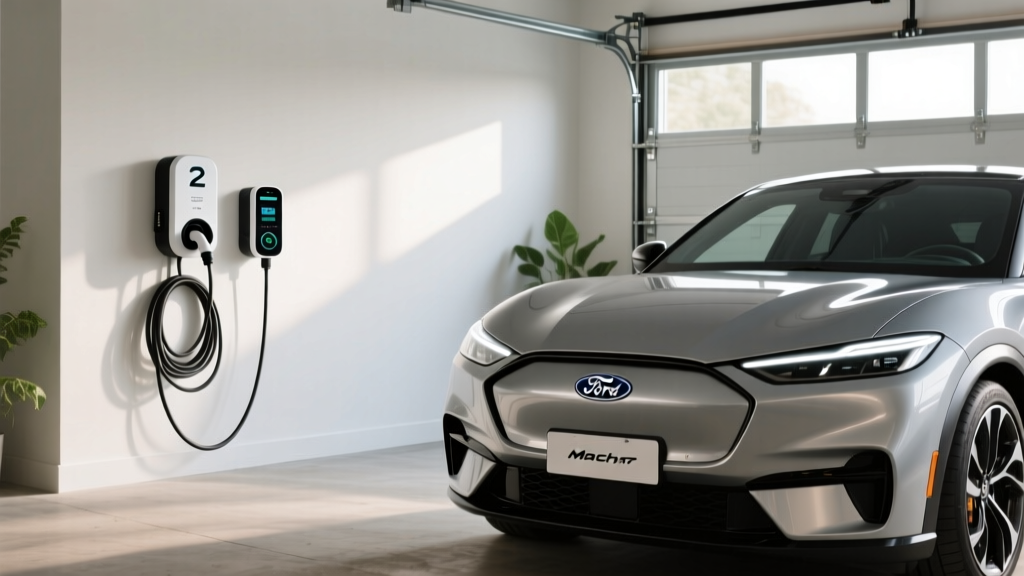
The Ford Mustang Mach-E remains one of the most popular mainstream electric SUVs, with the 2026 lineup offering battery packs from 72 kWh (Standard Range) to 91 kWh usable (Extended Range). But owning a Mach-E — or any EV — hinges on one critical piece of infrastructure: a reliable home charger. Relying on a standard 120V wall outlet means adding roughly 3–5 miles of range per hour, which won't keep up with a daily commute. A properly installed Level 2 home charger transforms the ownership experience, replenishing your battery overnight at a fraction of public-charging cost.
This guide covers everything you need to select, install, and optimize a home charger for your Mustang Mach-E, including electrical requirements, connector compatibility, real-world charging times, and the true cost per mile compared to gasoline.
Understanding Charging Levels: What Each Adds to Your Mach-E
Before picking hardware, you need to understand the three charging tiers available to EV owners. The key distinction: kW (kilowatts) measures the rate of power delivery — how fast energy flows into your battery. kWh (kilowatt-hours) measures total energy stored — your battery's capacity. Think of kW as water pressure and kWh as the size of the tank.
| Level | Voltage / Power | Typical kW | Miles of Range Added per Hour | 10–80% Time (est.) |
|---|---|---|---|---|
| Level 1 (120V outlet) | 120V / 12A | ~1.4 kW | 3–5 mi/hr | ~60+ hours |
| Level 2 (240V home/public) | 240V / 32–48A | 7.7–11.5 kW | 20–32 mi/hr | ~7–10 hours |
| DC Fast Charging | 400V+ architecture | Up to 150 kW peak | N/A (measured in minutes) | ~32–38 minutes |
The Mach-E's onboard charger accepts up to 10.5 kW on Level 2 AC power (2024+ models with the upgraded onboard charger; earlier 2021–2023 models were limited to 10.5 kW as well on higher trims). That means even if you install a 48-amp (11.5 kW) charger, the car will only draw about 10.5 kW. You'll still benefit from the headroom — future EVs in your household may accept the full 11.5 kW, and the charger runs cooler when not at its maximum rating.
On DC fast charging, the Extended Range Mach-E peaks around 150 kW, though the charge curve tapers significantly above 80% state of charge. Expect a 10–80% session to take roughly 32–38 minutes at a 150 kW+ station, with the final 20% potentially doubling total session time. Always plan DC stops around the 80% mark to avoid wasting time at low charge rates.
Which Connector Does the Mustang Mach-E Use?
Connector compatibility is essential when choosing a charger — and this is where things have shifted dramatically for Ford owners.
| Model Year | Built-In Port | DC Fast Charging Access | Adapter Needed? |
|---|---|---|---|
| 2021–2024 | CCS1 (J1772 + DC pins) | CCS1 stations natively; NACS Superchargers via Ford-approved adapter | NACS adapter for Tesla Supercharger access (provided by Ford to eligible owners) |
| 2025–2026 | NACS (native Tesla-style) | Tesla Superchargers natively; CCS1 stations via adapter | CCS1 adapter may be needed for older Electrify America or non-Tesla DC stations |
For home Level 2 charging, the situation is straightforward: all Level 2 chargers sold in North America use either a J1772 connector (which fits the CCS1 port's AC portion) or a NACS connector. If you own a 2021–2024 Mach-E with a CCS1 port, any J1772 Level 2 charger will plug in directly. If you own a 2025–2026 model with NACS, you'll need a NACS-equipped charger or a J1772-to-NACS adapter.
When buying a home charger in 2026, the smart move is to choose a model that ships with a NACS connector or offers a swap option, since the industry is consolidating around NACS. Ford's own Ford Connected Charge Station is available in NACS for current models.
Electrical Requirements and Installation Costs
Installing a Level 2 charger is an electrical project, not a plug-and-play purchase. Here's what your electrician will evaluate:
- Circuit requirement: A 48-amp charger requires a dedicated 60-amp circuit (NEC code mandates that continuous loads use no more than 80% of circuit capacity: 48A ÷ 0.80 = 60A breaker).
- Voltage: 240V, single-phase — the same as your electric dryer or oven.
- Wire gauge: Typically 6 AWG copper (THHN in conduit) or 4 AWG aluminum for a 60A circuit, though run length may require upsizing.
- Panel capacity: Your electrician will calculate whether your main service panel has enough spare capacity. Many older homes with 100-amp or 150-amp panels may need a panel upgrade to 200 amps before adding a 60A EV circuit.
- Permit: Most jurisdictions require an electrical permit for new 240V circuits, with inspection after installation.
Typical Home Charger Installation Cost Breakdown (2026)
| Component | Cost Range | Notes |
|---|---|---|
| Level 2 charger (hardware) | $350 – $700 | Depends on brand, power, smart features |
| Electrician labor (standard install) | $500 – $1,500 | Short run from panel to garage; longer runs cost more |
| Electrical permit | $50 – $200 | Varies by municipality |
| Panel upgrade (if needed) | $1,500 – $3,500 | 100A → 200A upgrade; not always required |
| Total (no panel upgrade) | $900 – $2,400 | Typical for homes with 200A service and short wire run |
| Total (with panel upgrade) | $2,400 – $5,900 | Older homes with 100A–150A service |
The single biggest variable is whether your panel can handle the additional load. If you have a modern 200-amp panel with spare breaker slots and your calculated load allows it, expect to stay under $2,000 all-in. If you need a panel upgrade, budget closer to $4,000–$5,000. Always get a load calculation from a licensed electrician before committing.
Cost to Charge: Mach-E Per-Mile Cost vs. Gas
One of the strongest arguments for home charging is the dramatic cost savings over gasoline. Here's how the numbers work for a Mustang Mach-E Extended Range (EPA efficiency: ~37 kWh/100 miles, per fueleconomy.gov).
| Scenario | Cost per kWh | Cost per 100 Miles | Cost per Mile |
|---|---|---|---|
| Home charging (off-peak utility rate) | $0.10/kWh | $3.70 | $0.037 |
| Home charging (national avg residential) | $0.17/kWh | $6.29 | $0.063 |
| Public Level 2 (network pricing) | $0.30/kWh | $11.10 | $0.111 |
| DC Fast Charging (typical network) | $0.40/kWh | $14.80 | $0.148 |
| Gas SUV (25 MPG combined, $3.50/gal) | — | $14.00 | $0.140 |
| Gas SUV (25 MPG combined, $4.00/gal) | — | $16.00 | $0.160 |
At home on off-peak rates, a Mach-E costs roughly 3.7 cents per mile — about one-quarter the cost of a 25-MPG gas SUV at $3.50/gallon. Even at the national average residential rate of ~$0.17/kWh, you're paying around 6.3 cents per mile. Public DC fast charging, however, can exceed gas costs per mile, which is why home charging is the economic backbone of EV ownership.
To maximize savings, check whether your utility offers a time-of-use (TOU) plan with reduced overnight rates. Many utilities offer off-peak electricity between 10 PM and 6 AM at $0.08–$0.12/kWh. Set your Mach-E's scheduled charging feature (or your charger's scheduling function) to take advantage of these windows.
Recommended Level 2 Chargers for the Mustang Mach-E
Based on power output, build quality, smart features, and connector availability in 2026, here are four chargers well-suited to the Mach-E:
ChargePoint Home Flex (NACS or J1772)
- Power output: Up to 12 kW (50A) — adjustable down to 16A for smaller circuits
- Connector: Available in NACS or J1772
- Cable length: 23 feet
- Smart features: Wi-Fi, ChargePoint app scheduling, energy tracking, Alexa integration
- Price: ~$599 (J1772), ~$649 (NACS)
- Best for: Flexibility — amperage dial lets you match any circuit from 20A to 60A
Ford Charge Station Pro (NACS)
- Power output: Up to 11.5 kW (48A)
- Connector: NACS (native fit for 2025+ Mach-E)
- Cable length: 25 feet
- Smart features: FordPass integration, scheduled charging, OTA updates, V2H-capable with F-150 Lightning (not Mach-E currently)
- Price: ~$699
- Best for: Seamless Ford ecosystem integration and native NACS fit
Wallbox Pulsar Plus (J1772 or NACS)
- Power output: Up to 11.5 kW (48A)
- Connector: J1772 or NACS options
- Cable length: 25 feet
- Smart features: Wi-Fi + Bluetooth, myWallbox app, Power Sharing (distribute load across two chargers on one circuit), load balancing
- Price: ~$549–$599
- Best for: Two-EV households; compact form factor
Emporia Vue Level 2 Charger
- Power output: Up to 11.5 kW (48A)
- Connector: J1772 (NACS adapter available)
- Cable length: 24 feet
- Smart features: Integrates with Emporia Vue energy monitor for whole-home solar/load tracking, scheduling, off-peak optimization
- Price: ~$399
- Best for: Budget-conscious buyers with solar panels or energy monitoring
All four chargers deliver enough power to max out the Mach-E's 10.5 kW onboard charger. The ChargePoint Home Flex earns top marks for its adjustable amperage — if your electrician determines you only have room for a 40A circuit, you can dial the ChargePoint down to 32A without replacing hardware.
Safety, Code, and Installation Best Practices
EV chargers draw sustained high current for hours — a duty cycle that stresses electrical connections more than typical household appliances. Follow these non-negotiable safety guidelines:
- Dedicated circuit: Your Level 2 charger must be on its own dedicated breaker. Never share a circuit with other high-draw appliances.
- GFCI protection: NEC 2023 (and most adopted local codes) requires GFCI protection for 240V EV charging outlets. Hardwired installations may have different requirements than receptacle-based setups — your electrician will determine compliance.
- Outdoor rating: If your charger is installed outdoors (carport, driveway), ensure it carries a NEMA 4 or IP55+ weatherproof rating. All four chargers listed above are rated for outdoor use.
- Hardwired vs. plug: A NEMA 14-50 receptacle offers portability (take the charger when you move), but hardwired installations avoid the ~$100–$200 cost of a quality industrial-grade receptacle and eliminate a potential failure point. Many EV owners have experienced issues with cheap 14-50 receptacles overheating — if you go the plug route, use a Hubbell or Bryant commercial-grade receptacle.
- Cable management: Keep the charging cable off the ground with a wall-mounted holster to prevent abrasion and trip hazards.
Charging Times by Battery Size: What to Expect Overnight
Here's how long a full Level 2 session takes for the 2026 Mustang Mach-E lineup, assuming a 10.5 kW charge rate (48A, 240V):
| Trim / Battery | Usable Capacity | 0–100% Level 2 Time | 10–80% Level 2 Time |
|---|---|---|---|
| Select (Standard Range) | ~72 kWh | ~7 hours | ~5 hours |
| Premium / GT (Extended Range) | ~91 kWh | ~9 hours | ~6.5 hours |
| Rally (Extended Range) | ~91 kWh | ~9 hours | ~6.5 hours |
For most owners, a 10–80% session overnight (say, 11 PM to 6 AM on a TOU plan) will add roughly 200+ miles of range — more than enough for any daily commute. The Mach-E's EPA range sits at 250–320 miles depending on trim and drivetrain, though expect real-world highway range to be 10–15% lower, particularly in cold weather or at sustained speeds above 70 mph. A 30°F winter morning can reduce range by 20–30% due to battery heating demands and cabin climate use.
Use the Mach-E's built-in preconditioning feature (available via FordPass scheduled departure) to warm the battery while still plugged in. This preserves range and improves regenerative braking performance in cold conditions.
Frequently Asked Questions
How much does it cost to install a home EV charger for a Mustang Mach-E?
Expect $900–$2,400 for a standard installation (charger + electrician + permit) if your panel has sufficient capacity. If you need a panel upgrade from 100A to 200A, total costs can reach $2,400–$5,900. Get a load calculation from a licensed electrician before purchasing equipment.
How fast will each charging level add range to my Mach-E?
Level 1 (120V) adds 3–5 miles per hour. Level 2 (240V, 48A) adds approximately 25–32 miles per hour. DC fast charging can add up to 50+ miles in 10 minutes at peak rate, though the charge curve tapers significantly above 80% SoC.
Which connector is compatible with my Mustang Mach-E?
Model years 2021–2024 use a CCS1 port and accept J1772 Level 2 chargers natively. Model years 2025–2026 use a NACS port and require a NACS-equipped Level 2 charger or a J1772-to-NACS adapter. Check your vehicle's charge port before purchasing a charger.
How much does charging a Mach-E cost per mile compared to gas?
At the national average residential electricity rate (~$0.17/kWh), the Mach-E costs approximately $0.06/mile to charge at home. A comparable 25-MPG gas SUV at $3.50/gallon costs $0.14/mile — more than double. Off-peak home rates can drop the Mach-E to under $0.04/mile.
What electrical upgrades might I need for a Level 2 charger?
You'll need a dedicated 60-amp, 240V circuit for a 48A charger. If your main panel is 100A or 150A and already near capacity, a panel upgrade to 200A may be required. Your electrician will perform a NEC Article 220 load calculation to determine this. Older homes with knob-and-tube wiring or Federal Pacific/Zinsco panels may require full rewiring or panel replacement.
Does the Mustang Mach-E qualify for the federal EV tax credit?
The IRS §30D clean vehicle credit offers up to $7,500 for eligible new EVs, but qualification depends on MSRP caps (under $80,000 for SUVs), buyer income limits ($150K single / $300K joint), and battery component/critical mineral sourcing requirements. As of 2026, the Mach-E's eligibility varies by trim and sourcing — check the IRS qualified vehicle list and consult a tax professional before relying on the credit. Point-of-sale transfer is available at participating dealers.
Installing a home Level 2 charger is the single most impactful upgrade a Mustang Mach-E owner can make. It eliminates range anxiety, slashes fueling costs to pennies per mile, and means you start every morning with a full battery. Size your circuit correctly, choose a quality NACS-compatible charger, and let a licensed electrician handle the install — the upfront investment pays for itself within the first year of ownership.