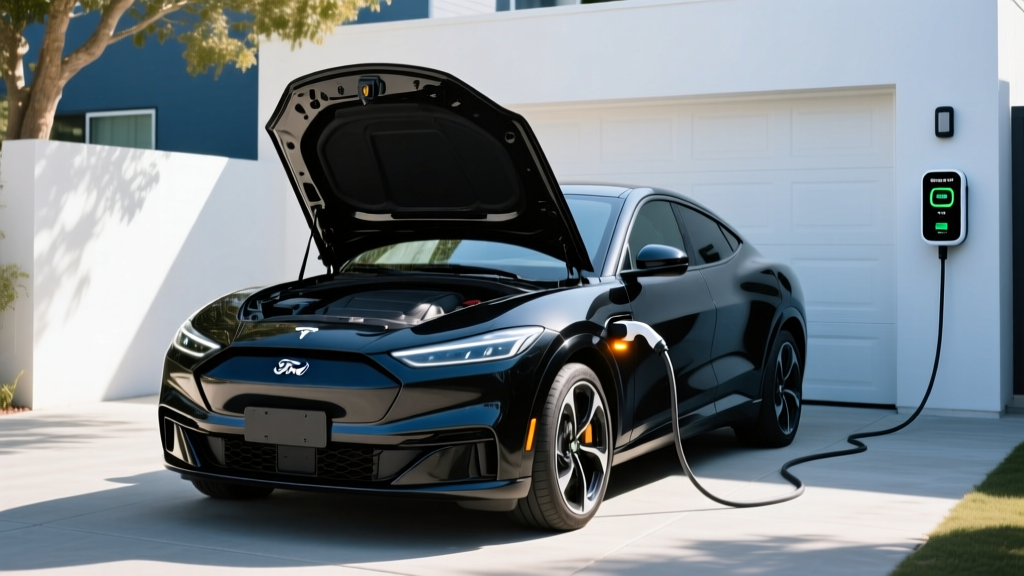
The 2024 Ford Mustang Mach-E GT represents a pivotal shift in public charging access: it is among the first wave of non-Tesla EVs to gain native access to the Tesla Supercharger network. But navigating the transition from CCS1 to NACS, understanding real-world DC fast charging speeds, and sizing a home Level 2 setup for its 91 kWh battery pack requires precise planning. This guide covers every charging scenario a Mach-E GT owner will face, from daily home top-ups to cross-country Supercharger road trips.
2024 Mustang Mach-E GT: Charging Spec Overview
Before we break down each charging level, here are the hard numbers for the 2024 Mach-E GT with the extended-range battery:
| Spec | Value |
|---|---|
| Battery (usable) | 91 kWh (NMC chemistry) |
| EPA Range | 260 miles (GT); 290 mi (GT w/ Performance Upgrade loses range) |
| Max DC Fast Charge Rate | 150 kW peak |
| 10–80% DC Fast Time | ~45 minutes (at optimal conditions) |
| Level 2 Onboard Charger | 10.5 kW (48A) |
| Level 2 Full Charge Time | ~8.5–9 hours (0–100%) |
| Native Charge Port | CCS1 (2024 model year); NACS adapter provided by Ford |
| EPA Efficiency | 84 MPGe combined (GT AWD) |
Charging Levels Explained: Speeds in kW and Miles Per Hour
Understanding the distinction between kW (power — how fast energy flows) and kWh (energy — the battery's total capacity) is essential. Think of kW as the diameter of a hose and kWh as the size of the bucket. Here is how each level fills the Mach-E GT's 91 kWh battery:
| Level | Power (kW) | Voltage / Amps | Miles Added Per Hour | 0–80% Time (91 kWh) |
|---|---|---|---|---|
| Level 1 (120V) | 1.2–1.4 kW | 120V / 12A | 3–5 mi/hr | ~60+ hours (impractical) |
| Level 2 (240V Home) | 10.5 kW (vehicle-limited) | 240V / 48A | ~30 mi/hr | ~7 hours (10–80%) |
| Level 2 (Public 40A) | 9.6 kW | 240V / 40A | ~27 mi/hr | ~7.5 hours |
| DC Fast (150 kW peak) | 150 kW → tapering | 400V+ DC | ~200+ mi in first 20 min | ~45 min (10–80%) |
| DC Fast (350 kW station) | Still 150 kW peak | — | Same as above | No faster than 150 kW charger |
Key takeaway: The Mach-E GT's onboard charger caps Level 2 at 10.5 kW. Installing a 60A home circuit (delivering 48A continuous) maximizes this. A 50A circuit (40A continuous, 9.6 kW) will charge slightly slower but still covers overnight needs. For DC fast charging, the vehicle peaks at 150 kW — plugging into a 350 kW Electrify America stall won't charge any faster than a 150 kW Supercharger.
Tesla Supercharger Access: NACS Adapter and Network Compatibility
The 2024 Mach-E GT shipped with a CCS1 (Combined Charging System) port. However, Ford began providing a NACS (North American Charging Standard) adapter to Mach-E owners in early 2024, enabling access to Tesla's Supercharger network — over 25,000 stalls in North America as of 2026.
| Connector | Network | Compatibility with 2024 Mach-E GT |
|---|---|---|
| CCS1 | Electrify America, EVgo, ChargePoint, Ionity | Native — plug directly in |
| NACS (Tesla) | Tesla Supercharger (V2 150 kW, V3 250 kW, V4) | Via Ford-provided NACS adapter |
| CHAdeMO | Largely deprecated in US | Not compatible — no adapter available |
| J1772 (Level 2) | Public L2, home chargers | Native (CCS1 includes J1772 upper inlet) |
Charging curve at a Supercharger: The Mach-E GT will pull close to 150 kW between roughly 10–35% State of Charge (SoC). From 35–60%, expect 100–120 kW. Above 60%, the rate tapers to 60–80 kW, and above 80%, it drops to under 40 kW. This is why the 10–80% metric matters — charging the final 20% can take as long as the first 50%.
Home Level 2 Installation: Requirements, Costs, and Panel Upgrades
Charging a 91 kWh battery overnight requires a properly sized 240V circuit. Here is what a typical Mach-E GT home installation involves:
Electrical requirements:
- Ideal circuit: 60A breaker / 48A continuous (delivers full 10.5 kW the Mach-E can accept)
- Minimum practical: 50A breaker / 40A continuous (9.6 kW — still adds ~27 mi/hr)
- Wire gauge: 6 AWG copper (for 60A) or 8 AWG (for 50A), run in conduit if exposed
- Outlet vs. hardwired: NEMA 14-50 outlet (plug-in) or hardwired — hardwired is preferred for 48A+ to avoid thermal issues at the receptacle
| Cost Component | Typical Range |
|---|---|
| Level 2 Charger (hardware) | $400 – $750 |
| Electrician labor (standard install, <50 ft run) | $500 – $1,500 |
| Permit and inspection | $50 – $200 |
| Electrical panel upgrade (100A → 200A, if needed) | $1,500 – $4,000 |
| Total (no panel upgrade) | $950 – $2,450 |
| Total (with panel upgrade) | $2,450 – $6,450 |
Will you need a panel upgrade? Homes built before 1990 often have 100A or even 60A main service panels. Adding a 60A EV circuit to a 100A panel that is already running central A/C, an electric dryer, and an electric range may exceed safe load calculations. A licensed electrician will perform a load calculation per NEC Article 220 to determine if an upgrade is required. Newer homes (200A service) rarely need an upgrade for a single EV charger.
Federal tax incentive: The IRS Residential Clean Energy Credit (25C) covers 30% of home charging equipment and installation costs, up to $1,000 per year. This applies to both the charger hardware and electrician labor. Confirm eligibility with a tax professional — income caps do not apply to 25C (unlike the §30D vehicle credit).
Cost to Charge: Home vs. Public vs. Gas
The Mach-E GT's efficiency averages about 3.0–3.3 miles per kWh (roughly 30–33 kWh per 100 miles) in mixed driving. Here is what that translates to in real dollars:
| Scenario | Rate | Cost for 260 mi (full range) | Cost Per Mile |
|---|---|---|---|
| Home (off-peak utility rate) | $0.12/kWh | $9.90 | $0.038 |
| Home (average US residential) | $0.17/kWh | $14.00 | $0.054 |
| Public Level 2 (ChargePoint, etc.) | $0.25–$0.40/kWh | $20.60 – $33.00 | $0.079 – $0.127 |
| Tesla Supercharger (average 2026) | $0.28–$0.40/kWh | $23.00 – $33.00 | $0.088 – $0.127 |
| Electrify America DC Fast | $0.35–$0.55/kWh | $28.70 – $45.10 | $0.110 – $0.173 |
| Gas equivalent (25 MPG, $3.40/gal) | $3.40/gallon | $35.36 | $0.136 |
Even at public DC fast charging rates, the Mach-E GT generally costs less per mile than a comparable 25 MPG gas vehicle. At home off-peak rates, the savings are dramatic — roughly $0.04/mile vs. $0.14/mile for gas, a 70% reduction in "fuel" cost.
Time-of-use tip: Most utilities offer EV-specific rate plans with off-peak rates between 10 PM and 6 AM. Programming the Mach-E's scheduled charging feature (via the FordPass app) to charge only during these windows maximizes savings.
Recommended Home Level 2 Chargers for the Mach-E GT
These chargers are selected to match the Mach-E GT's 10.5 kW onboard charger capability. All support the J1772 connector (native to the Mach-E's CCS1 port for Level 2).
Ford Connected Charge Station
Power: 10.5 kW (48A) | Connector: J1772 (25 ft cable)
Smart features: FordPass integration, scheduled charging, charge status in-vehicle
Price: ~$599 (often included or discounted with vehicle purchase)
Verdict: Purpose-built for Ford EVs. Ensures full 10.5 kW utilization. Best integration with the Mach-E's native scheduling and preconditioning.
ChargePoint Home Flex
Power: Up to 12 kW (50A) on 60A circuit; configurable 16–50A
Connector: J1772 (23 ft cable) | Smart features: Wi-Fi, app scheduling, Alexa, amperage adjustment
Price: ~$549
Verdict: Excellent third-party option. Amperage can be dialed down to match your circuit. Works with any EV, making it future-proof.
Tesla Wall Connector (with J1772 adapter)
Power: Up to 11.5 kW (48A) on 60A circuit
Connector: NACS native — requires separate J1772 adapter for Mach-E
Smart features: Wi-Fi, OTA updates, power sharing (dual units on one circuit)
Price: ~$425 + adapter (~$50)
Verdict: Best value hardware, but the adapter hassle makes it less ideal unless you also own a Tesla. Better suited for mixed-EV households.
Safety, Electrical Code, and Installation Best Practices
EV charging draws sustained high current for hours — this is fundamentally different from intermittent loads like a dryer or oven. The following safety requirements apply per the National Electrical Code (NEC):
- Dedicated circuit: The EV charger must be on its own dedicated breaker — no sharing with other outlets or appliances.
- Continuous load rule: EV charging is classified as a continuous load (3+ hours). The breaker must be rated at 125% of the charger's amperage. A 48A charger requires a 60A breaker minimum.
- GFCI protection: NEC 2020 and later require GFCI protection for all 240V EV receptacles (NEMA 14-50). Hardwired installations may not require a GFCI breaker depending on local code interpretation — your electrician will confirm.
- Outdoor rating: If the charger is installed outdoors (garage-adjacent carport, driveway), the unit must carry a NEMA 4 or IP65 weather rating. All three chargers recommended above meet this standard.
- Permit and inspection: Most jurisdictions require an electrical permit for new 240V circuits. The inspection ensures proper wire gauge, breaker sizing, grounding, and GFCI compliance. Budget $50–$200 for the permit fee.
Frequently Asked Questions
Can the 2024 Mach-E GT charge at a Tesla Supercharger without an adapter?
No. The 2024 model year Mach-E GT has a CCS1 charge port. You must use Ford's official NACS adapter to plug into a Tesla Supercharger. Starting with the 2025 model year, Ford transitioned to a native NACS port, eliminating the adapter requirement for newer vehicles.
How much does it cost to install a home EV charger for the Mach-E GT?
Expect $950–$2,450 for a standard installation (60A circuit, hardwired or NEMA 14-50, less than 50 feet of wire run, no panel upgrade). If your home needs a 200A panel upgrade, total cost can reach $2,450–$6,450. The federal 25C credit covers 30% of equipment and labor, up to $1,000.
How fast does each charging level add range to the Mach-E GT?
Level 1 (120V): 3–5 miles per hour. Level 2 (240V, 48A): ~30 miles per hour. DC Fast Charging (150 kW peak): approximately 150+ miles in the first 20 minutes, tapering significantly above 80% SoC.
Is DC fast charging bad for the Mach-E GT's battery long-term?
Occasional DC fast charging is fine. However, daily use of DC fast charging (especially at high SoC) accelerates degradation. Ford's battery management system includes a buffer and active thermal management. The high-voltage battery is warranted for 8 years / 100,000 miles with a minimum 70% capacity retention threshold per Ford's official warranty documentation. For daily use, home Level 2 charging at 80–90% SoC maximizes battery longevity.
Does the Mach-E GT support plug-and-charge at Superchargers?
Yes, once your FordPass account is linked to your Tesla charging profile (set up through the FordPass app), the Mach-E GT supports automatic authentication at Superchargers — no app swipe or RFID card needed. Billing is processed through your linked payment method.
How does charging cost compare to gas for the Mach-E GT?
At home off-peak rates ($0.12/kWh), the Mach-E GT costs approximately $0.04 per mile — roughly 70% less than a 25 MPG gas vehicle at $3.40/gallon ($0.14/mi). Even at public Supercharger rates ($0.28–$0.40/kWh), per-mile costs ($0.09–$0.13) remain competitive with or below gasoline.
What happens if I charge my Mach-E GT on a 350 kW Electrify America station?
The vehicle will only draw its maximum of 150 kW. The station is capable of more, but the car's battery management system limits intake. You will not charge any faster at a 350 kW stall than at a 150 kW stall. This is normal and protects the battery.