Understanding Mustang EV Range and Charging Dynamics
When buyers search for mustang ev range, they are typically looking at the Ford Mustang Mach-E lineup. For the 2026 model year, the Mach-E continues to offer a compelling mix of performance and efficiency, but maximizing that range depends entirely on your charging strategy. A vehicle's battery is only as useful as your ability to replenish it efficiently.
The 2026 Mustang Mach-E features a usable battery capacity of approximately 70 kWh (Standard Range) to 91 kWh (Extended Range). According to fueleconomy.gov, the Extended Range RWD model achieves an EPA-estimated range of 320 miles. However, real-world testing shows that highway driving at 75 mph or cold-weather operation can reduce this figure by 15–25%.
Real-World Range Expectations
- EPA Sticker: 320 miles (Extended Range RWD)
- Highway (70-80 mph): ~260–280 miles
- Cold Weather (below 32°F): ~240–260 miles
- City/Stop-and-Go: ~310+ miles (regen-heavy)
Charging Levels: Speeds and Miles Per Hour
To maintain your Mustang's range, you must understand the three tiers of EV charging. The distinction between kW (power/speed) and kWh (energy/capacity) is vital: kW is how fast you fill the tank; kWh is the size of the tank.
| Level | Voltage/Power | Miles of Range Added Per Hour | Best Use Case |
|---|---|---|---|
| Level 1 | 120V / 1.4 kW | 3–5 miles | Emergency / Overnight top-ups |
| Level 2 | 240V / 7.7–11.5 kW | 25–40 miles | Daily home / workplace charging |
| DC Fast | 400V+ / 150+ kW | 150–250 miles in 20 mins | Road trips / Highway corridors |
Home Charger Installation: Costs and Requirements
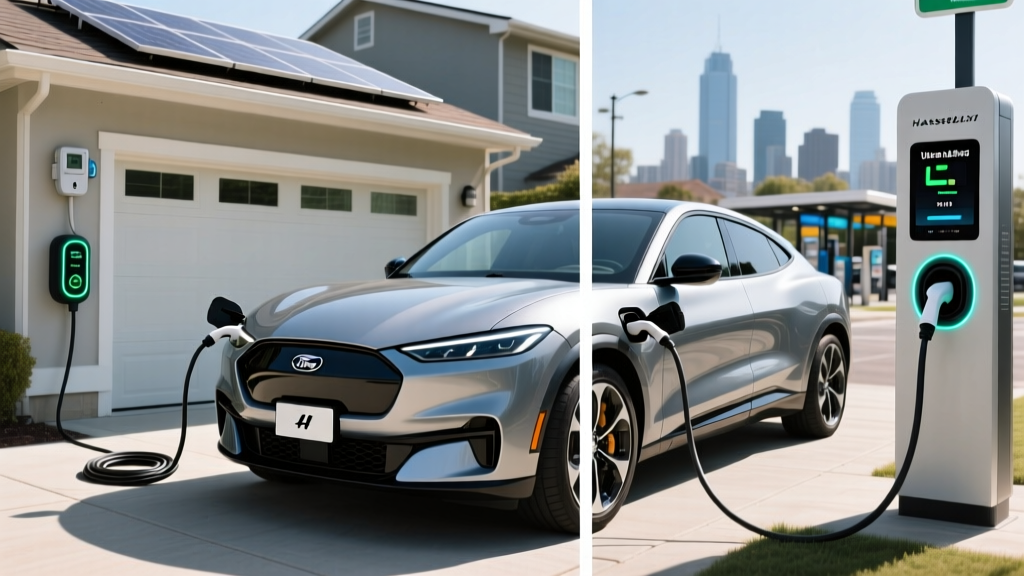
Installing a Level 2 home charger is the most effective way to ensure you always start with a full "tank." For a Mustang Mach-E, a 48-amp (11.5 kW) charger is ideal to fully replenish the battery overnight.
Electrical Requirements
You will need a dedicated 240V circuit. For a 48-amp charger, the National Electrical Code (NEC) requires a 60-amp breaker. Most modern homes have 200-amp panels that can support this, but older homes may require a panel upgrade.
| Item | Cost Range | Notes |
|---|---|---|
| Level 2 Charger (48A) | $400 – $700 | Smart Wi-Fi enabled models |
| Electrical Permit | $50 – $200 | Varies by local jurisdiction |
| Electrician Labor | $600 – $1,500 | Depends on distance from panel |
| Panel Upgrade (Optional) | $1,500 – $3,500 | Only if current panel is maxed out |
| Total (Standard) | $1,050 – $2,400 | Before any local utility rebates |
Connector Compatibility: NACS vs. CCS1
The 2026 Mustang Mach-E has transitioned to the North American Charging Standard (NACS) port for new models, though many 2021–2025 models on the road still use CCS1. Ford provides adapters for legacy owners to access the Tesla Supercharger network.
| Connector | Model Years | Network Access | Adapter Needed? |
|---|---|---|---|
| NACS (Tesla) | 2025–Present | Tesla Superchargers + NACS stations | CCS adapter for older public stations |
| CCS1 | 2021–2024 | Electrify America, EVgo, ChargePoint | NACS adapter for Tesla Superchargers |
Cost Analysis: Charging vs. Gasoline
One of the primary benefits of the Mustang EV is the reduced operating cost. Based on a national average electricity rate of $0.16/kWh and gasoline at $3.40/gallon:
| Energy Source | Cost Per Unit | Efficiency | Cost Per Mile |
|---|---|---|---|
| Home Electricity | $0.16 / kWh | 3.0 miles/kWh | $0.053 |
| Public DC Fast | $0.48 / kWh | 3.0 miles/kWh | $0.160 |
| Gasoline (25 MPG) | $3.40 / Gallon | 25 miles/gallon | $0.136 |
Home charging offers significant savings, while public DC fast charging is often comparable to or slightly more expensive than gasoline. However, the convenience and speed of DC fast charging remain essential for long-distance travel.
Equipment Recommendations for 2026
Best Overall: ChargePoint Home Flex
- Power: Up to 12 kW (50 Amp)
- Connector: NACS or CCS1 (selectable)
- Features: Wi-Fi, Alexa integration, 25ft cable
- Price: ~$599
Best Value: Emporia Vue 2
- Power: Up to 11.5 kW (48 Amp)
- Connector: Universal J1772 (with NACS adapter)
- Features: Energy monitoring, load balancing
- Price: ~$399
Charging Times: 10% to 80% Benchmarks
Charging speeds are not linear. The "charge curve" means the vehicle pulls maximum power (kW) only until about 80% State of Charge (SoC), after which it slows to protect battery health.
- Level 2 (11.5 kW): ~7–9 hours for a full 0–100% charge.
- DC Fast (150+ kW): ~20–25 minutes for 10–80% (approx. 200 miles of range).
For daily use, it is recommended to set your charge limit to 80% or 90% to prolong the long-term health of the NMC or LFP battery chemistry.
Frequently Asked Questions
Do I need a permit for a home charger?
Yes, most local jurisdictions require an electrical permit for a new 240V circuit. This ensures the work meets safety codes and is typically handled by your licensed electrician.
Can I use a standard outlet for my Mustang EV?
Yes, but Level 1 (120V) charging is very slow, adding only about 3–5 miles of range per hour. It is only practical for PHEVs or very low-mileage daily commutes.
Does cold weather affect charging speed?
Yes. Lithium-ion batteries charge much slower when cold. The Mustang Mach-E uses battery preconditioning to warm the pack before you reach a charger, which significantly improves the initial charge rate.