Why a 1995 Supercharged Mustang GT Owner Needs This Charging Primer
If you're coming from something like a 1995 supercharged Mustang GT — a 5.0L pushrod V8 with an aftermarket blower pushing 350–400 hp, 12–16 mpg on a good day, and the visceral soundtrack of a roots-type supercharger — an electric vehicle feels like stepping onto another planet. No gas station detours, no oil changes, no supercharger belt squeal at WOT. Instead, you're trading fuel pumps for charging plugs and horsepower for kilowatts.
The good news: the fundamentals of EV charging are straightforward once you understand three things — kW (power, how fast energy flows), kWh (energy, how much the battery holds), and the three charging levels. This guide breaks down exactly what you need to charge at home, on the road, and what it all costs, with the same precision you'd use to tune boost pressure on that Fox-body Mustang.
The Three Charging Levels: Speeds, kW, and Miles Per Hour
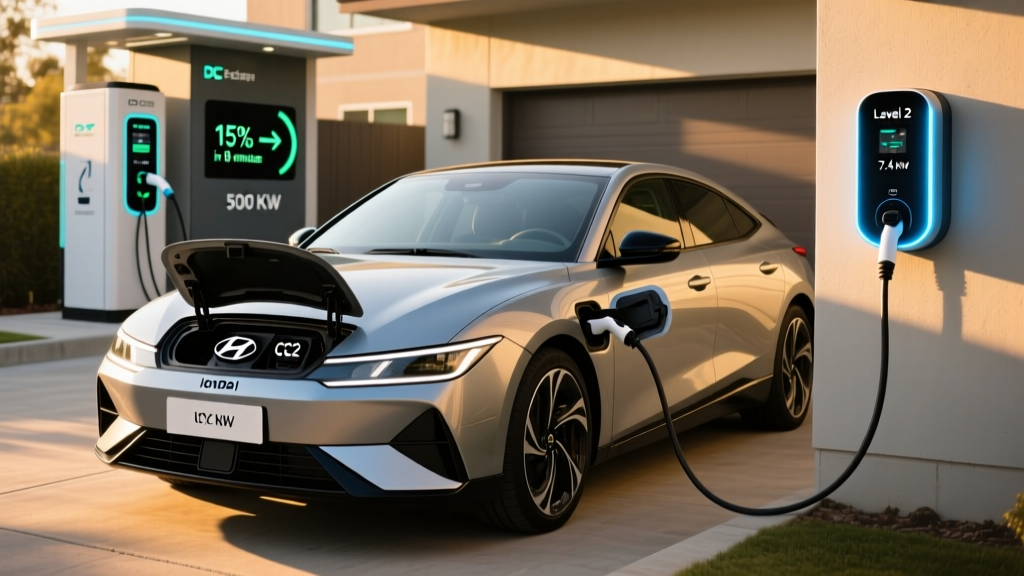
Every EV sold in the US charges via one of three levels. Here's the exact breakdown:
| Level | Voltage | Power (kW) | Miles of Range Added Per Hour | Typical Use Case |
|---|---|---|---|---|
| Level 1 | 120V AC | 1.0–1.4 kW | 3–5 miles/hr | Overnight top-up, PHEVs, emergencies |
| Level 2 | 240V AC | 3.3–19.2 kW | 12–75 miles/hr | Home daily charging, workplace, public AC |
| DC Fast Charge | 400–800V DC | 50–350 kW | 150–1,200+ miles/hr (peak) | Road trips, highway corridors |
Critical distinction: kW is the rate of energy delivery (like the flow rate of a gas pump nozzle). kWh is the total energy stored (like the gallons in your fuel tank). A 77 kWh battery charged at 11.5 kW takes roughly 6.7 hours from 0–100% in ideal conditions. Real-world charging always slows as the battery fills — more on that below.
- Tesla Model Y (75 kWh usable, 250 kW peak): ~18–22 minutes on a V3 Supercharger
- Hyundai Ioniq 5 (77.4 kWh, 800V architecture, 233 kW peak): ~18 minutes on a 350 kW CCS station
- Ford F-150 Lightning Extended Range (131 kWh, 150 kW peak): ~41 minutes on a 150 kW DC charger
- Chevrolet Equinox EV (85 kWh, 150 kW peak): ~30 minutes on a 150 kW charger
These times assume battery preconditioning and a charger capable of the vehicle's peak rate. Cold batteries or undersized chargers add significant time.
Home Level 2 Installation: Electrical Requirements, Costs, and Panel Gotchas
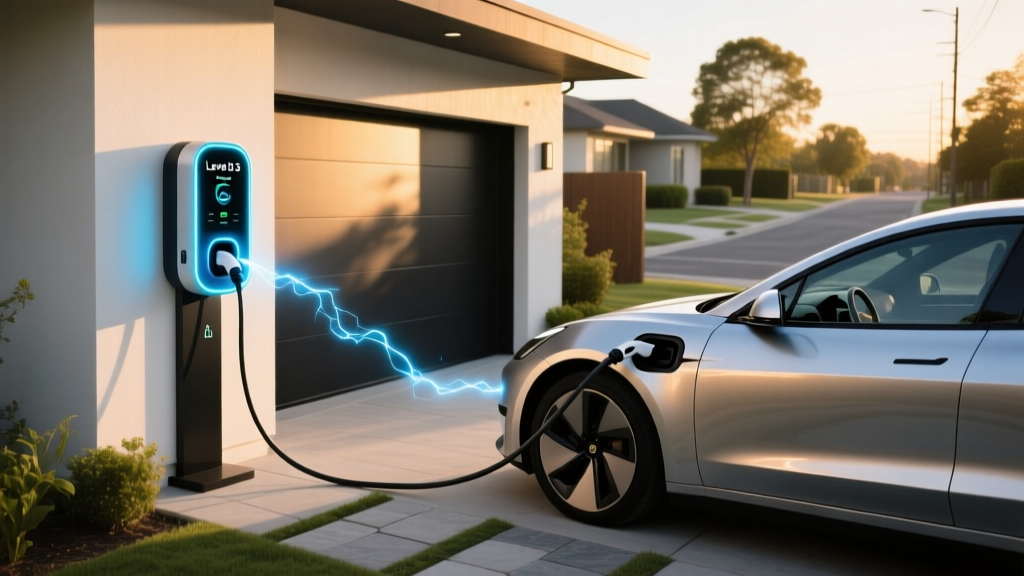
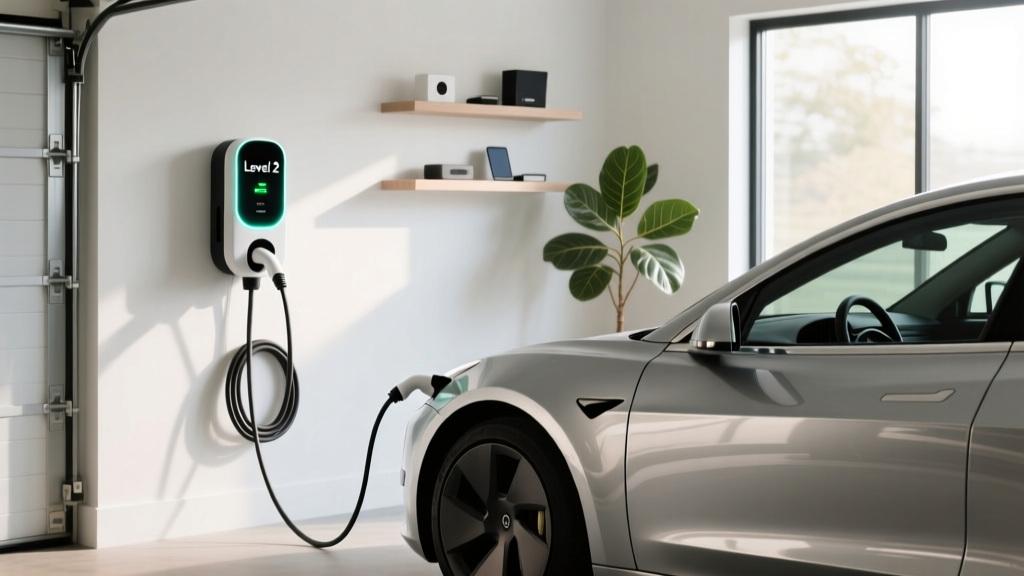
Level 2 home charging is where 85–95% of all EV charging happens for owners with garage or driveway access. Here's what's required:
Electrical Requirements
- Voltage: 240V (same as your electric dryer or oven circuit)
- Amperage: 40A circuit is the most common, delivering 9.6 kW continuous (a 48A circuit delivers 11.5 kW; a 60A circuit supports the full 48A continuous draw of higher-power chargers)
- Dedicated circuit: NEC code requires a dedicated breaker — you cannot share this circuit with other appliances
- Continuous-load rule: EV charging is classified as a continuous load under NEC Article 625, meaning the circuit must be rated for 125% of the charger's maximum draw. A 40A charger needs a 50A breaker; a 48A charger needs a 60A breaker
Installation Cost Breakdown
| Component | Low-End | High-End | Notes |
|---|---|---|---|
| Level 2 EVSE (charger unit) | $250 | $700 | Smart Wi-Fi chargers cost more |
| Electrician labor | $300 | $1,200 | Depends on run length, conduit, drywall work |
| Electrical permit | $50 | $200 | Varies by municipality |
| Panel upgrade (if needed) | $1,500 | $4,000+ | Required if your panel is 100A or near capacity |
| Total (no panel upgrade) | $600 | $2,100 | Most homes with 200A service |
| Total (with panel upgrade) | $2,100 | $6,100+ | Older homes, 100A panels |
Safety and Code Considerations
- GFCI protection: NEC 2020 and later requires GFCI protection for EV receptacles (NEMA 14-50 outlets). Hardwired chargers avoid this requirement and are generally recommended by electricians for reliability.
- Outdoor rating: If your charger is outdoors, ensure it carries a NEMA 4 or NEMA 4X rating for weather resistance.
- Hardwired vs. plug-in: Hardwired installations eliminate the GFCI nuisance-trip issue, allow higher amperage (48A+), and are more secure. Plug-in (NEMA 14-50) offers portability but limits you to 40A continuous.
- Load management: Some smart chargers (e.g., Emporia, Wallbox) offer load-sensing features that dynamically adjust charge rate to avoid overloading your panel — useful if a panel upgrade isn't feasible.
Connector Compatibility: NACS, CCS1, CHAdeMO, and Adapter Needs
The connector landscape has consolidated significantly since 2024. Here's where things stand in 2026:
| Connector | Brands Using It (Native) | DC Fast Charge Availability |
|---|---|---|
| NACS (Tesla) | Tesla, Ford, GM, Rivian, Volvo, Polestar, Mercedes, Nissan (2025+), Honda (2025+), Fisker, Lucid | Tesla Supercharger network (60,000+ stalls in North America), plus growing third-party NACS stations |
| CCS1 (Combo) | Hyundai, Kia, BMW, VW, Porsche, Audi, Stellantis, Subaru, Toyota (bZ series), legacy Ford/GM (pre-2025) | Electrify America, EVgo, ChargePoint, Ionity (Europe) |
| CHAdeMO | Nissan Leaf (legacy), Mitsubishi Outlander PHEV (legacy) | Declining; most new stations omit CHAdeMO |
Adapter requirements:
- CCS vehicle → Tesla Supercharger: Tesla sells a CCS-to-NACS adapter (~$199). Ford and GM also offer adapters for their NACS-transition vehicles.
- NACS vehicle → CCS station: Tesla provides a NACS-to-CCS adapter for Supercharger-compatible non-Tesla EVs, and most NACS-native vehicles ship with one.
- CHAdeMO owners: Adapters to CCS or NACS are not commercially available. CHAdeMO infrastructure is shrinking — factor this into any used Nissan Leaf purchase decision.
Cost to Charge: $/kWh Scenarios and Cost Per Mile vs. Gas
Let's put real numbers on what charging actually costs compared to filling up a supercharged 5.0L Mustang that sips 14 mpg at $3.40/gallon.
| Scenario | Cost per kWh | EV Efficiency (kWh/mi) | Cost per Mile | Gas Equivalent (14 mpg @ $3.40/gal) |
|---|---|---|---|---|
| Home off-peak (utility TOU rate) | $0.08–$0.12 | 0.28–0.35 | $0.02–$0.04 | $0.24/mile |
| Home standard rate | $0.13–$0.18 | 0.28–0.35 | $0.04–$0.06 | $0.24/mile |
| Public Level 2 (ChargePoint, etc.) | $0.20–$0.35 | 0.28–0.35 | $0.06–$0.12 | $0.24/mile |
| DC Fast Charge (Electrify America, EVgo) | $0.35–$0.55 | 0.28–0.35 | $0.10–$0.19 | $0.24/mile |
| Tesla Supercharger (member/non-member) | $0.25–$0.40 | 0.28–0.32 | $0.07–$0.13 | $0.24/mile |
Annual savings math (12,000 miles/year):
- 1995 Supercharged Mustang GT (14 mpg): 857 gallons × $3.40 = $2,914/year
- EV charged 90% at home ($0.14/kWh avg) + 10% DCFC ($0.45/kWh): blended ~$0.05/mi × 12,000 = $600/year
- Annual fuel savings: approximately $2,300 — enough to cover a home charger installation in the first year.
Note: EV electricity costs vary by utility. Check your provider's time-of-use (TOU) rates — charging between 10 PM and 6 AM can cut costs by 40–60% versus peak hours. According to the U.S. Department of Energy's fueleconomy.gov, the national average electricity price for EV charging at home is approximately $0.14/kWh in 2026.
Equipment Recommendations: Best Home Chargers for 2026
Tesla Wall Connector (Gen 4)
- Power: Up to 11.5 kW (48A) on a 60A circuit
- Connector: NACS native
- Cable length: 24 ft
- Smart features: Wi-Fi, OTA updates, load sharing with 2nd unit, Powerwall integration
- Price: ~$425
- Best for: Tesla, Ford, GM, Rivian, and all NACS-equipped vehicles
ChargePoint Home Flex
- Power: Up to 12 kW (50A) on a 60A circuit; configurable down to 16A
- Connector: NACS or CCS1 (J1772 with adapter)
- Cable length: 23 ft
- Smart features: Wi-Fi, Alexa integration, scheduling, detailed energy tracking via app
- Price: ~$550–$650
- Best for: Multi-EV households, CCS and NACS flexibility
Emporia Vue Smart Charger
- Power: Up to 11.5 kW (48A)
- Connector: NACS or J1772
- Cable length: 24 ft
- Smart features: Real-time load management (pairs with Emporia energy monitor), solar-aware charging, TOU scheduling
- Price: ~$350–$400
- Best for: Homes with solar panels, tight electrical panels needing load management
Wallbox Pulsar Plus
- Power: Up to 11.5 kW (48A)
- Connector: J1772 (CCS1 compatible); NACS version available
- Cable length: 25 ft
- Smart features: Wi-Fi + Bluetooth, Power Sharing (daisy-chain two units on one circuit), Eco-Smart solar integration
- Price: ~$450–$550
- Best for: Two-EV garages sharing a single circuit
Charging Curve Reality: Why Peak kW Is Not Sustained kW
Coming from a supercharged Mustang where boost builds linearly with RPM, you'll need to recalibrate expectations for EV charging. A vehicle rated at "250 kW peak DC fast charging" does not charge at 250 kW for the entire session. Here's why:
- 10–30% SoC: Battery accepts peak or near-peak power. This is the fastest segment.
- 30–60% SoC: Power begins tapering. A 250 kW peak vehicle might sustain 150–200 kW here.
- 60–80% SoC: Significant taper. Power may drop to 80–120 kW as the battery management system protects cell health.
- 80–100% SoC: Dramatic taper to ~20–40 kW. Charging from 80–100% can take as long as 10–80%. This is why road-trip strategy targets 10–80% stops.
Preconditioning matters: Most modern EVs warm the battery to optimal temperature (typically 30–40°C) before a DC fast charge session. If you navigate to a charger using the car's built-in navigation, preconditioning usually starts automatically. Without it — especially in cold weather — your peak charge rate may be cut by 30–50% for the first several minutes.
800V architectures (Hyundai Ioniq 5, Kia EV6, Porsche Taycan, Lucid Air) sustain higher power deeper into the charge curve compared to 400V systems, which is why their 10–80% times are competitive despite similar peak kW ratings.
Frequently Asked Questions
How much does it cost to install a home EV charger?
For most homes with a 200A electrical panel and a short wire run from the panel to the garage, expect $600–$2,100 total (charger + electrician + permit). Homes needing a panel upgrade to 200A should budget $2,100–$6,100+. Always get 2–3 quotes from licensed electricians and confirm they have specific EV charger installation experience. The IRS §30C credit may cover up to 30% of home charging equipment and installation costs (capped at $1,000) for eligible taxpayers — check current-year eligibility on irs.gov.
How fast will each charging level add range?
Level 1 (120V) adds roughly 3–5 miles per hour — fine for PHEVs with small batteries or emergency trickle charging. Level 2 (240V, 48A) adds 30–45 miles per hour for most EVs, fully replenishing a 75–85 kWh battery overnight in 7–9 hours. DC fast charging at 150–250 kW adds 150–300+ miles in 15–25 minutes (10–80% SoC), depending on battery size and vehicle architecture.
Which connector/charger is compatible with my EV?
Check your vehicle's charge port. For 2025–2026 models: Tesla, Ford, GM, Rivian, Volvo, and several others use NACS. Hyundai, Kia, BMW, VW, and most legacy EVs use CCS1. If you own a CCS vehicle and want access to Tesla Superchargers, you'll need a manufacturer-approved adapter. For home Level 2, any J1772-compatible charger works with CCS vehicles, and NACS chargers work with NACS vehicles — the J1772 standard covers Level 1 and Level 2 AC charging across all connectors.
How much does charging cost per mile vs gas?
Home charging at typical utility rates ($0.10–$0.18/kWh) costs $0.03–$0.06 per mile for most EVs. DC fast charging on road trips runs $0.10–$0.19 per mile. Compare this to a 14 mpg supercharged Mustang at $3.40/gallon: $0.24 per mile. Even exclusive DC fast charging is cheaper per mile than premium fuel in a low-MPG performance car. Per fueleconomy.gov, EVs convert 77–85% of grid electricity to wheels, versus 12–30% for gasoline vehicles.
What electrical upgrades might I need?
The most common upgrade is a panel replacement from 100A to 200A ($1,500–$4,000) in older homes. You may also need: a new dedicated 50A or 60A double-pole breaker, conduit runs from the panel to the garage (longer runs = higher cost), and potentially a whole-home surge protector. Some utilities require a "make-ready" inspection before energizing a new EV circuit. A few municipalities now allow "smart panel" devices (like Span or Lumin) as alternatives to full panel upgrades — these manage loads dynamically to stay within your existing panel's capacity.