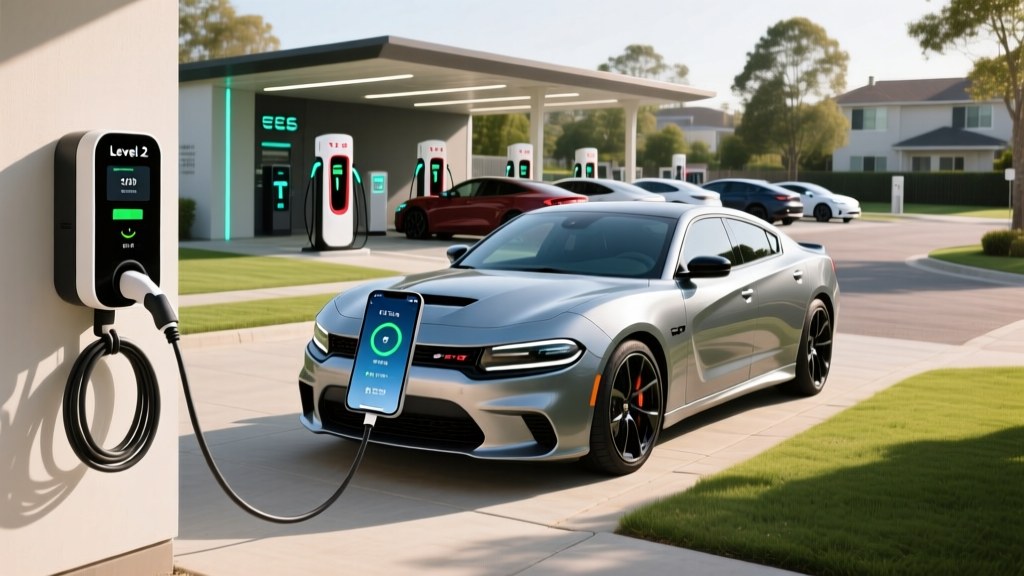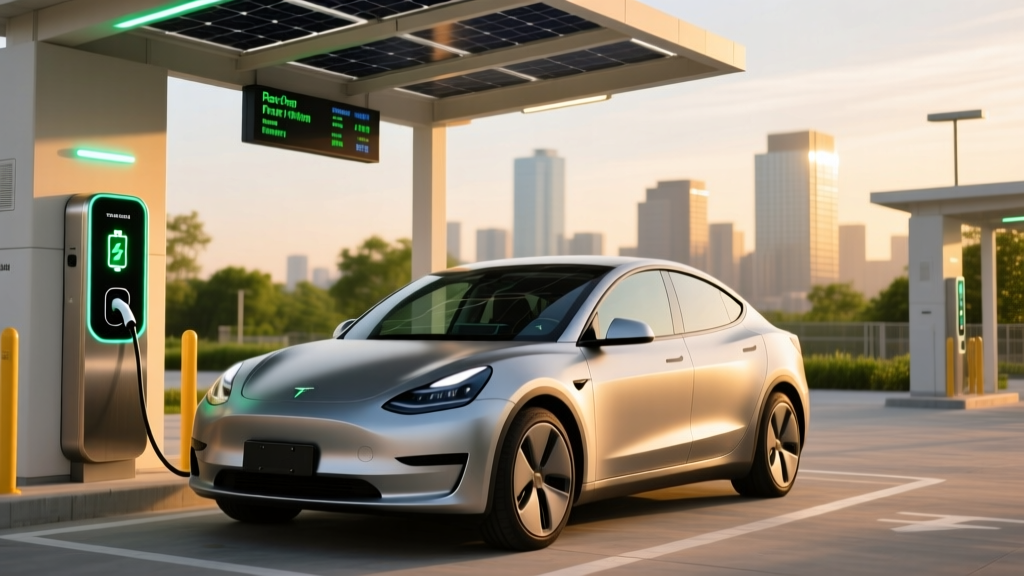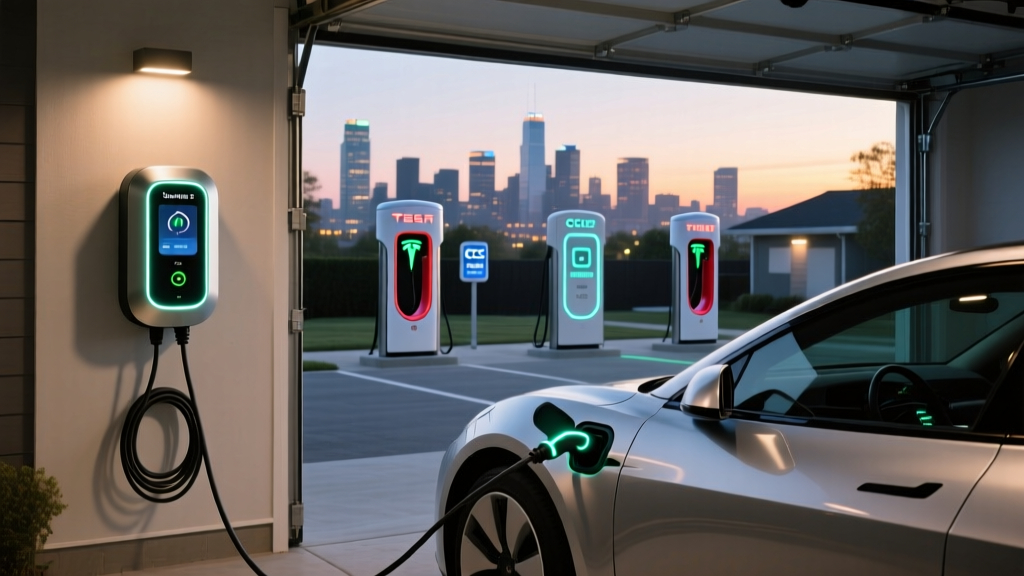
If you've spent years behind the wheel of a 2004 Monte Carlo SS supercharged — that 3.8L L36 V6 pushing 240 hp through a 4T65-E HD transmission, burning roughly 10–11 gallons on a highway road trip — the jump to an electric vehicle requires rewiring more than just your commute. You're trading a 17.5-gallon fuel tank and a network of gas stations for a lithium-ion battery pack and a very different refueling ecosystem. The good news: most EV owners do 80% or more of their charging at home, often paying the equivalent of $1.00–$1.20 per gallon. But getting that home setup right — and understanding public charging when you need it — is where the details matter enormously.
This guide walks you through exactly what you need to know: charging speeds in real numbers, what your home's electrical panel can (and can't) handle, which connector your new EV will use, and what you'll actually pay per mile compared to the 93-octane your Monte Carlo SS demanded.
Understanding the Three Charging Levels: kW, Speed, and What They Mean
Before anything else, a critical distinction: kW (kilowatts) measures power — how fast energy flows into your battery, like water pressure from a hose. kWh (kilowatt-hours) measures energy — the total capacity of your battery, like the size of a bucket. Your EV battery might hold 75 kWh of energy, and a charger might deliver power at 11 kW or 150 kW. Confusing these two is the single most common EV mistake new owners make.
Here's how the three charging levels break down in real-world terms:
| Level | Voltage / Amperage | Power (kW) | Miles of Range Added Per Hour | Typical Use Case |
|---|---|---|---|---|
| Level 1 | 120V / 12A | ~1.4 kW | 3–5 mi/hr | Overnight trickle; PHEVs or very low daily mileage |
| Level 2 | 240V / 32–48A | 7.7–11.5 kW | 25–44 mi/hr | Home daily charging; workplace; public destination |
| DC Fast Charging | 400–800V DC | 50–350 kW | 180–1,000+ mi/hr (peak) | Road trips; rapid top-ups; commercial fleets |
Real-world context: If you drive a 2026 Hyundai Ioniq 5 (84 kWh usable battery, EPA 310 miles) and arrive home at 30% State of Charge (SoC), a 48A Level 2 charger delivering 11.5 kW will refill you to 80% in roughly 4.5 hours — easily overnight. That same 10–80% session at a 250 kW DC fast charger (like a Tesla Supercharger V4 or Electrify America Hypercharger) takes approximately 18–22 minutes, though peak speed only holds between roughly 10–55% SoC before the charge curve tapers to protect battery chemistry.
For a former Monte Carlo SS owner accustomed to a 4-minute gas station stop, DC fast charging is your road-trip equivalent — but Level 2 at home is where the daily convenience lives.
Home Charger Installation: Electrical Requirements, Costs, and Panel Upgrades
Installing a Level 2 home charger is where most new EV owners face their first real decision point. The 2004 Monte Carlo SS supercharged never asked anything of your home's electrical system, but a 48A Level 2 EV charger draws continuous load comparable to running an electric oven and a clothes dryer simultaneously — for hours.
Electrical Requirements
A typical Level 2 home charger requires:
- Circuit: Dedicated 240V circuit, 40A–60A breaker (NEC Article 625 requires the circuit to be rated 125% of the charger's continuous draw, so a 48A charger needs a 60A breaker)
- Wire: 6 AWG or 4 AWG copper (depending on run length and local code)
- Outlet vs. hardwired: NEMA 14-50 outlet offers portability; hardwired avoids GFCI nuisance trips common with 240V receptacles under continuous EV load
- Location: Garage or exterior wall near your parking spot, within cable reach (25 ft is standard; some chargers offer 18–24 ft)
The Panel Upgrade Reality
This is the cost variable most online guides gloss over. If your home has a 100A electrical service panel — common in houses built before 2000 — adding a 60A EV circuit may exceed your panel's capacity, especially if you already run electric heat, an electric dryer, and an electric range. A licensed electrician will perform a NEC Article 220 load calculation to determine whether your panel can handle the additional draw.
If an upgrade is needed, moving from a 100A to a 200A panel typically costs $1,500–$3,500 depending on your utility's requirements, conduit runs, and local permit fees. In some older homes, a full service upgrade from the utility transformer can push costs to $4,000–$5,000. This is non-negotiable — overloading a panel is a fire hazard, and no licensed electrician will sign off on it.
| Component | Low Estimate | High Estimate | Notes |
|---|---|---|---|
| Level 2 Charger (Equipment) | $350 | $750 | Smart Wi-Fi chargers (e.g., ChargePoint Home Flex, Emporia Level 2) |
| Electrician Labor (Install) | $400 | $1,200 | Depends on run length, wall type, conduit needs |
| Permit & Inspection | $50 | $250 | Varies by municipality; some utilities bundle this |
| Electrical Panel Upgrade (if needed) | $1,500 | $3,500 | 100A → 200A service; not always required |
| Total (No Panel Upgrade) | $800 | $2,200 | Most common scenario for newer homes |
| Total (With Panel Upgrade) | $2,300 | $5,700 | Older homes or high-load households |
Pro tip: Many utilities offer rebates of $250–$1,000 for Level 2 charger installation, and some states offer additional incentives. Check your utility's EV program page and the Alternative Fuels Data Center state incentive database before scheduling your electrician. The federal Residential Clean Energy Credit (IRC §25D) was modified under recent legislation — consult a tax professional for current-year eligibility, as the EV charger credit specifically (formerly §30C) has separate rules from the vehicle credit.
Connector Compatibility: NACS, CCS1, CHAdeMO, and What Your EV Needs
The connector landscape shifted dramatically between 2023 and 2026. Here's where things stand now:
| Connector | Brands Using It (Factory) | DC Fast Charging Network Access | Adapter Availability |
|---|---|---|---|
| NACS (J3400) | Tesla (all models), Ford, GM, Rivian, Volvo, Polestar, Fisker | Tesla Supercharger network (17,000+ stalls); growing third-party NACS stations | CCS-to-NACS adapters available from Tesla and third parties (~$200–$250) |
| CCS1 | Hyundai, Kia, BMW, VW, Audi, Porsche, Mercedes, Stellantis | Electrify America, EVgo, ChargePoint DC, Ionity (EU) | NACS-to-CCS adapters available for Supercharger access on some networks |
| CHAdeMO | Nissan Leaf (legacy); largely discontinued on new models | Shrinking network; some Electrify America and EVgo legacy stalls | No practical adapter to NACS or CCS for DC fast charging |
What this means for you: If you're buying a new EV in 2026, the industry has largely converged on NACS and CCS1. The CHAdeMO standard is effectively legacy — functional but unsupported on new vehicles. When selecting a home Level 2 charger, choose one with the connector that matches your EV, or select a unit with a J1772 plug (the universal Level 2 standard) and use the adapter that came with your vehicle for NACS if needed.
For home Level 2 charging, the physical connector matters less than it does for DC fast charging, because every EV sold in the US includes an adapter (or has a built-in J1772 inlet) for Level 2. The real connector question is for public fast charging on road trips — and that's where knowing whether your EV is NACS or CCS determines which networks you can use without an adapter.
Cost Per Mile: EV Charging vs. Gas for Your Monte Carlo SS Replacement
Let's run the numbers that matter. The 2004 Monte Carlo SS supercharged, with its 3.8L V6, averaged roughly 20 MPG combined on regular unleaded (it recommended premium for full supercharged performance). At $3.50/gallon, that's $0.175 per mile in fuel alone.
A comparable midsize EV — say a 2026 Chevrolet Blazer EV (EPA 307 miles, 102 MPGe combined, ~31 kWh/100mi) — has very different economics depending on where you charge:
| Charging Scenario | Cost per kWh | Cost per Mile (at 3.1 mi/kWh) | Annual Fuel Cost (12,000 mi) | vs. Monte Carlo SS Gas Cost |
|---|---|---|---|---|
| Home Level 2 (off-peak utility rate) | $0.09–$0.14 | $0.029–$0.045 | $348–$540 | Saves $1,560–$1,752/year |
| Home Level 2 (standard residential rate) | $0.16–$0.20 | $0.052–$0.065 | $624–$780 | Saves $1,320–$1,476/year |
| Public Level 2 (workplace, mall, destination) | $0.20–$0.35 | $0.065–$0.113 | $780–$1,356 | Saves $744–$1,320/year |
| DC Fast Charging (road trips, Electrify America, EVgo) | $0.35–$0.55 | $0.113–$0.177 | $1,356–$2,124 | Saves $0–$744/year |
| Monte Carlo SS (gas, 20 MPG, $3.50/gal) | — | $0.175 | $2,100 | Baseline |
The key insight: Home charging is where EV economics shine. If you can install Level 2 at home and charge on off-peak rates (many utilities offer EV-specific time-of-use plans with rates as low as $0.06–$0.09/kWh overnight), your annual fuel cost drops to roughly $350–$540. That's a $1,500+ annual savings over the Monte Carlo SS — and those savings compound year over year. However, if you rely exclusively on DC fast charging (no home access), your fuel cost approaches or even exceeds what you paid for gas. This is why home charging access is the single most important factor in EV ownership satisfaction.
According to fueleconomy.gov, electricity costs vary significantly by state — from roughly $0.10/kWh in Louisiana and Washington to $0.30+/kWh in California and Hawaii. Always check your local utility's EV rate plan before calculating your personal savings.
Charging Time Examples: What to Expect with Common Battery Sizes
Charging times depend on your battery's usable capacity (in kWh) and the charger's power output (in kW), but the relationship isn't linear because of the charge curve. Lithium-ion batteries accept charge fastest between roughly 10–55% SoC, then taper significantly above 80% to prevent lithium plating and thermal stress. This is why manufacturers quote "10–80%" times rather than 0–100%.
Level 2 Home Charging Times (10% to 80% SoC)
- 60 kWh battery (e.g., base Nissan Ariya, VW ID.4 Standard): ~5–6 hours on a 48A/11.5 kW charger
- 75–84 kWh battery (e.g., Tesla Model Y Long Range, Hyundai Ioniq 5): ~6–7 hours on a 48A/11.5 kW charger
- 100+ kWh battery (e.g., Ford F-150 Lightning Extended Range, Rivian R1S Max): ~8–10 hours on a 48A/11.5 kW charger
DC Fast Charging Times (10% to 80% SoC)
- 400V architecture, 150 kW peak (e.g., VW ID.4): ~28–32 minutes; sustained average ~80–90 kW after initial peak
- 800V architecture, 250–350 kW peak (e.g., Hyundai Ioniq 5, Kia EV6, Porsche Taycan): ~18–22 minutes; sustained average ~150–180 kW
- Tesla Supercharger V4, 250 kW peak (Model Y, Model 3): ~20–25 minutes for Long Range variants
Charge curve reality check: A charger rated for 250 kW does not deliver 250 kW for the entire session. In testing, most 800V vehicles peak near their rated maximum between 10–40% SoC, then taper to 100–120 kW by 60% SoC, and drop below 50 kW by 85% SoC. If you're road-tripping, charging to 80% and driving on is faster than waiting for a slow trickle from 80–100%.
Equipment Recommendations: Best Home Level 2 Chargers in 2026
Not all Level 2 chargers are created equal. Here are three proven units that cover different budgets and feature sets, all compatible with J1772 (universal Level 2 standard) and available with NACS connectors or adapters:
ChargePoint Home Flex
- Power Output: Up to 12 kW (50A) on a 60A circuit; configurable down to 16A for smaller panels
- Connector: J1772 (NACS adapter available separately)
- Cable Length: 23 ft
- Smart Features: Wi-Fi, app scheduling, utility demand-response integration, Alexa, energy tracking
- Price: ~$550–$650
- Best For: Flexible amperage adjustment if your panel is tight on capacity
Emporia Level 2 EV Charger
- Power Output: Up to 11.5 kW (48A) on a 60A circuit
- Connector: J1772
- Cable Length: 24 ft
- Smart Features: Wi-Fi, app control, solar integration (pairs with Emporia Vue energy monitor), load management
- Price: ~$350–$400
- Best For: Budget-conscious buyers who want smart features and solar-aware charging
Tesla Wall Connector (Gen 4)
- Power Output: Up to 11.5 kW (48A) on a 60A circuit
- Connector: NACS (native Tesla); J1772 adapter included for non-Tesla EVs
- Cable Length: 24 ft
- Smart Features: Wi-Fi, OTA updates, power sharing (link multiple units on one circuit), Tesla app integration
- Price: ~$475
- Best For: Tesla owners or households with mixed NACS/J1772 vehicles
Critical selection criteria: Always match the charger's maximum amperage to your circuit. A 48A charger requires a 60A breaker (per NEC 125% rule). If your electrician installs a 50A breaker, configure your charger to 40A maximum. Never oversize the charger beyond what the circuit supports — this is a code violation and a fire risk.
Safety, Electrical Code, and Permit Considerations
EV charging is a continuous, high-draw electrical load — your charger will run at full power for 4–10 hours at a time. This is fundamentally different from an appliance that cycles on and off. The National Electrical Code (NEC) Article 625 governs EV charging installations, and your local jurisdiction will enforce it through the permit and inspection process.
Key Safety Requirements
- Dedicated circuit: Your Level 2 charger must have its own dedicated breaker — no sharing with other outlets or appliances.
- GFCI protection: NEC 2020+ requires GFCI protection for outdoor receptacles used for EV charging. However, many EV manufacturers and electricians recommend hardwired installations over NEMA 14-50 outlets specifically to avoid GFCI nuisance trips, which are common with continuous high-draw loads on 240V receptacles.
- Outdoor rating: If your charger is installed outdoors, the unit must carry an NEMA 4 or NEMA 4X rating for weather resistance. All recommended chargers above meet this standard.
- Permit and inspection: Most jurisdictions require an electrical permit for a new 240V circuit. The inspection ensures wire gauge, breaker sizing, and grounding meet code. Do not skip this — unpermitted work can void homeowner's insurance claims related to electrical fires.
- Cable management: Use a wall-mounted cable organizer or holster. A 24-ft charging cable left on a garage floor is a trip hazard and will degrade from being driven over.
Public Charging: Networks, Reliability, and Road Trip Strategy
For the road trips your Monte Carlo SS was built for — say, 600 miles from Chicago to Denver — public DC fast charging is your lifeline. Here's how the major networks compare in 2026:
- Tesla Supercharger: 17,000+ stalls in North America; consistently highest reliability (~97% uptime); now open to NACS-equipped non-Tesla EVs. Peak power: 150–250 kW depending on station generation.
- Electrify America: 4,000+ stalls; 150–350 kW chargers at newer stations; CCS1 native, NACS adapters available at select locations. Reliability has improved but still trails Tesla (~90–93% uptime per J.D. Power studies).
- EVgo: 3,500+ stalls; mix of 50–350 kW; strong urban coverage; subscription plans reduce per-kWh cost.
- ChargePoint (DC fast): Primarily a network aggregator; reliability varies by site host.
Road trip planning tip: Use A Better Route Planner (ABRP) or your EV's built-in navigation to pre-condition your battery before arriving at a DC fast charger. Battery preconditioning warms the cells to optimal temperature (roughly 30–40°C), which can improve peak charge rate by 20–40% in cold weather. Without preconditioning, a winter fast-charge session can take 30–50% longer.
Frequently Asked Questions
How much does it cost to install a home EV charger?
Expect $800–$2,200 for a standard Level 2 installation (equipment + electrician + permit) if your electrical panel has sufficient capacity. If a panel upgrade from 100A to 200A is required, total costs range from $2,300–$5,700. Always get a load calculation from a licensed electrician before committing.
How fast will each charging level add range?
Level 1 (120V) adds 3–5 miles of range per hour. Level 2 (240V, 48A) adds 25–44 miles per hour depending on vehicle efficiency. DC fast charging adds 180–1,000+ miles per hour at peak, but sessions are typically measured in 10–80% time (18–32 minutes for most modern EVs) because the charge rate tapers significantly above 80% SoC.
Which connector/charger is compatible with my EV?
For 2026 model-year EVs, the two dominant connectors are NACS (Tesla, Ford, GM, Rivian, Volvo) and CCS1 (Hyundai, Kia, BMW, VW, Porsche, Mercedes). Check your vehicle's charge port before purchasing a home charger. For Level 2 home charging, all EVs accept J1772 (directly or via adapter). For DC fast charging, your connector determines which public networks you can access without an adapter.
How much does charging cost per mile vs gas?
Home Level 2 charging on off-peak rates costs roughly $0.03–$0.05 per mile — compared to $0.175/mile for a 20 MPG vehicle at $3.50/gallon gas. That's a $1,500+ annual fuel savings at 12,000 miles/year. However, exclusive reliance on DC fast charging at $0.35–$0.55/kWh pushes EV cost per mile to $0.11–$0.18, narrowing or eliminating the savings.
What electrical upgrades might I need?
The most common upgrade is a panel capacity increase from 100A to 200A service ($1,500–$3,500). You may also need a new conduit run from your panel to the charger location (especially for detached garages), a sub-panel, or a utility service upgrade if your transformer can't support the additional load. A licensed electrician's load calculation will identify exactly what's needed before any work begins.
Making the switch from a supercharged V6 to an EV is a genuine paradigm shift — but one that pays dividends in daily convenience and operating cost if you invest in the right home charging infrastructure. Get your electrician's assessment, choose a charger matched to your panel and your EV's connector, and you'll never visit a gas station again except to buy a coffee.