Why the Model Y Long Range Demands a Smart Charging Strategy
The 2026 Tesla Model Y Long Range AWD remains one of the most popular EVs on American roads, and for good reason. With a 0-60 mph time of 4.8 seconds, 385 horsepower, and an EPA-estimated 320 miles of range from its ~75 kWh (usable) NMC battery pack, it delivers sports-sedan acceleration wrapped in a practical crossover. But unlocking that performance — and keeping the battery healthy for years — depends entirely on how you charge it.
Whether you're a new owner figuring out home charging or a prospective buyer weighing the Model Y Long Range against competitors, this guide covers the exact numbers: charge speeds, installation costs, connector compatibility, and what you'll actually spend per mile. We'll also address that 4.8-second 0-60 time and how battery state of charge affects it.
| Spec | Value |
|---|---|
| EPA Range | 320 miles |
| Real-World Highway (~70 mph) | ~270–290 miles |
| Real-World Cold Weather (20°F) | ~240–265 miles |
| Battery (usable) | ~75 kWh, NMC chemistry |
| Max DC Fast Charge Rate | 250 kW (peak) |
| 10–80% DC Fast Charge | ~25 minutes (V3 Supercharger) |
| Level 2 Charge Rate | 11.5 kW (48A onboard) |
| 0-60 mph | 4.8 seconds |
| Horsepower | 385 hp |
| MPGe (combined) | 117 MPGe |
| Connector | NACS (native Tesla) |
| Base MSRP | $47,990 |
| Battery Warranty | 8 years / 120,000 miles |
Source: fueleconomy.gov and Tesla.com. Real-world estimates based on independent testing and owner data; actual results vary with temperature, terrain, and driving style.
Charging Levels Explained: kW, Miles Per Hour, and What They Mean
Before installing anything, you need to understand the three charging levels and how they differ. The most common confusion in EV ownership is mixing up kW (kilowatts — the rate of power delivery, like water pressure) with kWh (kilowatt-hours — the total energy stored, like gallons in a tank). A 75 kWh battery charged at 11.5 kW takes roughly 6.5 hours from empty. A 250 kW DC fast charger delivers that same energy far faster, but only up to a point — more on charge curves below.
| Level | Voltage | Max Power (kW) | Miles of Range Added Per Hour | Best For |
|---|---|---|---|---|
| Level 1 (120V outlet) | 120V | 1.4 kW | ~3–5 mi/hr | Emergency/overnight trickle |
| Level 2 (240V home) | 240V | 11.5 kW | ~37–44 mi/hr | Daily home charging |
| DC Fast (Supercharger) | 400V+ | 250 kW (peak) | ~1,000+ mi/hr (peak) | Road trips, rapid top-ups |
Level 1 is what you get from a standard household 120V outlet. It's painfully slow for a 75 kWh battery — a full charge from 10% would take over 50 hours. It works only if you drive fewer than 30 miles daily and can leave the car plugged in overnight.
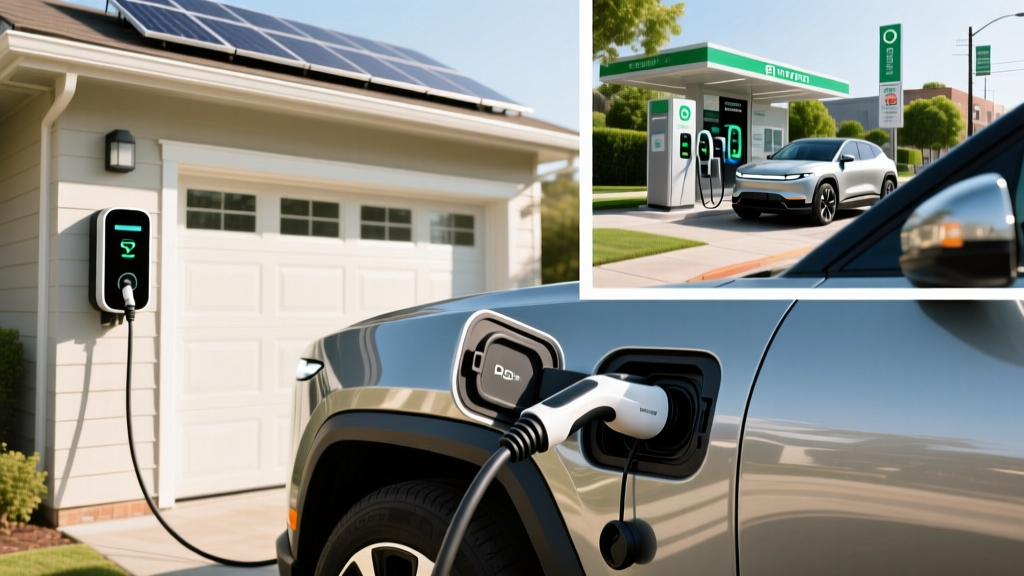
Level 2 is the standard for home EV ownership. A 240V circuit delivering 48 amps provides 11.5 kW to the Model Y's onboard charger. That's roughly 37–44 miles of range per hour of charging. Plug in at 6 PM with 40% battery, and you'll wake up at 100% by 7 AM. This is where 90%+ of Model Y charging happens for most owners.
DC Fast Charging bypasses the onboard charger entirely, sending DC current straight to the battery. On a Tesla V3 Supercharger, the Model Y Long Range can peak at 250 kW — adding up to 175 miles in 15 minutes under ideal conditions. But peak rate is not sustained rate.
Understanding the Charge Curve
DC fast charging follows a taper curve. The Model Y will pull close to 250 kW only between roughly 10–30% state of charge (SoC). From 30–50%, it drops to ~150 kW. From 50–80%, it tapers further to ~75–50 kW. Above 80%, charging slows dramatically to protect battery health — sometimes dropping below 25 kW. This is why manufacturers quote 10–80% times (~25 minutes for the Model Y) rather than 0–100% times. Charging from 80–100% on DC fast can take as long as 10–80%.
Pro tip: For road trips, charge to 80% and drive on. The time you "save" charging from 80–100% at a Supercharger is almost always less than the time you'd gain by just driving to the next station and topping up again from a low SoC.
Home Charger Installation: Electrical Requirements, Costs & Panel Upgrades
Installing a Level 2 home charger for your Model Y Long Range is the single best investment in EV ownership. Here's what's involved electrically and financially.
Electrical Requirements
The Model Y's onboard charger accepts up to 11.5 kW (48 amps at 240V). To deliver this safely, the National Electrical Code (NEC) requires the circuit to be rated at 125% of the continuous load — meaning you need a 60-amp dedicated circuit with a NEMA 14-50 outlet or a hardwired connection. A hardwired setup is generally preferred for 48A+ charging because NEMA 14-50 receptacles can overheat under sustained high-current use if not installed to exacting standards.
What if your electrical panel can't handle 60 amps? Many older homes have 100-amp or 150-amp main panels that are already near capacity. Adding a 60-amp EV circuit may require a panel upgrade to 200 amps, which is a significant additional cost. Some homeowners opt for a lower-amperage circuit (e.g., 40A breaker / 32A continuous = ~7.7 kW) to avoid a panel upgrade. That still delivers ~25 miles of range per hour — enough for most daily needs.
Installation Cost Breakdown
| Component | Low Estimate | High Estimate | Notes |
|---|---|---|---|
| Level 2 Charger (hardware) | $400 | $750 | Quality Wi-Fi-enabled 48A unit |
| Electrician labor | $500 | $1,500 | Varies by run length, wall type, conduit |
| Electrical permit | $50 | $200 | Required in most jurisdictions |
| Panel upgrade (if needed) | $1,500 | $3,500 | 100A → 200A service upgrade |
| Total (no panel upgrade) | $950 | $2,450 | Most common scenario |
| Total (with panel upgrade) | $2,450 | $5,950 | Older homes with 100A service |
The federal Residential Clean Energy Credit (IRS Form 5695) covers 30% of home EV charger equipment and installation costs, up to $1,000, through 2032 — provided you live in a qualifying census tract. Check with a tax professional for your specific eligibility. Some states and utilities offer additional rebates on top of the federal credit.
Connector Compatibility: NACS, CCS1, and Adapter Realities
The 2026 Model Y Long Range ships with a NACS (North American Charging Standard) port — Tesla's proprietary connector, now adopted industry-wide. This is the simplest charging ecosystem of any EV on the market because you get native access to the entire Tesla Supercharger network (20,000+ stalls in North America) without any adapter.
| Connector Type | Native or Adapter? | Network Access |
|---|---|---|
| NACS (Tesla) | Native | Tesla Superchargers, Tesla Destination Chargers |
| CCS1 | Adapter required (Tesla CCS Adapter, ~$175) | Electrify America, EVgo, ChargePoint DC stations |
| CHAdeMO | Not supported (no adapter available) | N/A — network largely retired |
| J1772 (Level 2 public) | Adapter included with vehicle | Public Level 2 stations (ChargePoint, Blink, etc.) |
Do you need a CCS adapter? If you travel in areas where Tesla Superchargers are sparse but Electrify America or EVgo stations are available, the Tesla CCS adapter (~$175 from Tesla's shop) is a worthwhile insurance policy. However, with Tesla opening Superchargers to non-Tesla EVs and expanding rapidly, most Model Y owners rarely need CCS access.
For Level 2 public charging (shopping centers, workplaces, hotels), the J1772 adapter that ships with the car handles every non-Tesla Level 2 station. At 11.5 kW, the Model Y charges at the same rate on J1772 as it does on a Tesla Wall Connector — assuming the station can deliver 48A or more. Many public Level 2 stations max out at 30–40A (7.2–9.6 kW), so expect slightly slower speeds in the wild.
Cost to Charge: Model Y Long Range Per-Mile Cost vs. Gas
One of the strongest financial arguments for the Model Y Long Range is the per-mile energy cost. Let's break it down with real numbers based on the Model Y's efficiency of roughly 28 kWh per 100 miles (EPA combined).
| Scenario | Rate | Cost Per Full Charge (75 kWh) | Cost Per Mile |
|---|---|---|---|
| Home (off-peak utility rate) | $0.13/kWh | $9.75 | $0.036 |
| Home (average US residential) | $0.17/kWh | $12.75 | $0.047 |
| Tesla Supercharger (average) | $0.35/kWh | $26.25 | $0.097 |
| Electrify America / 3rd-party DC | $0.48/kWh | $36.00 | $0.133 |
| Gas equivalent (25 MPG, $3.50/gal) | $3.50/gal | — | $0.140 |
| Gas equivalent (25 MPG, $4.50/gal) | $4.50/gal | — | $0.180 |
Even at the most expensive DC fast-charging rates, the Model Y Long Range costs less per mile than a comparable 25-MPG gas crossover. At home off-peak rates, it's roughly one-quarter the cost of gasoline. Over 15,000 miles per year, home charging saves $1,200–$2,000 annually compared to a gas vehicle at current fuel prices.
Time-of-use (TOU) rates matter enormously. Many utilities offer off-peak rates of $0.08–$0.13/kWh between 10 PM and 6 AM. Scheduling your Model Y to charge during these windows (easily done in the Tesla app) can cut your annual charging bill in half compared to charging during peak afternoon hours.
Best Home Chargers for the Model Y Long Range (2026 Picks)
Since the Model Y uses NACS natively, your best home charger options are NACS-equipped units that can deliver the full 48 amps the car can accept. Here are three proven choices:
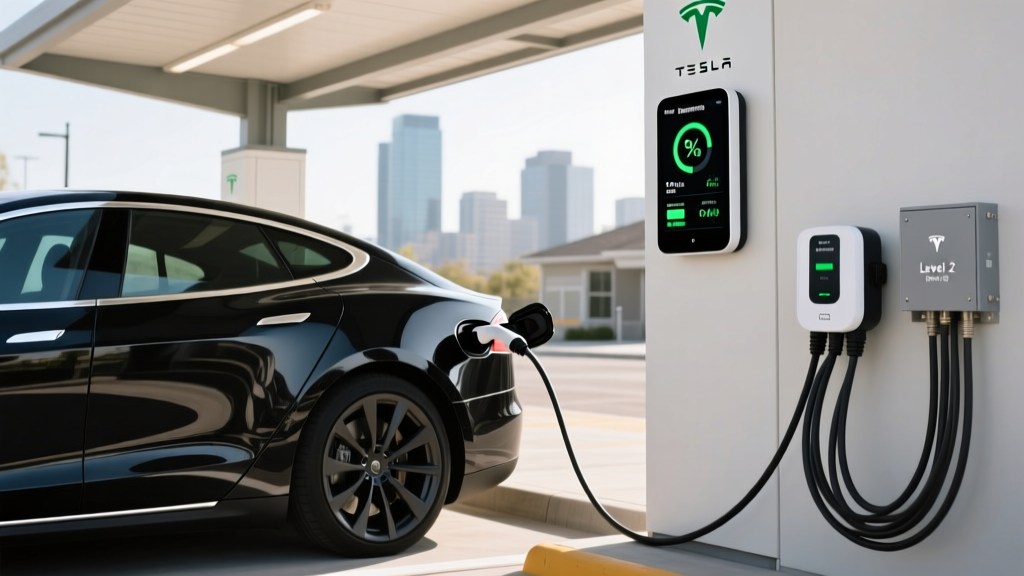
Tesla Wall Connector (Gen 3) — Best Overall
- Power Output: 11.5 kW (48A @ 240V)
- Connector: NACS (native)
- Cable Length: 24 feet
- Smart Features: Wi-Fi, OTA updates, power sharing between units, load management
- Price: ~$475
- Why: Purpose-built for Tesla vehicles, seamless integration, supports power sharing if you add a second EV. The 24-foot cable reaches most garage configurations.
ChargePoint Home Flex — Most Versatile
- Power Output: Up to 12 kW (50A, configurable down to 16A)
- Connector: NACS or J1772 (select at purchase)
- Cable Length: 23 feet
- Smart Features: Wi-Fi, Alexa integration, scheduling, energy tracking app
- Price: ~$550–$650
- Why: Amperage is adjustable via DIP switches, making it ideal if your panel can't support a full 60A circuit. Works with Amazon Alexa for voice scheduling. Excellent app.
Emporia Vue Smart EV Charger — Budget Pick
- Power Output: 11.5 kW (48A @ 240V)
- Connector: NACS or J1772
- Cable Length: 24 feet
- Smart Features: Wi-Fi, solar integration, energy monitoring, scheduling
- Price: ~$400
- Why: Best value for a full-48A smart charger. Integrates with Emporia's whole-home energy monitor if you have solar panels. NEMA 4 outdoor rated.
All three chargers require a 60A dedicated circuit for full 48A output. If your panel is constrained, the ChargePoint Home Flex's configurability lets you set it to 32A (40A breaker) or 40A (50A breaker) without buying a different unit.
How the Model Y Long Range's 0-60 Time Relates to Battery Charge
The Model Y Long Range's 4.8-second 0-60 mph time is one of its headline specs, but EV performance is directly tied to battery state of charge. Here's what owners should know:
- Above 50% SoC: Full 385 hp is available. You'll hit the rated 4.8-second time consistently.
- 20–50% SoC: Power delivery begins to taper slightly. Expect 0-60 in roughly 5.2–5.5 seconds — still quick, but noticeably softer.
- Below 20% SoC: The battery management system limits peak current to protect the cells. 0-60 may stretch to 6+ seconds, and you'll see a power-limit warning on the display.
- Cold battery (below 50°F): Even at high SoC, a cold battery can't deliver peak power. Preconditioning (automatic when navigating to a Supercharger) warms the battery to optimal temperature, restoring full performance.
This is why keeping your Model Y between 20–80% SoC for daily driving isn't just good for battery longevity — it's also the sweet spot for consistent performance. The NMC chemistry in the Long Range degrades faster if regularly held at 100% or dropped to 0%, so Tesla recommends a daily charge limit of 80% and 100% only for road trips.
Safety, Code & Installation Best Practices
Level 2 EV charging draws high current for hours at a time — more sustained load than almost any other household appliance. Proper installation isn't optional; it's a safety requirement.
- Dedicated circuit: Your EV charger must have its own dedicated circuit — no sharing with dryers, ovens, or HVAC. A shared circuit risks tripped breakers and overheated wiring.
- GFCI protection: NEC 2020 and later require GFCI protection for all EV charging outlets. Hardwired installations with GFCI breakers are preferred for reliability.
- Outdoor rating: If your charger is installed outdoors (driveway, carport), it must be rated NEMA 4 or NEMA 4X for weather resistance. All three chargers recommended above meet this standard.
- Permit and inspection: Most jurisdictions require an electrical permit for EV charger installation. Your electrician should pull this permit, and the work should be inspected. Unpermitted work can void home insurance claims and create resale issues.
- Wire gauge: A 60A circuit requires 6 AWG copper wire (THHN in conduit) or 4 AWG for longer runs to minimize voltage drop. Your electrician will calculate the correct gauge based on run length.
The panel-upgrade question: If your home has a 100-amp main panel, adding a 60-amp EV circuit is likely impossible without an upgrade. A licensed electrician will perform a load calculation (NEC Article 220) to determine if your panel has sufficient headroom. Don't skip this step — overloaded panels are a fire hazard. Budget $1,500–$3,500 for a 200-amp panel upgrade if needed.
Frequently Asked Questions
How much does it cost to install a home EV charger for the Model Y?
Expect $950–$2,450 for a standard installation (charger + electrician + permit) if your electrical panel has sufficient capacity. If you need a 200-amp panel upgrade, add $1,500–$3,500, bringing the total to $2,450–$5,950. The federal Residential Clean Energy Credit can offset 30% of equipment and installation costs (up to $1,000) if you're in a qualifying census tract.
How fast will each charging level add range to the Model Y Long Range?
Level 1 (120V): ~3–5 miles per hour. Level 2 (240V, 48A): ~37–44 miles per hour. DC Fast Charging (250 kW Supercharger): up to ~175 miles in 15 minutes at peak rate, but the full 10–80% session takes about 25 minutes due to the charge curve taper above 50% SoC.
Which connector and charger is compatible with my Model Y Long Range?
The 2026 Model Y uses the NACS connector natively. This gives you direct access to Tesla Superchargers and Tesla Destination Chargers. For CCS1 stations (Electrify America, EVgo), you'll need the Tesla CCS adapter (~$175). For public Level 2 (J1772), the adapter included with the car works. CHAdeMO is not supported.
How much does charging the Model Y cost per mile vs. gas?
At home off-peak rates ($0.13/kWh), the Model Y Long Range costs about $0.036 per mile — roughly one-quarter the cost of a 25-MPG gas crossover at $3.50/gallon ($0.14/mile). Even at public DC fast-charger rates ($0.35–$0.48/kWh), the Model Y costs $0.097–$0.133 per mile, still less than gasoline. Over 15,000 annual miles, home charging saves $1,200–$2,000 versus gas.
What electrical upgrades might I need for a Level 2 home charger?
You need a 240V dedicated circuit with a 60-amp breaker (for full 48A charging). If your home has a 100-amp main panel or the panel is already near capacity, you may need a panel upgrade to 200 amps ($1,500–$3,500). Alternatively, you can install a lower-amperage circuit (40A breaker / 32A continuous = 7.7 kW) to avoid the upgrade, which still provides ~25 miles of range per hour. Always have a licensed electrician perform a load calculation before deciding.
Does the Model Y Long Range's 0-60 time change at low battery?
Yes. The rated 4.8-second 0-60 mph time requires above 50% state of charge and a warm battery. Below 20% SoC, power is limited by the battery management system and 0-60 can stretch past 6 seconds. Cold batteries (below 50°F) also reduce peak power even at high SoC. Preconditioning the battery before hard driving restores full performance.