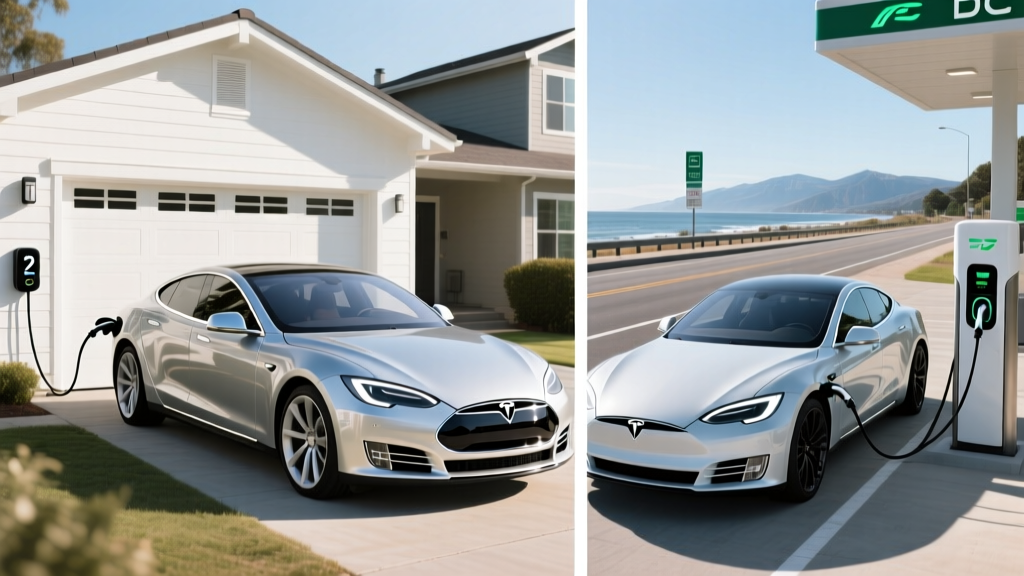
The Tesla Model S Long Range pairs a 100 kWh (usable) battery pack with dual motors producing 670 horsepower and a blistering 3.1-second 0-60 mph time. But owning one of the quickest production sedans on the road means solving the infrastructure side of the equation: how do you keep 402 miles of EPA-rated range topped up without wasting time or money? This guide walks through every charging option for the Model S Long Range — from a basic 120V outlet to Tesla's V4 Supercharger network — with exact kW figures, install costs, and real-world charge-curve behavior you won't find on a spec sheet.
Understanding Charging Levels: kW Power vs. kWh Energy
Before plugging in, one distinction matters more than any other: kW (kilowatts) measures power — the rate at which electricity flows into your car. kWh (kilomatt-hours) measures energy — the total capacity of your battery. Think of kW as the width of a hose and kWh as the size of the bucket. A wider hose (higher kW) fills the bucket faster.
The Model S Long Range's 100 kWh battery is the bucket. Your charger's kW rating determines how quickly you fill it. Here's what each level delivers in practice:
| Level | Voltage / Amperage | Max Power (kW) | Miles of Range Added Per Hour | Typical Use Case |
|---|---|---|---|---|
| Level 1 | 120V / 12A | ~1.4 kW | 3–5 mi/hr | Emergency top-up, overnight trickle |
| Level 2 | 240V / 48A | 11.5 kW | 30–44 mi/hr | Daily home charging, workplace |
| DC Fast Charge | 400V+ / variable | 250 kW peak | ~200 mi in 15 min | Road trips, rapid top-up |
The Model S Long Range's onboard charger accepts up to 11.5 kW on Level 2 (48 amps at 240V). On DC fast charging via the NACS (North American Charging Standard) connector, it can peak at 250 kW at a V3 or V4 Supercharger — though as with all EVs, that peak is not sustained across the entire session.
How Fast Will Each Level Charge the Model S Long Range?
Real-world charge times depend on starting state of charge (SoC), battery temperature, and the charger's actual output. Tesla's thermal management system preconditions the battery when you navigate to a Supercharger, warming or cooling the pack to optimize charge acceptance. Without preconditioning — for example, at a non-Tesla DC charger using an adapter — peak rates may be lower.
Level 1 (120V, 1.4 kW): A full 10–100% charge would take roughly 70+ hours. This is only practical for recovering 30–40 miles overnight if you're stranded without Level 2 access.
Level 2 (240V, 11.5 kW): Charging from 10% to 80% takes approximately 6 hours. A full 10–100% session takes about 8.5 hours. This is the sweet spot for overnight home charging — plug in when you get home, wake up to a full battery.
DC Fast Charge (250 kW peak, Supercharger V3/V4): From 10% to 80%, expect approximately 25–30 minutes with a preconditioned battery. The charge curve tapers significantly above 80% — charging from 80–100% can take nearly as long as 10–80%. For road trips, the most time-efficient strategy is to charge to 80% and move on to the next stop rather than waiting for a full battery.
Home Charger Installation: Electrical Requirements and Costs
The single most important upgrade for any Model S owner is a dedicated Level 2 home charging circuit. Here's what's involved electrically:
- Circuit: A dedicated 60-amp breaker is recommended to deliver a continuous 48 amps (EV chargers are considered continuous loads under NEC, meaning the breaker must be rated at 125% of the load).
- Wiring: 6 AWG copper wire (or 4 AWG aluminum) run from your electrical panel to the charger location.
- Voltage: 240V, single-phase — the same type of circuit as an electric dryer or oven.
- Panel capacity: Your main electrical panel must have sufficient spare capacity. Most modern homes with 200-amp service can accommodate a 60A EV circuit without a panel upgrade. Older homes with 100A service may require a panel upgrade ($1,500–$3,000+).
- Permit: Most jurisdictions require an electrical permit for a new 240V circuit, typically $50–$200 depending on your municipality.
How Much Does It Cost to Install a Home EV Charger?
| Cost Component | Simple Install (panel nearby, short wire run) | Complex Install (long run, conduit, sub-panel) |
|---|---|---|
| Level 2 Charger Equipment | $400–$600 | $400–$750 |
| Electrician Labor | $400–$800 | $1,000–$2,500 |
| Permit & Inspection | $50–$150 | $100–$250 |
| Panel Upgrade (if needed) | $0 | $1,500–$3,500 |
| Total Range | $850–$1,550 | $3,000–$7,000 |
The wide range reflects real-world variables. A 2026 Tesla Wall Connector costs $475 and delivers up to 11.5 kW (48A) with a 24-foot cable. If your panel is in the garage next to where you park, total installed cost often falls under $1,500. If you need 80 feet of conduit run to a detached garage or your panel is maxed out, costs climb substantially.
What Electrical Upgrades Might I Need?
Before hiring an electrician, check your panel's amp rating and available breaker slots. Red flags that signal a panel upgrade:
- Your main breaker reads 100A or less
- No available double-pole breaker slots
- Your electrician's load calculation shows the panel is already near capacity
- Your home has a Federal Pacific or Zinsco panel (known safety hazards that insurers may flag)
If a full panel upgrade isn't feasible, consider a smart load-management system like the Emporia VUE or SPAN smart panel, which dynamically limits charger draw to keep total household load within your panel's capacity. This avoids a costly upgrade while still delivering adequate charging speed.
Connector Compatibility: NACS and Beyond
The Model S Long Range uses the NACS (North American Charging Standard) connector — Tesla's proprietary design, now adopted as an industry standard. As of 2026, the Model S ships with a native NACS port, meaning no adapter is needed at Tesla Superchargers or at the growing number of non-Tesla networks (Electrify America, EVgo, ChargePoint) that have deployed NACS-equipped stalls.
| Connector Type | Compatibility with Model S Long Range | Adapter Needed? |
|---|---|---|
| NACS (Tesla native) | Native — all Superchargers, growing non-Tesla networks | No |
| CCS1 | Compatible with Tesla CCS adapter (included with newer vehicles or ~$175 separately) | Yes — CCS-to-NACS adapter |
| CHAdeMO | Largely obsolete in North America; no official Tesla adapter available in 2026 | N/A — avoid |
| J1772 (Level 2 public) | Compatible with Tesla J1772 adapter (included with vehicle) | Yes — J1772-to-NACS adapter (included) |
For home Level 2 charging, the Tesla Wall Connector uses a native NACS plug. If you want flexibility to charge a non-Tesla EV in the future, consider a charger with a J1772 connector and use the Tesla adapter, or choose a charger like the Lectron V-Box Pro that ships with interchangeable connector options.
Charging Cost Per Mile: Electricity vs. Gasoline
The Model S Long Range achieves an EPA-rated 120 MPGe combined, translating to roughly 30 kWh per 100 miles (or 3.3 miles per kWh). Here's what that costs in real scenarios compared to a comparable gas sedan getting 25 MPG combined:
| Charging Scenario | Rate ($/kWh) | Cost per 100 Miles | Cost per Mile |
|---|---|---|---|
| Home (off-peak utility rate) | $0.10–$0.14 | $3.00–$4.20 | $0.03–$0.04 |
| Home (standard residential rate) | $0.15–$0.20 | $4.50–$6.00 | $0.05–$0.06 |
| Public Level 2 (ChargePoint, etc.) | $0.25–$0.49 | $7.50–$14.70 | $0.08–$0.15 |
| Tesla Supercharger (V3/V4) | $0.28–$0.48 | $8.40–$14.40 | $0.08–$0.14 |
| Gas equivalent (25 MPG, $3.40/gal) | N/A | $13.60 | $0.14 |
At home on off-peak rates, the Model S Long Range costs roughly $0.03–$0.04 per mile to fuel — less than one-quarter the cost of a comparable gas sedan. Even on Tesla Superchargers at peak pricing, the cost per mile is roughly equivalent to gasoline. The savings are most dramatic when charging at home on a time-of-use (TOU) utility plan that offers overnight rates below $0.12/kWh.
Recommended Level 2 Chargers for the Model S Long Range
Since the Model S onboard charger maxes out at 11.5 kW (48A), you don't need an 80A charger — but you do want a reliable unit that can sustain 48A continuously, night after night. Here are top picks for 2026:
Tesla Wall Connector (Gen 4)
- Power Output: Up to 11.5 kW (48A at 240V)
- Connector: Native NACS — no adapter needed
- Cable Length: 24 feet
- Smart Features: Wi-Fi, OTA updates, power sharing between multiple units, access control via Tesla app
- Price: $475
- Best For: Tesla-only households wanting seamless integration
ChargePoint Home Flex
- Power Output: Up to 12 kW (50A at 240V) — adjustable down to 16A
- Connector: J1772 (use included Tesla adapter) or NACS version
- Cable Length: 23 feet
- Smart Features: Wi-Fi, ChargePoint app scheduling, Alexa integration, energy reporting
- Price: $599–$649
- Best For: Multi-EV households or future-proofing for non-Tesla EVs
Emporia Level 2 EV Charger
- Power Output: Up to 11.5 kW (48A at 240V)
- Connector: J1772 (Tesla adapter included) or NACS
- Cable Length: 24 feet
- Smart Features: Wi-Fi, Emporia app, integration with Emporia VUE energy monitor, solar-aware charging
- Price: $399
- Best For: Budget-conscious buyers with solar panels or energy monitoring
All three units are NEMA 4 rated for indoor/outdoor use and include built-in GFCI protection. The Tesla Wall Connector is the obvious default for a Model S-only garage, but the ChargePoint Home Flex earns its keep if you anticipate adding a non-Tesla EV to the household.
Safety and Electrical Code Considerations
EV charging involves sustained high-current draw — often 8+ hours at 48 amps. This isn't the same as running a dryer for 45 minutes. Key safety and code requirements include:
- Dedicated circuit: Your Level 2 charger must have its own dedicated double-pole breaker — never share a circuit with other appliances.
- GFCI protection: NEC 2023 (Article 625) requires GFCI protection for EV charging outlets. Most hardwired Level 2 chargers (including the Tesla Wall Connector) have built-in GFCI. If using a plug-in charger on a NEMA 14-50 receptacle, your electrician must install a GFCI breaker.
- Outdoor rating: If your charger is mounted outside, ensure it's rated NEMA 4 (weatherproof). All three chargers recommended above meet this standard.
- Wire gauge and conduit: Your electrician will size wire based on run length. Runs over 50 feet may require upsizing to 4 AWG copper to prevent voltage drop.
- Load calculation: Per NEC 220, your electrician must perform a whole-house load calculation to confirm your panel can handle the added continuous load.
Always hire a licensed electrician familiar with NEC Article 625 (Electric Vehicle Charging System Equipment). Ask whether they've installed EV chargers before — it's a specialized enough task that general electricians sometimes make errors with continuous-load calculations or GFCI requirements.
Real-World Charging Tips for Model S Long Range Owners
Beyond the hardware, a few operational habits make a significant difference in battery longevity and charging convenience:
- Daily charge limit: Tesla recommends setting the charge limit to 80–90% for daily driving and reserving 100% for road trips. This reduces stress on the NMC battery cells and slows long-term degradation.
- Scheduled charging: Use the Tesla app to schedule charging during off-peak utility hours (typically 11 PM–7 AM). This can cut your electricity cost by 30–50% compared to peak rates.
- Preconditioning for Superchargers: When you navigate to a Supercharger in the Tesla navigation system, the car automatically begins preconditioning the battery. This can shave 5–10 minutes off your charge session by ensuring the pack is at optimal temperature when you arrive.
- Avoid repeated DC fast charging to 100%: DC fast charging generates significant heat. Occasional use is fine, but relying on it exclusively accelerates battery degradation. Home Level 2 charging is gentler on the pack.
- Cold-weather strategy: In sub-freezing climates, plug in whenever possible — even if not charging. The Model S uses grid power to maintain battery temperature, preserving range and ensuring regenerative braking is available immediately.
Frequently Asked Questions
How much does it cost to install a home EV charger for the Model S?
A straightforward Level 2 installation with a Tesla Wall Connector typically costs $850–$1,550 total (equipment + electrician + permit). Complex installs requiring long wire runs, conduit, or a panel upgrade can range from $3,000–$7,000. Get at least two quotes from licensed electricians familiar with EV charger installs.
How fast will each charging level add range to my Model S Long Range?
Level 1 (120V) adds roughly 3–5 miles per hour. Level 2 (240V, 48A) adds approximately 30–44 miles per hour. DC fast charging at a Tesla Supercharger can add up to 200 miles in about 15 minutes, though charge speed tapers significantly above 80% SoC.
Which connector is compatible with the Model S Long Range?
The Model S uses the NACS connector natively. This works at all Tesla Superchargers and an increasing number of non-Tesla networks. For CCS1 public chargers, you'll need the Tesla CCS adapter ($175 or included with newer vehicles). A J1772 adapter (included with the car) handles public Level 2 stations.
How much does charging cost per mile vs. gasoline?
Charging at home on off-peak rates costs roughly $0.03–$0.04 per mile — about one-quarter the cost of gasoline at $3.40/gallon in a 25 MPG sedan ($0.14/mile). Even at Tesla Supercharger rates of $0.28–$0.48/kWh, the Model S costs approximately $0.08–$0.14 per mile, competitive with gasoline.
What electrical upgrades might I need for a Level 2 charger?
You'll need a dedicated 60-amp, 240V circuit with 6 AWG copper wiring. If your home has a 100-amp electrical panel, limited breaker slots, or an outdated panel (Federal Pacific, Zinsco), you may need a panel upgrade costing $1,500–$3,500. A licensed electrician's load calculation will determine this.
Does the Model S Long Range qualify for the federal EV tax credit?
As of 2026, the Tesla Model S Long Range (MSRP starting at $79,990) exceeds the IRS §30D sedan price cap of $55,000 and does not qualify for the $7,500 federal tax credit. Additionally, buyer income caps apply ($150K single / $300K joint). Check current rules at IRS.gov before purchasing, as regulations may shift.
What's the battery warranty on the Model S Long Range?
Tesla covers the battery and drive unit for 8 years or 150,000 miles, whichever comes first, with a minimum 70% capacity retention guarantee. Based on industry degradation data, most Model S packs retain 88–92% capacity after 100,000 miles — well above the warranty threshold.