Quick Verdict: What Model 3 Long Range RWD Owners Need to Know About Charging
The 2025 Tesla Model 3 Long Range Rear Wheel Drive pairs a ~79 kWh usable NMC battery with an EPA-estimated 363 miles of range and a NACS (North American Charging Standard) port that unlocks the Supercharger network natively. For most owners, the optimal home setup is a 48-amp (11.5 kW) Level 2 wall connector on a dedicated 60-amp, 240V circuit — adding roughly 44 miles of range per hour of charging and replenishing the battery from 10% to 80% overnight in about 7–8 hours. On the road, the Model 3 Long Range RWD peaks at around 250 kW at V3 Superchargers, hitting 10–80% in approximately 25–28 minutes under ideal conditions, with a pronounced taper above 80% that makes charging to 100% inefficient on road trips.
Charging Levels Explained: Speeds, kW, and Miles Per Hour
Understanding the three charging tiers is essential before investing in equipment. The critical distinction: kW (kilowatts) measures power — the rate at which energy flows into your battery. kWh (kilowatt-hours) measures energy — the total capacity stored. Think of kW as the width of a hose and kWh as the size of the tank.
| Level | Voltage / Amps | Max Power (kW) | Miles of Range Per Hour | Best For |
|---|---|---|---|---|
| Level 1 (120V) | 120V / 12A | ~1.4 kW | ~3–5 mi/hr | Emergency / overnight trickle |
| Level 2 (240V) | 240V / 48A | 11.5 kW | ~44 mi/hr | Daily home charging |
| DC Fast (V3 Supercharger) | 400V architecture | 250 kW peak | ~170 mi in 15 min | Road trips |
The Model 3 Long Range RWD's onboard charger accepts up to 11.5 kW (48 amps) on Level 2 AC power. Plugging into a lower-amperage Level 2 unit — say, a 32-amp (7.7 kW) charger — will still work but adds range more slowly, at roughly 30 miles per hour. On DC fast charging, the 250 kW peak is only sustained briefly at low state of charge (SoC); the charge curve tapers significantly above 50% SoC and drops sharply past 80%. This is why 10–80% time is the industry-standard metric, not 0–100%.
Home Charging Installation: Electrical Requirements and Costs
Installing a Level 2 home charger for your Model 3 Long Range RWD involves more than buying a wall unit. You need a dedicated circuit, proper wiring, and in many cases, a permit and inspection. Here is what the electrical side looks like for a full-speed 48-amp setup:
- Circuit requirement: 60-amp dedicated breaker (NEC code requires circuits to be rated at 125% of the continuous load; 48A × 1.25 = 60A)
- Wire gauge: 6 AWG copper (or 4 AWG aluminum) for runs up to ~100 feet; larger gauge for longer runs to prevent voltage drop
- Voltage: 240V single-phase, standard US residential split-phase
- Panel capacity: Your main electrical panel must have room for a 60-amp double-pole breaker AND sufficient total load capacity. Most modern 200-amp panels can accommodate this; older 100-amp panels often cannot.
Installation Cost Breakdown
Costs vary significantly based on your home's electrical infrastructure, the distance from panel to charger location, and local labor rates. Below are realistic 2025–2026 ranges based on national electrician averages:
| Component | Simple Install (panel nearby, 200A) | Complex Install (long run or panel upgrade) |
|---|---|---|
| EVSE Equipment (Tesla Wall Connector) | $400–$500 | $400–$500 |
| Electrician Labor (2–4 hrs simple / 6–10 hrs complex) | $400–$800 | $1,200–$2,500 |
| Materials (wire, conduit, breaker) | $100–$300 | $300–$800 |
| Permit & Inspection | $50–$200 | $100–$350 |
| Panel Upgrade (100A → 200A, if needed) | N/A | $1,500–$3,500 |
| Total Estimated Cost | $950–$1,800 | $3,500–$7,650 |
Homes built after 2000 with a 200-amp panel and a garage adjacent to the panel typically fall in the simple-install range. Pre-1980 homes with 100-amp service, or installations requiring a 60+ foot wire run through finished walls, push costs toward the complex end. Always get at least two quotes from licensed electricians and confirm they pull a permit — unpermitted work can void home insurance coverage and create a fire risk.
Connector Compatibility: NACS, CCS, and Adapter Needs
The 2025 Model 3 Long Range RWD comes equipped with a native NACS (J3400) charge port. This is Tesla's proprietary connector, now adopted industry-wide as the North American Charging Standard. Here is what that means for compatibility:
| Connector Type | Native Compatibility? | Adapter Needed? | Notes |
|---|---|---|---|
| NACS (Tesla) | Yes — native | No | Tesla Superchargers, Tesla Wall Connector, third-party NACS chargers |
| CCS1 | No | NACS-to-CCS adapter (~$200–$250) | Required for Electrify America, some ChargePoint/IONITY stations |
| CHAdeMO | No | NACS-to-CHAdeMO adapter (~$300+) | Rare and phasing out; not recommended to invest in |
| J1772 (Level 2 public) | No | Tesla J1772 adapter (included with car) | Hotels, workplaces, public Level 2 stations |
For daily home charging, the Tesla Wall Connector uses NACS natively, so no adapter is needed. On road trips, Tesla's Supercharger network covers the vast majority of DC fast-charging needs. However, carrying a CCS adapter is smart for redundancy — particularly in areas where Electrify America stations outnumber Superchargers or when Supercharger stalls are occupied.
Cost to Charge: Home vs. Public vs. Gas Comparison
One of the strongest ownership arguments for the Model 3 Long Range RWD is fuel cost savings, but the math depends heavily on where and when you charge. Using the EPA-rated efficiency of approximately 25 kWh/100 miles (4 miles per kWh) for the Long Range RWD, here is what charging costs look like across scenarios:
| Scenario | Rate | Cost Per kWh | Cost Per Mile | Annual Cost (12,000 mi) |
|---|---|---|---|---|
| Home — Off-Peak TOU (utility rate) | $0.08–$0.12/kWh | $0.10 avg | $0.025 | $300 |
| Home — Standard Rate (no TOU) | $0.14–$0.18/kWh | $0.16 avg | $0.040 | $480 |
| Public Level 2 (ChargePoint, etc.) | $0.25–$0.49/kWh | $0.35 avg | $0.088 | $1,056 |
| Tesla Supercharger V3 (DC fast) | $0.28–$0.42/kWh | $0.35 avg | $0.088 | $1,056 |
| Gas Car (30 MPG combined, $3.50/gal) | — | — | $0.117 | $1,404 |
Home charging on a time-of-use (TOU) plan delivers the lowest per-mile cost — roughly a quarter of what a 30 MPG gas car spends on fuel. Even at standard residential rates without TOU optimization, you save significantly. Public DC fast charging narrows the gap but still undercuts gasoline. The key takeaway: if you can charge at home, the Model 3 Long Range RWD saves $900–$1,100 per year in fuel costs compared to a comparable gas sedan.
Recommended Home Charging Equipment for the Model 3 Long Range RWD
Not all Level 2 chargers deliver the same power, cable management, or smart features. The Model 3's 11.5 kW onboard charger means you want at least a 48-amp unit to capture the full charging speed. Here are three strong options:
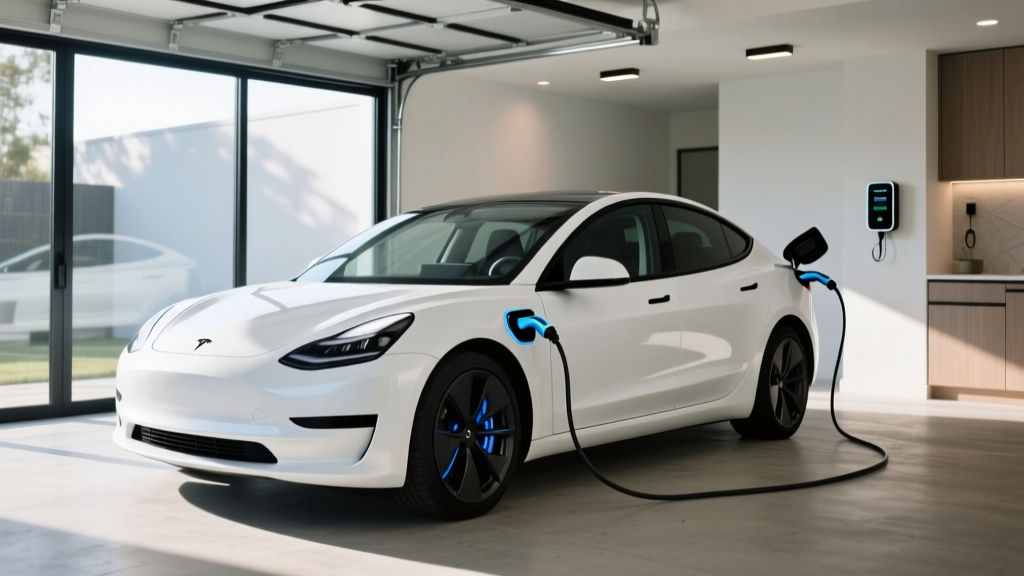
Tesla Wall Connector (Gen 3)
- Power Output: 11.5 kW (48A)
- Connector: NACS (native)
- Cable Length: 24 feet
- Smart Features: Wi-Fi, OTA updates, power sharing (link multiple units on one circuit), load management
- Price: ~$400–$475
- Why: Seamless Tesla integration, best-in-class for Tesla-only households, supports power sharing if you add a second EV later.
ChargePoint Home Flex
- Power Output: Up to 12 kW (50A) — configurable down to match your circuit
- Connector: NACS (2025+ models) or J1772 with adapter
- Cable Length: 23 feet
- Smart Features: Wi-Fi, app scheduling, Alexa integration, energy tracking
- Price: ~$550–$650
- Why: Flexible amperage configuration works with panels that can't support a full 60A circuit; great for mixed-EV households.
Emporia Vue with EV Charger
- Power Output: Up to 11.5 kW (48A)
- Connector: NACS or J1772 (configurable)
- Cable Length: 24 feet
- Smart Features: Whole-home energy monitoring integration, solar-aware charging, app control
- Price: ~$500–$600 (charger) + $200–$400 (Vue panel monitor)
- Why: Ideal for solar owners who want to charge only on excess production; provides full home energy visibility.
For a Tesla-only household, the Tesla Wall Connector is the default recommendation — it is purpose-built, competitively priced, and requires no adapter. The ChargePoint Home Flex earns its place for homes with limited panel capacity (you can set it to 32A or 40A without swapping hardware) or mixed-fleet garages.
Safety, Code, and Electrical Panel Considerations
EV charging is a continuous high-draw electrical load — comparable to running a large electric oven for 8 hours straight. Safety and code compliance are non-negotiable:
- Dedicated circuit: Your Level 2 charger must be on its own dedicated breaker. Sharing a circuit with other appliances is a code violation and a fire hazard.
- GFCI protection: The 2020 and 2023 NEC require GFCI protection for EV outlets (NEMA 14-50 receptacles). Hardwired installations (like the Tesla Wall Connector) are exempt from GFCI in many jurisdictions since the EVSE itself includes ground-fault protection — but confirm with your local inspector.
- Outdoor rating: If your charger is installed outside (driveway, carport), the unit must be NEMA 4-rated for weather resistance. The Tesla Wall Connector and ChargePoint Home Flex both carry outdoor ratings.
- Panel load calculation: A licensed electrician should perform a NEC Article 220 load calculation before adding a 60-amp circuit. If your panel is already near capacity (common with electric ranges, dryers, and HVAC on a 100-amp panel), you may need a panel upgrade or a smart load-management device like the Emporia Smart Load Manager or Tesla's built-in power sharing.
- Permit and inspection: Nearly all US jurisdictions require an electrical permit for EV charger installation. The inspection ensures proper wire gauge, breaker sizing, grounding, and bonding. Skipping this step risks insurance claim denial in the event of an electrical fire.
DC Fast Charging Times and the Charge Curve Reality
On a Tesla V3 Supercharger (250 kW peak), the Model 3 Long Range RWD's charging session looks roughly like this under optimal conditions (battery preconditioned, 10% starting SoC, moderate ambient temperature):
- 10–30%: ~7 minutes (peak ~250 kW)
- 30–50%: ~7 minutes (tapering to ~180–200 kW)
- 50–80%: ~11 minutes (tapering to ~80–120 kW)
- Total 10–80%: ~25–28 minutes, adding approximately 250 miles of range
- 80–100%: ~25+ additional minutes (tapers to under 30 kW) — avoid unless necessary
This charge curve is why road-trip strategy focuses on 10–80% sessions. Charging past 80% at a DC fast charger is so slow that you are better off driving to the next station. Tesla's navigation system automatically preconditions the battery when you navigate to a Supercharger — warming it to the optimal temperature for fast charging. Skipping preconditioning (by driving to a charger without navigating to it) can add 5–10 minutes to your session, especially in cold weather. According to fueleconomy.gov, the 2025 Model 3 Long Range RWD achieves 132 MPGe combined, translating to roughly 25 kWh per 100 miles.
Frequently Asked Questions
How much does it cost to install a home EV charger for the Model 3 Long Range RWD?
Expect $950–$1,800 for a straightforward installation on an existing 200-amp panel with the charger located near the panel. Costs rise to $3,500–$7,650 if you need a panel upgrade (100A to 200A), long wire runs through finished walls, or trenching for a detached garage. The Tesla Wall Connector itself costs around $400–$475.
How fast will each charging level add range to my Model 3?
Level 1 (120V standard outlet): approximately 3–5 miles of range per hour — only practical for emergency top-ups or very low-mileage drivers. Level 2 (240V, 48A): approximately 44 miles of range per hour — fully replenishes a daily commute overnight. DC fast charging (V3 Supercharger, 250 kW): adds roughly 170 miles in 15 minutes at peak speed, tapering as the battery fills.
Which connector and charger is compatible with the Model 3 Long Range RWD?
The 2025 Model 3 uses a native NACS (J3400) charge port. Tesla Superchargers and the Tesla Wall Connector plug in directly with no adapter. For CCS1 stations (Electrify America, EVgo), you need a NACS-to-CCS adapter ($200–$250). A J1772 adapter is included with the car for public Level 2 stations at hotels and workplaces.
How much does charging cost per mile compared to gasoline?
At home on an off-peak utility rate (~$0.10/kWh), the Model 3 Long Range RWD costs about $0.025 per mile — roughly 78% cheaper than a 30 MPG gas car at $3.50/gallon ($0.117/mile). Even at public Supercharger rates (~$0.35/kWh), you pay about $0.088 per mile, still a 25% savings over gasoline. Annual savings for 12,000 miles of driving range from $350 (all Supercharger) to $1,100 (all home off-peak).
What electrical upgrades might I need before installing a Level 2 charger?
The most common upgrade is a panel capacity increase from 100 amps to 200 amps ($1,500–$3,500), required when your existing panel cannot safely support a new 60-amp circuit alongside existing loads. Other potential upgrades include adding a sub-panel in the garage, running new conduit for long wire distances, or installing a smart load-management system to share capacity between the EV charger and other high-draw appliances. A licensed electrician can assess your panel with a NEC Article 220 load calculation.
Does the Model 3 Long Range RWD qualify for the federal EV tax credit?
Under IRS §30D rules, the Tesla Model 3 Long Range RWD may qualify for up to $7,500 in federal tax credits, subject to battery sourcing and critical minerals requirements that change annually. Buyer income caps apply ($150K single / $300K joint), and the vehicle MSRP must be under $55,000 for sedans. The credit can be transferred to the dealer at point of sale as an immediate price reduction. Verify current-year eligibility on the IRS website or with a tax professional before purchasing, as sourcing rules tighten each year.