If you have just taken delivery of a 2026 Tesla Model 3 Long Range — or are about to — the first question after marveling at the 4.1-second 0-60 mph time is usually: how do I actually charge this thing at home? The Model 3 Long Range pairs a blistering dual-motor powertrain with an EPA-rated 342 miles of range and a roughly 79 kWh (usable) LFP or NMC battery pack, depending on the production batch Tesla is shipping this quarter. But none of that matters if your home charging setup leaves you waiting 40 hours on a 120V outlet.
This guide bridges the gap between the spec sheet and your garage wall. We will walk through every charging level, the real electrical work your house may need, what a home install actually costs in 2026, and the exact equipment that pairs best with the Model 3 Long Range's NACS charge port and 11.5 kW onboard AC charger.
Tesla Model 3 Long Range: Performance and Battery Specs at a Glance
| Spec | Figure |
|---|---|
| EPA Range | 342 miles |
| Real-World Highway (70 mph, mild weather) | ~295–310 miles |
| Real-World Cold (30°F, highway) | ~255–275 miles |
| Battery (usable) | ~79 kWh, NMC |
| 0-60 mph | 4.1 seconds |
| Peak Horsepower | ~346 hp combined |
| Max DC Fast Charge Rate | 250 kW peak (V3 Supercharger) |
| 10–80% DC Fast Charge | ~27 minutes |
| Onboard AC Charger | 11.5 kW (48A max) |
| Charge Port | NACS (native Tesla) |
| EPA Efficiency | 132 MPGe combined |
| Base MSRP | ~$47,740 (before incentives) |
| Powertrain / Battery Warranty | 8 years / 120,000 miles |
The model 3 long range 0 60 figure of 4.1 seconds is a headliner, but the more relevant daily metric is efficiency: 132 MPGe combined means roughly 25–27 kWh per 100 miles in mixed driving. That efficiency number is what lets us calculate real charging costs later.
Charging Levels Explained: kW, Miles Per Hour, and Real Timelines
The single most important distinction in EV charging is between kW (kilowatts), which measures power — how fast energy flows — and kWh (kilowatt-hours), which measures energy — how much the battery holds. Think of kW as the width of a hose and kWh as the size of the bucket. The Model 3 Long Range's bucket is ~79 kWh; the hose size depends on your charger.
| Level | Voltage / Amps | Max Power (kW) | Miles of Range Per Hour | 10–80% Time (Model 3 LR) |
|---|---|---|---|---|
| Level 1 (standard outlet) | 120V / 12A | ~1.4 kW | ~3–5 mi/hr | ~55+ hours (impractical) |
| Level 2 (home / public AC) | 240V / 48A | 11.5 kW | ~38–44 mi/hr | ~6.5 hours |
| DC Fast (Tesla V3 Supercharger) | 400V+ DC | 250 kW peak | ~1,000+ mi/hr (peak) | ~27 minutes |
| DC Fast (Tesla V4 Supercharger) | 800V DC | 350 kW peak* | ~1,200+ mi/hr (peak) | ~20 minutes* |
*V4 Supercharger times assume a compatible vehicle architecture; the current Model 3 Long Range is limited by its ~400V pack and will not pull a sustained 350 kW.
For daily ownership, Level 2 at home is where 90%+ of your charging will happen. Plug in when you get home, wake up to a full battery. Level 1 is only viable as an emergency trickle or for PHEVs with small packs. DC fast charging is for road trips — it is faster, more expensive per kWh, and repeated exclusive use accelerates battery degradation slightly over years.
Home Charger Installation: Electrical Requirements and Real Costs
To unlock the Model 3 Long Range's full 11.5 kW AC charging capability, you need a 240V circuit rated for at least 60 amps (EV chargers are considered continuous loads under NEC Article 625, so the circuit must be rated 125% of the charger's max draw — a 48A charger needs a 60A breaker).
What Your Electrical Panel Needs to Support
- Panel capacity: A modern 200A main panel is typically sufficient. Homes with 100A service — common in pre-1980 construction — will almost certainly need a panel upgrade or a load-management device.
- Dedicated circuit: The EV charger must have its own dedicated double-pole breaker. No sharing with dryers or ranges.
- Wire gauge: 6 AWG copper for a 60A circuit over typical residential runs (under ~100 ft). Longer runs may require 4 AWG to minimize voltage drop.
- GFCI protection: NEC 2020 and later require GFCI protection for EV outlets in garages. Hardwired chargers bypass this requirement and are generally preferred for reliability.
- Permit: Nearly every jurisdiction requires an electrical permit for a new 240V circuit. Your electrician typically pulls this; expect an inspection afterward.
Installation Cost Breakdown (2026 National Averages)
| Component | Simple Install (panel adjacent) | Complex Install (long run / panel upgrade) |
|---|---|---|
| Level 2 Charger (hardware) | $400 – $700 | $400 – $700 |
| Electrician labor (2–4 hrs simple / 6–10 hrs complex) | $600 – $1,200 | $1,800 – $3,500 |
| Materials (wire, conduit, breaker) | $150 – $400 | $400 – $1,000 |
| Permit & inspection | $100 – $300 | $150 – $500 |
| Panel upgrade (100A → 200A, if needed) | N/A | $2,000 – $4,500 |
| Total | $1,250 – $2,600 | $4,750 – $10,200 |
The wide range reflects a real split: if your panel is in the garage and has spare capacity, a clean hardwired install can be done in an afternoon for under $2,000 all-in. If you are running 80 feet of conduit from a basement panel to a detached garage, or your panel is maxed out, costs climb fast. Get three quotes from licensed electricians who have specific EV charger experience — ask for references from prior EV installs.
Some utilities offer rebates of $250–$1,000 for Level 2 installations, and a few states provide additional incentives. Check with your local utility and the Alternative Fuels Data Center for current programs in your zip code.
Connector Compatibility: NACS, CCS, and What the Model 3 Needs
The 2026 Tesla Model 3 Long Range ships with a native NACS (North American Charging Standard) port — the same connector Tesla has used since 2012 and that most major automakers have now adopted. This means:
- Tesla Superchargers: plug in directly, no adapter needed.
- Non-Tesla DC fast chargers (Electrify America, EVgo, etc.): most new stations now include NACS cables. Older CCS-only stations require a CCS-to-NACS adapter.
- Level 2 public chargers (ChargePoint, Blink, etc.): you will need a J1772-to-NACS adapter, which Tesla includes in the glovebox with every new Model 3.
| Connector | Used By | Model 3 LR Compatibility |
|---|---|---|
| NACS (Tesla) | Tesla, Ford, GM, Rivian, Hyundai, others (2025+) | Native — no adapter |
| CCS1 | Legacy non-Tesla DC chargers | CCS-to-NACS adapter required |
| CHAdeMO | Nissan Leaf (legacy), some older stations | No adapter available — avoid |
| J1772 | All non-Tesla Level 2 public chargers | J1772-to-NACS adapter (included with car) |
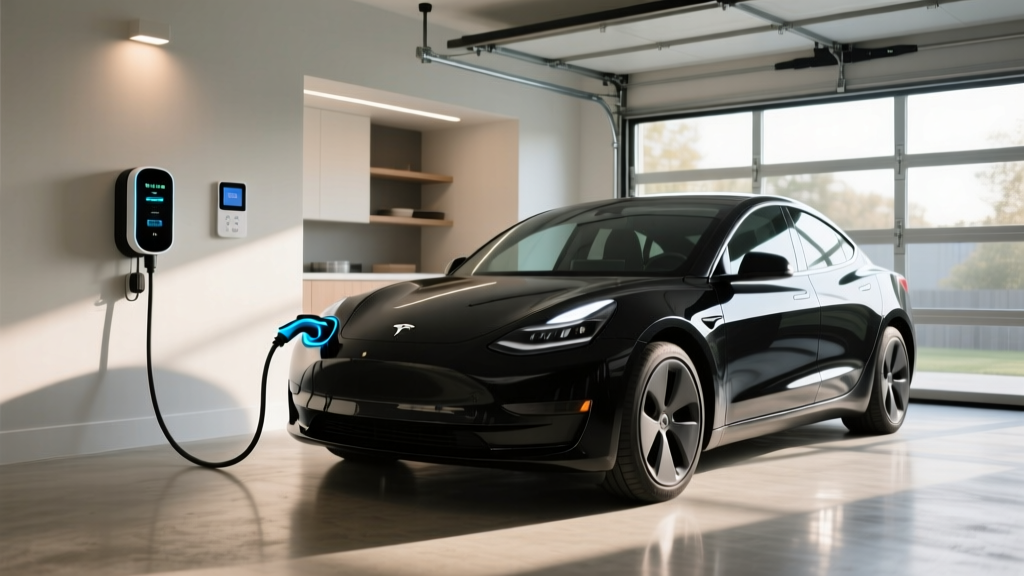
For home charging, you will install a NACS-connector wall unit (Tesla Wall Connector or a third-party NACS charger) and plug in directly. No adapters needed in your own garage.
Equipment Picks: Best Home Chargers for the Model 3 Long Range
Since the Model 3 Long Range's onboard charger maxes out at 11.5 kW (48A), any 48A or higher-rated Level 2 unit will extract maximum speed. Here are three proven options for 2026:
Tesla Wall Connector (Gen 3)
- Power Output: 11.5 kW (48A) at 240V
- Connector: NACS native
- Cable Length: 24 ft
- Smart Features: Wi-Fi, OTA firmware updates, Tesla app integration, load sharing between multiple units
- Price: ~$475
- Best For: Tesla-only households wanting seamless integration
ChargePoint Home Flex
- Power Output: Up to 12 kW (50A) — configurable 16A–50A
- Connector: J1772 (use included adapter for Model 3) or NACS version (2025+)
- Cable Length: 23 ft
- Smart Features: Wi-Fi, ChargePoint app, scheduling, energy tracking, Alexa integration
- Price: ~$599
- Best For: Multi-EV households (Tesla + non-Tesla) wanting flexible amperage
Emporia Level 2 EV Charger
- Power Output: 11.5 kW (48A) at 240V
- Connector: J1772 or NACS (select at purchase)
- Cable Length: 24 ft
- Smart Features: Wi-Fi, Emporia app, solar-integration scheduling, real-time energy monitoring
- Price: ~$399
- Best For: Budget-conscious buyers who still want smart scheduling and energy data
All three units are hardwirable (preferred) or plug into a NEMA 14-50 outlet. Hardwiring eliminates the GFCI breaker requirement and avoids the nuisance trips that 14-50 outlets sometimes cause with high-draw EV chargers.
Cost to Charge: Home vs. Public vs. Gas — The Real $/Mile Math
The Model 3 Long Range consumes roughly 26 kWh per 100 miles in mixed driving (per fueleconomy.gov). Here is what that costs across different charging scenarios compared to a comparable gas sedan getting 30 MPG combined:
| Scenario | Rate | Cost per 100 mi | Cost per Mile |
|---|---|---|---|
| Home (off-peak utility rate) | $0.09/kWh | $2.34 | $0.023 |
| Home (national avg residential) | $0.16/kWh | $4.16 | $0.042 |
| Public Level 2 (ChargePoint, etc.) | $0.25–$0.39/kWh | $6.50–$10.14 | $0.065–$0.101 |
| DC Fast (Tesla Supercharger avg) | $0.28–$0.36/kWh | $7.28–$9.36 | $0.073–$0.094 |
| DC Fast (Electrify America peak) | $0.43–$0.56/kWh | $11.18–$14.56 | $0.112–$0.146 |
| Gas sedan (30 MPG, $3.40/gal) | $3.40/gal | $11.33 | $0.113 |
At home on an off-peak rate, the Model 3 Long Range costs roughly one-fifth what a 30 MPG gas sedan costs per mile. Even on public DC fast chargers at average rates, you are saving 15–35% versus gas. Only the most expensive peak-rate public chargers approach gas-equivalent pricing.
If your utility offers time-of-use (TOU) rates, scheduling charging for overnight off-peak hours (typically 11 PM – 6 AM) is the single highest-ROI habit you can adopt as an EV owner. The Tesla app and all major smart chargers support scheduled charging natively.
Safety, Code, and the Panel-Upgrade Question
A few safety and code items deserve explicit attention because they show up as surprise costs or hazards:
- Never use an extension cord with a Level 2 charger — the sustained 48A draw generates heat at every connection point.
- Outdoor-rated equipment: If your charger mounts outside, it must carry a NEMA 4 (or IP65+) rating. All three units above qualify.
- Load management: If your panel is near capacity but a full upgrade is cost-prohibitive, devices like the Emporia VUE or a Tesla Wall Connector with load-sharing can dynamically reduce charger amperage when other circuits are drawing heavily. This is code-compliant in most jurisdictions and can avoid a $3,000+ panel upgrade.
- NEMA 14-50 outlet caution: If you choose a plug-in install rather than hardwired, use a commercial-grade outlet (Hubbell, Bryant) — residential-grade 14-50 receptacles have shown thermal failure under sustained EV charging loads.
- Permit and inspect: Unpermitted EV charger installs can void home insurance claims related to electrical fires. Always pull the permit.
Frequently Asked Questions
How much does it cost to install a home EV charger for a Model 3 Long Range?
For a straightforward install near a 200A panel with spare capacity, expect $1,250–$2,600 total (charger + electrician + permit). If your home needs a panel upgrade or a long conduit run, costs can reach $4,750–$10,200. Get multiple quotes from licensed electricians with EV-specific experience.
How fast will each charging level add range to the Model 3 Long Range?
Level 1 (120V) adds 3–5 miles per hour — essentially unusable for a 79 kWh battery. Level 2 at 48A (11.5 kW) adds 38–44 miles per hour, enough for a full overnight charge. DC fast charging at a V3 Supercharger peaks at roughly 1,000+ miles per hour of equivalent rate, delivering 10–80% in about 27 minutes.
Which connector is compatible with the 2026 Model 3 Long Range?
The Model 3 uses a native NACS port. Tesla Superchargers connect directly. For non-Tesla DC fast chargers still equipped with CCS cables, a CCS-to-NACS adapter is required. For Level 2 public stations with J1772 connectors, Tesla includes a J1772-to-NACS adapter in the vehicle.
How much does charging cost per mile compared to gas?
At the national average residential electricity rate ($0.16/kWh), the Model 3 Long Range costs about $0.04 per mile. A 30 MPG gas sedan at $3.40/gallon costs about $0.11 per mile. Home charging on off-peak rates drops to roughly $0.02/mile — one-fifth the cost of gas.
What electrical upgrades might my home need for a Level 2 charger?
The most common upgrade is a panel increase from 100A to 200A service ($2,000–$4,500) in older homes. You will definitely need a new dedicated 60A double-pole breaker and 6 AWG wire run. Homes with existing 200A panels and nearby garage locations often need nothing beyond the new circuit. A load-management device is an alternative if panel capacity is tight but a full upgrade is not justified.
Does the Model 3 Long Range qualify for the federal EV tax credit?
Under current IRS §30D rules, eligibility depends on MSRP caps (the Model 3 Long Range falls under the $55,000 sedan cap), buyer income limits ($150K single / $300K joint AGI), and battery critical-mineral and component sourcing requirements that tighten each year. The credit can now be transferred to the dealer at point of sale as an instant discount. Verify current-year eligibility on irs.gov or with a tax professional before relying on the credit in your purchase math.