If you've been searching for Model 3 free Supercharging, you've likely encountered a maze of outdated forum posts, expired promotions, and conflicting information. Here's the reality for 2026: Tesla no longer offers unlimited free Supercharging on new Model 3 purchases as a standard perk. The era of transferable lifetime free Supercharging ended years ago, and Tesla's promotional landscape has shifted toward referral-based credits, seasonal promotions, and inventory-specific incentives.
But that doesn't mean you can't score free or heavily discounted Supercharging miles — and more importantly, understanding the full charging ecosystem (home, destination, and DC fast charging) will save you far more money over the life of your Model 3 than any promotional credit ever could.
This guide breaks down exactly how to charge a Tesla Model 3 in 2026 — including whether free Supercharging credits are still obtainable, what home charging installation actually costs, and how your per-mile charging cost compares to gas.
Does Model 3 Free Supercharging Still Exist in 2026?
The short answer: not as a standard purchase incentive. Tesla discontinued unlimited free Supercharging on new Model 3 and Model Y orders back in 2019. Since then, the company has periodically offered limited-time promotions:
- Referral program credits: Tesla's referral program (accessible via the Tesla app) periodically awards Supercharging credits — typically 1,000 to 5,000 free Supercharging miles — when an existing owner refers a new buyer. Availability and amounts fluctuate by quarter and region.
- End-of-quarter inventory deals: Tesla has historically offered 10,000 miles of free Supercharging on in-stock or demo Model 3 vehicles during end-of-quarter pushes. These are unannounced until they appear on Tesla's website and expire quickly.
- Loyalty/upgrade credits: Existing Tesla owners trading in for a new Model 3 may occasionally receive Supercharging credits as a loyalty incentive, though this is not guaranteed.
Understanding Charging Levels: How Fast Does Each Add Range?
Before evaluating costs, you need to understand the three charging tiers available to your Model 3. The critical distinction: kW (kilowatts) measures power — how fast energy flows into your battery. kWh (kilowatt-hours) measures energy — the total capacity of your battery. Think of kW as the flow rate of a hose and kWh as the size of the bucket.
| Level | Voltage | Max Power (kW) | Miles of Range Added per Hour | Best Use Case |
|---|---|---|---|---|
| Level 1 (120V outlet) | 120V | 1.4–1.9 kW | 3–5 mi/hr | Emergency/overnight trickle for low-mileage drivers |
| Level 2 (240V home/public) | 240V | 7.2–11.5 kW | 25–44 mi/hr | Daily home charging, workplace, hotels |
| DC Fast Charging (Supercharger/CCS) | 400V+ | 170–250 kW (peak) | ~750–1,000 mi/hr (at peak) | Road trips, rapid top-ups |
The 2025–2026 Model 3 Long Range AWD features an ~82 kWh usable battery (NMC chemistry) with an EPA-estimated range of approximately 363 miles. The Rear-Wheel Drive trim carries a smaller ~60 kWh LFP (lithium iron phosphate) battery with roughly 272 miles of EPA range.
Charging Time Examples: 10–80% State of Charge
Most EV owners charge between 10% and 80% state of charge (SoC) for daily use and road trips, as charging slows significantly above 80% to protect battery health. Here's what that looks like for the Model 3:
- Level 1 (120V, ~1.5 kW): 10–80% on a Long Range (~57 kWh needed) takes roughly 38 hours. Impractical for anything beyond overnight trickle charging.
- Level 2 (240V, 48A/11.5 kW): 10–80% takes approximately 5–6 hours. Ideal for overnight charging — plug in at 10 PM, wake up fully charged.
- DC Fast Charge (V3 Supercharger, 250 kW peak): 10–80% in approximately 25–30 minutes. Note: the Model 3 peaks near 250 kW only between roughly 10–30% SoC, then tapers progressively. Sustained average power from 10–80% is closer to 120–150 kW.
Home Charger Installation: Requirements, Costs & Panel Upgrades
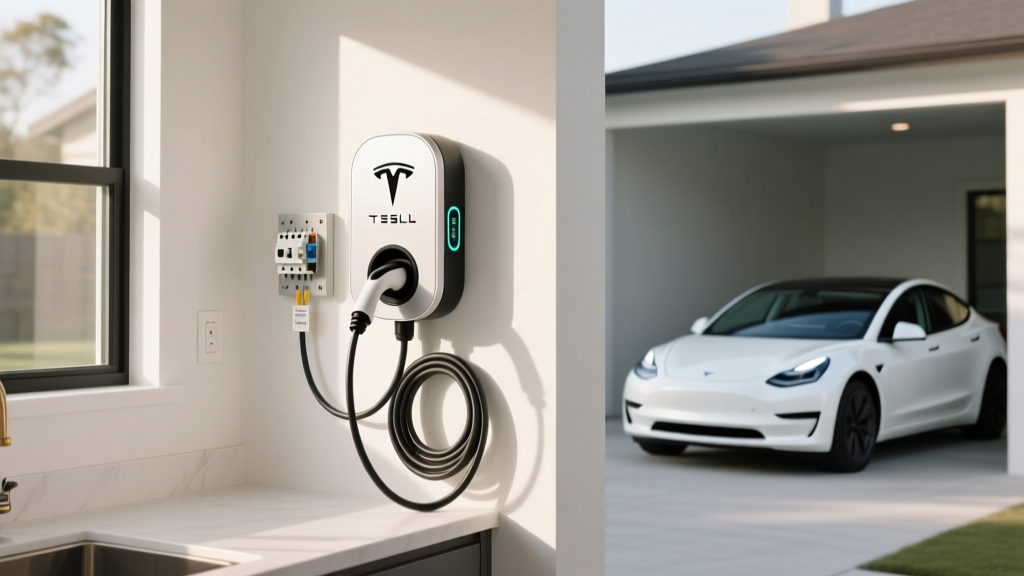
Installing a Level 2 home charger is the single most impactful upgrade for EV ownership. For a Model 3, this means a 240V circuit — the same voltage as your electric dryer or oven. Here's what's involved:
Electrical Requirements
Tesla's Wall Connector supports up to 48 amps, which requires a 60-amp dedicated circuit (electrical code requires circuits to be rated at 125% of continuous load). If your home's electrical panel has spare capacity — typically 200 amps total for a modern home — this is straightforward.
However, many older homes (pre-2000 construction) have 100-amp or even 60-amp panels that may not support an additional 60-amp circuit alongside existing loads like central A/C, electric ranges, and dryers.
Installation Cost Breakdown
| Component | Simple Install (panel nearby, no upgrade) | Complex Install (long run, panel upgrade) |
|---|---|---|
| Charger equipment (Tesla Wall Connector or equivalent) | $400–$500 | $400–$500 |
| Electrical permit | $50–$150 | $50–$200 |
| Electrician labor (2–4 hrs simple / 6–12 hrs complex) | $300–$800 | $1,200–$3,000 |
| Panel upgrade (if needed) | $0 | $1,500–$3,500 |
| Conduit, wiring, misc materials | $100–$300 | $300–$800 |
| Total estimated cost | $850–$1,750 | $3,450–$8,000 |
The wide range reflects real-world variability. A garage with the panel on the same wall might cost under $1,000 total. A detached garage requiring a 100-foot conduit run and a panel upgrade can exceed $7,000. Get at least three quotes from licensed electricians — and confirm they have specific EV charger installation experience.
Safety & Code Considerations
- Dedicated circuit: Your Level 2 charger must be on its own dedicated breaker — not shared with other appliances.
- GFCI protection: NEC 2020 and later require GFCI (ground-fault circuit interrupter) protection for EV charging outlets in garages. Tesla's Wall Connector has built-in GFCI protection, which satisfies this requirement for hardwired installations.
- Outdoor rating: If installing outside, ensure your charger carries a NEMA 4 or IP65 rating for weather resistance. The Tesla Wall Connector is rated for indoor and outdoor use.
- Permit required: Virtually all jurisdictions require an electrical permit for a new 240V circuit. Skipping the permit risks insurance claim denials and code violations at resale.
Which Connector Is Compatible with the Tesla Model 3?
This is where Tesla ownership has gotten simpler — and more complicated — depending on your model year.
| Connector Standard | 2018–2024 Model 3 | 2025–2026 Model 3 | Notes |
|---|---|---|---|
| NACS (Tesla proprietary / SAE J3400) | ✅ Native | ✅ Native | All Superchargers and Tesla destination chargers |
| CCS1 (Combo) | ❌ Requires adapter | ❌ Requires adapter | Needed for Electrify America, EVgo, and other non-Tesla DC networks |
| CHAdeMO | ❌ Requires adapter | ❌ Requires adapter | Largely legacy; adapter is expensive (~$400) and rarely worth it |
| J1772 (Level 2 public) | ❌ Adapter included | ❌ Adapter included | Tesla ships a J1772-to-NACS adapter with every vehicle |
The Model 3 uses the NACS (North American Charging Standard) connector natively. As of 2025, Tesla opened its Supercharger network to non-Tesla EVs via built-in Magic Dock adapters at select stations, and nearly every major automaker (Ford, GM, Rivian, Hyundai, Volvo, and others) has adopted NACS for their 2025–2026 models. This means the Supercharger network — over 6,000 stations and 60,000+ connectors in North America — remains the most reliable DC fast charging network for your Model 3.
For non-Tesla public chargers, you'll need Tesla's CCS1-to-NACS adapter (approximately $175 from Tesla's shop). Keep it in your frunk for road trips through areas with sparse Supercharger coverage.
Charging Cost Per Mile: Home vs. Supercharger vs. Gas
This is where the economics of EV ownership become clear — especially when you don't have free Supercharging. Let's compare real costs using the 2026 Model 3 Long Range AWD (approximately 25 kWh/100 miles efficiency, based on EPA data):
| Charging/Fuel Scenario | Rate | Cost per 100 Miles | Cost per Mile |
|---|---|---|---|
| Home Level 2 (national avg electricity, off-peak) | $0.13/kWh | $3.25 | $0.033 |
| Home Level 2 (California, peak TOU) | $0.35/kWh | $8.75 | $0.088 |
| Home Level 2 (utility EV plan, overnight) | $0.07/kWh | $1.75 | $0.018 |
| Tesla Supercharger (national avg) | $0.30/kWh | $7.50 | $0.075 |
| Non-Tesla DC fast charger (avg) | $0.40/kWh | $10.00 | $0.10 |
| Gas sedan (30 MPG combined, $3.40/gal) | $3.40/gal | $11.33 | $0.113 |
Even without free Supercharging, home charging on an off-peak utility rate saves you 70–85% per mile compared to gasoline. Supercharging at $0.30/kWh still undercuts a 30-MPG gas sedan by roughly 34%. The only scenario where charging approaches gas costs is using expensive public DC fast chargers at peak rates — which is why home Level 2 installation pays for itself quickly.
Recommended Home Chargers for the Tesla Model 3
While Tesla's Wall Connector is the obvious default, several third-party options work well with the Model 3's NACS port. Here are top picks for 2026:
Tesla Wall Connector (Best Overall)
- Power output: Up to 11.5 kW (48A)
- Connector: NACS native
- Cable length: 24 feet
- Smart features: Wi-Fi, OTA updates, power sharing between two units, Tesla app integration
- Price: ~$475
- Verdict: The default choice for Tesla owners. Seamless integration, fast Level 2 speeds, and clean design. Hardwired only (no plug).
ChargePoint Home Flex (Best Universal)
- Power output: Up to 12 kW (50A, configurable down to 16A)
- Connector: NACS (available as native option for 2025+)
- Cable length: 23 feet
- Smart features: Wi-Fi, ChargePoint app scheduling, Alexa integration, flexible amperage settings
- Price: ~$550–$650
- Verdict: Excellent if you own multiple EV brands or want NEMA 14-50 plug flexibility for portability.
Emporia Vue Smart Charger (Best Budget)
- Power output: Up to 11.5 kW (48A)
- Connector: NACS native (2025+ models)
- Cable length: 24 feet
- Smart features: Wi-Fi, energy monitoring, solar integration, scheduling via app
- Price: ~$350–$400
- Verdict: Best value if you want smart scheduling and energy tracking without paying Tesla's premium.
Grizzl-E Smart (Most Durable)
- Power output: Up to 10 kW (40A)
- Connector: NACS available
- Cable length: 24 feet
- Smart features: Wi-Fi, OCPP compatibility, extreme cold rated (-40°F)
- Price: ~$450–$550
- Verdict: Built like a tank for harsh climates. Lower max amperage but more than sufficient for overnight charging.
Frequently Asked Questions
How much does it cost to install a home EV charger for a Tesla Model 3?
A straightforward installation with an adequate electrical panel typically costs $850–$1,750 including equipment, labor, and permits. If your home requires a panel upgrade from 100A to 200A, expect total costs between $3,450 and $8,000. Always get a professional load calculation first.
How fast will each charging level add range to my Model 3?
Level 1 (120V) adds 3–5 miles per hour. Level 2 (240V, 48A) adds 35–44 miles per hour — enough to fully recharge overnight. DC fast charging at a V3 Supercharger (250 kW peak) can add up to 175 miles in 15 minutes, though charge speed tapers significantly above 80% SoC.
Which connector and charger is compatible with my Model 3?
All Model 3 vehicles use the NACS connector natively, compatible with all Tesla Superchargers and Destination Chargers. For non-Tesla public DC chargers (CCS1), you'll need a CCS-to-NACS adapter (~$175). Tesla includes a J1772-to-NACS adapter for public Level 2 stations.
How much does charging a Model 3 cost per mile vs. gas?
Home charging at the national average electricity rate ($0.13/kWh) costs roughly $0.033 per mile. Supercharging averages about $0.075 per mile. A comparable 30-MPG gas sedan at $3.40/gallon costs $0.113 per mile. Home charging saves 70%+ per mile vs. gasoline.
What electrical upgrades might I need for a home charger?
The most common upgrade is a panel capacity increase from 100A to 200A, costing $1,500–$3,500. You may also need a new conduit run if your garage is far from the panel. Homes with existing 200A panels and nearby garage locations typically need no upgrades beyond the dedicated 60A circuit.
Can I still get free Supercharging through Tesla's referral program?
Tesla's referral program periodically offers Supercharging credits (typically 1,000–5,000 miles) to new buyers referred by existing owners. Availability and credit amounts change frequently. Check Tesla's current referral terms in the Tesla app before relying on credits as part of your purchase decision.
Is the Model 3 LFP battery different for charging?
Yes. The Rear-Wheel Drive Model 3 uses an LFP (lithium iron phosphate) battery, which Tesla recommends charging to 100% regularly — unlike the NMC battery in the Long Range, which should be kept at 80% for daily use to minimize degradation. LFP batteries also charge slightly slower at DC fast chargers, with 10–80% taking approximately 30–35 minutes vs. 25–30 minutes for the Long Range.
Bottom Line: Plan for Home Charging, Treat Free Supercharging as a Bonus
The search for Model 3 free Supercharging is understandable — nobody wants to pay more than necessary. But the math is clear: even with paid Supercharging at $0.30/kWh, your per-mile cost undercuts gasoline substantially. And with a home Level 2 charger installed for $850–$1,750 (in the straightforward case), your ongoing fuel cost drops to pennies per mile.
Focus your energy on getting a quality home charger installation at a competitive price. If free Supercharging credits come your way through a referral or seasonal promotion, treat them as a welcome bonus — not the foundation of your ownership economics. For the latest on federal EV tax credits under IRS §30D, consult the IRS directly or a qualified tax professional, as income caps, MSRP limits, and battery sourcing requirements apply.