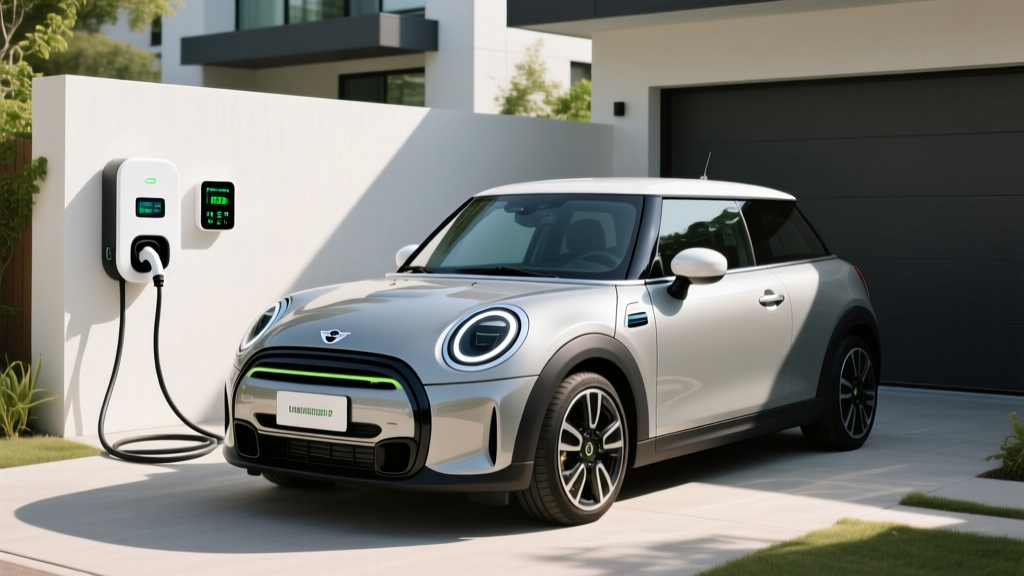
Mini Cooper EV Range and Why Charging Setup Matters
The 2025 Mini Cooper Electric (SE trim) carries an EPA-rated 114 miles of range from a 54.2 kWh (usable ~40.7 kWh) lithium-ion NMC battery. The base Cooper E trim stretches that to an EPA 153 miles with the same pack tuned differently. Either way, this is a compact urban EV — and that relatively modest battery size makes your home charging setup the single biggest factor in daily usability.
With a battery this size, you don't need a 350 kW public charger to make the most of the car. You need a reliable, properly installed Level 2 home charger that can fully replenish the pack overnight — and an understanding of what each charging level actually delivers in miles per hour. This guide breaks down exactly what Mini Cooper EV owners and prospective buyers need.
Charging Levels Explained: kW, Miles Per Hour, and 10–80% Times
Before comparing equipment, it's essential to separate kW (kilowatts) from kWh (kilowatt-hours). This is the single most common EV mistake. kW measures power — the rate at which electricity flows into your car. kWh measures energy — the total capacity of the battery. Think of kW as the width of a hose and kWh as the size of the bucket.
| Level | Voltage / Current | Power (kW) | Miles Added/Hour | 10–80% Time (Cooper SE) |
|---|---|---|---|---|
| Level 1 (120V) | 120V / 12A | ~1.4 kW | ~4–5 mi/hr | ~18–20 hours |
| Level 2 (240V) | 240V / 32A | ~7.7 kW | ~25–28 mi/hr | ~3.5 hours |
| Level 2 (240V, 48A) | 240V / 48A | ~11 kW | ~35–38 mi/hr | ~2.5 hours |
| DC Fast (CCS2) | 400V architecture | Peak ~95 kW | N/A (session-based) | ~28–30 minutes |
The Mini Cooper SE's onboard charger maxes out at 11 kW AC, so installing a 48A Level 2 circuit will let you capture the car's full AC charging capability. A 32A circuit (7.7 kW) still works fine — it just adds roughly one extra hour to a 10–80% session. For DC fast charging, the 2025 Cooper Electric uses the CCS2 connector (European spec) or CCS1 in North America, with a peak rate of approximately 95 kW. The charging curve tapers noticeably above 80% state of charge, which is why 10–80% is the standard benchmark.
How Much Does It Cost to Install a Home EV Charger?
This is the question every new EV buyer asks, and the answer varies dramatically depending on your home's electrical panel, the distance from the panel to your garage or parking spot, and local permit costs. Below is a realistic breakdown for a typical 240V / 48A hardwired Level 2 installation.
| Component | Typical Range | Notes |
|---|---|---|
| Level 2 Charger (Equipment) | $350 – $750 | Smart Wi-Fi models cost more; basic units are cheaper |
| Electrician Labor | $500 – $1,500 | Depends on run length, wall type, conduit needs |
| Electrical Permit | $50 – $300 | Varies by municipality; some bundle with inspection |
| Panel Upgrade (if needed) | $1,500 – $3,500+ | Required if your panel is 100A or near capacity |
| TOTAL (no panel upgrade) | $900 – $2,550 | Most homes with 200A panels fall in this range |
| TOTAL (with panel upgrade) | $2,400 – $6,050+ | Older homes (pre-1990s) are most at risk |
What Electrical Upgrades Might I Need?
A 48A Level 2 charger requires a dedicated 60A circuit at 240V. Per the National Electrical Code (NEC), continuous loads must be derated to 80% of the breaker rating, so a 60A breaker supports 48A continuous draw. Your electrician will check whether your panel has enough spare capacity — measured in amps — to add this circuit without exceeding 80% of the panel's total rating.
Homes with a 200A panel and moderate existing loads (central AC, electric dryer, electric range) typically have enough headroom. Homes with a 100A panel or those already running multiple large electric appliances will likely need a panel upgrade to 200A. This is the single biggest cost variable and the one most online guides gloss over.
A licensed electrician will also determine whether you need:
- Conduit runs — exposed wiring requires EMT or PVC conduit; longer runs cost more in materials and labor
- A GFCI breaker — the 2020 and 2023 NEC require GFCI protection for EV charging circuits in garages; this adds $50–$150 to the breaker cost
- Outdoor-rated equipment — if your parking spot is outside, both the charger and the receptacle (if using a NEMA 14-50 plug instead of hardwiring) must carry a NEMA 3R or 4 rating
Connector Compatibility: Which Charger Fits the Mini Cooper EV?
The 2025 Mini Cooper Electric sold in North America uses the CCS1 (Combined Charging System) connector for both Level 2 AC and DC fast charging. However, the North American charging landscape is rapidly shifting toward NACS (North American Charging Standard), originally developed by Tesla and now adopted by Ford, GM, Rivian, Volvo, and others.
| Connector | AC Charging | DC Fast | Used By |
|---|---|---|---|
| J1772 | Yes (Level 1 & 2) | No | All non-Tesla EVs (AC portion of CCS1) |
| CCS1 | Yes (via J1772 upper) | Yes | Mini, VW, BMW, Hyundai, Kia, most non-Tesla |
| NACS | Yes | Yes | Tesla, Ford, GM, Rivian, Volvo (2025+ models) |
| CHAdeMO | No | Yes | Nissan Leaf (legacy); being phased out |
What this means for Mini Cooper EV owners: For home Level 2 charging, any charger with a J1772 connector will plug directly into your Cooper Electric. That covers the vast majority of Level 2 home chargers on the market. For DC fast charging on the road, you'll use CCS1 stalls at networks like Electrify America and EVgo.
If you also own a Tesla or plan to charge at Tesla Superchargers in the future, you can purchase a NACS-to-CCS1 adapter (roughly $200–$300) once Tesla opens its network more broadly to CCS-equipped vehicles. For now, the Mini Cooper Electric is not natively compatible with Tesla Superchargers.
Cost to Charge: Home vs. Public vs. Gas
One of the strongest arguments for EV ownership is the cost-per-mile advantage — but only if you charge at home on off-peak electricity rates. Public DC fast charging erodes that advantage significantly.
| Scenario | Rate ($/kWh) | Efficiency | Cost per Mile |
|---|---|---|---|
| Home (off-peak utility rate) | $0.11/kWh | 3.8 mi/kWh (115 MPGe) | $0.029/mi |
| Home (average US rate) | $0.17/kWh | 3.8 mi/kWh | $0.045/mi |
| Public Level 2 (ChargePoint, etc.) | $0.30/kWh | 3.8 mi/kWh | $0.079/mi |
| DC Fast Charging (Electrify America) | $0.48/kWh | 3.8 mi/kWh | $0.126/mi |
| Gas Equivalent (30 MPG, $3.40/gal) | — | 30 MPG | $0.113/mi |
At off-peak home rates, the Cooper SE costs roughly 4× less per mile than a comparable gas-powered Mini Hardtop. Even at average residential rates, you're saving more than half. The economics only flip against you if you rely almost exclusively on premium-priced DC fast chargers — which is why a home Level 2 setup isn't optional for Mini Cooper EV ownership; it's the financial backbone of it.
According to fueleconomy.gov, the 2025 Mini Cooper SE achieves 115 MPGe combined, which translates to about 29 kWh per 100 miles. That efficiency figure is what we used in the calculations above.
Best Home Chargers for the Mini Cooper EV: Equipment Picks
Given the Cooper SE's 11 kW AC onboard charger limit and ~41 kWh usable battery, you don't need an 80A charger. A quality 40A or 48A unit is the sweet spot — enough to fully charge the car overnight in 3–4 hours without overspending on hardware you can't fully utilize.
Emporia Vue Level 2 (Best Value)
- Power Output: 48A / 11.5 kW (240V hardwired)
- Connector: J1772 (compatible with Cooper SE)
- Cable Length: 24 ft
- Smart Features: Wi-Fi, app scheduling, energy monitoring, solar integration
- Price: ~$399
- Why it works: Full 48A output matches the Cooper's 11 kW AC limit. Energy monitoring helps track costs.
ChargePoint Home Flex (Most Flexible)
- Power Output: Up to 50A / 12 kW (adjustable 16A–50A)
- Connector: J1772
- Cable Length: 23 ft
- Smart Features: Wi-Fi, Alexa, scheduling, ChargePoint network integration
- Price: ~$649
- Why it works: Adjustable amperage means you can dial it down to match a 40A circuit if your panel is tight, or max it at 50A on a 60A breaker.
Wallbox Pulsar Plus (Compact Pick)
- Power Output: 40A / 9.6 kW (240V)
- Connector: J1772
- Cable Length: 25 ft
- Smart Features: Wi-Fi + Bluetooth, app control, Power Sharing for dual installs
- Price: ~$449
- Why it works: Small form factor, 40A is adequate for the Cooper SE's ~41 kWh pack (full charge in ~4.5 hours from 0%).
Tesla Universal Wall Connector (Future-Proof)
- Power Output: 48A / 11.5 kW (240V hardwired)
- Connector: NACS with built-in J1772 adapter (Magic Dock style)
- Cable Length: 24 ft
- Smart Features: Wi-Fi, Tesla app, OTA updates, load sharing
- Price: ~$599
- Why it works: If you might add a Tesla to the household, this charges both NACS and J1772 vehicles without adapters.
All four chargers above are UL-listed and eligible for the federal Alternative Fuel Vehicle Refueling Property Credit (§30C), which covers up to 30% of equipment and installation costs (max $1,000 for residential). Check IRS.gov §30C guidelines for eligibility, including census-tract requirements that apply in 2025–2026.
Safety, Code, and Installation Best Practices
EV charging places a sustained high-amperage load on your home's electrical system — unlike a dryer that cycles on and off, an EV charger may run at full draw for hours. This makes proper installation non-negotiable.
- Dedicated circuit: Your Level 2 charger must be on its own dedicated breaker — never shared with other appliances. A 48A charger requires a 60A breaker; a 40A charger requires a 50A breaker.
- GFCI protection: The NEC (2020 and later editions) mandates GFCI protection for EV charging outlets in garages. Hardwired installations may be exempt in some jurisdictions, but many electricians include GFCI breakers as standard practice for safety.
- Outdoor rating: If your charger is mounted outdoors, it must carry at minimum a NEMA 3R rating (rain-resistant). For areas with driving rain or hose spray, look for NEMA 4 (watertight). All four chargers recommended above are rated for outdoor use.
- Cable management: A 24–25 ft cable is standard and sufficient for most single-car garages. If your parking spot is farther from the wall, verify cable length before purchasing — extension cords are not permitted for EV charging.
- Permit and inspection: Most jurisdictions require a permit for new 240V circuit installations. Your electrician should pull this permit and schedule a post-installation inspection. Unpermitted work can void home insurance claims and complicate future home sales.
Mini Cooper EV Quick Spec Reference
| Spec | Value |
|---|---|
| EPA Range | 114 miles (SE) / 153 miles (E trim) |
| Battery (Usable) | ~40.7 kWh (NMC chemistry) |
| Efficiency | 115 MPGe / 29 kWh/100 mi |
| Max AC Charge Rate | 11 kW (48A @ 240V) |
| Max DC Fast Charge | ~95 kW (10–80% in ~28–30 min) |
| Power / Torque | 218 hp / 243 lb-ft (SE) |
| 0–60 mph | 6.7 seconds |
| Connector | CCS1 (J1772 + DC pins) |
| Base MSRP (SE) | ~$30,900 (before incentives) |
| Battery Warranty | 8 years / 100,000 miles |
The Cooper SE's 218-hp electric motor and 6.7-second 0–60 time make it genuinely quick around town, even if the range is modest. For urban commuters with home charging and daily drives under 60 miles, the math works well. For road-trippers, the 114-mile EPA range — and likely 80–90 miles in winter — means DC fast charging stops every 70–80 miles on longer routes.
Frequently Asked Questions
Can I charge the Mini Cooper EV on a standard 120V outlet?
Yes, but it's painfully slow. A 120V/12A outlet delivers about 1.4 kW, adding roughly 4–5 miles of range per hour. A full charge from empty would take 20+ hours. For the Cooper SE's ~41 kWh battery, Level 1 works only as a trickle-charge top-off if you drive fewer than 30 miles daily. For any serious use, Level 2 is strongly recommended.
How fast will each charging level add range to my Mini Cooper EV?
Level 1 (120V): ~4–5 miles per hour. Level 2 at 32A (7.7 kW): ~25–28 miles per hour. Level 2 at 48A (11 kW): ~35–38 miles per hour. DC fast charging at peak ~95 kW: 10–80% in approximately 28–30 minutes. These figures assume the Cooper SE's efficiency of roughly 3.8 miles per kWh.
Do I need a NACS charger for my Mini Cooper?
No. The Mini Cooper Electric uses the CCS1/J1772 standard. Any J1772-equipped Level 2 charger will work directly. NACS is currently relevant only for Tesla owners or those planning to buy a Ford, GM, or Rivian vehicle that has adopted the Tesla connector. You can always add a NACS-to-J1772 adapter later if needed.
Is the Mini Cooper EV eligible for the $7,500 federal tax credit?
Tax credit eligibility under IRS §30D depends on multiple factors: the vehicle's MSRP must be under $55,000 (sedans), your modified adjusted gross income must fall below $150,000 (single) or $300,000 (joint), and the battery must meet critical-mineral and component-sourcing requirements that tighten each year. The Mini Cooper EV's eligibility has fluctuated as sourcing rules change — always verify current status on the IRS qualified vehicles list before purchasing. The credit can now be transferred to the dealer at point of sale as an instant discount.
What if my home's electrical panel doesn't have enough capacity?
If your electrician determines your panel is at or near capacity, you have three options: (1) upgrade to a 200A panel ($1,500–$3,500+), (2) install a lower-amperage charger (e.g., 32A instead of 48A, which requires only a 40A breaker), or (3) use a smart panel-load-management device like the Emporia Smart Panel or Span Drive that dynamically reduces charger draw when other appliances are running. Option 2 is often the most cost-effective for the Cooper SE, since its small battery doesn't demand maximum charging speed.
How much does it cost to fully charge the Mini Cooper SE at home?
To charge the ~41 kWh usable battery from 10% to 100% at home: at $0.11/kWh (off-peak), it costs roughly $4.06. At $0.17/kWh (national average), about $6.27. For comparison, filling a gas-powered Mini Hardtop's 11.6-gallon tank at $3.40/gallon costs about $39.44. Over a year of 12,000 miles, home charging costs $348–$537 versus $1,360 for gas.
Bottom line: The Mini Cooper EV's 114-mile EPA range and ~41 kWh battery make it one of the most home-charging-friendly EVs on the market. You don't need expensive high-power equipment — a properly installed 40A or 48A Level 2 charger on a dedicated 240V circuit will fully replenish the car overnight, at a cost of roughly $4–$6 per full charge. Budget $900–$2,550 for a professional installation (more if your panel needs an upgrade), choose a UL-listed smart charger with a J1772 connector, and pull the required permits. That setup transforms the Cooper SE into a genuinely practical daily driver for urban and suburban commutes.