If you own a Tesla—or are about to buy one—the single most important efficiency metric isn't EPA range. It's miles per kilowatt-hour (mi/kWh). This number tells you exactly how far your Model 3, Model Y, Model S, or Model X will travel on one unit of electricity, and it directly determines what you'll pay to charge at home, at a Supercharger, or on a public DC fast-charging network.
Unlike gas cars where we default to miles per gallon, EV efficiency is measured in either mi/kWh (higher is better) or watt-hours per mile, Wh/mi (lower is better). Tesla's onboard display defaults to Wh/mi, but translating that into miles per kilowatt-hour makes cost comparisons with gasoline—and comparisons across EV brands—far more intuitive.
This guide covers the real-world mi/kWh figures for every current Tesla model, what those numbers mean for your wallet, and exactly how to set up a home Level 2 charger to maximize convenience and minimize cost.
Tesla Efficiency: Miles Per Kilowatt-Hour by Model
Efficiency varies by model, trim, wheel size, and drivetrain. Rear-wheel-drive (RWD) vehicles are lighter and more efficient; all-wheel-drive (AWD) and Performance trims carry more weight and wider tires that increase rolling resistance. Larger wheels (20- or 21-inch) also reduce efficiency compared to standard 18- or 19-inch setups.
Below are the EPA-rated combined efficiencies converted to mi/kWh, alongside real-world expectations based on mixed highway and city driving at moderate temperatures (65–75°F).
| Model / Trim | Battery (kWh usable) | EPA Range | EPA mi/kWh | Real-World mi/kWh | EPA Wh/mi |
|---|---|---|---|---|---|
| Model 3 RWD | 57.5 | 272 mi | 4.7 | 4.0–4.3 | 250 |
| Model 3 Long Range AWD | 75 | 341 mi | 4.5 | 3.8–4.2 | 263 |
| Model 3 Performance | 75 | 315 mi | 4.2 | 3.5–3.9 | 278 |
| Model Y RWD | 57.5 | 277 mi | 4.8 | 4.0–4.4 | 248 |
| Model Y Long Range AWD | 75 | 320 mi | 4.3 | 3.6–4.0 | 281 |
| Model Y Performance | 75 | 293 mi | 3.9 | 3.3–3.7 | 304 |
| Model S Long Range | 95 | 402 mi | 4.2 | 3.5–3.9 | 286 |
| Model S Plaid | 95 | 359 mi | 3.8 | 3.2–3.5 | 314 |
| Model X Long Range | 95 | 335 mi | 3.5 | 2.9–3.2 | 335 |
| Model X Plaid | 95 | 311 mi | 3.3 | 2.7–3.0 | 360 |
EPA mi/kWh figures assume a mix of city and highway driving at moderate temperatures. Expect a 10–20% efficiency drop on sustained highway driving above 70 mph due to aerodynamic drag. In freezing weather (below 32°F), battery preconditioning and cabin heating can reduce real-world mi/kWh by 20–35%. Teslas with a heat pump (all 2021+ models) mitigate this loss compared to resistive heating, but cold weather always costs range. For the most accurate personal figure, track your car's trip meter over several weeks of your typical commute.
kW vs. kWh: The Distinction Every EV Owner Must Know
Before we talk charging, let's clear up the most common EV terminology confusion:
- kWh (kilowatt-hour) = energy. This is the capacity of your battery (e.g., 75 kWh) and the unit you're billed for by your utility. Think of it like gallons in a gas tank.
- kW (kilowatt) = power. This is the rate at which energy flows into your car during charging. Think of it like the flow rate of a gas pump nozzle.
Your Tesla's efficiency—miles per kilowatt-hour—bridges the two. If your Model Y Long Range gets 4.0 mi/kWh in real-world driving and you charge 10 kWh from your home panel, you've added roughly 40 miles of range. A 11.5 kW Level 2 charger delivers that 10 kWh in under an hour.
Charging Levels Explained: Speeds, Miles Per Hour, and 10–80% Times
Every Tesla sold today supports three charging tiers. Here's how they translate to actual miles added per hour of charging and realistic 10–80% session times.
| Level | Voltage | Max Power (kW) | Miles of Range Per Hour | 10–80% Time (75 kWh Battery) | Typical Use Case |
|---|---|---|---|---|---|
| Level 1 | 120V AC | 1.0–1.4 kW | 3–5 mi/hr | ~50+ hours | Overnight trickle; emergency top-ups |
| Level 2 (Home) | 240V AC | 7.7–11.5 kW | 28–44 mi/hr | 5–7 hours | Daily home charging; overnight full recharge |
| Level 2 (Public) | 208–240V AC | 6.6–19.2 kW | 24–70 mi/hr | Varies | Workplace, shopping, hotels |
| DC Fast (Supercharger V3) | 400V DC | 250 kW peak | ~200 mi in 15 min | ~25–30 min | Road trips; rapid top-ups |
| DC Fast (Supercharger V4) | 400V+ DC | Up to 350 kW (capable) | ~250 mi in 15 min | ~20–25 min | Newer Tesla Supercharger stalls |
Charging curve reality check: Peak kW rates are never sustained across the entire session. A Model 3 Long Range at a V3 Supercharger may peak at 250 kW around 10–20% state of charge (SoC), tapering to ~150 kW by 50%, ~75 kW by 70%, and ~40 kW above 85%. This is why the 10–80% metric matters more than peak kW—it reflects the usable fast-charging window. Charging past 80% slows dramatically to protect battery longevity, which is why Tesla's navigation system typically recommends charging to 80% on road trips unless you need the full range to reach your next stop.
Home Charger Installation: Electrical Requirements, Costs, and Panel Upgrades
Installing a dedicated Level 2 home charger is the single most impactful upgrade a Tesla owner can make. It transforms your daily routine from "plan around charging" to "wake up with a full battery every morning." But costs vary enormously based on your home's electrical infrastructure.
Electrical Requirements
Tesla's Wall Connector supports up to 48 amps continuous draw, which requires a 60-amp dedicated breaker on a 240-volt circuit (NEMA 14-60 or hardwired). The National Electrical Code (NEC) mandates that continuous loads not exceed 80% of a breaker's rating—hence 48A on a 60A breaker.
If your electrical panel doesn't have capacity for a 60A breaker, you can configure the Wall Connector for lower amperage (e.g., 32A on a 40A breaker delivers ~7.7 kW) or consider a panel upgrade.
Panel Upgrade Considerations
Homes built before the 1990s often have 100-amp main service panels that may already be near capacity with existing appliances (electric range, dryer, HVAC). Adding a 60A EV circuit to a maxed-out 100A panel is a code violation and a fire risk. A licensed electrician will perform a load calculation (NEC Article 220) to determine if your panel can handle the additional draw.
If an upgrade to 200-amp service is needed, expect this to add significantly to your project cost. In some cases, a smart load-management device (like the Emporia Smart Panel or a Span electrical panel) can avoid a full upgrade by dynamically throttling EV charging when other appliances are drawing heavily.
| Component | Basic Install (Near Panel) | Standard Install (50–80 ft run) | Complex Install (Panel Upgrade) |
|---|---|---|---|
| Tesla Wall Connector (hardware) | $420 | $420 | $420 |
| Electrical permit | $50–$150 | $50–$150 | $100–$250 |
| Electrician labor (60A circuit) | $300–$600 | $600–$1,500 | $1,000–$2,000 |
| Conduit, wire, fittings | $50–$150 | $200–$500 | $300–$600 |
| Panel upgrade (if needed) | — | — | $1,500–$4,000 |
| Total estimated cost | $820–$1,320 | $1,270–$2,570 | $3,320–$7,270 |
Federal incentive: The IRS Residential Clean Energy Credit (§25C) offers a 30% tax credit on home EV charging equipment and installation costs, capped at $1,000 per year. This credit is available for equipment placed in service through 2032, subject to income and location requirements. Consult a tax professional for your specific eligibility.
Connector Compatibility: NACS, CCS, and Adapters
Tesla vehicles use the North American Charging Standard (NACS) connector natively. As of 2025, NACS has become the dominant EV charging connector in North America, with Ford, GM, Rivian, Hyundai, and most other automakers adopting it. However, many existing public Level 2 and DC fast chargers still carry CCS1 (Combined Charging System) or the legacy CHAdeMO connector.
| Connector | Used By | Tesla Native? | Adapter Needed? |
|---|---|---|---|
| NACS (Tesla) | Tesla, Ford, GM, Rivian, Hyundai (2025+) | Yes — all Teslas | None for Tesla Superchargers & NACS public chargers |
| CCS1 | Most non-Tesla EVs (2014–2024) | No | Tesla CCS Adapter (~$175) — required for Electrify America, some EVgo stations |
| CHAdeMO | Nissan Leaf, older Japanese EVs | No | Not supported by Tesla; no official adapter available |
| J1772 (Level 2) | All non-Tesla EVs (Level 2 AC) | No | Tesla includes a J1772 adapter with every vehicle |
Practical advice: Every Tesla ships with a J1772-to-Tesla adapter for public Level 2 chargers and a NEMA 14-50 mobile connector plug for 240V outlets. For DC fast charging on non-Tesla networks (Electrify America, EVgo), purchase the Tesla CCS Adapter from the Tesla store. With NACS rapidly becoming the standard, new public charger installations increasingly feature NACS cables natively.
Charging Cost Per Mile: Tesla vs. Gasoline
The economic case for EV ownership hinges on the cost-per-mile gap between electricity and gasoline. Your actual savings depend on local electricity rates, whether you charge at home or on public networks, and what you'd otherwise pay for fuel.
| Charging Scenario | Rate | Cost per kWh | Tesla ¢/mile | Gas SUV ¢/mile ($3.50/gal) | Savings per 1,000 mi |
|---|---|---|---|---|---|
| Home (national avg. residential) | $0.16/kWh | $0.16 | 4.0¢ | 14.0¢ | $100 |
| Home (off-peak TOU rate) | $0.09/kWh | $0.09 | 2.3¢ | 14.0¢ | $117 |
| Home (high-cost state, e.g., CA avg.) | $0.28/kWh | $0.28 | 7.0¢ | 14.0¢ | $70 |
| Tesla Supercharger V3 (avg.) | $0.30/kWh | $0.30 | 7.5¢ | 14.0¢ | $65 |
| Public DC fast (Electrify America) | $0.43/kWh | $0.43 | 10.8¢ | 14.0¢ | $32 |
| Gas SUV baseline | $3.50/gal, 25 MPG | — | — | 14.0¢ | — |
For a Model Y Long Range driven 12,000 miles per year and charged primarily at home on a time-of-use (TOU) off-peak rate, annual fuel cost runs roughly $275. The equivalent gas SUV at 25 MPG and $3.50/gallon costs $1,680—a yearly savings of over $1,400. Even exclusive Supercharger use keeps the Tesla under $900/year in energy costs.
According to fueleconomy.gov, the 2025 Model Y Long Range achieves a combined 122 MPGe, equivalent to roughly 27 kWh per 100 miles.
Recommended Home Charging Equipment
While Tesla's Wall Connector is the default choice for Tesla owners, several third-party chargers offer competitive features. All recommendations below support the NACS connector natively or via Tesla's included adapter.
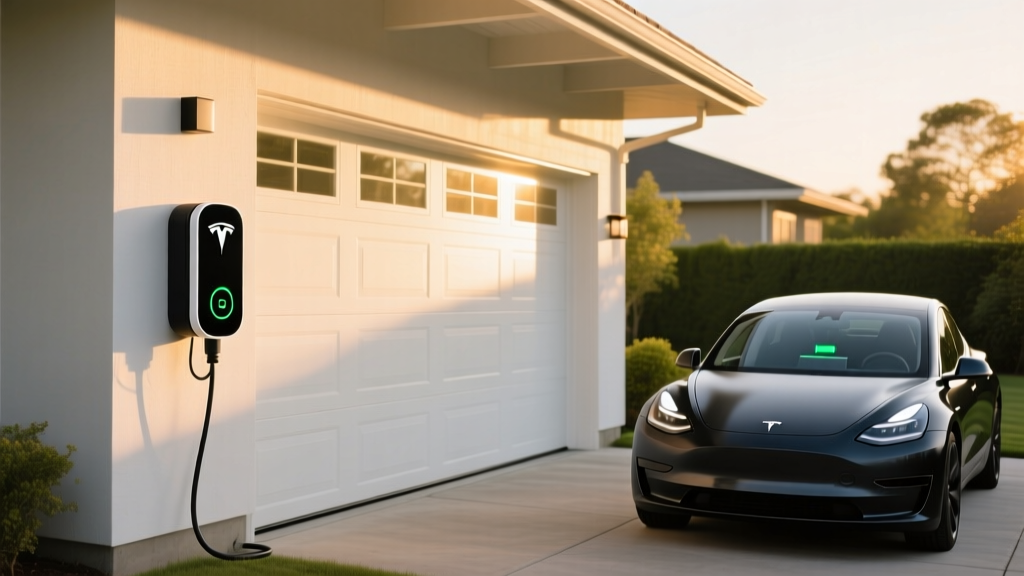
Tesla Wall Connector (Gen 3)
- Max output: 11.5 kW (48A, 240V)
- Connector: NACS native
- Cable length: 24 ft
- Smart features: Wi-Fi, OTA updates, power sharing (pair two units on one circuit), access control
- Outdoor rated: Yes (NEMA 4)
- Price: ~$420
- Best for: Tesla-only households wanting max speed and seamless integration
ChargePoint Home Flex (NACS)
- Max output: 12 kW (50A, 240V)
- Connector: NACS (2025+ models)
- Cable length: 23 ft
- Smart features: Wi-Fi, Alexa, app scheduling, detailed energy reports
- Outdoor rated: Yes (NEMA 4)
- Price: ~$550
- Best for: Multi-EV households; robust app and scheduling
Emporia Level 2 EV Charger
- Max output: 11.5 kW (48A, 240V)
- Connector: J1772 (use Tesla adapter) or NACS (2025+)
- Cable length: 24 ft
- Smart features: Wi-Fi, integration with Emporia home energy monitor, solar-aware scheduling
- Outdoor rated: Yes
- Price: ~$400
- Best for: Budget-conscious buyers with solar panels or energy monitoring
Tesla Mobile Connector (Bundle)
- Max output: 7.7 kW (32A, NEMA 14-50) or 1.4 kW (NEMA 5-15)
- Connector: NACS native
- Cable length: 20 ft
- Smart features: None (no Wi-Fi or app)
- Outdoor rated: Not rated for permanent outdoor use
- Price: ~$200 (unit) + $35 (NEMA 14-50 adapter)
- Best for: Temporary/rental use; backup; no smart features needed
Our pick: For most Tesla owners, the Tesla Wall Connector at $420 is hard to beat—native NACS, 11.5 kW output, power sharing for a second EV, and seamless vehicle integration. If you own non-Tesla EVs alongside your Tesla, the ChargePoint Home Flex with its NACS connector and detailed app analytics is the stronger multi-vehicle choice.
Safety, Electrical Code, and Installation Best Practices
EV charging draws sustained high current for hours—unlike most household appliances that cycle on and off. This makes proper installation critical.
- Dedicated circuit: Your Level 2 charger must be on its own dedicated breaker. Sharing a circuit with other appliances risks tripping the breaker or overheating wiring.
- GFCI protection: The 2020 NEC (Article 625.54) requires GFCI protection for all EV receptacles rated 150V to ground or less and 60A or less. Hardwired installations (like the Wall Connector) are exempt from GFCI requirements but must follow all other NEC Article 625 provisions.
- Outdoor rating: If your charger is mounted outside or in an unsealed garage, ensure the unit carries a NEMA 4 (weather-resistant) rating. All recommended units above meet this standard.
- Wire gauge: A 60A circuit requires minimum 6 AWG copper wire (or 4 AWG aluminum). Your electrician will size wire based on run length and local code amendments.
- Permit and inspection: Most jurisdictions require a permit for any new 240V circuit. A post-installation inspection ensures code compliance and protects your homeowner's insurance coverage. Never skip this step—an unpermitted install can void insurance claims related to electrical fires.
- Utility notification: Some utilities require you to notify them before adding an EV charger, particularly if it draws above 40A. They may offer TOU rate plans that significantly reduce your charging cost.
For the final electrical specifications and load calculation, always defer to a licensed electrician familiar with NEC Article 625 (Electric Vehicle Charging System Equipment). The National Fire Protection Association (NFPA) publishes the full NEC code cycle updates.
Frequently Asked Questions
How much does it cost to install a home EV charger for a Tesla?
A standard Tesla Wall Connector installation on a new 60A/240V circuit typically costs $1,270–$2,570 including hardware ($420), electrician labor, wire, conduit, and permit. If your home needs a 200A panel upgrade, total costs can reach $3,300–$7,300. The IRS §25C credit covers 30% of equipment and installation, up to $1,000.
How fast will each charging level add range to my Tesla?
Level 1 (120V standard outlet) adds 3–5 miles per hour—barely enough for low-mileage commuters. Level 2 (240V home charger at 11.5 kW) adds 35–44 miles per hour, fully recharging a 75 kWh battery overnight. Tesla Superchargers (DC fast) can add up to 200 miles in 15 minutes at peak rate, though the charging curve tapers significantly above 50% SoC.
Which connector and charger is compatible with my Tesla?
All Teslas use the NACS connector natively. Tesla Superchargers and new public NACS chargers plug in directly. For CCS-equipped public DC fast chargers (Electrify America, some EVgo stations), you'll need the Tesla CCS Adapter (~$175). For J1772 public Level 2 chargers, Tesla includes a J1772 adapter with every vehicle.
How much does charging a Tesla cost per mile compared to gas?
Charging a Model Y Long Range at home on the national average residential rate ($0.16/kWh) costs about 4.0¢ per mile. The average gas SUV at 25 MPG and $3.50/gallon costs 14.0¢ per mile. Even at the national average Supercharger rate (~$0.30/kWh), the Tesla costs 7.5¢ per mile—roughly half the cost of gasoline. Over 12,000 miles/year, home charging saves $1,200–$1,400 annually.
What electrical upgrades might I need for a home Tesla charger?
Homes with a 200A main panel and spare capacity typically need no upgrade—just a new 60A breaker and wire run. Homes with 100A service or heavily loaded panels may require a panel upgrade to 200A ($1,500–$4,000) or a smart load-management system. A licensed electrician will perform a NEC Article 220 load calculation to determine your home's capacity. Older homes with knob-and-tube wiring or Federal Pacific/Zinsco panels will likely need a full panel replacement regardless of EV charging.
What is a good miles per kilowatt-hour for a Tesla?
Most current Tesla models achieve 3.5–4.8 mi/kWh under EPA combined testing. Real-world efficiency typically falls between 3.0–4.4 mi/kWh depending on speed, temperature, and terrain. The Model 3 RWD and Model Y RWD are the most efficient (4.7–4.8 EPA mi/kWh), while the Model X Plaid is the least (3.3 EPA mi/kWh) due to its weight and aerodynamic profile. Anything above 4.0 mi/kWh in mixed real-world driving is excellent.
Should I charge my Tesla to 100% every night?
No. For daily use, Tesla recommends setting the charge limit to 80% (or 90% for LFP-equipped Model 3 RWD vehicles, which tolerate full charges better). Charging to 100% regularly on NMC batteries accelerates degradation. Reserve 100% charges for road trips where you need maximum range. You can set this limit in the Tesla app or on the vehicle's touchscreen under Charging settings.