Quick Reality Check: Your EV's EPA-rated range assumes a specific miles per kWh (mi/kWh) efficiency under controlled conditions. In real-world driving—especially at highway speeds, in cold weather, or with heavy cargo—expect to achieve 85-95% of that efficiency, which directly reduces your range proportionally.
Understanding Miles Per kWh: Your EV's True Efficiency Metric
Miles per kWh (mi/kWh) is the electric vehicle equivalent of miles per gallon—it tells you how far your EV can travel using one kilowatt-hour of battery energy. This single metric determines your real-world range, charging costs, and how quickly you'll need to plug in.
Unlike MPG, which most drivers intuitively understand, mi/kWh requires a mental shift. Higher numbers are better: a car achieving 4.0 mi/kWh is more efficient than one getting 3.0 mi/kWh. Most 2026 EVs fall between 2.5 and 4.5 mi/kWh depending on size, weight, aerodynamics, and powertrain efficiency.
The math is straightforward: Battery capacity (kWh) × Efficiency (mi/kWh) = Real-world range. A 75 kWh battery in a vehicle rated at 3.5 mi/kWh delivers approximately 263 miles before needing a charge.
How Miles Per kWh Varies Across 2026 EVs
| 2026 Model | Battery (kWh) | EPA Range (mi) | EPA mi/kWh | Real-World mi/kWh* |
|---|---|---|---|---|
| Tesla Model 3 Long Range | 75 | 341 | 4.5 | 3.8-4.2 |
| Hyundai Ioniq 6 SE | 77.4 | 361 | 4.7 | 4.0-4.4 |
| Ford Mustang Mach-E Extended | 91 | 312 | 3.4 | 2.9-3.2 |
| Rivian R1T Dual-Motor | 128 | 352 | 2.8 | 2.3-2.6 |
| Chevrolet Equinox EV 3RS | 85 | 319 | 3.8 | 3.2-3.5 |
*Real-world mi/kWh reflects highway driving at 70-75 mph, moderate climate control use, and temperatures between 50-80°F. Cold weather (below 32°F) can reduce efficiency by 20-30%.
The EPA's fuel economy database shows that aerodynamic sedans like the Ioniq 6 and Model 3 consistently outperform boxier SUVs and trucks in mi/kWh. The physics is simple: less drag means less energy required to maintain speed.
Charging Levels: How Fast You'll Add Range
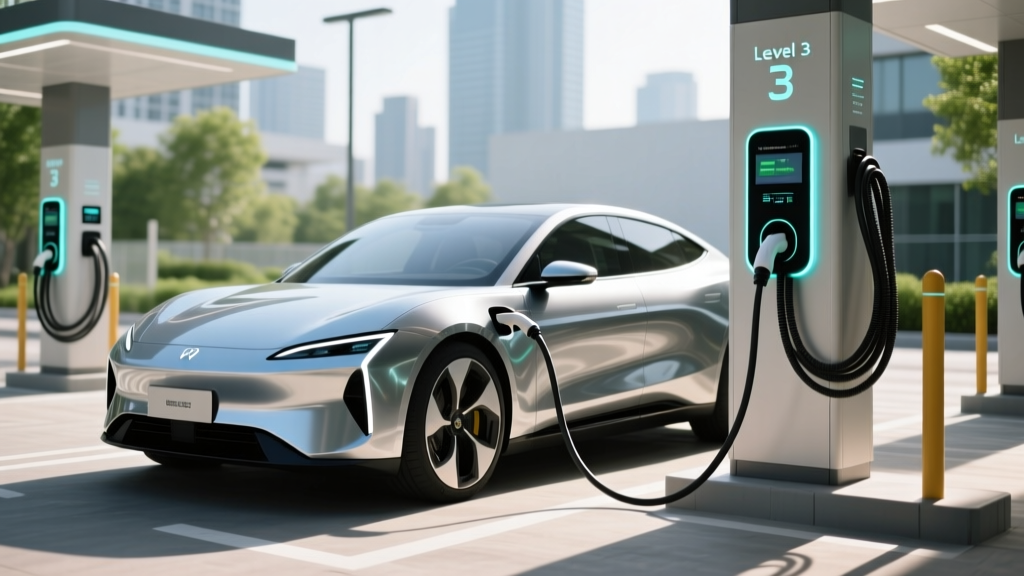
Your charging speed—measured in kilowatts (kW)—determines how quickly you replenish your battery. But the actual miles added per hour depends directly on your vehicle's mi/kWh efficiency.
| Charging Level | Voltage/Amps | Power (kW) | Miles Added/Hour (at 3.5 mi/kWh) | Best For |
|---|---|---|---|---|
| Level 1 | 120V / 12A | 1.4 kW | ~4-5 miles | Overnight top-ups, PHEVs |
| Level 2 (Basic) | 240V / 32A | 7.7 kW | ~25-27 miles | Daily home charging |
| Level 2 (Fast) | 240V / 48A | 11.5 kW | ~38-40 miles | High-capacity batteries |
| DC Fast (Peak) | 400-800V DC | 150-350 kW | ~500-1,200 miles (10-80% in 18-30 min) | Road trips, quick stops |
Critical distinction: kW measures charging power (how fast energy flows), while kWh measures battery capacity (how much energy is stored). A 240V/48A Level 2 charger delivers 11.5 kW of power. If you charge for one hour, you add 11.5 kWh to your battery—which translates to roughly 40 miles in a vehicle achieving 3.5 mi/kWh.
Home Charger Installation: Requirements and Costs
Installing a Level 2 home charger requires a dedicated 240-volt circuit, similar to what powers an electric dryer or oven. Most homes need a 40-amp or 50-amp circuit to support 32A or 40A continuous charging (electrical code requires circuits rated 25% higher than continuous load).
Electrical Requirements
- Circuit: Dedicated 240V, 40A or 50A breaker
- Wire gauge: 6 AWG copper for 40A; 4 AWG for 50A
- Outlet: NEMA 14-50 (common) or hardwired connection
- Panel capacity: Minimum 100A service; 200A recommended for modern homes with EV + electric appliances
Panel Upgrade Reality
Homes built before 1990 often have 100-amp electrical panels that may lack capacity for an EV charger, especially if you also use electric heat, an electric stove, and a dryer. A panel upgrade to 200A costs $1,500-$3,000 but may be necessary to avoid tripping the main breaker.
| Component | Cost Range | Notes |
|---|---|---|
| Level 2 Charger (Equipment) | $400-$800 | 40A-48A smart chargers |
| Electrician Labor | $600-$2,000 | Depends on panel distance, wall type |
| Permit & Inspection | $100-$400 | Required in most jurisdictions |
| Panel Upgrade (if needed) | $1,500-$3,000 | Only for older/undersized panels |
| Total (typical install) | $1,100-$3,200 | Excluding panel upgrade |
| Total (with panel upgrade) | $2,600-$6,200 | For older homes needing 200A service |
Connector Compatibility: Which Plug Does Your EV Use?
The EV charging landscape has consolidated around two main connectors in North America for 2026 models:
| Connector Type | Brands Using It (2026) | Adapter Needed? |
|---|---|---|
| NACS (Tesla) | Tesla, Ford, GM, Rivian, Volvo, Polestar, Mercedes, Fisker | No (native on most new models) |
| CCS1 | Hyundai, Kia, BMW, VW, Audi, legacy models | CCS-to-NACS adapter for Tesla Superchargers |
| CHAdeMO | Nissan Leaf (discontinued), Mitsubishi | Rare; limited public infrastructure |
Most 2026 EVs now ship with NACS ports natively. If you own a 2022-2024 model with CCS1, you can purchase a Tesla-approved CCS-to-NACS adapter ($200-$250) to access the Supercharger network.
Charging Costs: Home vs. Public vs. Gas
The cost per mile to drive an EV depends on your local electricity rates, your vehicle's mi/kWh efficiency, and whether you charge at home or use public DC fast chargers.
| Scenario | Electricity Cost ($/kWh) | Vehicle Efficiency (mi/kWh) | Cost Per Mile | Annual Cost (12,000 mi) |
|---|---|---|---|---|
| Home (off-peak utility rate) | $0.12 | 3.5 | $0.034 | $408 |
| Home (standard rate) | $0.18 | 3.5 | $0.051 | $612 |
| Public Level 2 | $0.30 | 3.5 | $0.086 | $1,032 |
| DC Fast Charger | $0.48 | 3.5 | $0.137 | $1,644 |
| Gas Car (28 MPG, $3.50/gal) | N/A | N/A | $0.125 | $1,500 |
The takeaway: Home charging at off-peak rates delivers the lowest cost per mile—roughly 75% cheaper than gasoline. Public DC fast charging narrows the gap, especially in states with high electricity rates. For maximum savings, install a home Level 2 charger and take advantage of time-of-use utility plans that offer cheaper rates overnight.
Recommended Home Chargers for 2026
ChargePoint Home Flex
- Power: Up to 11.5 kW (48A at 240V)
- Connector: NACS or CCS1 (configurable)
- Cable length: 23 feet
- Smart features: Wi-Fi, scheduling, energy tracking, Alexa integration
- Price: $699
- Best for: Most homes with 50A circuits
Emporia Vue Level 2 Charger
- Power: Up to 11.5 kW (48A at 240V)
- Connector: NACS
- Cable length: 24 feet
- Smart features: Solar integration, load management, app control
- Price: $599
- Best for: Homes with solar panels or energy monitoring
Tesla Wall Connector
- Power: Up to 11.5 kW (48A at 240V)
- Connector: NACS
- Cable length: 24 feet
- Smart features: Wi-Fi updates, power sharing (multiple units), Tesla app
- Price: $475
- Best for: Tesla owners, multi-EV households
Safety and Code Considerations
EV charger installation must comply with the National Electrical Code (NEC) Article 625 and local building codes. Key requirements include:
- Dedicated circuit: Your EV charger needs its own breaker—never share a circuit with other high-draw appliances.
- GFCI protection: Outdoor installations require Ground Fault Circuit Interrupter protection (built into most modern chargers or the breaker).
- Outdoor rating: If installing outside, ensure the charger is NEMA 4-rated for weather resistance.
- Permit required: Most municipalities require an electrical permit and post-installation inspection. Skipping this can void insurance coverage and create fire hazards.
- Load calculation: Your electrician will perform a load calculation to ensure your panel can handle the EV charger without exceeding 80% of its rated capacity.
Real-World Charging Time Examples
Charging times depend on battery size, charger power, and your vehicle's mi/kWh efficiency. Here's how long common scenarios take:
10-80% Charge Times (2026 Models)
- Tesla Model 3 Long Range (75 kWh): 18-22 minutes at 250 kW DC fast charger; 7-8 hours at 11.5 kW Level 2
- Hyundai Ioniq 6 (77.4 kWh): 18 minutes at 350 kW DC fast charger (800V architecture); 6.5-7 hours at 11.5 kW Level 2
- Ford F-150 Lightning Extended (131 kWh): 40-45 minutes at 150 kW DC fast charger; 11-12 hours at 11.5 kW Level 2
- Chevrolet Equinox EV (85 kWh): 25-30 minutes at 150 kW DC fast charger; 7-8 hours at 11.5 kW Level 2
Charge curve reality: DC fast charging speeds peak between 10-50% state of charge, then taper significantly. A charger rated at 250 kW won't sustain that rate for the full session—expect an average of 100-150 kW over a 10-80% charge.
Factors That Reduce Your Miles Per kWh
Understanding what degrades your EV's efficiency helps you maximize range and minimize charging costs:
- Highway speed: Aerodynamic drag increases exponentially above 65 mph. Driving 75 mph instead of 65 mph can reduce mi/kWh by 15-20%.
- Cold weather: Battery chemistry slows in freezing temperatures, and cabin heating draws significant power. Expect 20-30% efficiency loss below 32°F.
- Roof cargo: Roof boxes and bike racks increase drag, reducing mi/kWh by 10-15%.
- Aggressive acceleration: Rapid starts and hard braking waste energy. Smooth driving improves efficiency by 10-15%.
- Tire pressure: Underinflated tires increase rolling resistance. Check monthly for optimal efficiency.
Frequently Asked Questions
How much does it cost to install a home EV charger?
A typical Level 2 home charger installation costs $1,100-$3,200, including equipment ($400-$800), electrician labor ($600-$2,000), and permits ($100-$400). Homes with older electrical panels may need a 200A upgrade, adding $1,500-$3,000.
How fast will each charging level add range?
Level 1 (120V) adds 4-5 miles per hour. Level 2 (240V, 48A) adds 38-40 miles per hour in a vehicle achieving 3.5 mi/kWh. DC fast charging adds 500-1,200 miles in a 20-30 minute session, depending on battery size and charger power.
Which connector/charger is compatible with my EV?
Most 2026 EVs use the NACS (Tesla) connector. Older models (2022-2024) may have CCS1 ports and require an adapter for Tesla Superchargers. Check your vehicle's charge port or owner's manual. CHAdeMO is largely discontinued.
How much does charging cost per mile vs gas?
Home charging at $0.12/kWh in a vehicle achieving 3.5 mi/kWh costs $0.034 per mile—about 75% cheaper than a 28 MPG gas car at $3.50/gallon ($0.125/mile). Public DC fast charging at $0.48/kWh costs $0.137/mile, slightly more than gas.
What electrical upgrades might I need?
Homes built before 1990 often have 100A panels that may need upgrading to 200A ($1,500-$3,000) to support an EV charger plus other electric appliances. Your electrician will perform a load calculation to determine if an upgrade is necessary.
Does cold weather affect miles per kWh?
Yes. Below 32°F, expect 20-30% efficiency loss due to battery chemistry limitations and cabin heating demand. Preconditioning your battery while plugged in (using grid power) can recover some of this loss.
Can I use a regular household outlet to charge my EV?
Yes, but Level 1 charging (120V, 1.4 kW) adds only 4-5 miles per hour—suitable for plug-in hybrids or overnight top-ups if you drive less than 40 miles daily. For battery EVs, Level 2 charging is strongly recommended.
Understanding miles per kWh empowers you to make informed decisions about EV purchases, charging infrastructure, and driving habits. The most efficient 2026 models achieve 4.0+ mi/kWh, delivering lower charging costs and longer real-world range—critical factors for maximizing your electric vehicle investment.