Why Miles Per kWh Is the Most Important EV Metric You're Not Tracking
If you're shopping for an electric vehicle or optimizing how you charge the one you own, how many miles per kWh your car delivers is the single number that determines your real-world range, your charging cost, and how often you stop on road trips. Think of it as the EV equivalent of MPG — except instead of measuring distance per gallon of fuel, it measures distance per unit of electrical energy.
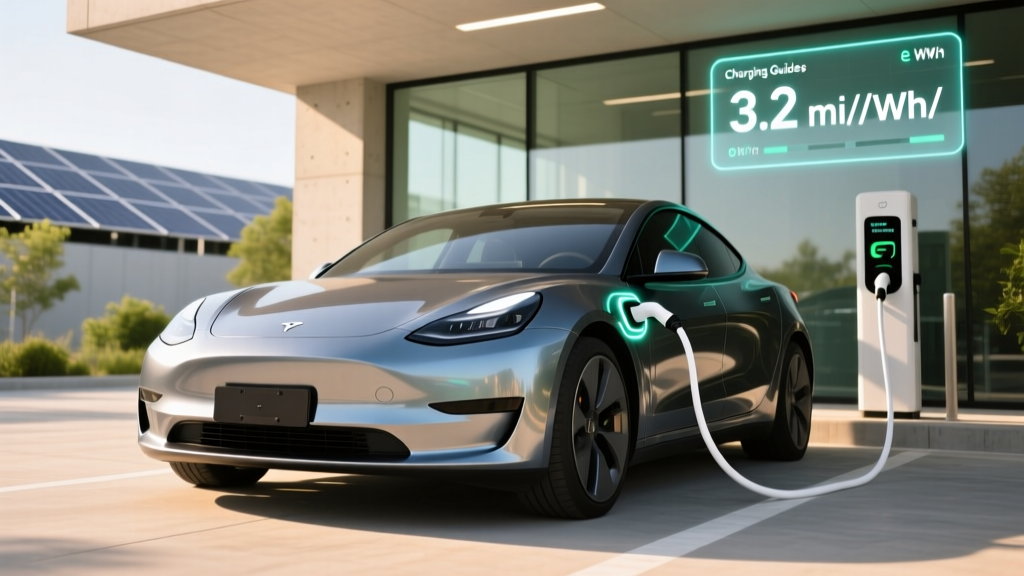
Here's the catch: the EPA publishes miles per kWh (or its inverse, kWh per 100 miles) on every EV's window sticker and on fueleconomy.gov, but real-world efficiency varies dramatically based on speed, temperature, terrain, and driving style. A Tesla Model 3 rated at 4.0 miles/kWh on the combined cycle might deliver 3.2 miles/kWh at 80 mph in winter. That gap is the difference between making it to the next charger and needing a tow.
This guide breaks down miles per kWh across popular 2025–2026 EVs, shows you how to translate that number into dollars per mile, and covers everything you need to charge at home and on the road — from electrical panel upgrades to connector compatibility.
Miles Per kWh Across Popular EVs: The Efficiency Leaderboard
Not all electrons are used equally. Lighter, more aerodynamic vehicles with efficient powertrains squeeze more miles from every kilowatt-hour. Here's how current models stack up using EPA combined efficiency data:
| Vehicle | Battery (kWh usable) | EPA Range (mi) | Miles/kWh (combined) | kWh/100 mi | Real-World Highway Estimate |
|---|---|---|---|---|---|
| Lucid Air Pure RWD | 88 | 419 | 4.76 | 21.0 | ~3.8 mi/kWh |
| Tesla Model 3 LR AWD | 75 | 341 | 4.55 | 22.0 | ~3.6 mi/kWh |
| Hyundai Ioniq 6 SE LR RWD | 77.4 | 361 | 4.66 | 21.5 | ~3.7 mi/kWh |
| Chevrolet Equinox EV RS FWD | 85 | 319 | 3.75 | 26.7 | ~3.0 mi/kWh |
| Ford F-150 Lightning Lariat | 131 | 320 | 2.44 | 41.0 | ~1.9 mi/kWh |
| Rivian R1T Dual-Motor Max | 141 | 410 | 2.91 | 34.4 | ~2.3 mi/kWh |
| Kia EV6 GT-Line AWD LR | 77.4 | 282 | 3.64 | 27.5 | ~2.9 mi/kWh |
The spread is significant: the Lucid Air gets nearly twice as many miles per kWh as the F-150 Lightning. That means the Lucid needs half the energy — and half the charging time — to cover the same distance. When you're paying $0.35/kWh at a DC fast charger, that efficiency gap translates directly to your wallet.
Charging Levels Explained: kW, Miles Added Per Hour, and Charge Times
Understanding how fast each charging level adds range requires knowing two things: the charger's power output in kilowatts (kW) and your vehicle's efficiency in miles per kWh. A 50 kW charger adds range twice as fast to a 4.5 mi/kWh sedan as it does to a 2.5 mi/kWh truck.
| Level | Voltage / Phase | Power Output (kW) | Miles of Range Added Per Hour* | Typical Use Case | 10–80% Charge Time (85 kWh battery) |
|---|---|---|---|---|---|
| Level 1 | 120V / 1-phase | 1.0–1.4 kW | 3–5 mi/hr | Overnight trickle, emergency top-off | 50+ hours (not practical) |
| Level 2 | 240V / 1-phase | 3.3–19.2 kW | 12–70 mi/hr | Home daily charging, workplace | 5–16 hours (overnight) |
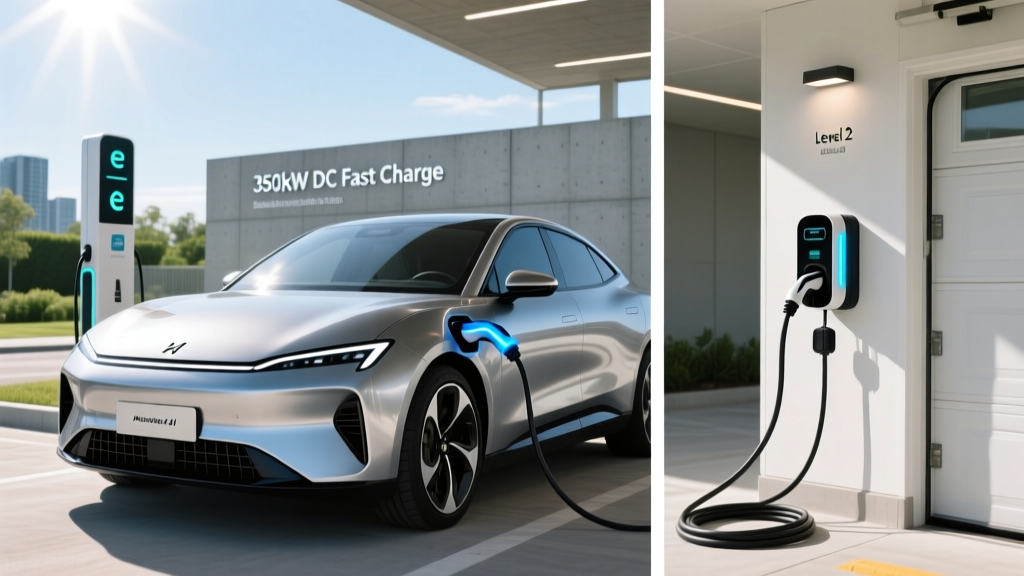
| DC Fast Charge | 400V–800V DC | 50–350 kW | 150–1,000+ mi/hr (peak) | Road trips, rapid top-ups | 15–45 minutes |
*Miles added per hour depends on vehicle efficiency. A 4.5 mi/kWh car on an 11.5 kW Level 2 charger gains ~52 mi/hr; a 2.5 mi/kWh truck gains ~29 mi/hr.
Why DC Fast Charging Isn't a Flat Rate
DC fast charging follows a charge curve, not a constant speed. A vehicle advertising "250 kW peak" may only sustain that rate between 10–30% state of charge (SoC). Above 50% SoC, the rate tapers significantly to protect the battery. Above 80%, charging slows to Level 2 speeds or slower.
For example, the Hyundai Ioniq 5 on a 350 kW Electrify America station peaks near 240 kW from 10–30% SoC, averages roughly 180 kW through 55%, then drops to 60–80 kW by 80%. The result: 10–80% in approximately 18 minutes. But charging from 80–100% at that same station could take another 25 minutes. This is why road-trip strategy focuses on 10–80% charges — the last 20% is painfully slow and rarely worth the wait.
Home Charger Installation: Electrical Requirements, Costs, and Panel Upgrades
Most EV owners do 80–90% of their charging at home on a Level 2 charger. Installing one involves electrical work that varies enormously in cost depending on your home's existing infrastructure.
Typical Electrical Requirements for Level 2 Charging
A standard Level 2 home charger requires a 240-volt dedicated circuit, similar to what an electric dryer or oven uses. The most common setups:
- 40-amp circuit / 32-amp continuous — delivers 7.7 kW, sufficient for most overnight charging (adds ~30–35 miles per hour for efficient sedans)
- 50-amp circuit / 40-amp continuous — delivers 9.6 kW, recommended for larger-battery vehicles or two-EV households
- 60-amp circuit / 48-amp continuous — delivers 11.5 kW, the practical maximum for most residential panels
Electrical code (NEC 2023, Article 625) requires that EV charging loads be treated as continuous, meaning the circuit must be rated at 125% of the charger's maximum draw. A 48-amp charger needs a 60-amp breaker.
Installation Cost Breakdown
| Component | Simple Install (panel nearby, no upgrade) | Complex Install (long run, panel upgrade needed) |
|---|---|---|
| Level 2 Charger (hardwired or NEMA 14-50) | $350–$700 | $350–$700 |
| Electrician labor (2–4 hrs simple / 6–12 hrs complex) | $300–$800 | $1,200–$3,500 |
| Electrical panel upgrade (100A → 200A, if needed) | $0 | $1,500–$4,000 |
| Permit and inspection | $50–$200 | $100–$350 |
| Conduit, wiring, and materials | $100–$300 | $400–$1,200 |
| Total Estimated Cost | $800–$2,000 | $3,550–$9,750 |
Permits and Code Requirements
Most jurisdictions require a permit for EV charger installation. Key code requirements include:
- Dedicated circuit — the charger cannot share a circuit with other major appliances
- GFCI protection — required for outdoor receptacles (NEMA 14-50); hardwired units may have built-in GFCI
- Outdoor rating — if mounted outside, the charger and any receptacle must be rated for wet locations (NEMA 4 or IP65)
- Cable management — NEC requires the charging cable to not create a trip hazard across walkways
Connector Compatibility: NACS, CCS, and CHAdeMO in 2025–2026
The connector landscape has consolidated significantly. Tesla's North American Charging Standard (NACS) has been adopted by nearly every major automaker for 2025–2026 models, but millions of CCS-equipped EVs remain on the road.
| Connector | Brands Using It (New Vehicles) | DC Fast Charge Networks | Adapter Needed? |
|---|---|---|---|
| NACS (Tesla standard) | Tesla, Ford, GM, Rivian, Volvo, Polestar, Hyundai, Kia (2025+), BMW, Mercedes | Tesla Supercharger, Electrify America (new stalls), EVgo, ChargePoint | CCS→NACS adapter for older CCS vehicles (~$100–$200) |
| CCS1 | Most 2024 and earlier non-Tesla EVs, some 2025 carryover models | Electrify America, EVgo, ChargePoint, older Supercharger access via adapter | NACS→CCS adapter for Tesla Supercharger access (e.g., Lectron, ~$150) |
| CHAdeMO | Nissan Leaf (discontinued), Mitsubishi Outlander PHEV (legacy) | Limited — declining availability | No adapter available; use CHAdeMO stations only |
For home Level 2 charging, all non-Tesla EVs use the J1772 connector. Tesla vehicles use a proprietary connector but include a J1772 adapter in the glovebox. Starting in 2025, most new EVs ship with NACS ports, and Level 2 home chargers are now available with native NACS cables (e.g., Tesla Wall Connector) or with J1772 connectors that work via adapter.
Cost Per Mile: Charging at Home vs. Public vs. Gas
The true cost advantage of an EV depends on where you charge and your vehicle's miles per kWh. Here's a realistic breakdown:
| Scenario | Rate | Vehicle Efficiency | Cost Per Mile | Annual Cost (12,000 mi) |
|---|---|---|---|---|
| Home charging (off-peak utility rate) | $0.10/kWh | 3.5 mi/kWh | $0.029 | $343 |
| Home charging (standard residential avg.) | $0.16/kWh | 3.5 mi/kWh | $0.046 | $549 |
| Public Level 2 (ChargePoint, EVgo) | $0.25–$0.39/kWh | 3.5 mi/kWh | $0.071–$0.111 | $857–$1,337 |
| DC fast charging (road trip, EA/EVgo) | $0.35–$0.55/kWh | 3.0 mi/kWh (highway) | $0.117–$0.183 | $1,400–$2,200 |
| Gasoline car (28 MPG combined) | $3.40/gal | 28 MPG | $0.121 | $1,457 |
| Gasoline truck (19 MPG combined) | $3.40/gal | 19 MPG | $0.179 | $2,147 |
Home charging is where EVs dominate. At off-peak rates of $0.10/kWh — available in many utility territories through time-of-use (TOU) plans — an efficient EV costs under 3 cents per mile to fuel. That's roughly one-quarter the cost of a 28 MPG gas car at $3.40/gallon.
However, if you rely entirely on DC fast charging at $0.45/kWh, your cost per mile can match or exceed a fuel-efficient gas car. The economics of EV ownership hinge on reliable home or workplace charging. Before buying, verify that you can install a Level 2 charger or that your employer offers workplace charging.
Time-of-Use Rates: Charge Smarter, Pay Less
Most utilities offer TOU plans that drop electricity rates to $0.06–$0.12/kWh between 10 PM and 6 AM. Setting your EV or charger to schedule charging during these windows can cut your fuel cost in half compared to standard rates. Smart chargers (see recommendations below) automate this with built-in scheduling and utility integration.
Recommended Home Level 2 Chargers: Specs, Features, and Pricing
Here are four proven Level 2 chargers that balance power, reliability, smart features, and value for 2025–2026 EV owners:
Tesla Wall Connector (Gen 3)
- Power output: 11.5 kW (48A) on 60A circuit
- Connector: Native NACS; J1772 adapter included
- Cable length: 24 ft
- Smart features: Wi-Fi, OTA updates, load sharing (pair two units on one circuit), power sharing
- Price: ~$475
- Best for: Tesla/NACS owners wanting maximum power and clean integration
ChargePoint Home Flex
- Power output: Up to 12 kW (50A) on 60A circuit; adjustable down to 16A
- Connector: J1772 (works with all EVs; NACS vehicles use included adapter)
- Cable length: 23 ft
- Smart features: Wi-Fi, app scheduling, TOU integration, Alexa, ENERGY STAR certified
- Price: ~$599
- Best for: Universal compatibility and flexible amperage for older panels
Emporia Level 2 EV Charger
- Power output: Up to 11.5 kW (48A) on 60A circuit
- Connector: J1772 or NACS (configurable at purchase)
- Cable length: 24 ft
- Smart features: Wi-Fi, integration with Emporia energy monitor, solar-aware scheduling, TOU
- Price: ~$399 (J1772) / ~$449 (NACS)
- Best for: Budget-conscious buyers with solar panels or energy monitoring
Grizzl-E Smart
- Power output: Up to 10 kW (40A) on 50A circuit
- Connector: J1772 (NACS adapter available)
- Cable length: 24 ft
- Smart features: Wi-Fi, OCPP support, adjustable amperage, extreme cold rated (-40°F)
- Price: ~$499
- Best for: Cold-climate durability and outdoor installations
All four units are hardwired or NEMA 14-50 plug compatible. Hardwired installations are generally preferred for 48A+ chargers because a NEMA 14-50 receptacle is limited to 50A circuits (40A continuous), capping you at 9.6 kW. If you want the full 11.5 kW, plan for a hardwired connection on a 60A circuit.
Charging Time Examples: How Long Does It Really Take?
Charge time depends on battery size, charger power, and the vehicle's onboard charger capacity (for Level 2) or DC fast-charge capability. Here are realistic 10–80% times for common scenarios:
| Vehicle (Battery Size) | Level 2 at 7.7 kW (32A) | Level 2 at 11.5 kW (48A) | DC Fast at 150 kW peak | DC Fast at 250+ kW peak |
|---|---|---|---|---|
| Tesla Model 3 LR (75 kWh) | ~7.5 hrs | ~5 hrs | ~30 min | ~22 min (V3 Supercharger) |
| Hyundai Ioniq 5 (77.4 kWh) | ~8 hrs | ~5.5 hrs | ~28 min | ~18 min (800V architecture) |
| Chevy Equinox EV (85 kWh) | ~8.5 hrs | ~5.5 hrs | ~32 min | ~25 min |
| Ford F-150 Lightning Ext. (131 kWh) | ~13 hrs | ~8.5 hrs | ~50 min | ~41 min |
| Rivian R1T Max Pack (141 kWh) | ~14 hrs | ~9.5 hrs | ~55 min | ~42 min |
Note that Level 2 charging at home is designed for overnight replenishment. Even the F-150 Lightning's 131 kWh battery gains roughly 75% charge in 8–9 hours on an 11.5 kW charger — more than enough for daily driving. DC fast charging is reserved for road trips, where the 10–80% window is the practical target.
Frequently Asked Questions
How much does it cost to install a home EV charger?
A straightforward Level 2 installation with an existing 200-amp panel and short wire run costs $800–$2,000 including the charger, electrician labor, permit, and materials. If your home needs a panel upgrade from 100A to 200A, total costs can reach $3,500–$9,750. Get at least two quotes from licensed electricians and ask for a load calculation before committing.
How fast will each charging level add range?
Level 1 (120V) adds 3–5 miles per hour — roughly 30–50 miles overnight. Level 2 (240V) at 7.7 kW adds 25–35 miles per hour for an efficient sedan, or 15–22 mi/hr for a large truck. DC fast charging at 150+ kW can add 150–300+ miles in 20 minutes, depending on vehicle efficiency and the charge curve taper.
Which connector is compatible with my EV?
For 2025–2026 models: Tesla, Ford, GM, Rivian, Volvo, and most Hyundai/Kia vehicles use NACS. Most 2024 and earlier non-Tesla EVs use CCS1. The Nissan Leaf uses CHAdeMO. For home Level 2 charging, all EVs accept J1772 or NACS — adapters bridge the gap. Check your vehicle's charge port or owner's manual to confirm.
How much does charging cost per mile compared to gas?
Home charging at $0.10–$0.16/kWh costs $0.03–$0.05 per mile for an efficient EV — about one-quarter the cost of a 28 MPG gas car at $3.40/gallon ($0.12/mile). Public DC fast charging at $0.35–$0.55/kWh costs $0.12–$0.18 per mile, comparable to or slightly more than gasoline. Home charging access is essential for EV cost savings.
What electrical upgrades might I need for a home charger?
The most common upgrade is a panel replacement from 100-amp to 200-amp service ($1,500–$4,000), required when your existing panel lacks capacity for a dedicated 40–60 amp EV circuit. You may also need new conduit runs if the charger is far from the panel (e.g., detached garage), or a sub-panel installation. A licensed electrician's load calculation will determine what's needed — don't skip this step.
Does cold weather affect miles per kWh?
Yes, significantly. Battery chemistry slows in cold temperatures, cabin heating draws energy, and air density increases aerodynamic drag. Expect 15–30% lower miles per kWh at 30°F and 25–40% lower at 0°F compared to EPA ratings. Vehicles with heat pumps (standard on most 2025+ EVs) mitigate this by 5–10 percentage points. Preconditioning your battery while plugged in recovers some efficiency.
Understanding how many miles per kWh your EV delivers — and how charging infrastructure, cost, and conditions affect that number — is the foundation of confident EV ownership. Pair an efficient vehicle with home Level 2 charging on off-peak rates, and your per-mile fuel cost drops below almost any gasoline alternative on the market.