If you've just taken delivery of a 2025 or 2026 Mercedes-Benz EV — whether it's the EQE 350+, the EQS sedan, or the newer CLA EV — you've probably been offered the Mercedes-Benz Wallbox Home at the dealership or through the Mercedes me portal. The pitch is appealing: an OEM-branded charger styled to match your garage, integrated with your vehicle's app ecosystem, and backed by the three-pointed star. But at a premium price point compared to third-party Level 2 chargers, is the Mercedes Wallbox the smart play, or are you paying a logo tax?
After installing and living with the Mercedes Wallbox Home alongside units like the ChargePoint Home Flex and Enel X Way, here's a data-driven breakdown of what this charger actually delivers — including real charge times, electrical requirements, installation costs, and whether a third-party unit might serve you better.
Mercedes-Benz Wallbox Home: Core Specifications
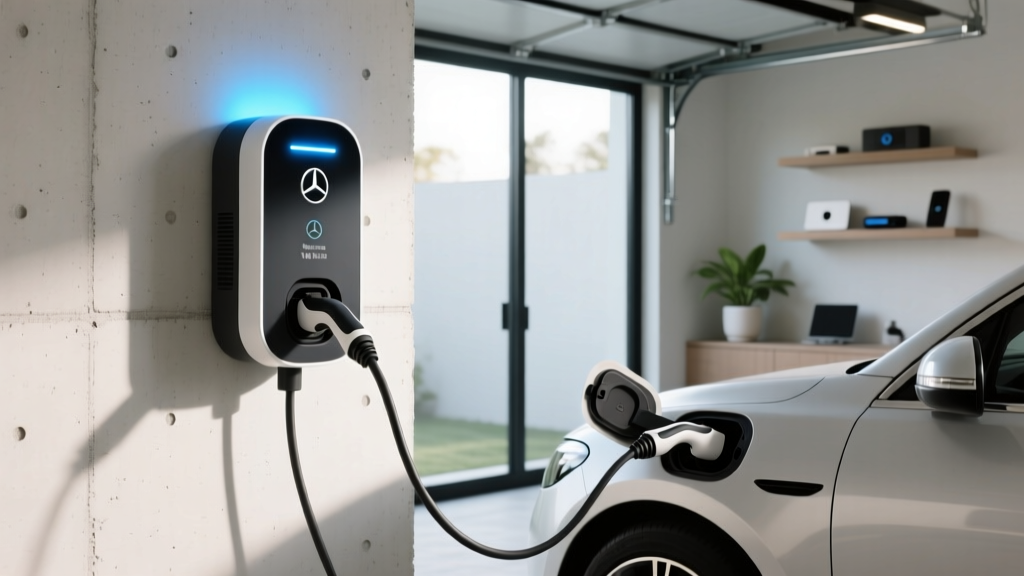
The current-generation Mercedes-Benz Wallbox Home is a hardwired Level 2 AC charger designed for residential use. Here's what you're working with:
| Specification | Value |
|---|---|
| Max Power Output | 11.5 kW (48A at 240V) |
| Adjustable Amperage | 16A / 24A / 32A / 40A / 48A via DIP switches |
| Connector (North America) | CCS1 (J1772 + DC pins, AC-only output) |
| NACS Compatibility | Requires CCS1-to-NACS adapter (sold separately) |
| Cable Length | 24 feet (7.3 m) |
| Wi-Fi / Smart Features | Yes — Mercedes me connect integration, scheduled charging, energy monitoring |
| Indoor/Outdoor Rating | NEMA 4 (indoor/outdoor rated) |
| Energy Star Certified | Yes |
| MSRP (charger unit only) | ~$599–$699 |
| Warranty | 3 years |
How Fast Does Each Charging Level Add Range?
Before we get into the Wallbox specifically, it's worth understanding where Level 2 home charging fits in the broader EV charging landscape. Here's a practical reference:
| Charging Level | Voltage | Power (kW) | Miles of Range Added per Hour | Typical Use Case |
|---|---|---|---|---|
| Level 1 | 120V AC | 1.0–1.4 kW | 3–5 mi/hr | Emergency / overnight trickle for small batteries or PHEVs |
| Level 2 (Standard) | 240V AC | 7.2–11.5 kW | 25–44 mi/hr | Home daily charging — the sweet spot for most EV owners |
| DC Fast Charging | 400–800V DC | 50–350 kW | 150–800+ mi/hr (peak) | Road trips, highway corridors — not for daily home use |
The Mercedes Wallbox Home sits at the upper end of Level 2. At 11.5 kW, it delivers approximately 38–44 miles of range per hour depending on your vehicle's efficiency. For context, the 2026 EQE 350+ achieves roughly 3.0 mi/kWh (about 90 MPGe combined per fueleconomy.gov), meaning an hour on the Wallbox adds roughly 34 miles. A less efficient vehicle like the EQS SUV might see closer to 28–30 miles per hour of charging.
Real-World Charge Times: Mercedes Wallbox on Current EQ Models
Here's what 10–80% charge looks like on the Wallbox at its full 11.5 kW output, factoring in typical AC charging losses (~5–8%):
| Vehicle | Usable Battery (kWh) | 10–80% Time (est.) | Overnight 20–80% (est.) |
|---|---|---|---|
| 2026 EQE 350+ | 90.6 kWh | ~6 hr 15 min | ~5 hr 30 min |
| 2026 EQS 450+ Sedan | 107.8 kWh | ~7 hr 30 min | ~6 hr 30 min |
| 2026 EQS SUV 450 4MATIC | 108.4 kWh | ~7 hr 40 min | ~6 hr 45 min |
| 2026 EQB 350 4MATIC | 66.5 kWh | ~4 hr 40 min | ~4 hr |
| 2026 CLA EV (announced) | ~85 kWh (preliminary) | ~5 hr 50 min | ~5 hr |
For most Mercedes EV owners, the pattern is simple: plug in when you get home at 25–40% SoC, wake up to 80% by morning. Even the largest batteries (EQS sedan/SUV) top up comfortably overnight. The 11.5 kW output is more than adequate for residential daily use — you simply don't need faster AC charging at home unless you're running a commercial fleet.
Connector Compatibility: NACS, CCS1, and Adapter Needs
The North American EV charging landscape has shifted dramatically toward NACS (the Tesla-originated connector now standardized as SAE J3400). Here's where the Mercedes Wallbox fits:
| EV Brand / Model Year | Native Connector | Works with Mercedes Wallbox? | Adapter Needed? |
|---|---|---|---|
| Mercedes-Benz EQE/EQS/EQB (2022–2024) | CCS1 | Yes — direct plug | None |
| Mercedes-Benz (2025+ models transitioning to NACS) | NACS | Yes — with adapter | NACS-to-J1772 adapter (~$150–$250) |
| Tesla Model Y / Model 3 | NACS | Yes — with adapter | NACS-to-J1772 adapter |
| Ford Mustang Mach-E, F-150 Lightning | NACS (2025+) | Yes — with adapter | NACS-to-J1772 adapter |
| Hyundai Ioniq 5 / Kia EV6 (pre-2026) | CCS1 | Yes — direct plug | None |
| Nissan Ariya / Leaf | CCS1 / CHAdeMO (Leaf) | CCS1: Yes / CHAdeMO: No | CHAdeMO vehicles cannot use this charger |
The NACS transition matters here. If you're buying a 2025+ Mercedes that ships with a NACS port, you'll need a NACS-to-J1772 adapter to use the Wallbox (which outputs through a CCS1/J1772 connector). Mercedes and third-party suppliers offer these adapters, but it's an additional $150–$250 cost. If you own a mix of EVs in your household — say, a Mercedes and a Tesla — a CCS1-output charger like the Wallbox with an adapter is workable but adds friction. Some buyers opt for a native NACS charger (like the Tesla Universal Wall Connector) instead to avoid the adapter step.
Electrical Requirements and Home Installation Costs
The Mercedes Wallbox Home is a hardwired unit — it does not plug into a standard outlet. This means professional installation by a licensed electrician is required, and the total cost goes well beyond the $599–$699 charger MSRP.
Electrical Specifications
- Voltage: 240V AC (split-phase, standard US residential)
- Amperage: Up to 48A continuous draw, requiring a 60A dedicated circuit breaker (NEC code requires 125% overhead for continuous loads: 48A × 1.25 = 60A)
- Wire gauge: Typically 6 AWG copper (THHN in conduit or NM-B/Romex, depending on local code)
- Panel capacity: Your main electrical panel must have sufficient spare capacity — ideally 200A service for homes running a 48A EV circuit alongside HVAC, electric range, and dryer
Installation Cost Breakdown
| Cost Component | Low Estimate | High Estimate | Notes |
|---|---|---|---|
| Mercedes Wallbox Home (unit) | $599 | $699 | Purchased through Mercedes dealer or me portal |
| Electrician labor (standard install) | $500 | $1,200 | Running wire from panel to garage, mounting unit, 1–4 hours |
| Materials (wire, conduit, breaker) | $150 | $400 | Varies with distance from panel to charger location |
| Electrical permit | $50 | $200 | Required in most jurisdictions — varies by city/county |
| Panel upgrade (if needed) | $1,500 | $4,000+ | Only if your panel is maxed out or is 100A service — common in pre-2000 homes |
| Total (no panel upgrade) | $1,299 | $2,499 | Typical for most homes with 200A service |
| Total (with panel upgrade) | $2,799 | $6,499+ | Older homes or those adding solar/battery simultaneously |
Can You Run the Wallbox at Lower Amperage?
Yes — and this is one of the Wallbox's practical strengths. DIP switches inside the unit let your electrician set the output to 16A, 24A, 32A, 40A, or 48A. If your panel can't support a 60A breaker but can handle a 50A breaker, the Wallbox can be set to 40A continuous (9.6 kW). You lose about 17% of peak charging speed, but for overnight charging, the difference is negligible — you're still waking up to a full battery. This flexibility is a genuine advantage over fixed-amperage units.
How Much Does Charging Cost Per Mile vs. Gas?
The economics of home charging remain one of the strongest arguments for EV ownership. Let's compare real costs using the 2026 EQE 350+ (EPA combined efficiency: ~94 MPGe, or roughly 33 kWh per 100 miles) as our baseline.
| Charging Scenario | Cost per kWh | Cost per 100 Miles | Cost per Mile |
|---|---|---|---|
| Home — off-peak utility rate | $0.10–$0.14 | $3.30–$4.62 | $0.033–$0.046 |
| Home — standard residential rate (US avg.) | $0.16–$0.18 | $5.28–$5.94 | $0.053–$0.059 |
| Home — peak / high-cost state (CA, HI, MA) | $0.28–$0.42 | $9.24–$13.86 | $0.092–$0.139 |
| Public Level 2 (ChargePoint, EVgo L2) | $0.25–$0.49 | $8.25–$16.17 | $0.083–$0.162 |
| DC Fast Charging (Electrify America, Tesla SC) | $0.35–$0.61 | $11.55–$20.13 | $0.116–$0.201 |
| Gas comparison: Mercedes E 350 (25 MPG combined, $3.40/gal) | |||
| Gasoline equivalent | $3.40/gal | $13.60 | $0.136 |
The takeaway: Charging at home on off-peak rates costs roughly one-quarter to one-third what you'd spend on gas for an equivalent Mercedes sedan. Even at peak residential rates in high-cost states, home charging is competitive with or cheaper than premium gasoline. Public DC fast charging is the most expensive option — in some cases exceeding the per-mile cost of gas — which is why home Level 2 charging is the economic foundation of EV ownership.
The Mercedes Wallbox includes energy monitoring through the Mercedes me app, so you can track your kWh consumption and cost per session. Pair this with a time-of-use (TOU) utility plan that offers off-peak rates between 10 PM and 6 AM, and you'll minimize cost per mile significantly. Many utilities offer EV-specific rate plans — check with your provider.
Mercedes Wallbox vs. ChargePoint, Enel X, and Tesla: Equipment Comparison
The Wallbox Home competes in a crowded field of premium Level 2 chargers. Here's how it stacks up on the specs that matter:
Mercedes-Benz Wallbox Home
- Power: 11.5 kW (48A)
- Connector: CCS1 (J1772 AC)
- Cable: 24 ft
- Smart features: Mercedes me integration, scheduled charging, load management
- Price: $599–$699
- Pros: Seamless Mercedes app integration, adjustable amperage, NEMA 4 outdoor rated, Energy Star
- Cons: CCS1 connector requires adapter for NACS vehicles, app ecosystem locked to Mercedes, no plug-in (NEMA 14-50) option, limited non-Mercedes smart features
ChargePoint Home Flex
- Power: 12.0 kW (50A)
- Connector: J1772 (CCS1 compatible) or NACS (2025+ version)
- Cable: 23 ft
- Smart features: ChargePoint app, Alexa, scheduling, energy reports, works with any EV brand
- Price: $549–$699
- Pros: Brand-agnostic app, NEMA 14-50 plug or hardwire option, NACS version available, strong third-party ecosystem
- Cons: Slightly bulkier unit, no native Mercedes integration, app can be cluttered
Enel X Way JuiceBox Pro 48
- Power: 11.5 kW (48A)
- Connector: J1772
- Cable: 25 ft
- Smart features: JuiceNet app, scheduling, energy tracking, utility demand-response programs
- Price: $499–$599
- Pros: Lower price point, utility program integration for rebates, longest cable in class
- Cons: Enel X Way US operations have faced uncertainty — check current support/warranty status before purchasing
Tesla Universal Wall Connector
- Power: 11.5 kW (48A)
- Connector: NACS with integrated J1772 adapter (Magic Dock-style)
- Cable: 24 ft
- Smart features: Tesla app, Power Share (load balancing between two units), works with any EV
- Price: $599
- Pros: Built-in NACS + J1772 — no separate adapter needed, clean design, Power Share for multi-EV garages
- Cons: Tesla app ecosystem (non-Tesla EVs get limited smart features), no Energy Star certification on all SKUs
Our Equipment Verdict
Buy the Mercedes Wallbox Home if: You own exclusively Mercedes-Benz EVs, value the Mercedes me app integration, and want a single ecosystem for vehicle and charger management. The adjustable amperage is a genuine advantage for homes with panel constraints.
Choose the ChargePoint Home Flex if: Your household has mixed EV brands (Mercedes + Tesla + Hyundai, for example) and you want a brand-agnostic platform. The NACS version eliminates adapter needs for newer vehicles, and the plug-in NEMA 14-50 option gives you portability if you move.
Consider the Tesla Universal Wall Connector if: You're transitioning to NACS across your fleet and want a single charger that natively serves both Tesla and non-Tesla vehicles without any adapter purchase. The Power Share feature is excellent for two-EV households sharing a single 60A circuit.
Safety, Code Compliance, and Installation Best Practices
Hardwired Level 2 chargers are subject to the National Electrical Code (NEC) and local amendments. Here's what your installation must address:
- Dedicated circuit: The Wallbox requires its own dedicated breaker — it cannot share a circuit with other appliances. For 48A continuous draw, that's a 60A double-pole breaker.
- GFCI protection: NEC 2020/2023 (Article 625) requires GFCI protection for EV supply equipment. The Wallbox has built-in ground-fault protection, but some jurisdictions require an additional GFCI breaker. Your electrician will determine this based on local code.
- Outdoor rating: The Wallbox is NEMA 4 rated, meaning it can withstand rain, splashing water, and dust — suitable for outdoor mounting. However, direct sun exposure in hot climates (AZ, TX, FL) can degrade the housing and cable over time. A shaded mounting location or protective cover is recommended.
- Cable management: The 24-foot cable should be managed with an integrated holster or wall hook to prevent tripping hazards and cable damage. Mercedes includes a cable wrap on the unit.
- Permit and inspection: Most municipalities require an electrical permit for EV charger installation ($50–$200). The work must pass inspection before the circuit is energized. Do not skip this step — unpermitted work can void homeowner's insurance claims related to electrical fires.
- Utility notification: Some utilities require notification before adding a significant new load (48A is substantial). They may offer a dedicated EV meter or TOU rate plan that saves you money. Check before installation.
Federal Tax Credit and Incentive Considerations
The Alternative Fuel Vehicle Refueling Property Credit (IRS Form 8911) can cover up to 30% of the cost of home EV charging equipment and installation, capped at $1,000. This is separate from the §30D new clean vehicle credit for the car itself.
Key eligibility points for the refueling property credit:
- The equipment must be installed at your primary residence in the United States.
- The property must be placed in service during the tax year.
- Eligibility is subject to census tract requirements — the credit is available primarily in non-urban or low-income census tracts per the Inflation Reduction Act provisions. Check your eligibility using the IRS census tract tool or consult a tax professional.
- The credit is non-refundable — it can reduce your tax liability to zero but won't generate a refund beyond that.
- State and utility rebates may stack on top of the federal credit. Many utilities offer $250–$1,000 rebates for Level 2 charger installation — check energy.gov for state-specific programs.
Always consult a qualified tax professional for your specific situation. Tax credit rules change, and eligibility depends on individual circumstances including income, filing status, and property location.
Frequently Asked Questions
How much does it cost to install a Mercedes Wallbox charger at home?
Expect $1,299–$2,499 total (charger + electrician + materials + permit) for a standard installation in a home with adequate 200A panel capacity. If your home needs a panel upgrade, add $1,500–$4,000+. Get at least two quotes from licensed electricians — prices vary significantly by region and job complexity.
How fast will the Mercedes Wallbox charge my EQE or EQS overnight?
At full 11.5 kW output, the Wallbox adds approximately 34–44 miles of range per hour depending on your model's efficiency. A 10–80% charge on an EQE 350+ (90.6 kWh battery) takes roughly 6 hours 15 minutes. For most owners, plugging in at 30% SoC in the evening means a full 80% charge well before morning.
Is the Mercedes Wallbox compatible with non-Mercedes EVs?
Yes — the CCS1/J1772 connector works with virtually all non-Tesla EVs natively. For NACS-equipped vehicles (Teslas, 2025+ Ford/Hyundai/Mercedes models), you'll need a NACS-to-J1772 adapter. The charger itself is brand-agnostic for basic charging; however, smart features (scheduled charging, energy monitoring) are optimized for the Mercedes me app.
How much does home charging cost per mile compared to gas?
At the US average residential rate of ~$0.17/kWh, charging an EQE 350+ costs approximately $0.056 per mile — roughly 41% of what you'd pay for premium gasoline in a comparable E 350 sedan ($0.136/mile at 25 MPG and $3.40/gallon). Off-peak utility rates drop this to $0.033–$0.046 per mile.
What electrical upgrades might I need for the Mercedes Wallbox?
The most common upgrade is a panel capacity increase from 100A to 200A service, required in older homes that lack headroom for a 60A dedicated EV circuit. Other potential upgrades include: adding a sub-panel in a detached garage, upgrading aluminum wiring to copper, or installing a whole-home surge protector. Your electrician will identify these during a pre-install assessment.
Can I install the Mercedes Wallbox myself?
No — and you shouldn't try. The Wallbox is hardwired (not plug-in), requires a 240V/60A dedicated circuit, and must comply with NEC Article 625 and local codes. Unpermitted, DIY electrical work at this amperage poses fire and shock risks and may void your homeowner's insurance. Always use a licensed electrician.
Does the Mercedes Wallbox work with solar panels or home batteries?
The Wallbox itself does not have native solar-matching or V2H (vehicle-to-home) capability. However, it can be paired with a solar system through smart load management — some solar inverters (Enphase, SolarEdge) offer EV charger integration that prioritizes solar-generated electricity for charging. If you have or plan to install solar, mention this to your electrician during the charger install so they can plan the circuit layout accordingly.