The Short Answer: Yes, But It Depends on Your Model and Connector
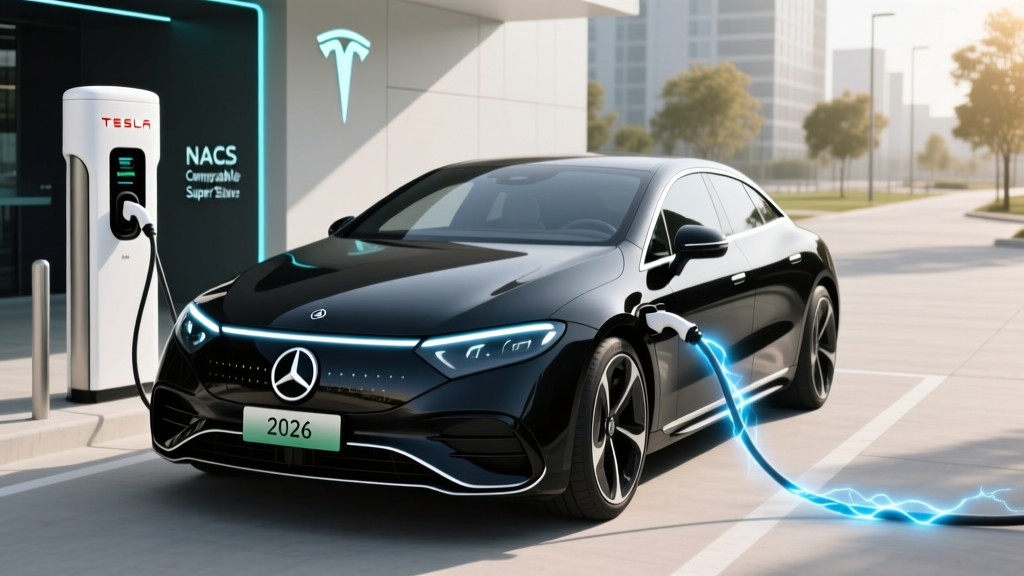
If you own a Mercedes-Benz EV or plug-in hybrid and you're wondering whether you can pull up to a Tesla Supercharger and plug in, the answer in 2026 is nuanced. Newer Mercedes models built with the North American Charging Standard (NACS) port can access Tesla Superchargers natively. Older models equipped with CCS1 connectors require a certified adapter. And for home charging, the situation is even more straightforward — Tesla's Wall Connector works with any NACS-equipped Mercedes, while a J1772 adapter opens up compatibility for CCS models.
This guide covers every compatibility scenario for Mercedes-EQ and Mercedes PHEV owners, breaks down the real costs of home charger installation, and explains exactly what equipment you need to charge at home or on the road.
Mercedes Connector Compatibility at a Glance
| Mercedes Model (2024–2026) | Native Port | Tesla Supercharger Access | Adapter Required? |
|---|---|---|---|
| EQS Sedan (2025+ NACS update) | NACS | Yes — native | No |
| EQS SUV (2025+ NACS update) | NACS | Yes — native | No |
| EQE Sedan/SUV (2025+ NACS update) | NACS | Yes — native | No |
| EQB (2024–2026) | CCS1 | Yes — with adapter | CCS-to-NACS adapter |
| EQS (2022–2024) | CCS1 | Yes — with adapter | CCS-to-NACS adapter |
| EQE (2023–2024) | CCS1 | Yes — with adapter | CCS-to-NACS adapter |
| S 580e PHEV | J1772 (AC only) | No (Level 2 only) | J1772-to-NACS for Tesla Wall Connector |
Mercedes-Benz began transitioning its US-market EV lineup to NACS starting with the 2025 model year, aligning with the broader industry shift. According to Mercedes-Benz USA, vehicles equipped with NACS can access Tesla's Supercharger network — now exceeding 25,000 stalls nationwide — without any additional hardware. For CCS1-equipped models, Mercedes has approved third-party CCS-to-NACS adapters, and Tesla's own adapter (priced around $250) is also compatible.
Charging Levels Explained: How Fast Will Each Level Add Range?
Before selecting equipment, you need to understand the three charging levels available to Mercedes EV owners. The critical distinction: kW (kilowatts) measures power — how fast energy flows into your battery. kWh (kilowatt-hours) measures energy — the total capacity of your battery. Think of kW as the width of a hose and kWh as the size of the bucket.
| Charging Level | Voltage | Power (kW) | Miles of Range Added Per Hour | Typical Use Case |
|---|---|---|---|---|
| Level 1 (120V AC) | 120V | 1.0–1.4 kW | 3–5 mi/hr | Overnight top-up, emergencies |
| Level 2 (240V AC) | 240V | 7.2–19.2 kW | 20–65 mi/hr | Home daily charging, workplace |
| DC Fast Charging | 400V–800V DC | 50–350 kW | 150–800+ mi/hr (equivalent) | Road trips, rapid top-ups |
For context, the 2026 Mercedes EQS 450+ carries a 107.8 kWh usable battery (NMC chemistry) with an EPA-estimated range of 385 miles. On a Level 2 charger at 11 kW, a full charge from 10% takes roughly 10 hours. On a 200 kW DC fast charger, the EQS can add 10–80% in approximately 31 minutes, though the charge curve tapers significantly above 80% SoC — a protection measure to preserve battery health.
The smaller EQB 350 4MATIC, with its 66.5 kWh battery and 227-mile EPA range, charges from 10–80% in about 32 minutes on a 100 kW DC fast charger and fully replenishes overnight on a Level 2 home unit at 7.2 kW in roughly 9 hours.
Connector Compatibility: NACS, CCS1, and What You Need
The connector landscape in 2026 has largely consolidated around NACS, but millions of CCS1-equipped vehicles remain on the road. Here's what each standard means for Mercedes owners:
- NACS (North American Charging Standard): Originally Tesla's proprietary connector, now an open standard adopted by Mercedes, Ford, GM, Rivian, Hyundai, and others. Smaller, lighter plug. Supports both AC Level 2 and DC fast charging through the same port.
- CCS1 (Combined Charging System): The previous industry standard. Larger connector with separate AC and DC pins. Still found on 2022–2024 Mercedes-EQ models and most non-Tesla EVs built before 2025.
- CHAdeMO: Legacy DC standard (Nissan Leaf, older Mitsubishi). Not used on any Mercedes product. Largely phased out of new infrastructure.
Connector Quick Reference
| Connector | AC Charging | DC Fast Charging | Used By Mercedes? | Adapter to NACS Available? |
|---|---|---|---|---|
| NACS | Yes | Yes | 2025+ models | N/A (native) |
| CCS1 | Yes (via J1772 upper) | Yes | 2022–2024 models | Yes (~$200–$300) |
| CHAdeMO | No | Yes | No | Limited/none |
| J1772 | Yes | No | PHEVs (AC only) | Yes (~$100–$150) |
Adapter reality check: If you own a 2022–2024 EQS or EQE with CCS1, you'll need a CCS-to-NACS adapter to use Tesla Superchargers. Tesla sells an official adapter for approximately $250, and Lectron offers a third-party option around $200. These adapters handle up to 250 kW DC fast charging. However, be aware that adapters add a connection point that can introduce slight efficiency loss and, in rare cases, communication handshake failures between the vehicle and charger. Always carry your adapter in the vehicle — forgetting it means no Supercharger access.
How Much Does It Cost to Install a Home EV Charger?
Home Level 2 charging is where Mercedes EV owners will do 80–90% of their charging. But installation costs vary dramatically based on your home's electrical infrastructure. Here's the full breakdown:
Electrical requirements for a typical Level 2 installation:
- Voltage: 240V (same as a dryer or oven circuit)
- Amperage: 40A circuit for a 32A continuous charger, or 60A circuit for a 48A charger (NEC requires circuits rated at 125% of continuous load)
- Dedicated circuit: Required — you cannot share with other appliances
- Permit: Required in most jurisdictions; cost varies by municipality
Home Level 2 Charger Installation Cost Breakdown
| Component | Low Estimate | High Estimate | Notes |
|---|---|---|---|
| Level 2 Charger Equipment | $400 | $750 | 32A–48A smart charger, NACS or J1772 |
| Electrician Labor (standard install) | $500 | $1,500 | 240V run from panel to garage, <50 ft |
| Electrical Permit | $50 | $300 | Varies by city/county |
| Panel Upgrade (if needed) | $1,500 | $4,000 | 100A → 200A service upgrade for older homes |
| Conduit/Wiring (long runs) | $200 | $800 | If panel is far from garage, >50 ft |
| Total (no panel upgrade) | $950 | $2,550 | Most homes built after 2000 |
| Total (with panel upgrade) | $2,450 | $6,550 | Homes with 100A service or full panels |
The panel-upgrade gotcha: Many homes built before 1990 have 100-amp electrical service. Adding a 40A or 60A dedicated EV circuit to an already-loaded 100A panel is unsafe and will fail inspection. A service upgrade to 200A typically costs $1,500–$4,000 depending on your utility's requirements, trenching needs, and local labor rates. Always have a licensed electrician perform a load calculation before committing to a charger install.
Some utilities offer rebates of $200–$500 for Level 2 installations, and certain states provide additional incentives. Check your local utility's EV program page for current offers.
Cost to Charge: Home vs. Public vs. Gas — The Real Per-Mile Numbers
One of the strongest arguments for a Mercedes EV over a comparable gas-powered Mercedes is the per-mile fuel cost. But the savings depend heavily on where and when you charge.
Charging Cost Scenarios vs. Gasoline (2026 Averages)
| Scenario | Rate ($/kWh) | Cost to Charge 107.8 kWh (EQS) | Cost Per Mile (385 mi range) | vs. Gas (25 MPG, $3.50/gal) |
|---|---|---|---|---|
| Home Off-Peak (utility rate) | $0.08–$0.12 | $8.62–$12.94 | $0.022–$0.034 | 87–92% cheaper |
| Home Standard Rate | $0.13–$0.18 | $14.01–$19.40 | $0.036–$0.050 | 76–86% cheaper |
| Public Level 2 (ChargePoint, etc.) | $0.25–$0.40 | $26.95–$43.12 | $0.070–$0.112 | 44–74% cheaper |
| DC Fast (Electrify America/Tesla) | $0.35–$0.55 | $37.73–$59.29 | $0.098–$0.154 | 20–64% cheaper |
| Gas Equivalent (S 500, 25 MPG) | — | $53.90 (15.4 gal) | $0.140 | Baseline |
Key takeaway: A Mercedes EQS owner charging primarily at home on off-peak rates pays roughly $0.03/mile in electricity — compared to $0.14/mile for gasoline in a comparable S 500. Over 15,000 miles annually, that's a savings of approximately $1,650/year. However, if you rely exclusively on DC fast charging at $0.50/kWh, your per-mile cost climbs to ~$0.14, essentially matching gasoline. Home charging access is the economic linchpin of EV ownership.
For the smaller EQB with its 66.5 kWh battery, a full home charge at $0.12/kWh costs just $7.98 — enough for 227 EPA-rated miles at $0.035/mile.
Recommended Home Chargers for Mercedes EVs (2026)
Not all Level 2 chargers are equal. Here are three proven options that pair well with Mercedes EVs, selected for reliability, smart features, and appropriate power output:
Tesla Wall Connector (NACS)
- Power Output: Up to 11.5 kW (48A on 60A circuit)
- Connector: NACS native
- Cable Length: 24 ft
- Smart Features: Wi-Fi, OTA updates, power sharing between units, access control
- Price: ~$475
- Best For: 2025+ NACS-equipped Mercedes EQS, EQE, EQS SUV. CCS owners need the Tesla J1772 adapter ($50) or a CCS-to-NACS adapter on the vehicle side.
ChargePoint Home Flex (J1772/NACS)
- Power Output: Up to 12 kW (50A on 60A circuit); adjustable down to 16A
- Connector: Available in J1772 or NACS
- Cable Length: 23 ft
- Smart Features: Wi-Fi, Alexa integration, scheduled charging, detailed energy reporting via app
- Price: ~$550–$700
- Best For: CCS1-equipped Mercedes (J1772 version) or NACS models. The adjustable amperage is ideal for homes with limited panel capacity.
Emporia Vue Level 2 Charger
- Power Output: Up to 11.5 kW (48A on 60A circuit)
- Connector: J1772 or NACS
- Cable Length: 24 ft
- Smart Features: Energy monitoring, solar integration, scheduled charging, budget-friendly smart features
- Price: ~$400–$500
- Best For: Budget-conscious Mercedes owners who want smart scheduling and solar-aware charging without premium pricing.
Important installation note: All three chargers above require a dedicated 240V circuit. The Tesla Wall Connector and Emporia can both be hardwired (preferred for outdoor installs) or plugged into a NEMA 14-50 outlet. If you choose a plug-in install, ensure your electrician installs a GFCI breaker as required by NEC 2020 and later for outdoor receptacles. Hardwired installations avoid the GFCI requirement and are generally more reliable long-term.
Safety, Code, and Electrical Considerations
EV charging involves sustained high-current draw for hours — a fundamentally different load profile than most household appliances. Here's what you need to know:
- Dedicated circuit: NEC Article 625 requires EV charging equipment to be on a dedicated branch circuit. No sharing with garage outlets, lights, or other appliances.
- GFCI protection: Required for all outdoor receptacles (NEC 2020+). Hardwired chargers are exempt from the receptacle GFCI rule, which is one reason electricians often prefer hardwired installs.
- Outdoor rating: If mounting outside, ensure the charger carries a NEMA 4 or IP55+ rating. The Tesla Wall Connector and ChargePoint Home Flex are both rated for outdoor use.
- Load calculation: A licensed electrician must perform a NEC Article 220 load calculation to verify your panel can handle the additional 40A–60A draw. This is non-negotiable for permit approval.
- Wire gauge: 6 AWG copper for 48A circuits; 4 AWG for 60A circuits over longer runs. Your electrician will specify based on run length and local code.
For Mercedes PHEV owners (like the S 580e or GLC 350e), the smaller batteries (13–23 kWh) and AC-only J1772 charging mean lower electrical demands. A 240V/16A circuit (3.8 kW) is typically sufficient and may not require a panel upgrade even in older homes.
Mercedes EV Charging Times: Model-by-Model Breakdown
Charge times depend on battery size, charger power, and the vehicle's onboard charger capacity. Here are realistic 10–80% times for current Mercedes electrified models:
| Model | Battery (kWh usable) | Max DC Charge Rate | 10–80% DC Fast Time | Level 2 (11 kW) Full Charge | EPA Range |
|---|---|---|---|---|---|
| EQS 450+ (2026) | 107.8 kWh (NMC) | 200 kW | ~31 min | ~10 hrs | 385 mi |
| EQS 580 4MATIC | 107.8 kWh (NMC) | 200 kW | ~31 min | ~10 hrs | 345 mi |
| EQE 350+ | 90.6 kWh (NMC) | 170 kW | ~32 min | ~8.5 hrs | 305 mi |
| EQS SUV 450+ | 108.4 kWh (NMC) | 200 kW | ~32 min | ~10 hrs | 330 mi |
| EQB 350 4MATIC | 66.5 kWh (NMC) | 100 kW | ~32 min | ~6.5 hrs (7.2 kW) | 227 mi |
| S 580e PHEV | 23.3 kWh (NMC) | N/A (AC only) | N/A | ~2.5 hrs (9.6 kW) | 48 mi (EV) |
Real-world range reality: EPA estimates assume mixed driving at moderate temperatures. On sustained highway driving at 75+ mph, expect 10–15% less range. In cold weather (below 32°F), battery efficiency drops and cabin heating draws additional power — plan for 20–30% range reduction. A 385-mile EPA EQS may deliver 270–300 miles on a winter highway trip. Preconditioning the battery before fast charging (a feature built into Mercedes' MBUX navigation when a charger is set as your destination) can recover some of this loss by warming the battery to optimal charging temperature.
Frequently Asked Questions
Can Mercedes use Tesla chargers without an adapter?
2025 and newer Mercedes-EQ models equipped with a NACS port can use Tesla Superchargers and Tesla Destination Chargers natively, without any adapter. If your Mercedes has a CCS1 port (most 2022–2024 models), you need a CCS-to-NACS adapter, available from Tesla (~$250) or third-party brands like Lectron (~$200).
How much does it cost to install a home EV charger?
A standard Level 2 home installation runs $950–$2,550 including equipment ($400–$750), electrician labor ($500–$1,500), and permit ($50–$300). If your home needs a panel upgrade from 100A to 200A service, add $1,500–$4,000, bringing the total to $2,450–$6,550. Always get a load calculation from a licensed electrician first.
How fast will each charging level add range to my Mercedes?
Level 1 (120V) adds roughly 3–5 miles per hour — too slow for daily use on large batteries. Level 2 (240V) adds 20–65 miles per hour depending on amperage, easily replenishing a full EQS overnight. DC fast charging at 200 kW can add an EQS's 10–80% charge in about 31 minutes, equivalent to hundreds of miles per hour of plug-in time.
How much does charging cost per mile compared to gas?
Home charging at off-peak rates ($0.10/kWh) costs roughly $0.03/mile in an EQS — about 87% cheaper than gasoline at $3.50/gallon and 25 MPG ($0.14/mile). Public DC fast charging at $0.45/kWh costs roughly $0.13/mile, narrowing the savings significantly. The economics strongly favor home charging.
What electrical upgrades might I need for a home charger?
Homes with 200A service and available panel space typically need only a dedicated 240V circuit — no upgrade required. Homes with 100A service, older wiring, or panels near capacity may need a full service upgrade ($1,500–$4,000). A licensed electrician's load calculation is the only way to know for certain. Some utilities offer "make-ready" programs that cover part of the upgrade cost.
Will using a CCS-to-NACS adapter void my Mercedes warranty?
Mercedes-Benz has stated that using certified adapters for DC fast charging does not void the vehicle's battery or powertrain warranty. However, damage caused by a defective third-party adapter may not be covered. Stick with Tesla's official adapter or reputable brands like Lectron, and keep your purchase receipt.
Can I charge my Mercedes PHEV at a Tesla Supercharger?
No. Mercedes PHEVs (S 580e, GLC 350e, etc.) have AC-only J1772 ports and cannot accept DC fast charging of any kind. You can use a Tesla Level 2 Wall Connector at home with a J1772-to-NACS adapter, but Superchargers are DC-only and incompatible with PHEV hardware.
For the latest on Mercedes-EQ specifications and charging compatibility, refer to Mercedes-Benz USA's electric vehicle portal. For federal charging infrastructure tax credits (up to $1,000 for home charger equipment and installation under IRS §30C), consult a tax professional to confirm eligibility based on your census tract and income.